
 Doc Summary

Ajax is a reconnaissance vehicle family (formerly Scout SV), developed by General Dynamics UK for the British Army.
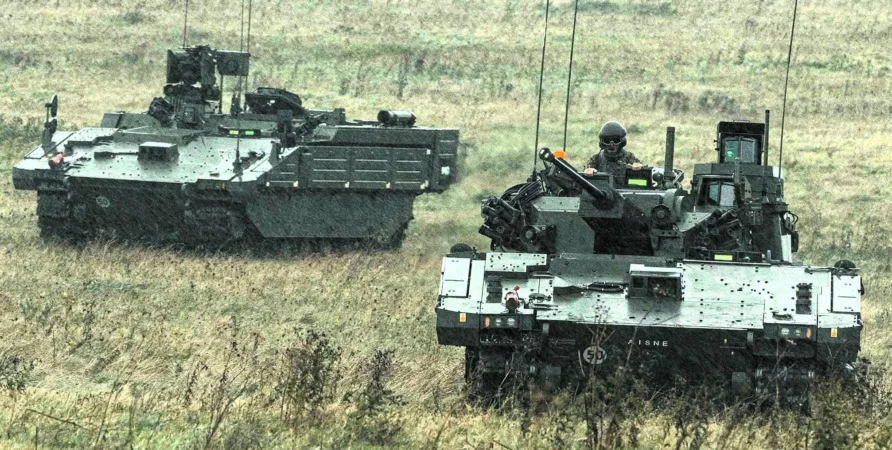
Almost everyone reading this article knows about the controversy surrounding Ajax, hopefully some of this is explained and contextualised below.
LAST UPDATE: 22/02/2026
The Period before Ajax #
Ajax has a complicated history, closely related to the Future Rapid Effects System (FRES) programme, and influenced by the Tactical Reconnaissance Armoured Combat Equipment Requirement (TRACER), which in turn came from the Family of Light Armoured Vehicles (FLAV) and Future Family of Light Armoured Vehicles (FFLAV) studies in the late eighties and early nineties.
Each of these sought to replace the Combat Vehicle Reconnaissance Tracked CVR(T) vehicle family, introduced in 1972.
CVR(T) left service in 2023, and until Ajax enters service, with some reporting stating some of its duties may be covered by vehicles such as Warrior Infantry Fighting Vehicle, until its planned withdrawal.
It would be unfair to characterise the General Dynamics Ajax start point as the 1985 FLAV study, but this is when the British Army started to look at CVR(T) replacement.

Naming Progression #
Although not named Ajax at that stage, it started as a component of the Future Rapid Effect System (FRES), specifically, Specialist Vehicles, or FRES SV. As FRES matured, the reconnaissance component became known as Specialist Vehicle Scout, SV Scout, Scout SV, or just Scout.
This remained until September 2015, when the Ministry of Defence formally rebranded the entire 589 strong vehicle fleet as Ajax during the DSEI exhibition.
Under the 2015 renaming, Ajax became both the collective name for the program and the specific title for the turreted reconnaissance variant.
2001 to 2006 – FRES Specialist Vehicle (SV) Assessment Starts #
FRES had been in progress since 2001, with requirements evolving.
The FRES Chassis Technology Demonstration Programmes (TDP) were split between BAE and General Dynamics from 2005. Upon their conclusion, there were some additional pre concept studies with them both in late 2007 for Specialist Vehicle (SV).
Specialist Vehicle, at this stage, was a requirement for two groups of vehicles.
- Specialist (Reconnaissance), tracked, 20 to 25 tonnes
- Specialist (Heavy), tracked, 30 to 40 tonnes
In a memorandum to the Defence Select Committee, dated 26th September 2006, the MoD confirmed that assessment phase planning work on the Specialist Variant (SV) had been started.
The preliminary scoping and planning work for the Assessment Phases for the Reconnaissance and Heavy roles has begun, but substantial work is subject to further Departmental approval. The assessment phase spend for the Reconnaissance and Heavy roles has yet to be decided, but is expected to be several hundreds of million pounds
This initial planning work would continue into the following year.
2007 to 2008 – FRES Specialist Vehicle Study Contracts #
The Ministry of Defence responded to the Defence Select Committee’s Seventh Report (FRES), published on the 8th of May 2007.
It confirmed initial contracts had been placed by the FRES Systems House (Atkins)
Work on the Reconnaissance and Heavy vehicle families has already begun, and an initial contract has been placed with the Systems House. Under this contract, they will begin the work necessary to further define the Reconnaissance family requirements and analyse options for meeting a number of the Manoeuvre Support vehicles within the Heavy family.
These initial contracts were focussed on turret integration and long-range sensors.
After being named as preferred bidder in 2007, a Thales/Boeing partnership were appointed in February 2008 as the FRES System of System Integrator (SOSI) in a £4 million initial contract.
The UK Ministry of Defence (MoD) today announced the award of a contract to Thales UK in partnership with The Boeing Company [NYSE: BA] for the System of Systems Integrator (SOSI) role on the Future Rapid Effect System (FRES) program. The initial six-month contract, valued at £4 million (US$8 million), defines the framework for the SOSI’s ongoing role in the subsequent phases of this key program, which will provide the British Army with a new family of medium-weight, network-enabled armored vehicles. The role of the SOSI is to drive the successful delivery of a coherent FRES capability. The Thales UK-Boeing SOSI team will be integrated into the MoD’s FRES project team to form an Integrated Customer Team that will manage the delivery of FRES. The SOSI will provide expertise in the following areas: Program management, System-of-systems engineering and integration, Through-life capability and technology management, Alliance development and supply chain management, Development of MoD’s SOSI competence
After the ‘Trials of Truth’ in the summer of 2007, General Dynamics were selected as preferred bidder for the FRES Utility Vehicle in May 2008, with their Piranha V.
In April 2008, the MoD confirmed selection of the 40mm CTAS for both Warrior Capability Sustainment Programme (CSP) and FRES SV, although they did not specify a turret design.
In June 2008, approval (2009 link) was given for the Specialist Vehicle (SV) element to progress to Assessment Phase and to further develop the Acquisition Strategy.
The Specialist Vehicle element of the FRES programme continues to make good progress and received Initial Gate approval to enter its Assessment Phase in June 2008.
Focus would be on what was then called Scout, or Recce Block 1 because of the pressing need to replace CVR(T).
It was still assumed that Recce, Medium Armour and Manoeuvre Support components would all use a Common Base Platform (or vehicle) called the CBP.
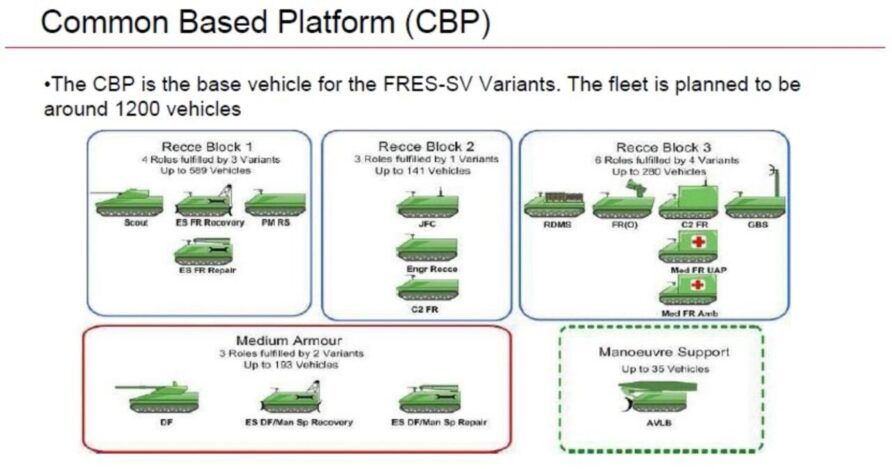
Lockheed Martin were awarded a FRES Specialist Vehicle (S) Scout study contract in October 2008, scheduled to complete in January 2009 (actual completion was March 2009)
Lockheed Martin has been awarded a study contract by Atkins, the Systems House on the UK Ministry of Defence’s Future Rapid Effects Systems (FRES) project, on behalf of the FRES Integrated Project Team (IPT). The study, to be delivered by January 2009, will develop performance, cost, time and risk information during integration of a concept turret and mission systems for the FRES Scout Vehicle (SV). Lockheed Martin’s principal subcontractors will be SciSys and Ultra Electronics.
The main emphasis of the study is to help MoD refine the FRES SV user and systems requirements, cost estimates and schedule to delivery. Trade studies will be performed in order to develop and assess options for integrating the mission systems into a combat-effective, affordable and low-risk Scout turret concept.
The work will also build upon the FRES Electronic Architecture Technology Demonstrator Programme (EATDP) that Lockheed Martin UK and its teammates delivered for MoD through Atkins in 2007. Lockheed Martin UK has consistently demonstrated its expertise in systems integration and delivering combat-effective mission system solutions to our customers, said Neil McCabe, Lockheed Martin UK’s Director of Armoured Fighting Vehicles and Launchers. We look forward to applying this expertise to the FRES project to help deliver this important capability to the British Army
In a Written Statement on the 11th of December 2008, the Secretary of State for Defence announced that the FRES Scout (alongside Warrior CSP) would now be its main priorities, pivoting away from the Utility Variant (UV).
Our examination of the equipment programme has, separately, considered the balance of investment and priority in the army’s armoured vehicle programme. We have concluded that, in the context of current operations, and bearing in mind the considerable recent investment in protected mobility, the highest priority should now be accorded to delivering the warrior capability sustainment programme and the FRES scout vehicle as quickly as possible. Against that background, we have decided to restructure the FRES programme, giving priority to FRES scout over the FRES utility vehicle. Whilst this will mean a delay to the programme, we recognise the importance of the utility vehicle and are now looking at the best way to take this procurement forward. General Dynamics (UK) will have an opportunity to compete in any future utility vehicle competition.
The same statement confirmed Preferred bidder status was withdrawn from General Dynamics for the FRES Utility Variant,
The National Audit published the Major Projects Report on 18th December 2008
It revealed the cost of the FRES Assessment Phase had risen by £206 million to £319 million, due to the Specialist roles now being included in the Assessment Phase.
This document also noted that FRES would now meet 16 roles and comprise five families of vehicles:
- Utility
- Reconnaissance
- Medium Armour
- Manoeuvre Support
- Basic Capability Units
Obviously, the Utility roles were somewhat in limbo following the announcement a week earlier.
2009 – FRES Scout Assessment Phase Contracts #
The Defence Select Committee published its Defence Equipment 2009 report in February 2009.
The FRES programme has been a fiasco.
In February 2007, we concluded that the MoD’s attempts to meet its medium-weight vehicle requirement had been a sorry story of indecision, changing requirements and delay. Two years later the story is, incredibly, even worse. We find it extraordinary that, some seven months after announcing General Dynamics UK as the provisional preferred bidder for the FRES Utility Vehicle, the MoD has announced that priority is now to be given to the FRES Scout Vehicle. Whilst we recognise that the MoD’s equipment requirements need to reflect changing threats, that is no excuse for the MoD’s behaviour in this programme; they have wasted their and industry’s time and money. The FRES Utility Vehicle programme was, from the outset, poorly conceived and managed. The MoD must work out what its requirements are for medium-weight armoured vehicles and identify lessons from the saga of the FRES Utility Vehicle programme.
In March, it was announced that FRES Specialist Vehicles (SV) would be obtained in a single programme, with an expected in-service point of 2015.
In June 2009, official cancellation of the Future Combat System (FCS), confirming an earlier announcement in April by US Secretary of Defense, Robert Gates.
The MoD also approved the FRES SV acquisition strategy and issued an Invitation to Tender (ITT) in June.
The stated intent at the time was for the tenders to be submitted by the end of the year, with contract signature in March 2010.
At the June 2009 Eurosatory show, BAE showed their largely self-funded MTIP-2 turret on a Warrior chassis. The MTIP-2 turret was a brand-new design with a fully stabilised 40 mm CTWS and appliqué armour package that provided the same protection level as the hull.
BAE marketing materials emphasised that the same turret could be used for Warrior and FRES Scout.
On the first of Jul 2009, A Written Statement confirmed the MoD’s new Armoured Fighting Vehicles sector strategy.
The provision of armoured fighting vehicles to our forces has attracted considerable interest among hon. Members and the British public. I am today announcing the MOD’s new armoured fighting vehicles sector strategy and how it links to the defence industrial strategy.
The defence industrial strategy set out the Government’s approach to the delivery of the capabilities required by our armed forces now and in the future, recognising the important contribution that the defence industry makes. Building on the principles of the DIS, the new AVF sector strategy lays out further guiding principles which will shape MOD’s relationship with industry, setting the context for individual project decisions and contributing to a coherent sector programme.
In our strategy, we have changed the emphasis on how we meet our operational sovereignty requirements, making clear that it is not necessary to retain industrial capabilities in the UK in order to achieve appropriate operational sovereignty. We plan to make greater use of the global market, particularly within the EU and NATO, so long as we have assured access to the appropriate capabilities and expertise to design, modify, maintain, repair, overhaul, assemble, integrate and test our armoured fighting vehicles. Of course our critical requirement for affordability and value for money will remain. We continue to have a requirement to manufacture certain UK-specific critical sub-systems onshore and we will retain onshore the ability to maintain, repair and overhaul our vehicles, making use of the Defence Support Group. However where bids we receive offer comparable value for money, I will always take into account employment and industrial considerations in this country.
Contrary to our present position which normally involves manufacturers or lead contractors retaining the exclusive right to the use of the design information of platforms or systems we acquire, we will in future in principle wish to acquire at the outset rights over design information, as well as assured access to relevant design knowledge, sufficient to allow third party modification of designs where appropriate, and to permit routine maintenance repair and overhaul activities.
Our strategy will generally be to procure base vehicles which can provide a suitable platform for the systems we require and which allow for modification and enhancement in the light of future developments in technology and future operational requirements. This strategy will cover the whole of our AFV fleet, both legacy and future. As an intelligent customer, we need to be able to define technical standards and architectures and make intelligent decisions about using the right technologies and integrating them using best systems engineering practice. Where we do not have these in-house, we will need to source independent advice from elsewhere.
We owe a great debt to the men and women of the armed forces who operate in hostile environments, risking their lives to secure freedom and to ensure that international terrorism, which threatens us all, is not allowed to take hold. We must ensure that they receive the very best support and the very best equipment for the roles they are undertaking. In this statement today, I have outlined a new strategy, one which will enable us to make the best procurement decisions in support of our armed forces. I believe that once the strategy is fully implemented it will ensure that we give our armed forces the armoured fighting vehicles they need and deserve to do their jobs as safely and effectively as modern technology can provide at best value for money for the UK taxpayer.
This was a significant change in approach to design sovereignty and support.
A few weeks later, the Ministry of Defence (MoD) confirmed that BAE and General Dynamics had been selected to compete the FRES SV Assessment Phase.
BAE Systems Global Combat Systems and General Dynamics (UK) are to receive a draft Invitation to Tender for the vehicles in the next few days.
The programme, termed by the MOD the Future Rapid Effect System Specialist Vehicle (FRES SV), is intended to provide reconnaissance and reconnaissance support variants to replace the existing Scimitar and Spartan vehicles now on operations in Afghanistan.
The final Invitation to Tender is expected to be issued later this month following this initial assessment phase.
Minister for Defence Equipment and Support, Quentin Davies, said:
“This follows the announcement of the strategy for the procurement of armoured vehicles which I made on 23 June. These vehicles will play a major role in current operations and in equipping the Army to stand ready to respond to a wide range of contingencies in the future. “[This] announcement shows that the Government puts the provision of the best vehicles that money can buy at the heart of its priorities.”
The issue of the draft Invitation to Tender for the FRES SV programme follows on from the announcement of the Armoured Fighting Vehicles Sector Strategy last week. The FRES programme, of which FRES SV forms a part, aims to deliver a medium-weight armoured vehicle fleet with higher levels of deployability and protection than in-service vehicles, and with the potential to accommodate changes in technology.
It will replace a number of vehicles that have reached or are reaching the end of their service lives, including the Combat Vehicle Reconnaissance (Tracked) [CVR(T)] Scimitar, and introduce some new capabilities.
The Equipment Examination decided that FRES SV should, with the Warrior Capability Sustainment Programme, be prioritised ahead of the FRES Utility Vehicle.
FRES SV is a medium-weight capability comprising three families of vehicles: Reconnaissance, Medium Armour and Manoeuvre Support.
The 16th of December 2009 is the date defined by Infrastructure and Projects Authority as the start of Specialist Vehicles – Recce Block 1.
In December 2009, BAE released imagery of a CV90 with 40mm CTAS armed CTAS turret as a contender for the FRES SV demonstration competition.
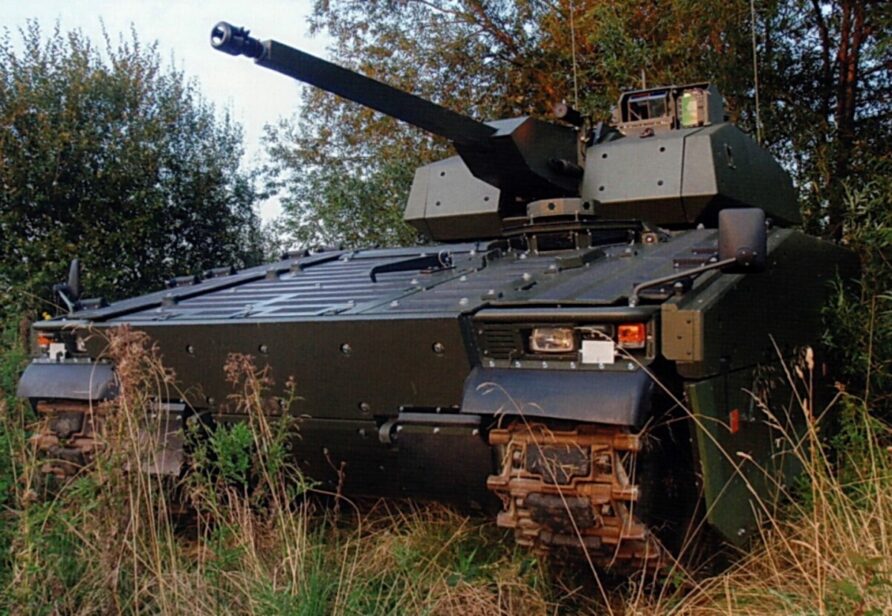
By the end of 2009, after Lockheed Martin had been awarded a study contract to investigate a common Warrior/FRES turret in 2008, it became clear that there would be two turret variants, one for Warrior and the other optimised for the reconnaissance role.
2010 – FRES Scout Demonstration Phase Contract Award #
The Investment approvals Board (IAB) were due to meet at the end of January 2010 to decide between the two competing bidders for Recce Block 1; Scout, Equipment Support Recovery, Equipment Support Repair and Protected Mobility Reconnaissance Support.
This first phase, or block, was planned to consist of just under 600 vehicles at an estimated cost of £2 billion (this would rise considerably)
BAE offered a modified CV90, in service with Sweden, Norway, Denmark, Finland and the Netherlands, total quantity over 1,100 by 2010. The basic BAE vehicle was to be constructed at Hägglunds in Sweden and shipped to Newcastle for final assembly and integration.
General Dynamics offered a modified version of the Austrian-Spanish Cooperative Development (ASCOD) vehicle which was in service with Spain and Austria as the Pizarro and Ulan respectively, total quantity approximately 230 vehicles between the two nations.
On the 9th of February 2010 it was reported that General Dynamics had improved their industrial participation offer.
Britain’s state-owned Defence Support Group has signed an outline deal with General Dynamics UK to assemble its ASCOD SV locally if the armoured vehicle builder secures a contract to build specialist vehicles for the British Army’s Future Rapid Effects System.
Under the memorandum of understanding, the British military vehicle maintenance and upgrade specialist could see substantial work taking place at DSG’s Donnington facilities, GD UK said Feb. 9.
If the ASCOD SV is selected, the two sides said, their aim is to transfer assembly, integration and testing for full-rate production of the ASCOD SV from General Dynamics’ European production facilities to Donnington
With the bids in and being evaluated, BAE and General Dynamics promoted their respective entries for FRES SV.
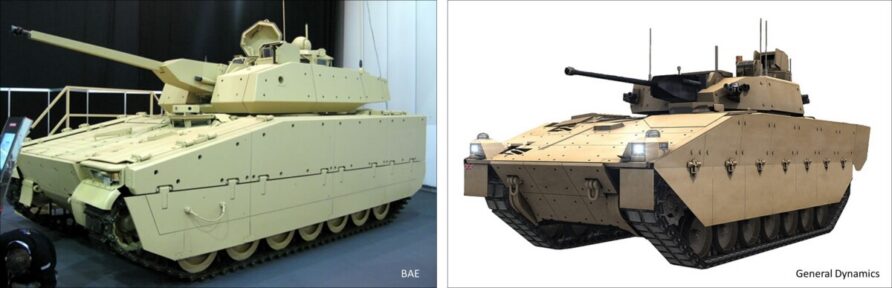
At the International Armoured Vehicle exhibition in mid-February, BAE revealed the latest version of their design for Scout.
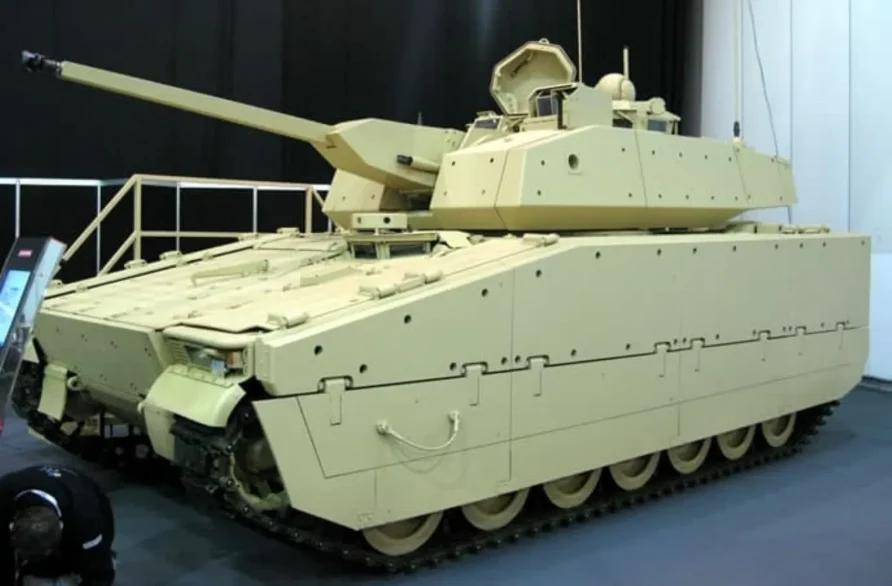
BAE again emphasised the benefits of a common turret based on their MTIP-2, although with minor differences depending on the role, showing a video of their offering in action.
BAE described the advantages of their design:
Nearly half of the armoured reconnaissance vehicles are a Scout variant and the rest are repair, recovery and protected mobility variants.
All will use the same chassis, referred to as a “common base platform.” A scout vehicle needs very high protection levels on the modern battlefield. BAE Systems’ combat-proven CV90 has made improvements in this area (and many others) with each of its six customers. We have fully met, and for certain threats, exceeded the MoD’s extremely challenging survivability requirements in mine blast trials. Trials commenced in 2004, culminating in a qualification test in 2008. Representative tests in 2009 have been successful against the FRES defined threats.
Furthermore, Our FRES SV Scout chassis has been modified from the base vehicle, reducing its physical size and therefore weight to optimise it for the army’s reconnaissance role. This has further increased the weight growth margins existing for CV90 while maintaining total system size and weight, consistent with the FRES reconnaissance requirement.
This evolutionary approach to meet changing threats means it is now the best-protected vehicle in its class, including mine protection comparable with a main battle tank – and yet, it can be carried by an A400M.
The FRES Scout variant builds on this pedigree and features a shorter and lower profile chassis plus an electronic architecture, or operating system, specifically developed to meet the needs of the British Army. CV90’s unusually low thermal and noise signatures and ability to perform long periods of silent watch suit it well for the Scout role.
General Dynamics also released information on their proposal.
General Dynamics UK has announced that its ASCOD SV candidate for the FRES Specialist Vehicle programme offers the option of early delivery for the heaviest direct fire variants, as a result of its weight capability and turret design.
Chief Engineer John Abunassar said: “From day one, ASCOD SV offers full operation at 42 tonnes. This means it can carry a 120mm gun easily without compromising armour or performance. Our design for a large turret ring is an advantage for the soldiers inside that opens up the flexible option of an early path to the heaviest FRES SV vehicles.”
ASCOD SV is capable of full operation at 42 tonnes. This performance is based on the technical maturity of the engine and transmission, which enable tremendous through-life growth. This is a significant advantage for the programme, which is founded on a Common Base Platform to satisfy the full FRES SV fleet of 1200-plus vehicles, including the heavy weight Direct Fire and bridge-layer.
The first FRES SV variants include the Scout, for which ASCOD SV has a turret designed to maximise space for soldiers inside. The large turret-ring diameter of 1.7m is wider than older vehicles such as Warrior, and the design increases space further by placing the main ammunition feed under armour outside the turret crew compartment. This gives soldiers considerable room for modern display screens, comfort for long periods inside the turret and ease of movement, even wearing full body armour and future wearable systems. With the need for military electronics ever-expanding on operations, the turret allows significant room for new systems to be fitted without compromising the design of the vehicle.
ASCOD SV is designed to offer the option of an early, low-risk path to a Direct Fire variant. General Dynamics has already fitted earlier variants of ASCOD in Europe for heavy direct fire roles. ASCOD SV’s large turret diameter is designed to be expanded to 2.1m, easily carrying, for example, a 120mm gun on a 1.9m turret ring. The vehicle’s 42-tonne capability allows it to carry such a gun at this higher weight without compromising full performance or its ability to carry the full FRES armour.
The turret design combines with the high power-distribution capability of the General Dynamics open Electronic Architecture, which allows new-generation systems to be plugged in as required and power generation to be expanded.
ASCOD SV is designed to a rating of 42 tonnes. FRES SV must meet today’s need. But it also needs to be the right vehicle for tomorrow. Growth is key in a vehicle that will be around for 30 years. The FRES SV Scout variant will initially weigh about 34 tonnes, but will need to grow to accommodate the addition of new technology and equipment to meet new threats as they emerge over its 30-year life cycle.
ASCOD SV more than meets this requirement. It has been designed to have room to grow to 42 tonnes with only minor component upgrades. It avoids costly major redesigns halfway through a vehicle’s life. This growth is possible thanks to General Dynamics UK’s selection of drivetrain.
Despite its modernity, the Renk 256B transmission is tested and proven, currently helping to drive the new generation of German Puma IFVs. Capable of operating to 45 tonnes it combines with MTU’s 600kW 8V engine to provide unparalleled growth potential for FRES SV.
They pointed to growth potential.
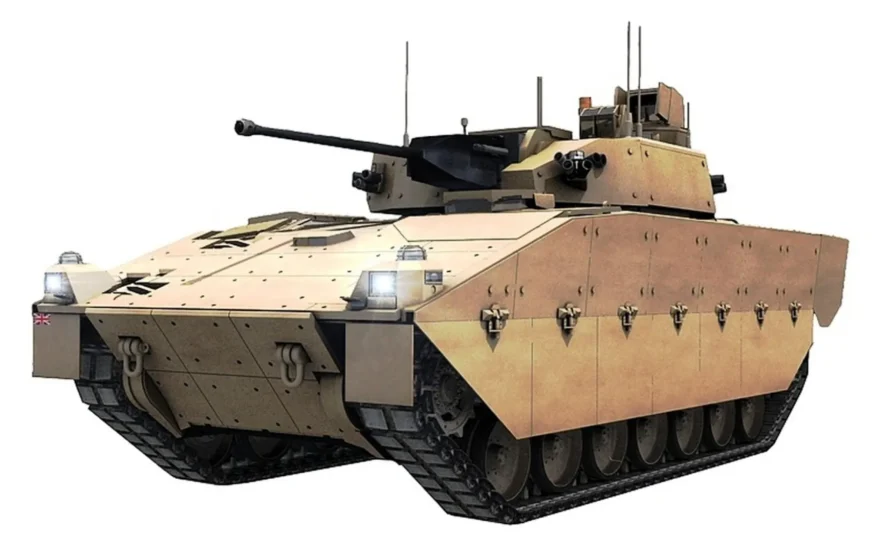
And also released a promotional video.
BAE announced their investment of £4.5 million in a Turret Test Rig for both Warrior and FRES programmes at the end of February 2010.
At the end of February, the Investment Approvals Board met to decide between General Dynamics and BAE for the FRES SV Recce Block 1 development contract.
On the 14th of March 2010, it was reported that following the receipt of informal guidance that BAE had offered the MoD an unsolicited deal on investment and jobs in the UK.
Amid fears that BAE’s share price could be hit today, chief executive Ian King is expected to table the offer after receiving informal guidance that ministers are poised to name General Dynamics as the preferred bidder for the replacement of the current Scout vehicles because its proposals were more attractive and would support more jobs.
Initial BAE plans to cut 500 jobs in Britain and for the manufacture in Sweden of most of the parts for a sophisticated vehicle offering greater firepower than the current generation of Scouts in Afghanistan have been quickly ditched. BAE is now promising to create or sustain 800 jobs in Britain, 500 of them in Newcastle, the home of Britain’s last tank-making facility.
But BAE’s swift reaction to the Scout decision is expected to be welcomed by ministers as an indication that competition for defence contracts can be made to work more effectively. BAE is understood to have been initially told it was in the “box seat” to win the order after spending £50m and five years designing a “big beast” it believes is technically superior to the General Dynamics rival.
The Scout order is part of a bigger armoured vehicle replacement programme that also involves the Warrior. The Warrior upgrade has been delayed because of spending constraints and uncertainty about its firepower but ministers say there is no intention of cancelling the contract for a frontline armoured vehicle.
Alan Garwood, BAE’s business development director, said: “We want the Army to have the best kit and we want to protect vital skills in the UK. To achieve this we are proposing to transfer work to Newcastle. This will create or sustain 800 skilled jobs.
“It would also sustain manufacturing at our Newcastle site until at least 2020. Finally, it would provide a platform for exports from the UK worth hundreds of millions.”
Three days later, BAE also announced that their CV90 based Scout prototype had completed and demonstrated the ability to meet the MoD’s growth requirements by successfully completing mobility tests at 40.4 tonnes.
“These trials, in common with every other aspect of our bid, were designed to provide hard evidence to show that we can meet MoD requirements within the timescale our soldiers deserve,” said Chief Engineer Malcolm Robinson. “All along we have taken a rigorous test-based approach with sound engineering to back up our claims, including investing five years and £50m in world-beating turret technology for FRES Scout and the related Warrior upgrade programme to deliver the best solutions for the British Army.”
Next up was the Demonstration Phase contract award.
On the 22nd March 2010, General Dynamics released the news that the press had been circulating for weeks
General Dynamics United Kingdom Limited has been selected by the Ministry of Defence to provide the next generation of armoured fighting vehicles to the British Army. The MoD has chosen General Dynamics’ ASCOD SV tracked vehicle as the winning design for the demonstration phase of the Specialist Vehicle competition, providing both the Scout variant and the Common Base Platform for up to 580 SV vehicles. ASCOD SV is the latest generation of a proven European design which has been significantly redesigned by General Dynamics’ UK engineering team, and will provide unparalleled military capability for the British Army over the 30 years of the vehicles’ life.
“The General Dynamics UK team won this competition to provide the British Army with its next generation of Armoured Fighting Vehicles (AFV) because it is the best vehicle for the British troops,” commented Dr. Sandy Wilson, President and Managing Director of General Dynamics UK. “We offered the best integrated solution, the best growth potential over the 30-year life of the vehicle, the best value for money for the British taxpayer and the best deal for the UK Industrial base.
The ASCOD SV programme is British to its bootstraps, delivering a Military off the Shelf vehicle with British design by British engineers to the British Army while safeguarding or creating 10,600 jobs for British workers.”
British troops using the ASCOD SV will have the best protection available in this vehicle class, both as it is delivered and as it grows to meet future threats. The vehicle will be immediately capable of delivering load- carrying growth potential of up to 42 tonnes thanks to a modern, proven drivetrain. This means that ASCOD SV is capable now of being equipped to meet future threats likely to appear over its entire 30 year life, without the need to upgrade its engine or transmission during that time. Finally, 80% of ASCOD SV’s full rate production will be based in the UK, securing or creating over 10,600 jobs for British workers.
These new jobs will be secured or created over the duration of the SV programme in South Wales where General Dynamics UK is based, Scotland, the North of England, the North West, the East and West Midlands, and the East and South of England. General Dynamics UK has sub-contracted Lockheed Martin UK INSYS to produce the turret of the Scout variant of ASCOD SV, and will transfer full rate production of the entire ASCOD SV programme to DSG in Donnington, ensuring 80% of ASCOD SV production happens in the UK.
Lord Peter Levene, Chairman of General Dynamics UK Limited said: “We are delighted that the MoD has selected ASCOD SV for its SV programme, a decision we believe will sustain the British tank industry for future generations. We are confident that the decision will, most importantly, provide the best protection for British soldiers, as well as provide both the greatest long-term value and the best military capability for the UK Government and the MoD. We look forward to delivering this contract in partnership with the MoD for the benefit of Britain’s armed forces.”
Based on a proven European design, it is the latest-generation vehicle developed specifically for SV by a team of General Dynamics UK’s engineers in Britain and Europe. It is a low-risk choice for SV, with excellent weight and growth potential.
The vehicle offers one common-base platform which can meet the range of SV roles. Its turret is designed by Lockheed Martin UK INSYS, specifically for the British Army’s scout role. ASCOD SV also offers high value to the UK Defence Industrial Base. Its Intellectual Property will be based in the UK, part of the sovereign capability available to the British Government. By value, 80% of the vehicle manufacture will be completed in the UK, with 70% of the supply chain companies UK-based.
Overall, ASCOD SV will create or safeguard more than 10,500 jobs in the UK.
General Dynamics also made the famous ‘British to Its Bootstraps’ claim
70% of the supply chain would be UK-based and 80% by value would be completed in the UK.
General Dynamics released imagery of the wider family of vehicles.

At the same time, the MoD announced that the Warrior Capability Sustainment Project (WCSP) had been deferred for a year.
A March 2010 Freedom of Information request by The Times revealed that the cost to date of the FRES programme was £207 million.
General Dynamics released further imagery of the FRES SV Scout design in May 2010, specifically, Recce Block 1
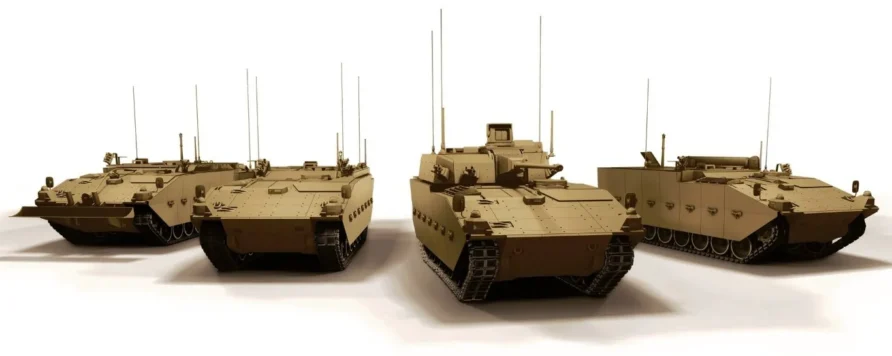
With the election out of the way, the MoD and General Dynamics announced successful negotiations with the MoD and the award of a £500 million contract for the Demonstration phase of FRES SV Recce Block 1.
The contract stated, ‘the system shall conform to all applicable UK and EU legislation at the time of entry into service’.
Relevant to noise and vibration, the following were applicable.
- Control of Noise at Work Regulations 2005
- Control of Vibration at Work Regulations 2005
Seven prototypes were to be built, with first testing completed by the end of 2013.
The powerful, sophisticated Scout vehicle will provide improved protection against a wide range of threats and bring greater firepower, improved situational awareness, more protection and enhanced mobility.
It will carry three crew members and have mounted both a new type of 40mm cannon and a machine gun. It will replace the Scimitar armoured fighting vehicle.
Minister for Defence Equipment, Support and Technology, Peter Luff, who signed the contract, said:
Military commanders have stressed the importance of having a wide range of vehicles from which they can select the most appropriate for specific tasks.
This contract is a major step towards providing an additional fleet of combat vehicles, capable of undertaking operations in the most demanding terrain and fully incorporating lessons from current conflicts.
Work on this phase of the programme will go ahead alongside the wider Strategic Defence and Security Review which will make sure that the capabilities that we are investing in are those best placed to provide the security we need for the future.
The design is derived from modifying the ASCOD SV vehicle, which is already in service with some NATO nations, is well-proven and is suitable for export sales.
Work will continue alongside this programme to update existing armoured reconnaissance vehicles in service in Afghanistan, such as the Scimitar, to maintain their operational capabilities.
The Chief of Defence Materiel, General Sir Kevin O’Donoghue, said:
Today’s announcement is the result of months of hard work by a wide range of stakeholders across MOD and General Dynamics UK enabling us to reach this point, ahead of the original plan.
The work that has been done has been, and continues to be, subject to the most careful scrutiny to ensure the decision is the right one for the long-term needs of the Army.
Master-General of the Ordnance, Major General Bill Moore, said:
This is a very good moment for the Army. Scout will provide a much better capability to find and track the enemy, so necessary for the successful prosecution of operations in the 21st century.
Scout will also deliver improved situational awareness, increased firepower, more protection and enhanced mobility, and it will be a key capability for land operations over the next few decades.
The Army will be heavily involved in the project from the start, particularly in the exhaustive trials with prototype vehicles, which are expected to start in 2013. When this phase concludes the MOD will be in a position to place a production contract.
General Dynamics announced it would establish a centre of excellent for Scout SV at Oakdale in South Wales in June 2010.
The loss of Scout was a big blow to BAE and the legacy of British armoured vehicle manufacturers; Alvis, GKN and Vickers. BAE were now able to get on with the sad business of closing much of its UK vehicle design and manufacturing base.
On July 1st, the Leicester Mercury published a story describing a loss of jobs at the BAE Braunceton Frith, Leicester site. Quoting a BAE official, it said
We don’t see any short to medium-term opportunities for design and manufacturing. Design is the majority of what Leicester does
Confirming earlier releases from General Dynamics, they would use a turret provided by Lockheed Martin, the actual design based on the Rheinmetall LANCE medium calibre turret, although Lockheed Martin insisted 75% of the turret would be manufactured in the UK.
General Dynamics released further video and imagery of SV Scout in August.
BY this point, FRES as a programme was being mentioned in public increasingly less and in October 2010, the National Audit Office (NAO) confirmed that it had been split into three separate programmes.
The Future Rapid Effect System has been recast from a single programme into three constituent programmes; Specialist Vehicle, Utility Vehicle and Manoeuvre Support. The Future Rapid Effect System funding lines have now been split across the three programmes and in future will be reported separately in the MPR.
The Strategic Defence and Security Review was published on the 19th of October 2010.
General Dynamics awarded a turret contract to Lockheed Martin in December 2010. This was for three Scout turrets, forming part of the demonstration phase, and included.
- Defence Support Group: Turret assembly integration and test
- Rheinmetall Land Systems: Turret structure, cannon mounting structure and CT40 Cased Telescoped Cannon System integration
- Ultra Electronics: Power management
- Curtiss Wright: Turret drives and stabilisation control
- Meggitt: Ammunition handling system and Moog for the slip ring
- Lockheed Martin UK – Ampthill: fire control and training and as the turret systems integrator
2011 – Medium Armour and Manoeuvre Support Removed #
In January 2011, FRES Medium Armour and Manoeuvre Support variants were removed from the application for Planning Round 11/12 funding.
Only the Reconnaissance group of vehicles now remained from the original FRES concept.
In May 2011, the MTU 8V 199 engine was selected.
In July 2011, General Dynamics released a press statement that described how SV was taking shape.
Little over a year since signing the Specialist Vehicle (SV) contract between the UK Ministry of Defence and General Dynamics UK, the first test version of the reconnaissance variant, Scout, has begun to take shape with the successful joining of the Experimental Demonstration Unit (EDU) turret to a “mule” base platform at the first attempt. The first successful combining of turret and base unit last week further proves the vehicle design, the systems integration between the two sections and the team work between prime contractor General Dynamics UK and turret design authority Lockheed Martin UK. It also highlights the excellent progress achieved by the Scout SV Industry team at an early stage.
“Mating the turret and base unit at such an early stage of the demonstration phase once again demonstrates our dedication to working towards delivering the Scout SV capability to the British Army as soon as is possible,” commented Dr. Sandy Wilson, president and managing director of General Dynamics UK on witnessing the event. “The fact that it happened at the first attempt only goes to show that the MoD chose the right team to deliver Scout SV.”
The mule base unit, known as PT3, is based on a mature ASCOD vehicle already in service with the Austrian Army. The 1.7 metre race ring, specifically designed by General Dynamics UK for Scout, was integrated onto the vehicle by General Dynamics European Land Systems at its Simmering facility in Austria. The vehicle was then transported to General Dynamics UK’s Pershore facility in Worcestershire, UK, to undergo a series of tests and prepare it to accept the EDU turret. It was then transferred to Lockheed Martin UK’s facility in Ampthill, Bedfordshire last week for the integration of the turret.
In parallel, the first EDU turret was being built at Rheinmetall Landsysteme in Gersthofen, Germany. Rheinmetall Landsysteme designs, develops and manufactures the Scout SV Turret Structure for turret design authority Lockheed Martin UK. Following a successful first build of the turret, the mandated CT40 Cased Telescoped Cannon System was integrated into it and fired for the first time in May, five months ahead of schedule. It was also subsequently transported to Ampthill where it has been undergoing extensive testing and preparation for integration with the PT3 mule base unit.
British troops using the Scout SV will have the best protection available in this vehicle class, both as it is delivered and as it grows to meet future threats. The vehicle will be immediately capable of delivering load-carrying growth potential of up to 42 tonnes thanks to a modern, proven drivetrain. This means that SV is capable of being equipped to meet future threats likely to appear over its entire 30 year life, without the need to upgrade its engine or transmission during that time
In late August 2011, the Thales Orion was confirmed as the main sight, also with Local Situational Awareness camera system. The Renk 256B was also by General Dynamics.
At the September 2011 DSEi show, SV was shown for the first time, at least a representative prototype.
Where we are today is that there is a real awareness that we need ground mounted armed reconnaissance. Scout gives us a significant growth potential with the ability to fit modern sensors systems and modern weapons systems. It is not just an armoured vehicle, it is an ISTAR platform and meets the requirement that we may need to fight for information.
Also reported was that Main Gate 2 would provision for between 400 and 589 vehicles, with an option for 200 Common Base Platforms. A number of component announcements were made, Barco for the displays and Thales for the optronics, for example.
In October 2011, a Parliamentary Answer to a written question tabled by Ben Wallace, (MP for Wyre and Preston, ex Scots Guards Officer, former director of QinetiQ, and future Secretary of State for Defence) sought clarification on UK manufacturing of SV.
Ben Wallace (Wyre and Preston North, Conservative)
To ask the Secretary of State for Defence what obligations his Department has placed on General Dynamics to manufacture and assemble the Scout Specialist Vehicle in the UK
Peter Luff (Parliamentary Under Secretary of State (Defence Equipment, Support and Technology), Defence; Mid-Worcestershire, Conservative)
The Ministry of Defence has placed no contractual obligations on General Dynamics UK (GDUK) to manufacture the Scout Specialist Vehicles (Scout SV) platforms in the UK. GDUK has, however, indicated that a significant proportion of the activity may be conducted in the UK.
In addition, the contract allows for the transfer of the assembly integration and test work on the platforms from offshore facilities, to the Defence Support Group in the UK. A value for money decision on whether to transfer this work will be taken later in the programme, closer to production. An enabling arrangement for industrial participation has also been put in place with General Dynamics, that will see work being carried out in the UK, or assistance being provided to UK exporters to Spain (assembly of ASCOD, the base vehicle for Scout SV is currently conducted in Spain)
Lockheed Martin were awarded the Warrior Capability Sustainment Programme (WCSP) contract in October 2011.
The National Audit Office confirmed in 2011 that the Assessment Phase had cost £131 million.
The government indicated a slippage of the in-service target to the middle of the decade to allow for more rigorous testing of the electronic systems.
2012 to 2013 – Demonstration Phase Progresses #
The MoD’s Equipment Pan was published in January 2012, confirming £5.5 billion for the armoured vehicle pipeline, including Scout SV.
Additional imagery was released.
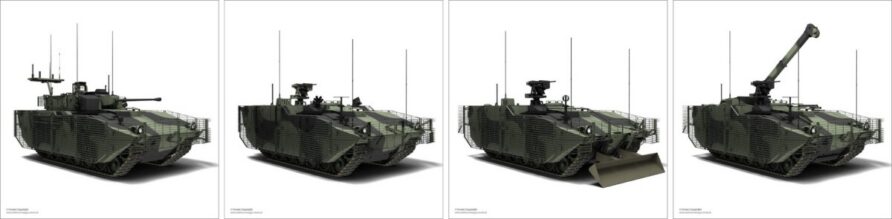
At the International Armoured Vehicle exhibition, General Dynamics showed an early version of Scout SV.
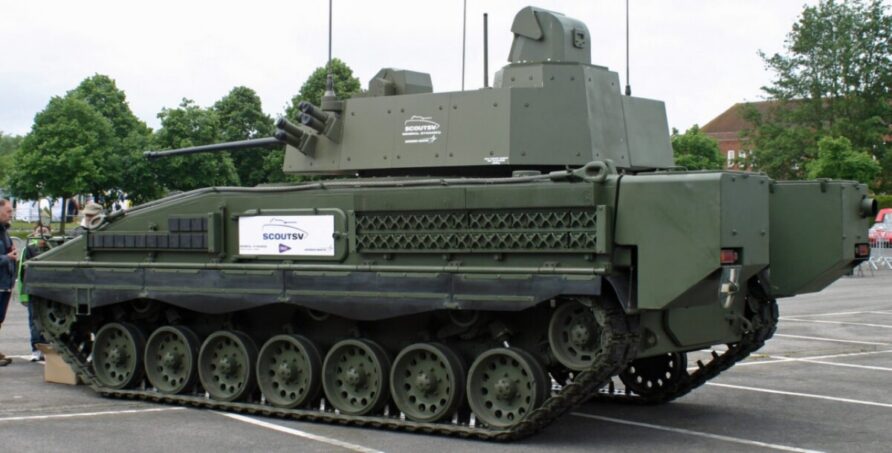
General Dynamics opened their armoured vehicle centre of excellent at Oakdale in South Wales on the and in the media releases to accompany this in May 2012, they confirmed the following progress.
- 24 contracts signed with suppliers to the programme across the UK and Europe
- Testing of key components complete
- First development turret for the Scout variant of SV, built and tested
- CT40 cannon system integrated into turret and successfully fired
- Representative PT3 Scout SV prototype unveiled
- New armour system tested against latest IED threats
- Powertrain physically integrated in the Mobile Test Rig (MTR).
The SV Mobility Test Rig (MTR) underwent its Accelerated Life Testing, designed to demonstrate reliability and provide test data.
The MTR covered 300km and towed a 92 tonne vehicle train, shown below.
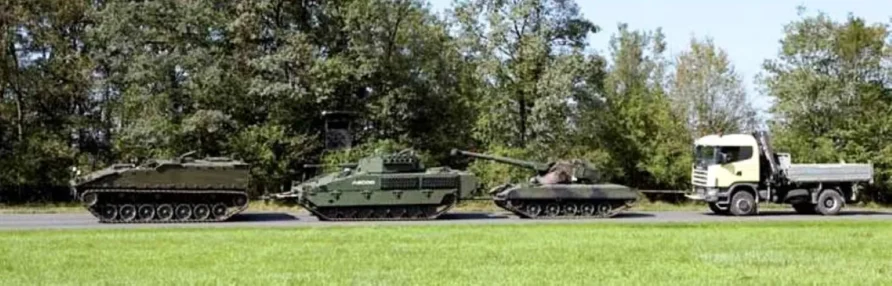
MTR underwent low-temperature testing in the INSTITUTO TECNOLÓGICO ‘LA MARAÑOSA’that included a 72-hour period at -32 degrees C followed by a series of starts using a pre heater and no pre-heater.
The Scout SV Preliminary Design Review was completed by the end of December 2012, 6 months later than scheduled.
In the summer of 2013, a further purchase of CTAS ammunition was announced, to support both Scout and Warrior programmes.
A delayed blast test was failed in July 2013.
Towards the end of 2013, news of problems with the Scout turret emerged.
Defense News reported that General Dynamics had agreed to pay Lockheed Martin several million pounds for failing to keep to a timetable on requirement delivery. It also reported problems with weight growth and a delayed ISD.
General Dynamics presented the MoD with a new schedule, representing the delays with the 40mm CTAS and its integration with the turret.
2014 – Award of £5.5 billion main manufacture contract for 589 vehicles #
February 2014 was publication date for the National Audit Office Major Projects Report
The current planning assumption is to deliver a reconnaissance fleet of up to *** vehicles incrementally
*** Was 589 vehicles.
It also confirmed the work done on some of the other variants.
In parallel, assessment studies, including representative mock-ups, confirmed that Ambulance, Command and Engineer Recce roles could be delivered by sub-system installation on the Protected Mobility Recce Support vehicle. Assessment studies continued on options for the remaining roles of Formation Recce (Overwatch), Joint Fires Command and Ground Base Surveillance roles, against the existing User Requirements, to determine whether incremental upgrades are required to develop their capability further
All the Key User Requirements were forecast to be met, the vehicle programme was right on track.
In June 2014, at Eurosatory in Paris, General Dynamics showcased the latest variant of ASCOD that embodied lessons from the FRES Specialist Vehicle (SV) programme. The vehicle was fitted with continuous rubber tracks and had a maximum weight of 35 tonnes.
The same month, at the DVD event, General Dynamics unveiled a pre-production prototype of the ‘Protected Mobility Recce Support’ (PMRS) variant.
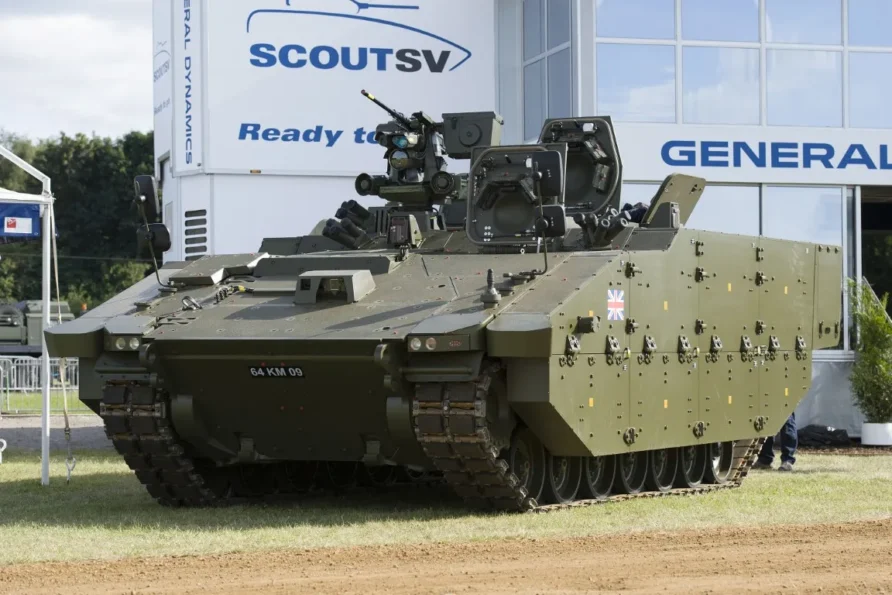
No other variants were on display.
Also in June 2014, a picture emerged for the Spanish Vehículo de Observación Avanzada) Advanced Reconnaissance Vehicle, based on the ASCOD Pizarro.
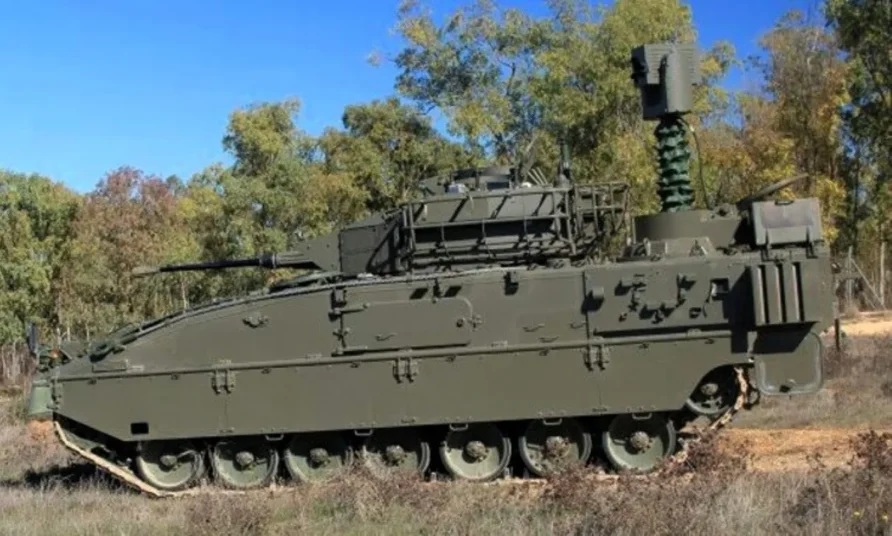
Note the elevating mast
The Scout Specialist Vehicle (SV) programme passed its second Main Gate approval in August 2014. This reduced the scope of the programme due to budget issues.
On the eve of the NATO Summit in Newport, Wales, the MoD placed the Manufacture order for Specialist Vehicles Scout in September 2014.
Announcing the award, General Dynamics said.
General Dynamics UK has been awarded a contract by the UK Ministry of Defence (MoD) to deliver 589 SCOUT Specialist Vehicle (SV) platforms to the British Army to provide essential capability to the Armoured Cavalry within Army 2020.
The platforms, consisting of six variants, will be delivered to the British Army between 2017 and 2024, alongside the provision of initial in-service support and training, and will serve at the heart of the Armoured Infantry Brigade structure.
This contract directly safeguards or creates up to 1,300 jobs across the programme’s UK supply chain, with 300 of these at General Dynamics UK’s Oakdale site.
SCOUT SV represents the future of Armoured Fighting Vehicles (AFV) for the British Army, providing best-in-class protection and survivability, reliability and mobility and all-weather intelligence, surveillance, target acquisition and recognition (ISTAR) capabilities. Its range of variants will allow the British Army to conduct sustained, expeditionary, full-spectrum and network-enabled operations with a reduced logistics footprint. SCOUT SV can operate in combined-arms and multinational situations across a wide-range of future operating environments.
Prime Minister David Cameron said: “I’m delighted that on the eve of the NATO Summit, we can announce the biggest single contract for AFVs for the British Army since the 1980s. These new vehicles are testament to the world class engineering skills in South Wales and across the UK, helping to create the Army’s first fully digitalised armoured vehicles. Not only will they be crucial in helping to keep Britain safe, they will also underpin nearly 1,300 jobs across the UK and showcase the strength of the UK’s highly skilled defence sector. With the second-largest defence budget in NATO, meeting NATO’s two per cent of GDP spending target and investing in new capabilities to deal with the emerging threats we are ensuring Britain’s national security, staying at the forefront of the global race and providing leadership within NATO.”
Secretary of State for Defence, the Rt Hon Michael Fallon MP said: “Today’s multi-billion pound contract is fantastic news for our soldiers in providing them with the most technologically advanced and versatile AFVs to overcome future threats. This is the biggest single order placed by the MoD for armoured vehicles for around 30 years and is an important part of the investment we are making to keep Britain safe. It is also excellent news for the supply chain of this state-of-the-art vehicle and will sustain 1,300 engineering jobs across the UK in key defence industries.”
Kevin Connell, Vice President General Dynamics UK – Land Systems, said: “We are delighted that the UK MoD has awarded us this important contract. SCOUT SV provides essential capability to the British Army to allow it to dominate the battle space for years to come and it secures thousands of jobs right across the UK for at least the next decade. General Dynamics UK and our partners have worked hard over the last four years to develop a world-leading vehicle, and we will maintain that same work ethic to deliver 589 SCOUT SV platforms to the British Army on-time and on-budget.”
SCOUT SV has been developed at General Dynamics UK’s AFV design and engineering centre in Oakdale, South Wales, maintaining the UK’s sovereign expertise in this important capability.
Speaking on the eve of the NATO Summit, Defence Secretary Michael Fallon said
Today’s multi-billion-pound contract is fantastic news for our soldiers in providing them with the most technologically advanced and versatile armoured fighting vehicles to overcome future threats. This is the biggest single order placed by Ministry of Defence for armoured vehicles for around 30 years and is an important part of the investment we are making to keep Britain safe. It is also excellent news for the supply chain of this state-of-the-art vehicle and will sustain 1,300 engineering jobs across the UK in key defence industries.
The Chief of the General Staff and head of the British Army, General Sir Peter Wall, said:
The Scout family is a transformational programme that will refresh our armoured capability and ensure the army remains a first-tier manoeuvre force. It provides advanced intelligence, surveillance, target acquisition and reconnaissance capabilities and will be the ‘eyes and ears’ of commanders on the battlefields of the future. With digital links to all of our other systems it will be able to fulfil a wide range of combat roles.
General Dynamics and the MoD also released a new image of the Scout variant.
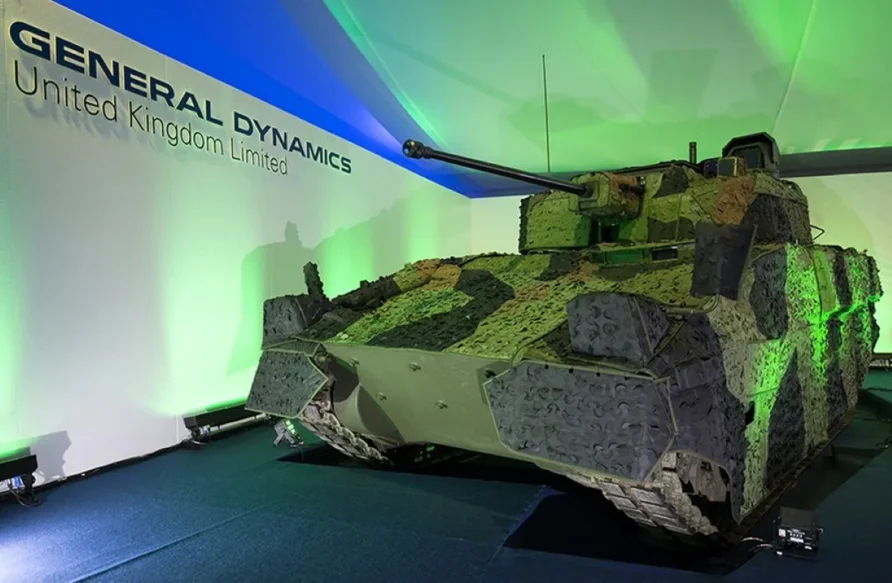
A subsequent National Audit Office (NAO) report confirmed that
In September 2014, six months earlier than planned, the Department awarded GDLS-UK the contract for the manufacture and initial in-service support phase. It brought forward the investment approvals process because it saw an opportunity to exert commercial leverage as GDLS-UK had failed to achieve the anchor milestone in July 2013, which allowed the Department to threaten to invoke the default and termination clause in the contract. The Department believed that committing to manufacture in 2014 – with some overlap of demonstration and manufacture phases – would incentivise GDLS-UK to invest early in producing vehicles and, as a result, reduce the risk of not achieving programme milestones. It also wanted to secure stability for the programme prior to the 2015 Strategic Defence and Security Review.
Many also reported that there was some urgency to have something tangible and headline grabbing at the NATO Summit.
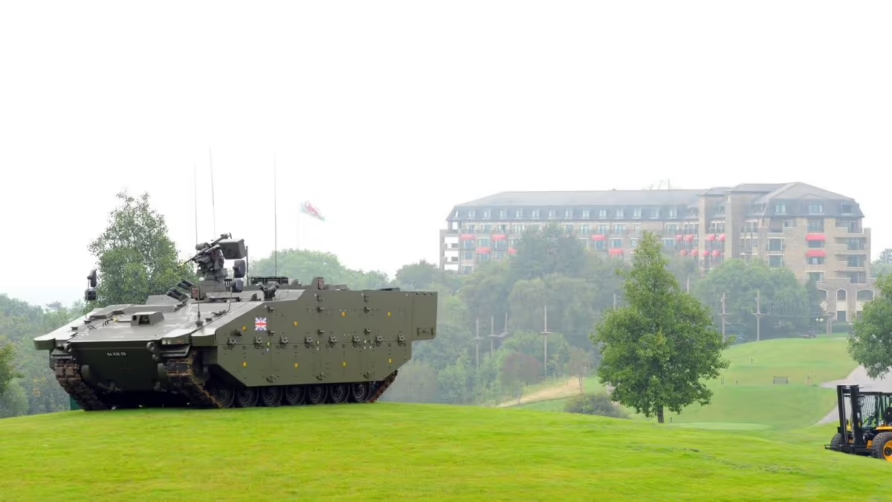
The change in IOC from the first quarter of 2017 to July 2020 was also agreed during the pre-contract negotiations.
Importantly, the contract was also changed to ‘firm price’ transferring the risk of inflationary cost growth from the MoD to General Dynamics at 2014 rates.
Note: In subsequent reporting, much referred to Ajax and General Dynamics being subject to a fixed price contract. In the context of UK government procurement, ’firm pricing’ and ‘fixed pricing’ are two distinct alternative pricing methods used to determine the price payable for goods, works, or services. Confusingly, firm price is also referred to as firm fixed price or FFP.
The MoD also agreed a 40-month overlap of the Demonstration and Manufacture stages as part of the contract.
It is also important to note that this contract provided that ALL 589 vehicles would be manufactured in Spain.
In September 2014, the Defence Science and Technology Laboratory (DSTL) raised issues of the vehicle and potential non-compliance with health and safety regulations regarding noise and vibration.
In October 2014, General Dynamics awarded a £621 million contract to Lockheed Martin for 245 turrets.
Stephen Ball, Chief Executive of Lockheed Martin UK, said.
This contract reflects the significant investment we have made in our workforce in Ampthill and clearly demonstrates our ability to play a key role in the design and development of the Armoured Fighting Vehicles of the future. The award not only sustains a significant number of highly skilled manufacturing jobs at our Ampthill site but will also greatly benefit our UK supply chain partners with whom we will work to deliver this modern, leading edge capability.”
The final versions and quantities were released over the next couple of days after the summit.
- Reconnaissance; including ground-based surveillance and joint fire control specialist capabilities
- Equipment and support repair; repairing and towing damaged vehicles
- Equipment and support recovery; recovering damaged vehicles
- Command and control; providing a mobile battlefield headquarters
- Protected mobility reconnaissance support, including formation reconnaissance overwatch and engineer reconnaissance; delivering and supporting specialist troops across the battlefield
- engineer reconnaissance; carrying specialist engineering equipment and personnel
Deliveries of Scout specialist vehicles were planned to start in 2017.
The training establishments and first squadron were planned to be equipped by mid-2019 to allow conversion to begin with a brigade ready to deploy from the end of 2020.
Variant details;
- Scout, with 40mm turret and 3 crew, quantity 245 broken down into 3 sub variants
- 198 Reconnaissance and Strike
- 23 Joint Fire Control for the forward observers
- 24 Ground-Based Surveillance with man portable radar
- Protected Mobility Recce Support, with Kongsberg protector RWS, 2 crew and 4 passengers, quantity 256, broken down into 4 sub variants
- 59 Armoured Personnel Carrier (APC)
- 112 Command and Control
- 34 Formation Reconnaissance Overwatch
- 51 Engineer Reconnaissance (3 crew and no passengers but specialist equipment?)
- Engineering Variants, with Kongsberg RWS, quantity 88
- 38 Recovery (3 crew plus an extra seat)
- 50 Repair (4 crew)
The statement also confirmed that although the MoD reserved the option to place additional orders, none were planned, the option specified up to 1,328 vehicles,
In fact, the Army’s requirement was for 686 vehicles, the 589 was based on an acceptance of a smaller number of reserve and training vehicles.
It was also noted that vehicle weight, of up to 42 tonnes, was significantly more than the 20–25 tonnes as noted in the original FRES requirements, and even heavier than the Heavy variants, at 35–40 tonnes. In essence, the lightest Scout would be heavier than the Heavy variant, many pointed out this might cause issues.
The variant types were much reduced from some of the original concept images from 2009, effectively merging Recce Block and Recce Block 2.
2009 was 1,200 vehicles, 2014 was 589 vehicles.
No more Recce Block 3, Medium Armour or Manoeuvre Support.

In November 2014, it was confirmed by the Government that the first 230 vehicles would be delivered by 2020 and a month later, that the 40mm CTAS had entered its final qualification phase.
A November 2014 Parliamentary Answer clarified the position on UK manufacturing
Lord Moonie – Labour
To ask Her Majesty’s Government why there is to be no assembly or production line for the Scout SV vehicle in the United Kingdom, and what, if any cost savings they anticipate as a result of that arrangement.
Lord Astor of Hever – The Parliamentary Under-Secretary of State for Defence
The contract let is in accordance with the Armoured Fighting Vehicle Sector Strategy, announced by the Ministry of Defence (MOD) on 23 June 2009. The strategy made clear that it is not necessary to retain industrial capabilities in the UK in order to achieve appropriate operational sovereignty. The strategy was intended to make greater use of the global market, particularly within the EU and NATO. This remains the case for Scout Specialist Vehicle. General Dynamics United Kingdom was selected on the basis of the best value for money for the MOD and has decided to use the production facilities at General Dynamics European Land Systems in Spain. Neither of the final competition bidders planned to assemble the entire vehicle in the UK; both planned to make best use of their established international facilities and supply chains. Following production of the first 100 vehicles, an option does exist to transfer vehicle assembly to the UK subject to an economic case being accepted.
2015 – Formal renaming to Ajax family and decision on UK final assembly at Merthyr Tydfil #
Throughout 2015, as the Specialist Vehicle progressed, various contracts were announced.
They included;
- Rheinmetall; £130 million contract from Lockheed Martin for the production of turret shells, the Turret Structure and Weapons Mount (TSWM). The first production unit is scheduled for delivery in 2016.
- Thales; £125 million contract for sighting systems and ancillary equipment. This includes the Orion primary sight, local situational awareness cameras and smoke dischargers. Scheduled for delivery between 2016 and 2021.
- Thales; £54 million contract for gunnery sights, the DNGS-T3 Stabilised Day/Night Gunnery Sight. Scheduled for delivery between 2016 and 2021.
- Oxley Group; £1 million contract for internal lighting, including DC Combi LED interior lights and Gooseneck task lights.
- Meggitt; £27.2 million contract for ammunition handling systems. Scheduled for delivery between 2016 and 2021.
- Kongsberg; £61 million contract for Protector Remote Weapon Station (RWS).
- Curtiss Wright; £32 million contract for Turret Drive Servo System (TDSS).
- ViaSat; £3.8 million contract to supply encrypted storage systems
- Esterline; £13.5 million contract to supply rugged display terminals including TX-335S turret crew-station displays, TX-321S triple-head driver’s displays and VPU-101 video-processing units.
- Raytheon; undisclosed contract amount for power management and distribution system
- Saab; undisclosed contract amount for Mobile Camouflage Systems. Scheduled for delivery between 2017 and 2024.
- Marshall Aerospace and Defence; Contract to support XPI Simulation for driver training systems. 28 sets of static and full motion simulators.
- XPI Simulation; £20 million contract for driver simulators.
- Smiths Detection; £6 million contract for LCD 3.3 Detectors.
- Vitavox; £2.8 million contract for ‘outacom’ public address systems.
- Williams F1; £17 million contract for design support on the Core Infrastructure Distribution System (CIDS) power and data backbone.
- GKN Aerospace; £27 million contract for rotationally moulded fuel tanks that will be self-sealing and foam filled for explosion protection.
In early 2015, General Dynamics submitted an unsolicited proposal to the MoD to extend its initial support contract by eight years. Part of this proposal was also to assemble Ajax at a facility in Merthyr Tydfil and transfer programme knowledge to the UK, from Spain.
A £390 million support contract was awarded to General Dynamics in July 2015, to run to December 2024.
The contract will extend the current in-service support contract for the Scout Specialist Vehicles (SV) to 2024, delivering onshore technical engineering and maintenance from a site in South Wales. As a result, General Dynamics UK has taken the decision to bring to Wales: assembly, integration and testing for the vehicles which was previously carried out overseas.
At DSEi in September, the latest Scout prototype was revealed, along with a name change.
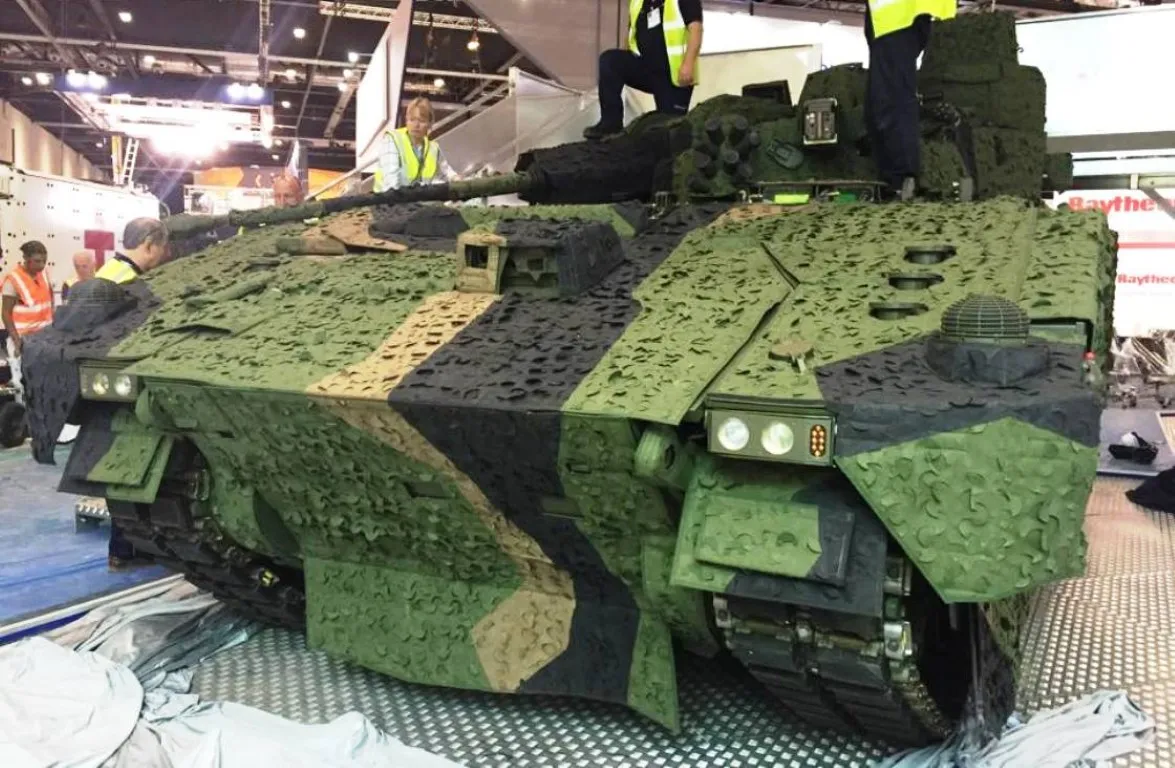
Scout became Ajax.
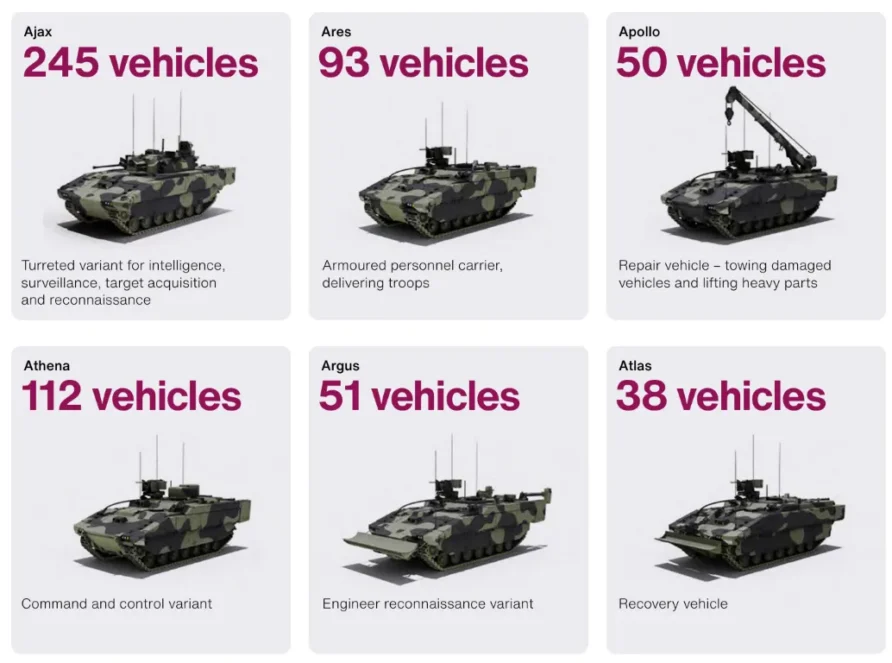
Ajax would apply to both the whole family of vehicles and, specifically, the vehicle formerly known as Scout.
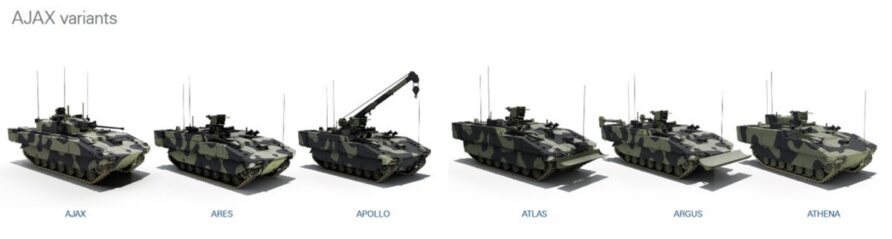
Within the 245 Ajax (Scout) variant there were planned to be three roles, this remained unchanged from previous announcements.
- Reconnaissance and Strike (Quantity 198)
- Joint Fires Control (Quantity 23)
- Ground-Based Surveillance (Quantity 24)
The last two would carry less ammunition for the main weapon and replace it with demountable equipment and additional personnel.
The engineering variants were renamed as
- Equipment Support Repair became Apollo (Quantity 50)
- Equipment Support Recovery became Atlas (Quantity 50)
This was a slight change from previous releases, with the recovery variant increasing from 38 to 50 (this put the total order over 589 so it was assumed to be a reporting error)
The non-turreted, non-engineering variants were previously called Protected Mobility Reconnaissance Support (PMRS) that covered four roles;, command and control, formation reconnaissance overwatch and engineer reconnaissance.
- Command and Control (C2) variant became Athena (Quantity 112)
- The Engineering Reconnaissance variant became Argus (Quantity 51)
- Formation Reconnaissance Overwatch (Quantity 34)
- Armoured Personnel Carrier (Quantity 59)
The last two were to be called Ares.
The quantities would be corrected in later reporting.
Reliability Growth Trials and Reliability Qualification Trials were scheduled to start in 2016 to complete in 2018.
Deliveries of the prototype vehicles were scheduled to complete by early 2017 with the Initial Operating Capability (IOC) 1 planned for the middle of 2019.
IOC 2, which would include the command and control variant, was planned for the middle of 2020.
This was another delay in IOC.
IOC was now planned for the middle of 2020
Interviews and announcements from DSEi also provided more details on the role split between Major Combat Operations (MCO) and Peace Support Operations (PSO).
220 sets of each type of armour would be purchased, role changing completed in the field.
General Dynamics, on 25th November 2015, announced that the deal for the Assembly, Integration and Test (AIT) site facility in Wales had been concluded in late October. The site was formerly used for fork lift production and was relatively close to the existing General Dynamics location in Oakdale.
The first vehicles were scheduled to enter AIT at the Wales site in early 2017.
For the initial vehicles, AIT would be completed in Spain, but by vehicles 64-70 the transition to Wales was to be completed.
AIT for vehicle 70 onwards was planned to be conducted in Wales.
The schedule for design verification and validation would continue through to 2017.
Initial Operating Capability would be 47 vehicles, all delivered by Q2 2019.
Full rate production was expected to start by Q4 2018, after Main Gate 2 at the end of 2017.
SDSR 2015 confirmed that Ajax vehicles would form part of the new ‘Strike Brigade’ concept, to be established by 2025.
In December 2015, the MoD placed a production order for the CTWS, although there was an announcement in 2015 for a £75m order. The deal with the joint BAE/NEXTER company CTA International was for £150m and was to provide 515 weapons for the SV Scout and Warrior vehicles.
The contract also included initial spares, test equipment, specialist tools and some training.
There were planned to be 245 for the Scout and 245 for Warrior, the balance being used for training, trials, and ammunition qualification.
Defence Secretary Michael Fallon said;
Today I can announce we have signed a £150 million contract to fit the Scout with a new Cased Telescope cannon, providing it with unrivalled firepower and a new ‘airburst ammunition’ capability.
Clarification on variants and quantities.
2016 – Successful completion of manned firing trials with 40 mm CTA cannon #
In March 2016, the first production systems were handed over to the MoD
The first production standard Cased Telescoped Cannon System has been handed over to the UK Ministry of Defence (MOD) in Bourges, France by CTA International (CTAI) – a 50/50 joint venture company between BAE Systems and Nexter Systems
In early April 2016, AJAX completed its first instrumented static live firing at Radnor Ranges in Powys, Wales.
Testing and qualification continued and in June 2016, the MoD issued a £12.9 million contract extension to CTAI for additional qualification.
Ajax crewed live firing trials commenced in September 2017, a spokesperson from General Dynamics said:
The start of the CT40 cannon manned industry firing phase is a significant milestone in the AJAX programme. This cutting-edge capability that enables AJAX to pack a significant punch, alongside its wide-range of best-in-class sensors that makes it an Information Age platform, ensures that the British Army has everything they need to do their job effectively
In December 2016, during a debate on the UK steel industry, MPs challenged the government on the origins of the AJAX. It was clarified in Hansard that while the vehicle was “assembled” in Wales, the hulls are fabricated using Spanish and Swedish steel, a point of contention for MPs representing British steel-working constituencies.
On the 15th of December 2016, a debate in the House of Commons on the British Army and the Strategic Defence and Security Review confirmed Ajax as the centrepiece of the new Strike Brigade concept and Army 2020 Refine
The SDSR 2015 significantly increased the readiness levels required of the Army, underpinned by investment in new capability and a war-fighting division as part of joint force 2025. It introduced the innovative strike brigades, based on the new AJAX vehicle family and the development of specialised infantry battalions, reconfigured to provide an increased contribution to countering terrorism and building stability overseas.
The first strike brigade will operate from Catterick and Salisbury plain and will be composed of the Household Cavalry Regiment, The King’s Royal Hussars, the 1st Battalion Scots Guards and The Highlanders, 4th Battalion The Royal Regiment of Scotland. A number of Royal Logistic Corps (RLC) and Royal Electrical and Mechanical Engineer (REME) units will be allocated to provide close support logistic support, beginning with 1 Regiment RLC and 1 Close Support Battalion REME.
Strike Brigades were designed to deploy rapidly over long distances (up to 2,000km) to respond to Russian aggression in Eastern Europe, they would turn out to be controversial and short-lived.
The answer to a December 2016 Parliamentary Question from John Redwood MP updated estimated job numbers supported by Ajax.
This information is not held by the Ministry of Defence (MOD), as it is the responsibility of the Prime Contractor, General Dynamics Land Systems UK Ltd, to appoint subcontractors.
The MOD assessment is that the programme is expected to support approximately 2,800 jobs across more than 160 UK suppliers. Of the total number of suppliers, 64% are UK-based.
2017 – Initiation of production and early assembly milestones #
In January 2017, Saab was contracted by Lockheed Martin to begin assembly of 16 virtual Crew Turret Trainers.
Between May and August 2017, Ajax went through a series of trials, extreme climate, littoral wading, and aircraft loading, for example.
A five-month-long live firing test programme started in September 2017, coinciding with a production version of Ajax being shown at DSEi. Alongside, the training solution was also showcased, the immersive Crew Turret Trainer (CTT) and the AJAX Desk Top Trainer (DTT), from Saab.
Defence Minister Harriett Baldwin visited the General Dynamics South Wales factory in September 2017 to witness the final assembly and Government Acceptance Testing (GAT) of the first Ares (PMRS) vehicles before they are handed over to the Army.
In November 2017, Marshall Aerospace and Defence Group were contracted to provide 25 shelters for the training systems.
- Crew Turret Trainer (CTT), a high-fidelity replica of the turret complete with controls and high definition imaging
- Appended Trainer (AT), contains a full set of computing and generates the imagery for injection into an AJAX actual turret, giving students the ability to train inside their own vehicle
- Performance After Action Review (PAAR) module, facilities for the trainers to completely re-run the exercise and develop student’s skills
It was subsequently reported that 2017 marked an increasing divergence between Demonstration and Manufacture phases, with initial work started on preparation for contract renegotiation.
2018 – Contract reset agreement and schedule Recast #
In public, 2018 was largely a series of updates on the trials and test programme, firing on the move, environmental and digital systems.
In parallel, one or two additional contracts and milestones were released, the threat detection system for example.
The 2023 Sheldon Review reported that
In February 2018, the DSTL team briefed their Platform Systems Division Head that, in their view, the Safety Cases being prepared for the Ajax vehicles were unsound.
This was followed by a formal written submission to DE&S.
The Athena and Apollo variants were shown at DVD 2018.
In October 2018, Ajax had entered Reliability Growth Trials with the Armoured Trials and Development Unit (ATDU).
Away from the public gaze, there was a significant event in 2018, a contract reset.
Between 2014 and 2017, the programme had been beset with disagreements between General Dynamics and the MoD, and missed milestones. On one side, General Dynamics claimed the MoD had delivered enabling equipment and facilities late, and the MoD claimed General Dynamics had failed to deliver vehicles and training facilities late.
In December 2018, both parties agreed to a contract reset, called Recast, putting aside their respective disputes and establishing a Joint Programme Office.
The agreement was signed, but the contract remained unamended.
In the same month, DE&S issued a safety notice (SNvE 425), directing users to the General Dynamics Noise and Vibration Calculator to calculate maximum exposure. It also stated that a longer-term action should be a design upgrade to reduce vibration.
2019 – Acceptance of first pre-series vehicles and Wider emergence of vibration concerns #
The first two production standard Ares were delivered to the British Army in January 2019 for mobility trials.
A DE&S Red Team review concluded that the IOC was not realistic.
The following month, the first of the driver training simulators were installed at Bovington.
Between 18 and 21 March 2019, the Infrastructure and Projects Authority conducted a Gateway Review of the programme and reported delivery as Amber.
In April 2019, the earlier safety notice was renewed.
Following the December 2018 agreement, the amended contract was signed by both parties in May 2019.
This contract revision recognised 28 change requirements that redefined Initial Operational Capability. In effect, the IOC date remained at July 2020 but what that meant was downgraded (the National Audit Office subsequently reported these technical constraints as being ‘notably on their weapon system and armour’
It was at this point that the concept of ‘Capability Drops’ was agreed.
Vehicles would be delivered (and subsequently reworked) in five batches, each batch having a specific set of capabilities.
All vehicles would eventually be at Drop 4 but Drop 0 would allow the Army to access vehicles.
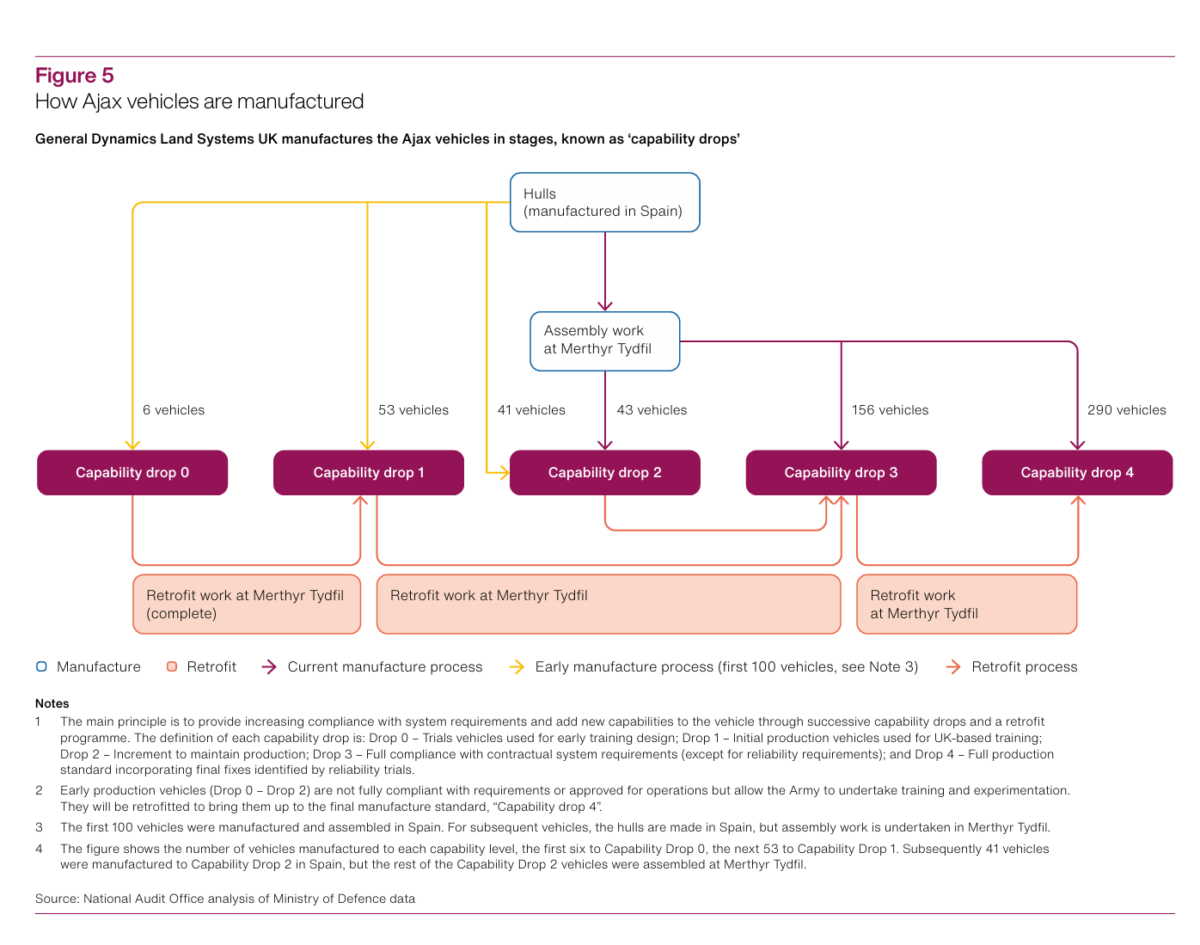
From the subsequent Sheldon Review
The negotiations introduced a new feature into the contract: it was agreed to develop the vehicle in five stages, or ‘capability drops’, numbered 0 to 4. The plan was to allow the Army early access to vehicles and build capability incrementally.
Capability Drop 0 was the existing prototype.
Capability Drop 1 vehicles were intended to be delivered for service in the Army, but to be used for training purposes and not full deployment.
Capability Drop 2 was intended to maintain stability in the supply chain and in production; it was not intended that any vehicles at this specification would be delivered to the Army.
Capability Drop 3 vehicles were to be the first deployable vehicles. Capability Drop 4 vehicles were to meet the final vehicle standard. Each vehicle produced at a capability drop standard below
Capability Drop 4 was to be retrofitted ahead of FOC to bring it up to the final standard required.
At the DSEi exhibition in September 2019, General Dynamics showed the Athena variant.
The MoD confirmed the earliest anecdotal reports of vibration in 2019
As preparation activity for the Capability Drop 1 vehicles at the end of 2019, some soldiers were invited to do pre-trials training on prototype variants. Whilst the on-board sensors did not register any issues subsequently, there were anecdotal reports of vibration.
This was from a 2019 written answer in 2021.
In September 2019, the Programme Director warned the Senior Responsible Owner that there was only a 10% chance of achieving a meaningful IOC (at July 2020)
Rehearsal Battlefield Missions began in October 2019 on the ARES variant. Concerns emerged during these initial trials periods about vibration.
On the 4th of December, the Commanding Officer of the Armoured Trials and Development Unit (ATDU) articulated these concerns in an email
I think we must push an engineering solution rapidly. We cannot be in the business of a Chernobyl style approach of known hazard exposure and then medical checks. That is not a proactive or defendable position in 2020
2020 – Identification of excessive noise and vibration issues with initial trial suspensions #
DSTL warned that crew members could be exposed to excessive levels of noise and vibration in early production vehicles, and that the General Dynamics noise and vibration calculator could underestimate. The Armour Trials and Development Unit (ATDU) raised concerns through the chain of command.
By January 2020, General Dynamic had missed all 11 of its milestones defined in the revised contract.
In evidence sessions to the House of Commons Parliamentary Select Committee on Defence, both Lockheed Martin and General Dynamics laid the blame for delays with Ajax and Warrior CSP on the 40 mm CTAS; however, this was countered by the MoD.
In March 2020, restrictions were again placed on restriction on how vehicles could be used in trial activities, but this was soon overtaken by COVID restrictions.
The Government confirmed that IOC was still in July 2020.
Trials resumed in June 2020, and General Dynamics released a video of an Ajax bridging vehicle.
Further information from a 2021 Parliamentary Answer.
A small number of soldiers engaged in Entry Qualification Trials reported noise and vibration characteristics in July 2020 and in September 2020, a medical staff report raised the possibility of noise injuries.
August 2020 marked the first verified instance of noise symptoms.
The MoD commissioned noise and vibration testing by the Institute of Naval Medicine (INM) in August 2020. In addition, the British Army Environmental Health Team, supported by DSTL, also carried out in ear assessments of vehicle crews in October and November 2020.
An Apollo variant was received by the Household Cavalry in October 2020.
In November 2020, a ban on the dynamic use of Ajax vehicles issued, with additional stipulation on hearing protection type. In subsequent reporting by the National Audit Office and others, there was a complex interaction between hearing protection requirements and noise and vibration on other vehicles used by the British Army (from 2019)
Also in November, General Dynamics contracted the Institute of Sound and Vibration Research to manage trial data.
The Institute of Naval Medicine issued their report in December 2020, making a number of recommendations.
By the end of 2020, the MoD had paid General Dynamics £3.167 Billion of the £5.522 Billion manufacture contract.
2021 – Full suspension of dynamic trials and commissioning of independent safety reviews #
A further safety notice was issued in January 2021, clarifying hearing protection types to be used.
The Defence Select Committee published a report called Obsolescent and outgunned: the British Army’s armoured vehicle capability on the 14th of March 2021.
The recent history of the British Army’s armoured fighting vehicle (AFV) capability is deplorable. Since the end of the Cold War in the late 1980s, the Army’s AFV fleets have been characterised by increasing obsolescence and decreasing numbers. In 1990, the UK had around 1,200 main battle tanks in its inventory, today has 227, and those that remain are in urgent need of modernisation.
The Government response was published on the 14th of May 2021
In April 2021, the Government confirmed that Ajax IOC had slipped to June 2021.
the army currently plans on an AJAX Initial Operating Capability of 30 Jun 2021.
IOC was also defined as ‘the delivery of the first 25 Capability Drop 1 Ajax vehicles, (8 ARES, 2 ATLAS, 3 APOLLO and 12 AJAX), and their associated support, training and infrastructure packages and is designed to enable vehicle familiarisation, initial training and experimentation, including static firing.’
Also in May 2021, General Dynamics showed an overwatch variant equipped with a Brimstone missile box launcher assembly.
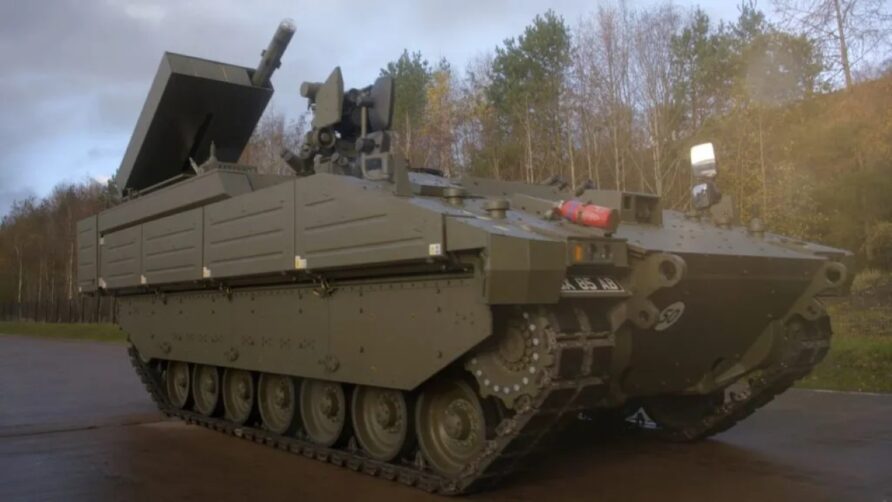
In May 2021, DSTL advised, and the British Army issued safety notices on the use of headsets whilst operating operational armoured vehicles. As the National Audit Office and others explain, this was not just an Ajax issue.
At the end of May, The Sun newspaper reported that trials had been halted due to safety issues in May 2021.
TANKS NO THANKS New tanks which cost the army a staggering £5.5billion have trials halted after troops fall sick and damage hearing. NEW tanks which cost the Army £5.5billion were grounded after making troops sick and damaging their hearing. Crews suffered nausea, swollen joints and tinnitus from the din and vibrations inside the Ajax armoured vehicles.
To resolve issues and disagreement on noise and vibration issues, the MoD commissioned independent analysis (from Milbrook) and an internal safety review, although with no plans to publish it.
Later in June 2021, DE&S issued an urgent stop to all vehicle use
Jeremy Quin Minister of State answered a question on noise and vibration.
During the ongoing demonstration and manufacture phase of AJAX, certain personnel raised concerns over noise and vibration levels.
All personnel who were at risk of exposure have had their hearing tested, and a small number of personnel are receiving ongoing medical attention.
Additional mitigations have been put in place whilst investigations continue.
And followed this up with additional updates the same month
The Ajax family of vehicles will transform the British Army’s reconnaissance capability. As our first fully digitalised armoured fighting vehicle, Ajax will provide crews with access to vastly improved sensors, and better lethality and protection. Maingate 1 approval was granted in March 2010. Negotiations with the prime contractor to recast the contract were held between December 2018 and May 2019. The forecast initial operating capability, or IOC, was delayed by a year to 30 June 2021—later this month—at 50% confidence, with 90% confidence for September 2021.
Despite the ongoing impact of covid, we have stuck by that IOC date, but of course, it remains subject to review. By the end of next week, we will have received the requisite number of vehicles to meet IOC. The necessary simulators have been delivered and training courses commenced. These delivered vehicles are all at capability drop 1 standard, designed for the experimentation, training and familiarisation of those crews that are first in line for the vehicles. Capability drop 3, applying the lessons of the demonstration phase, is designed for operations.
We remain in the demonstration phase, and as with all such phases, issues with the vehicle have emerged that we need to resolve. We were concerned by reports of noise issues in the vehicle. All personnel who may have been exposed to excessive noise have been tested, and training was paused. It now continues with mitigations in place as we pursue resolution. We have also commissioned independent vibration trials from world-class specialists at Millbrook Proving Ground, which should conclude next month.
I assure the House that we will not accept a vehicle that falls short of our requirements, and we are working with General Dynamics, the prime contractor, to achieve IOC. Similarly, we are currently working with General Dynamics to ensure that we have a mutually agreed schedule for reaching full operating capability. That is subject to an independent review, which we have commissioned. This is an important project for the British Army, delivering impressive capabilities and employing thousands of skills workers across the UK. We look forward to taking it into service.
As can be imagined, there was a flurry of articles about Ajax following the news of the safety issue related cessation of testing.
RUSI called it a Greek Tragedy, and the Daily Mail called it a dud
Jeremy Quin confirmed the appointment of a full-time SRO.
Also in mid-2021, further confirmation on Ajax air deployability, with a callback to FRES.
A single turreted, fully armoured AJAX vehicle can be flown in a C-17 with minimal preparation. Two Ajax variant vehicles can be transported in a C-17, after further suitable preparation.
It is intended that all Ajax variants will be capable of air transportation in an A400M aircraft with some level of strip. Stripped items would be transported separately. Four stripped-down Ajax variant vehicles would be transported in four A400M aircraft, and the stripped items in a further two A400M aircraft.
The definition of IOC was further detailed in a July 2021 Written Answer.
Initial Operating Capability (IOC) equates to the delivery of the first 25 Capability Drop 1 Ajax vehicles, (8 ARES, 2 ATLAS, 3 APOLLO and 12 AJAX), and their associated support, training and infrastructure packages and is designed to enable vehicle familiarisation, initial training and experimentation, including static firing
The Henry Jackson Society published a report on Ajax by Rob Clark.
Jeremy Quin provided a comprehensive update to the House of Commons in September 2021, focussing on safety, personnel, and technical issues.
It also noted the requirement for a full-time Senior Responsible Owner (SRO), the first time for the programme (detailed in evidence to the Select Committee earlier)
In another September 2021 answer, the MoD confirmed that 111 personnel were employed on the Ajax programme, and 12 for 40mm CTAS.
Another statement from Jeremy Quin in October 2021 provided further updates on safety issues.
The Times published an article in September 2021 in which it was claimed that ministers believed they had been deceived about Ajax.
By the end of 2021, General Dynamics had produced 324 of the 589 hulls, assembled and completed factory acceptance testing on 143 vehicles, and retrofitted 6 Drop 0 vehicles to Drop 1 standard.
The British Army had received 26 Drop 1 vehicles, intended for training and further familiarisation.
In parallel, by December 2021, of the 36 critical milestones defined in the contract reset, 18 were still outstanding, with 10 of them more than six months late.
During the same month, the publication of the HS&EP Ajax Noise and Vibration Review from the MoD Director of Health, Safety and Environmental Protection.
This report encapsulated work completed between 21st June and 14th July 2021 and was intended to
- Validating the chronology and timeline of events concerning safety issues within the Ajax programme (vehicle vibrations and concerns about potential hearing damage to military personnel)
- Assessing whether the correct health and safety procedures were followed regarding the actions taken in response to the issues with the programme, and determining whether judgements, decisions and mitigations were appropriate and proportionate; and
- Making recommendations for the future of the programme, and relating to past actions, if required.
[I have incorporated some of the reports chronology elsewhere in this article]
It concluded that noise issues had both electrical and mechanical origins.
- Track, suspension and running gear, in particular the tension and sprocket design/track interface.
- Engine and its mounting into the vehicle.
- Quality issues associated with, but not limited to, inconsistent routing of cabling, lack of bonding and weld quality; all of which can lead to potential electromagnetic compatibility issues with communication equipment. As witnessed during trials, insecure components and bolting within the vehicle can also lead to noise and vibration, and again this was noted by ATDU crews
- Headset performance and integration (noise only).
The report closed with a summary of programme issues and recommendations.
It concluded
101. Nothing in this Review detracts from the fact that GDUK has designed and built what MOD maintains is thus far a vehicle which is not fit for purpose and does not meet the contracted specification. The root cause that allowed a vehicle to cause potential harm to Army personnel through noise and vibration during the trials process was not a failure of a single individual or Defence Organisation. It was a complex combination of the Armed Forces’ relationship to harm and weaknesses in MOD’s acquisition system. The impact of Covid was also felt, both delaying trials and making communication more difficult.
102. From a cultural perspective, the Army did not believe it was potentially causing harm to people, especially from vibration, as it was tacitly expected that soldiers can and should endure such issues. Society and the law expect MOD to do better and requires it to have systems in place that protect its people from harm.
103. Within the acquisition system, safety is not viewed as an equal partner to cost, schedule and military capability, and the culture in MOD does not currently ensure safety is considered within strategic decision-making.
104. To have confidence that the events covered in this report will not be repeated, culture change needs to be progressed in the two areas above.
The MoD paused payments to General Dynamics in December 2021
At the end of 2021, another update from Jeremy Quin on Ajax, covering the contents of the safety report.
2022 – Resumption of limited user validation trials following design modifications #
The Public Accounts Committee (PAC) announced at the beginning of 2022 it would be holding an inquiry into Ajax, to be published in June.
The Government announced that an Ajax Lesson Learned Review would start in March 2022, the Terms of Reference published.
RUSI published their own Lessons from the Ajax Programme in May 2022.
On May 11th, 2022, the National Audit Office (NAO) published a report titled The Ajax Programme.
It noted that the Demonstration and Manufacture phase overlap was (at that point) 7 years and 9 months, compared with 3 years and 4 months it was expected to be in 2014.
It also noted that given changes to Army structures, it was now more dependent on Ajax, despite reducing the number of vehicles it ordered (and this included variants), and that the MoD did not know when it would enter service.
The report noted the reasons for the programme’s difficulties were.
The Department’s commercial approach to the programme may not protect it from further expenditure
The Department’s original requirements were highly specified, and its management of design changes has led to disputes and delays
The Department and GDLS-UK did not understand the scale of work or technical challenge, resulting in insufficient contingency in the programme schedule
The Department has not managed the programme effectively
The Department and GDLS-UK reset the contract in 2018, but this did not resolve the programme’s underlying problems
The Department knew of noise and vibration issues before soldiers reported injuries but was not aware of the severity of potential problems
The Department did not create effective mechanisms or incentives to resolve safety issues
The Department is taking steps to resolve the noise and vibration issues, but they continue to represent a significant risk to the programme
Other safety and technical risks remain unresolved
Future risks were described as.
The programme faces significant challenges, and it is not yet clear whether the issues are resolvable
The Department also recognises that it needs to strengthen its programme management.
The Department also faces significant challenges in developing the enabling capabilities that will allow it to use Ajax as intended
The delays to developing Ajax will have important operational and financial impacts for the Army
They made five recommendations
Agree a credible delivery plan to IOC and FOC with GDLS-UK.
Reassess the way the programme is governed and resourced
Improve the management information to provide more real-time visibility on progress, risks, and dependencies
Ensure that the contract incentives are focused on outcomes and align the need to deliver to time with an increased focus on developing the capability
Ensure that there is a clear mechanism and accountability for implementing the recommendations of its safety report
Jeremy Quin MP provided an update on the 19th May 2022 to the House of Commons on Ajax Programmatic Issues, Personnel, and the Sheldon Review.
This update confirmed that the Millbrook Proving Ground trials had concluded, and their initial findings informed a decision on User Validation Trials that commenced on the 12th of May, these being subject to specific control measures that would inform decisions on moving to the next step.
At the beginning of June 2022, the Public Accounts Committee published its previously announced inquiry.
Its conclusions were.
1. The Department is failing to deliver the enhanced armoured vehicles’ capability that the Army needs to better protect the nation and meet its NATO commitments
2. The Department has once again made fundamental mistakes in its planning and management of a major equipment programme
3. The failure to escalate and address noise and vibration issues in a timely manner shows that the Department must simplify its over-complex safety processes and change behaviours
4. Nearly two years after identifying injuries to soldiers, the Department still does not know how to fix the noise and vibration problems
5. We are doubtful that the Department can recover the programme within existing costs and commercial arrangements.
6. The Department’s plans for using Ajax are at risk because of uncertainty about what constitutes full operating capability, when this will be achieved and how Ajax vehicles will be enhanced in the future.
The report also made six recommendations
Recommendation: The Department must assess the longer-term implications of delays for the Army’s transformation programme and investigate alternative options to Ajax now so that it can act quickly if the contract with General Dynamics collapses. We will expect an update on this when we next take evidence from the Department and answers by December 2022.
Recommendation: Once the Ajax Lessons Learned Review has reported, the Department should write to the Committee setting out how it will incorporate the recommendations into its future management of equipment programmes – considering the findings and recommendations of our and the NAO’s reports – to prevent this familiar list of mistakes being repeated yet again.
Recommendation: The Department should set out the changes to its safety processes that it is making in response to the King Report and how it is monitoring the effectiveness of these initiatives. This should include the steps it is taking to improve openness and communication, including the use of the new web-based application. The Department should provide us with an update on progress when we next take evidence.
Recommendation: As a matter of the utmost urgency, the Department must establish whether noise and vibration issues can be addressed by modifications or whether they require a fundamental redesign of the vehicle. If the latter, the Department must decide whether the right course is to proceed with General Dynamics or if it should opt for an alternative. We will expect an update on this when we next take evidence and an answer by December 2022.
Recommendation: Whether or not the Department concludes that it should continue with the current Ajax contract, it must review its commercial arrangements to ensure these are appropriate to incentivise its prime contractor to deliver the programme and agree a recovery plan.
Recommendation: Once the Department has reached agreement on solutions to the noise and vibration problems, it must agree a revised schedule and critical path for initial operating capability and full operating capability, covering all enabling programmes. This should include clear definitions of what will be delivered at each stage, without reducing requirements just to achieve these milestones.
The Government subsequently agreed with all six findings and recommendations.
The MoD confirmed it had incurred, £300k of legal costs since 2020 in relation to current noise and vibration issues.
Lethality, Validation and Verification firings took place between the 28th September and 8th November 2022.
The Telegraph published an article on the 16th of October 2022 called Inside Britain’s £5.5 billion military disaster
The Ajax tank was meant to revolutionise modern warfare – but after a succession of setbacks, is it now destined for the scrap heap?
On December 20th 2022, the MoD reported that
User Validation Trials for Ajax armoured vehicles have successfully completed, and the vehicle testing programme will now progress to the Reliability Growth Trials. Vehicles have been tested across 1,530km at speeds up to 60kmph.
“success” was later called into question by the National Audit Office (NAO) and the 2026 Ministerial statement.
2023 – Commencement of reliability growth trials and resumption of contractor payments #
An initial draft of the Ajax Lessons Learned Report was received in January 2023, and an Ajax squadron was confirmed as comprising 27 vehicles.
On the 23rd of February, The Times published an article called Cushions and ear protectors to put faulty Ajax tanks back on track in which it described the latest with Ajax
The British Army claims it has fixed the troubled Ajax armoured vehicle programme by putting extra cushions in the seats and giving soldiers another pair of ear protectors.
Ben Wallace, the defence secretary, expressed hope that soldiers would no longer be deafened by the light tank as he said the programme had “turned a corner”.
Later that month, BFBS reported that Ajax might still be another 18 months from service entry.
Reliability and Growth Trials commenced on 31 January 2023.
The MoD resumed payments to General Dynamics in March 2023, and reported on positive progress.
Defence Secretary, Ben Wallace, said.
“Having worked closely with General Dynamics to address the issues, I am pleased to say that we are making progress and are now on course to see the delivery of a suite of hundreds of battle-ready vehicles for the British Army.”
Deputy Chief of the General Staff, Lieutenant General Sharon Nesmith, said
“I am pleased and excited to see AJAX progress through the Reliability and Growth Trials.
“Ajax is the heart of the Army’s modernisation programme, significantly enhancing our surveillance and strike capability.”
Full Operating Capability was scheduled for 2029, with Initial Operating Capability scheduled for the latter half of 2025.
The 172-page Ajax Lessons Learned Review was published on the 19th May 2023 (although not publicly until June)
The report also referenced relevant previous reports such as National Audit Office report, Public Accounts Committee Report, the Health, Safety and Environment Report, and Infrastructure Authority Report.
It detailed 13 principle findings and lessons, and 24 recommendations.
The MoD announced that training had resumed on Ajax in June 2023, with Capability Drop 1 vehicles.
Minister for Defence Procurement, James Cartlidge, said:
This is a significant moment for the British Army, marking a huge step forward for the Ajax Programme. The Ajax vehicles will provide a breakthrough in capability, and I’m pleased to see such positive progress towards delivering a suite of battle-ready vehicles for our forces.
In response to the publication of the Ajax Lessons Learned Review (Sheldon), there was a House of Commons Debate on the 15th of June 2023 (video here)
The Government accepted all the findings, and of the 24 formal recommendations, 15 were accepted (1, 2, 3, 4, 5, 6, 7, 10, 11, 12, 13, 14, 20, 23 and 24) and 9 accepted in principle.
General Dynamics announced the 10,000th CT40 round had been fired in August 2023.
A further question on legal issues, this time between 2010 and 2023, revealed a cost of £983k.
2024 – Ramp-up of production deliveries to training and frontline units #
In March 2024, the MoD announced completion of Ajax cold weather trials
Members of the DE&S Ajax delivery team worked with the British Army Household Cavalry Regiment (HCR) to put Ajax through its paces in sub-zero temperatures in Sweden.
This was accompanied by a promotional video
The British Army also released a video in August 2024 that showcased Ajax completing the first firing on the move exercise in the UK.
2025 – Declaration of Initial Operating Capability followed by training and reliability trial pause #
As of March 2025, the MoD had accepted 91 Ajax vehicles, with over 180 expected to be delivered by the end of 2025.
The Out of Service Date (OSD) for Ajax was confirmed as 2055.
In response to a Parliamentary Written Question tabled by James Cartlidge MP (Conservative – South Suffolk) on 28 April 2025, Defence Minister Maria Eagle stated
The Armoured Cavalry programme continues to remain on track to achieve Initial Operating Capability by December 2025. As at 10 April 2025, 100 Ajax platforms have been accepted by the Ministry of Defence.
A new Ajax Infantry Fighting Vehicle (IFV) variant was shown as the DSEi exhibition in September 2025.
Scott Milne, Vice President and General Manager at GDLS-UK, said
AJAX IFV represents the convergence of sovereign innovation, strategic foresight, and industrial strength. It’s not just a platform — it’s a product of the UK’s Defence Industrial Strategy and a direct response to the Strategic Defence Review’s call for adaptable, export-ready capability. Designed, built and supported in Britain, AJAX IFV will contribute to the British Army’s 10x lethality through advanced digital integration and modularity, enabling NATO-first operations with unmatched interoperability.”
Reportedly based on Ares, it featured a lengthened hull and uncrewed turret developed by Lockheed Martin, equipped with 40mm CTAS.
The press release noted that Ajax had completed more than 42,000 km of rigorous battlefield testing, over 20,000 rounds fired from its advanced 40mm cased telescoped cannon, operational assessments in both hot and cold climates, and live firing on the move and advanced mobility exercises.
Luke Pollard MP, Minister for Defence Readiness and Industry, said:
“Defence is an engine for growth. AJAX is contributing not only to the economy in South Wales but also UK-wide in the supply chain. We’re exploring the potential to export AJAX. AJAX boasts world-class capabilities, and it is a hugely important milestone that the UK-wide suppliers have delivered a vehicle that is safe, effective and truly cutting-edge, which will be recognised by allies and adversaries alike.”
Ajax Initial Operating Capability (IOC) was declared on November 5th 2025.
At the Project Controls Expo on 5th November 2025, the MoD was awarded Global Project Controls Megaproject of the Year for its work on Ajax.
From General Dynamics on the 14th of November 2025
MERTHYR TYDFIL, Wales – The British Army has announced that the AJAX Armoured Fighting Vehicle has achieved Initial Operating Capability (IOC)— a pivotal moment in the transformation of UK land forces and a key delivery for the UK Government’s Strategic Defence Review (SDR) 2025.
This milestone confirms that a squadron of AJAX vehicles are ready to deploy on operations, delivering reconnaissance and combat capabilities to the frontline.
Exercise Titan Storm was a major British Army training exercise held on Salisbury Plain, Wiltshire, in November 2025. It formed part of a wider 3rd (UK) Division national exercise involving over 5,000 troops, vehicles, drones, and air assets to rehearse high-intensity, multi-domain operations against modern threats (including drone integration and near-peer tactics).
Taking part were The Household Cavalry Regiment and The Royal Lancers, between them fielding approximately 60 Ajax family vehicles, conducting extended activities to simulate sustained reconnaissance and manoeuvre tasks.
It was reported approximately 30–31 soldiers across 23 vehicles reported noise and vibration-related symptoms:
- Vomiting / severe nausea
- Uncontrollable shaking
- Leg weakness
- Hearing issues / disorientation
The exercise was stopped immediately, and this would ultimately be the reason for IOC withdrawal in 2026.
No one was hospitalised, and the symptoms were described as non-life-threatening, but personnel received full medical care and continued monitoring.
On November 25th 2025, The Times reported that 31 soldiers had fallen ill after spending between 10 and 15 hours on the vehicle whilst deployed on Exercise Iron Fist on Salisbury Plain.
The British Army has been forced to stop the use of its Ajax armoured fighting vehicle after dozens of soldiers fell ill due to vibration and hearing problems, The Times can reveal.
Soldiers emerged from the £10 million vehicles vomiting, while others were said to be shaking so violently they could not control their bodies after war games on Salisbury Plain, sources said. Others had weakness in their legs.
Thirty-one soldiers from the Household Cavalry and the Royal Lancers were affected after they spent 10 to 15 hours in the vehicle, two sources said.
The Iron Fist exercise took place over the weekend, only weeks after Luke Pollard, a defence minister, showcased the vehicles and declared them safe for operations.
A Safety Notice was issued, stopping all use of the vehicles for two weeks whilst investigations could be completed.
Of the 61 vehicles of all AJAX types were involved in the exercise, 23 AJAX Vehicles were linked to soldiers suffering from noise or vibration injury.
The Government confirmed it sought legal advice.
On the 26th of November 2025, An update was provided to the House of Commons by Luke Pollard, Minister of State.
I am releasing this statement to the House today to provide an update to Parliament on the British Army’s Armoured Cavalry Programme (commonly known as Ajax). The programme has now reached Initial Operating Capability (IOC), however, a recent training exercise has raised concerns regarding the safety of the vehicles.
As safety is my top priority, prior to IOC I asked for and was given assurances in writing by senior Ministry of Defence (MOD) personnel that the system was safe.
On 22 November 2025, around 30 Service personnel operating Ajax reported noise and vibration symptoms during a training exercise. The exercise was stopped immediately in line with our safety protocols and those affected received full medical care and attention, and continue to be monitored. There have not been any hospitalisations and none of the symptoms are life threatening.
The safety of our Service personnel remains a top priority for the MOD. As such, and out of an abundance of caution, I have directed a pause on use of Ajax for training and exercising, while a safety investigation is carried out.
The rapid escalation of medical concerns, and halting the exercise immediately, demonstrates both the professionalism of our people, and an improved safety culture functioning as designed, with the chain of command acting appropriately and with the required urgency. It is important to highlight that Ajax is continually being tested and developed. This approach enables our soldiers and industry partners to work collaboratively to address challenges as they are identified.
The Defence Accident Investigation Board and the Army Safety Investigation Team are working with General Dynamics at pace to conduct an investigation into the incident.
The Ministry of Defence will provide further updates in due course, upon completion of the investigation.
A series of disclosures from ‘Fill Your Boots’ on X and Facebook in early December were released.
This is an example from December 3rd 2025
Hi mate. IF you post this Could it be annon please. Units have recently had GD employees on site inspecting and testing the AJAX fleet. They have been ‘removing data’ and inspecting vehicles. Stating that things like, drivers and commander not using seat belts or sitting in the seat correctly is part of the issue not the vehicle. Stating that they have found bolts loose so no wonder it’s vibrating. ( bolts that they fitted, vibrated loose and dropped out whilst crews are driving). They have been taking vehicles out on ‘test drives’ with vibration equipment covering about 5km at low speed, gentle manoeuvring on sterile areas then saying they will ‘generate’ data to represent the millage needed for full testing). It seems they are currently trying to find every excuse to blame the Users. Their engineers have been commenting saying they don’t understand how blokes can be getting sick due to vibration or anything caused by the platform as there’s nothing wrong with it.. Yet they won’t risk putting their own blokes in and test them in the same conditions and time frames as used by the troops on the Exercise. The defensive attitude of the majority of GD staff is becoming clearly visible. It’s becoming very much them and us divide. Instead of helping each other to find the issues and rectify them allowing the platform and program to move forward safely thus not wasting £10bn of the tax payers money, they seem to just want to find a way to blame the users to try and save face. The guys and girls on the shop floor are aware of all the issues posted by the GD employee, it’s all well known by those who have been working on the platform for some time. Units all know some of the soldiers who are working down at GD. They say how much their hands are tied. There are known multiple vehicles arriving at units unfit for purpose, and unfit to operate due to issues that should have been rectified before loaded on HETs. Critical vehicle fitted items missing, FFEs not fit for purpose, track issues, camera screen issues, driver / commander seat issues, Comms/Bowman vibrating its self to bits and stopping working, engine and automotive issues. The list is endless. It just seems GD don’t care, they pump the half-arsed vehicles out and take the publics money. There is no care for the users Health and Safety and GD just reply with ‘well this is what the army asked for’… The whole saga is a joke. And if it continues I doubt the platforms will survive the next 12/18 months and GD will pile in… or someone will be seriously injured and medically discharged yet again thanks the incompetence of GD.
And December 11th 2025
Detailed Employee Account: Systemic Issues within the General Dynamics Ajax Programme As a long-serving General Dynamics employee working directly on the Ajax vehicle programme, I feel compelled to document the profound systemic and cultural failures I have witnessed. My surprise is not that the programme has encountered technical challenges, but that the sheer scale and nature of the issues—many stemming from managerial pressure and a culture of corner-cutting—have not been brought to light earlier in a meaningful way. The problems extend far beyond design flaws. On the shop floor, we operate under intense pressure from management to meet deadlines, often at the expense of procedure and safety. The prevailing directive from certain managers is to “just make it fit,” with instructions to “do what you got to do—grind it, cut it, hammer it in, or boot it.” This ethos of force-fitting components directly contradicts engineering standards and creates inherent vulnerabilities in the vehicle’s integrity. I have observed managers and quality personnel witnessing these practices without intervention, effectively endorsing them. Specific, recurring failures include: · Critical Safety Omissions: Armour bolts left unfitted behind the VIP bin, compromising ballistic protection. · Persistent Functional Failures: The driver’s hatch mechanism continues to fail despite being a known, long-standing issue. · Chronic Leaks: Fuel and hydraulic leaks are commonplace, indicating persistent sealing or subsystem integration problems. · Falsified Safety Records: Most alarmingly, I have seen safety notices stamped off as completed. Upon physical verification, the required work had not been done. A grave example is within the Ajax battery compartment, a high-risk area that remains live even after isolation. Signing off on unperformed work here is not just negligent; it is dangerously irresponsible. The logistical and support side of the programme is equally broken. We face severe parts shortages. To keep the current production line moving, we have been systematically cannibalising vehicles from a storage fleet of approximately 50 trucks in Llanelli. These vehicles haven’t been started in years, their batteries are long dead, and we strip them for components because new parts are simply unavailable. This is not sustainable manufacturing; it is a desperate and inefficient salvage operation that underscores a profound failure in supply chain management. Perhaps most disheartening is the cultural corrosion. A specific example that shocked me was witnessing a former 2ic (second-in-command) at the Merthyr site rapidly abandon his principles upon accepting a managerial position within General Dynamics. This individual, once an advocate for the workforce and procedure, swiftly adopted the very “get it done at any cost” mentality he previously questioned. This rapid shift in morals highlights how the managerial culture actively assimilates and silences potential internal critics, perpetuating the cycle of failure. In summary, the issues with Ajax are not merely technical or confined to the drawing board. They are the product of a toxic operational culture that prioritises schedule over safety, encourages wilful blindness among management, and penalises adherence to standards. The shop floor is executing under duress, the logistical foundation is non-existent, and the safety of the end-user is being compromised by signed paperwork for work that remains undone. This programme requires more than a redesign; it needs a complete cultural overhaul and a genuine commitment to transparency and accountability from the highest levels down.
There were many more, and a few videos, all were passed to the relevant minister
UK Defence Journal reported adverse social media commentary, blaming crew competence for the issues.
It was confirmed in December 2025 that there were three investigations being carried out by
- Defence Accident Investigation Branch (DAIB)
- Army Safety Investigation Team (ASIT)
- A Ministerial Review
The latter supported by Secretary of State’s Strategic Advisor Malcolm Chalmers.
2026 – Withdrawal of Initial Operating Capability status and launch of comprehensive safety investigations #
In early 2026, further clarification was released on timescales to FOC.
- The final planned Capability Drop 1 to Capability Drop 3 upgrades were expected to be complete in October 2028
- The final planned Capability Drop 2 to Capability Drop 3 upgrades were expected to be complete in July 2028
- Capability Drop 4 was expected to be congruent with Full Operating Capability (FOC) in September 2029
On the 22nd of January 2026, an update was released by the Minister of State, Luke Pollard, expressing his anger at the initial findings of the ministerial review.
To say that I am angry about the findings of the Ministerial review is an understatement. It demonstrates that people were raising issues with this programme, but they were not being elevated to an appropriate level.
Ministers rely on accurate, timely and complete information to make decisions in the national interest. When that information does not meet this standard, the consequences are not abstract. They can be real, human and serious. And I experienced this first hand with a visit to the Field Army last week where I met troops who have operated the Ajax vehicles.
In this case, inaccurate information directly contributed to the decision to declare initial operating capability for Ajax. This is unacceptable, and today I have written formally to the wider Department to explain how I expect people to be accurate, innovative and challenge unnecessary process and bureaucracy, whilst maintaining our peoples’ safety. I have asked the permanent Secretary to follow up on the key themes of this report.
This House will understand I will not comment on individual HR matters, but I can update the House that the Senior Responsible Owner of the Ajax programme is no longer in that role. An interim Senior Responsible Owner has been appointed by the Army, and I have passed oversight of this programme to the National Armaments Director, who will update me regularly.
Three key points from this.
- The November 6th 2025 IOC was withdrawn
- The Senior Responsible Owner (SRO) was removed from post, and r
- Responsibility for the programme was passed to the National Armaments Director (NAD)
It was confirmed on 27th January 2026 that General Dynamics had been paid £4.664 Billion.
On the 1st of February 2026, the Times published a video from Mark Urban on Ajax (in which some of the accusations above were addressed)
Lockheed Martin released a video of their exportable turret on February 10th 2026.
The final cost is variously reported with and without VAT, inclusive or exclusive of assessment phase contracts, as Ajax specifically, or the Armoured Cavalry programme as a whole.
The whole programme cost has been more recently quoted as £6.2 billion, it is likely these will be finalised towards FOC, currently scheduled for 2029.
To be continued…
Footnote 1 – Explaining Capability Drops #
The Capability Drop concept is an incremental “spiral development” strategy designed to get Ajax vehicles into the hands of the British Army for training while technical fixes and final systems were still being refined.
This is a natural outcome of overlapping the demonstration and manufacture phases.
Instead of waiting for a perfect, final-specification vehicle, the MoD accepted vehicles in five distinct stages (Drops 0 through 4), with the agreement that all early vehicles would eventually be retrofitted to the final standard.
- Capability Drop 0 (Prototype): The early pre-production and prototype vehicles used for hull and automotive testing and development. It is believed there are 6 of these
- Capability Drop 1 (Early Training Standard): Basic automotive systems used for early training. It is believed there are 59 of these, each in storage.
- Capability Drop 2 (Intermediate Training Standard): This standard introduced more complex subsystems and to maintain stability in the supply chain. Approximately 84 vehicles, also in storage.
- Capability Drop 3 (The IOC Standard): Declared in late 2025, Drop 3 is the first ‘operationally deployable’ version. It included the fully integrated 40mm CTAS weapon, full modular armour package, enhanced cooling and interim noise and vibration mitigation measures (such as vibration-isolating seats and noise-cancelling headsets). Approximately 155 vehicles are held at this standard.
- Capability Drop 4 (The FOC Standard): This is the definitive “Full Operating Capability” version. It will incorporate all final engineering modifications derived from the noise and vibration trials, alongside the full software suite for the Morpheus digital backbone.
The final goal remains to have the entire fleet of 589 vehicles retrofitted to the Capability Drop 4 standard by 2029, ensuring a uniform fleet that meets all original 1,200 technical requirements.
Footnote 2 – Changing IOC and FOC #
The IOC (Initial Operating Capability) definitions and target dates for the Ajax programme have evolved repeatedly over more than a decade, while FOC (Full Operational Capability) targets have shown greater stability recently.
- Pre-2015: Early planning aimed for in-service around 2017 (original contract expectation).
- 2014–2015: IOC reset to July 2020 (later split as IOC 1 mid-2019 for reconnaissance, IOC 2 mid-2020 for command variants).
- 2019: July 2020 retained but redefined via Capability Drops
- 2020–2021: July 2020 official despite emerging noise/vibration problems; slipped to 30 June 2021 (50% confidence, 90% by September), defined as delivery of first 25 Drop 1 vehicles (8 ARES, 2 ATLAS, 3 APOLLO, 12 AJAX) plus support packages for training, familiarisation, experimentation, and static firing.
- 2023 Recast: IOC targeted for July–December 2025; FOC for October 2028–September 2029 (aligned with Drop 4 completion, full fleet maturity, and retrofits).
- 2025: On track for December IOC (April statements); declared achieved 5/6 November 2025 (squadron of ~27 vehicles ready for operations); withdrawn January 2026 after Exercise Titan Storm incidents, IOC pending ongoing investigations (Defence Accident Investigation Board, Army Safety Investigation Team, Ministerial Review, and others).
- FOC status (as of February 2026): Remains targeted for end-2029 (or September 2029 in detailed timelines)
Footnote 3 – Major Projects Authority Ratings #
The Government Major Projects Portfolio (GMPP) is the UK government’s list of its largest, most complex, innovative, and risky projects across departments, overseen for transparency, assurance, and performance tracking.
It evolved from the Major Projects Authority (MPA), established in 2011 post-2010 election to provide oversight of major government initiatives. The MPA published its first annual report in 2013 (covering data from 2012), marking the formal start of the GMPP, with around 199 projects at its 2014 peak.
In 2016, the MPA merged with Infrastructure UK to form the Infrastructure and Projects Authority (IPA), which continued annual GMPP reports, standardising processes like project exits, Delivery Confidence Assessments (DCA ratings: Green/Amber/Red), and data on whole-life costs, timelines, and benefits.
For Ajax, the programme name changed, as indicated in the table below.
| Year | Name | Rating |
| 2013 | Specialist Vehicles – Recce Block 1 | Green |
| 2014 | Mounted Close Combat | Amber/Green |
| 2015 | Mounted Close Combat | Amber |
| 2016 | Armoured Cavalry 2025 | Amber |
| 2017 | Armoured Cavalry 2025 | Amber |
| 2018 | Armoured Cavalry 2025 | Amber |
| 2019 | Armoured Cavalry 2025 | Amber |
| 2020 | Armoured Cavalry 2025 | Amber |
| 2021 | Armoured Cavalry 2025 | Red |
| 2022 | Armoured Cavalry 2025 | Red |
| 2023 | Armoured Cavalry 2025 | Amber |
| 2024 | Armoured Cavalry 2025 | Amber |
| 2025 | Armoured Cavalry 2025 | Not Provided |
Footnote 4 – Ajax Variants #
The Ajax programme consists of six main variants on a common tracked platform, for a total of 589 vehicles.
- Ajax (turreted reconnaissance) — 245 vehicles
- Ares (Armoured Personnel Carrier / Protected Mobility Recce Support) — 93 vehicles
- Athena (Command and Control) — 112 vehicles
- Argus (Engineering Reconnaissance) — 51 vehicles
- Atlas (Equipment Support Recovery) — 38 vehicles
- Apollo (Equipment Support Repair) — 50 vehicles
If you found value in this article, help me keep Think Defence going.
Think Defence is a hobby, a serious hobby, but a hobby nonetheless. I have removed those annoying adverts, but hosting fees, software subscriptions and other services add up.
To help me keep the show on the road, I ask that you support the site in any way you can. It is hugely appreciated.
You can click on an affiliate link, Buy Me a Coffee at https://ko-fi.com/thinkdefence, download an e-book at https://payhip.com/thinkdefence or even get some TD merch at https://www.redbubble.com/people/source360/
Youtubers, if you are going to lift content from here, the decent thing to do would credit me


Excellent overview TD. Really interesting how at every stage of the project MoD/HMG have gone against common sense decisions and against sovereign capability. Why appoint LM a US company that has skin in the game to eliminate a British company offering a standardised solution?
This reeks of institutional collusion and corruption. Since Ajax contract was placed, BAE have fielded multiple new versions of CV90 without any issues.
If Ajax continues which the CGS insists it will??? The army will be stuck with an unreliable platform with multiple ongoing problems which will never be solved.
Through life costs will be massive, there will be no exports or further work for Merthyr which will close anyway unless HMG are stupid enough to continue placing more vehicle contract to a US company that has over promised and underdelivered on every contract it has ever received
Fascinating to read this unhappy saga. I worked on TRACER and FRES SV for BAE Systems and subsequently supported Hagglunds in other vehicle bids. I always thought that CV90 was a decent no nonsense platform. I am not prepared to comment further. It seems that Ajax has come seriously unstuck and one suspects that there is no easy path forward from this point.
A good article, thank you. It shows that this program will not, for some considerable time (2028), deliver a deployable mix of operational vehicles (across all types) that meets the needs of a battlegroup, let alone a brigade. 131 (in drops 0-2) of the 580+ ordered vehicle are not operationally deployable at all – even though they equip front line units, what are these units to use if they have to go on operations? Soldier confidence must be close to or at the point where they will never trust the vehicle. The only answer is to start again, or replace with a version of CV90 – built in the UK or otherwise. As we read this article the Chancellor has the additional funds in hands right now.
This has the makings of a compelling book.
TD as usual a comprehensive explanation. What I can never get over having followed the machinations of the MoD and Armed Forces for over 15yrs is how they keep making the same mistakes. It's not just Ajax, you could write this about Nimrod, CR2/3, Warrior, T45, T23/26 Frigate Gap, F35/Typhoon lack of numbers, Medium Helicopter etc etc.
It is not just one individual or even one service. It is clear there is a complete lack of Strategic Thinking in procurement and operational level. We have to look at both the Civil Servant and Senior Leadership training that is happening in Defence sphere. We have to decouple agreeing with Politicians to getting Lordships and K's. You should have to show you have actually achieved something to get those accolades.
As to this problem. There is a simple solution (If not already sold) there are 98 M10 booker vehicles sitting in the Desert in the USA. Based on the Ascod design (Appreciate not identical). Buy them and this then gives time to take back the problematic vehicles and re-engineer them. In fact in the modern world where we only have 150 CR3's I would suggest asking GDLS to make another 100 and integrate them long term into a mixed CR3/M10 tank fleet as at 48T at Theatre Entry Level either Ajax or M10 (For God Sake change the name) is in effect a tank. I would even go as far since the turret ring is built for it get Rheinmetall to retrofit a 120mm turret on them. Plus all should be fitted with APS. Then turn the 295 Ajax variants into IFV's to replace the Warrior Debacle.
But that would take a lot of humble pie eating something the MoD and Army don't seem capable of.
As I have said here before (and elsewhere) my concern isn't recce. The arguments against Ajax for that role are evident even before you take into consideration drones. My concern is that Army lacks a cavalry vehicle. MBT's are for fighting other MBT's, mostly. Where is the vehicle for screens? Covering breaking from contact? Exploitation? And all those other tasks…