
The Supacat All Terrain Mobility Platform (ATMP), commonly known simply as the Supacat, is a lightweight, high-mobility 6×6 wheeled vehicle developed by the British company Supacat. The Supacat All Terrain Mobility Platform (ATMP) is just about exactly that, designed to carry heavy loads over extreme terrain.
An extremely versatile vehicle, the latest variant has an advanced electric drivetrain.
Table of Contents
Supacat ATMP Initial Development
During the 1982 Falklands Conflict, the majority of available helicopter lift was used for 105 mm Light Gun ammunition and Rapier battery generator fuel because the British Army had no suitable vehicle that could negotiate the soft terrain.

Although some CVR(T) and Volvo BV202 Snow Cat vehicles were embarked, they were very few and generally used for moving troops forward or engaging Argentine forces, not providing logistics support.

Immediately after the conflict, a requirement was defined to close that gap, especially for a vehicle that could both carry and tow more than a Snow Cat but be lighter and more compact, better suited to expeditionary and airborne operations.
Meanwhile, Supacat had designed a built a vehicle for agricultural use, intended for mounting and carrying spraying equipment to hard-to-reach locations.
The image below shows the prototype Supacat vehicle under trial.

In 1983, the MoD sponsored a set of trials on the Isle of Jura to further develop the requirement. Vehicles included the BV202, a Land Rover with low-pressure tyres, and the Supacat 6×6 vehicle in its Mk I guise.
A further set of trials were arranged at Lydd Ranges in 1983, the Supacat vehicle impressed, and 7 were purchased by the MoD for use on ranges with large intertidal areas, each with an enclosed cab.
Further work on the requirements resulted in an open-top vehicle with a pair of stowable ramps and a winch that could be used to haul pallets onboard.
This was the Mk 1, shown below.

More research with 5 Airborne Brigade resulted in the Mk 2.
The MoD formally created a revised requirement called the All-Terrain Mobility Platform (ATMP), the Mk 2 Supacat vehicle competing with twenty other designs, including the Rasant Berktrak mower-derived Rolba Goblin and Land Rover derived Esarco 6×6 shown below
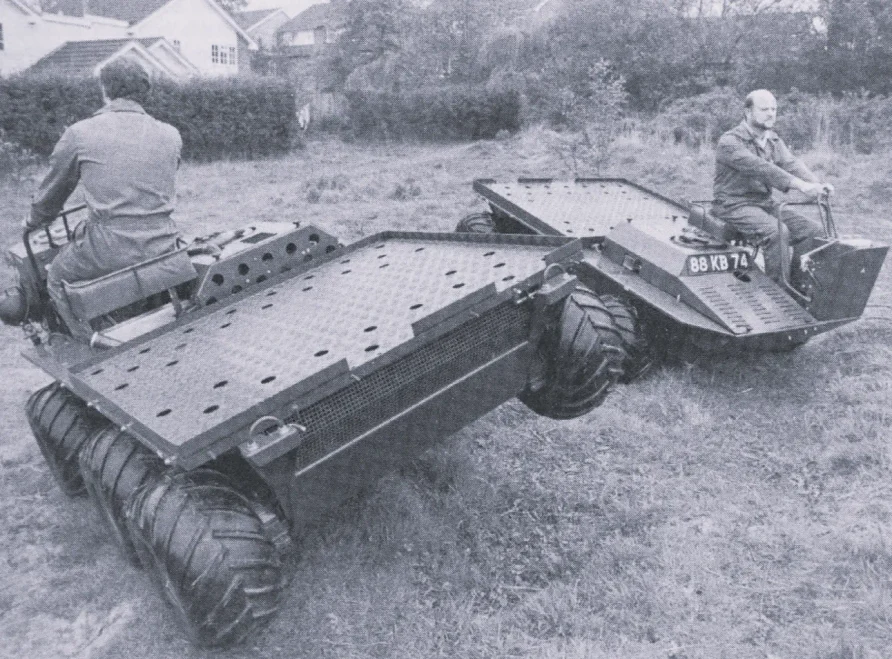

Although the Robla Goblin would enter service for a different requirement (EOD equipment carriage), the Supacat vehicle won and the ATMP name stuck.
Thirty-six Mk II’s entered British Army service in 1988, following trials the year earlier, and the two trials vehicles were also converted to production status.
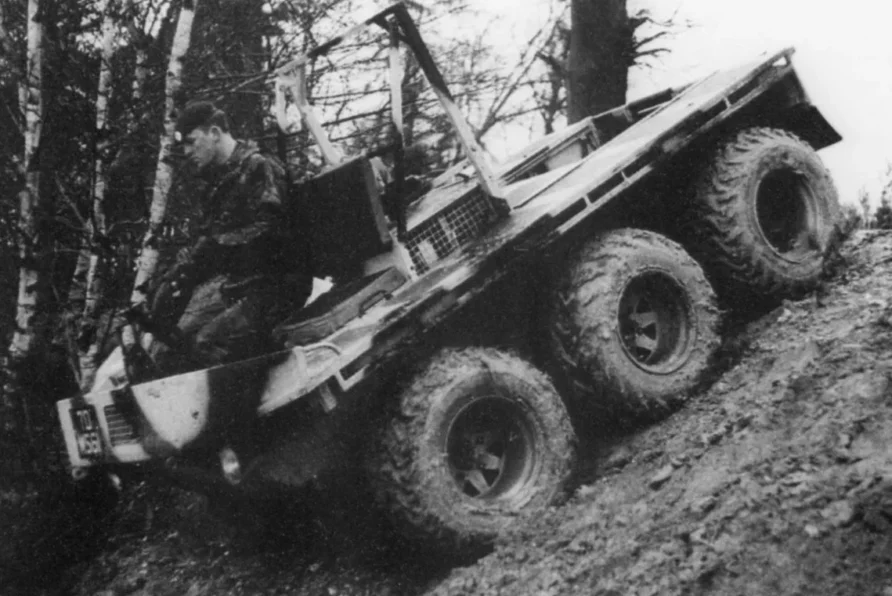
Supacat designed the vehicle but was unable to manufacture it in quantity, so entered into production-sharing contracts and in 1984, the production vehicles were manufactured by Williams Fairey Engineering Limited (of bridge fame).
Some were tested on the Falkland Islands, confirming their suitability in an environment that generated the requirement in the first place.
Supacat ATMP Operational Use and Further Orders
ATMP were used by the British Army during the 1991 Gulf War, with some being converted as Rapier missile towing vehicles, and for RAF airfield operations.

Following the conflict, twenty ATMP were quickly reverted to the standard configuration, and a crane was added and deployed with Royal Marines to Northern Iraq supporting the Kurdish minorities, OP HAVEN.
The C130 stacking pallet and forklift handling proved to be very useful, and the low ground pressure reportedly allowed it to be driven into a minefield to recover an injured soldier.
In 1995, an agreement was made between Alvis (now BAE Systems) and Supacat in which Supacat would retain design and production rights for civilian markets, but Alvis would be responsible for military markets.

An additional order for 86 ATMP and 84 SLLPT trailers was let for approximately £4 million in 1996.
Operation AGRICOLA was the name given to the UK contribution to KFOR, UK forces were responsible for securing a route to Priština from Macedonia. This route included the crucial Kacanik Defile, a narrow gorge with a series of bridges and tunnels.
5th Airborne Brigade consisted of elements of 1 and 3 PARA, reinforced with the 1st Battalion, The Royal Gurkha Rifles. In addition to 657/659 Squadron AAC Lynx helicopters, the main lift was supplied by eight RAF Chinook and five Puma helicopters.

ATMP were included in the main lift and were used to establish radio rebroadcast locations, among many other tasks.
An ATMP was used in the recovery operation at the Pentagon after the 9/11 attacks.

In the early 2000s, most of the ATMP vehicles were disposed of and in the run-up to operations in Iraq, many of them were repurchased from the civilian market, and pressed back into service.
Yes, this really happened.
Supacat Mark 3 – 06/12/00
A revolutionary new British vehicle, which can climb mountains and swim lakes, joins the ranks of the Army tomorrow.
The Supacat Mark 3 will become a key component of the Colchester based 16 Air Assault Brigade able to move heavy equipment and weapons across the most demanding of battlfields. Equipped with innovative self-loading trailers the fifty three new six wheeled vehicles can be airlifted by a Hercules aircraft, parachuted into a combat zone or lifted under a helicopter.
Defence Minister, John Spellar said’ “This is a demonstration of our commitment to giving the best kit possible to our Service personnel. Like our personnel, the new Supacat will be able to deploy anywhere in the world at very short notice.”
The Parachute Regiment used their ATMP in 2003, Operation TELIC (great article here)

In 2005, Supacat regained sole marketing rights.
Afghanistan and Withdrawal
In Afghanistan, ATMP were used to support C-IED efforts, Apache Attack Helicopter refuelling points and in their traditional logistics role. Due to years of neglect, a lack of investment, insufficient spares holdings and questions over continued support for a non-Euro compliant engine, they were withdrawn in 2001. 2010.
Reliability in the hot weather of Afghanistan was poor, the availability of 50% of the deployed fleet on any given day was considered to be good.
The cost of spares was proving to be high and taking up valuable space on the air bridge.
An environment mitigation package was considered before withdrawing the vehicles, but it was assessed as being equivalent to a complete redesign and therefore, a new acquisition. Supacat informed the MoD that, given their workload at the time with Jackal, it would be unable to deliver such a redesigned vehicle for two years.
The MoD then considered further options for the Land Force’s Load-carrying Platform capability, and it was judged that a quad bike and trailer did not have the payload to fulfil the role.
Several manufacturers were asked to ‘express an interest’ including…
Roush (Balter 2)

Development Engineering and Enterprise Limited (WVL-C6-AS)
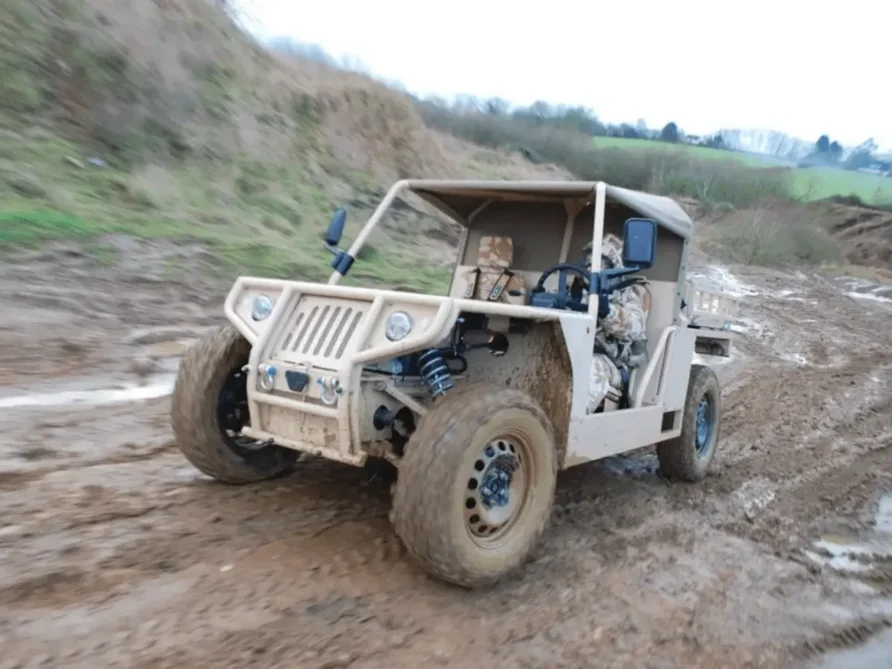
Enhanced Protection Systems UK Limited (Tomcar TN5)

John Deere, Yamaha Corporation, Honda Motor Company Limited and JC Bamford Excavators Limited declined to bid.
In April 2009, Enhanced Protection System was awarded the contract for 78 Springer vehicles at a total cost of £3 million, although other sources have that figure at £7 million.
Springer was not a great success, and withdrawn from Afghanistan in 2011.
Supacat ATMP Mark IV and Beyond
At the Land Forces 2014 exhibition in Australia, Supacat showed off its concept for a new and improved Supacat, the Mk IV.

Commenting on the updated design, Michael Halloran, MD of Supacat Pty Ltd, the Australian subsidiary of Supacat, said:
When we looked around the market, we found that there is nothing that combines the payload, mobility and robustness of the ATMP, so in developing this concept vehicle we decided to look at maintaining the fundamental strengths of the platform while updating the human interface and the automotive and communication systems.
At the Royal Navy’s Unmanned Warrior 16 exercise, an ATMP MkIII was used to support the QinetiQ team.

Subsequently, the MoD issued a tender requirement for a range of support services for the maritime autonomous trials team (MASTT).
In 2018, Supacat announced it would collaborate with the University of Exeter on a modernisation programme that would both address obsolescence issues and also develop a hybrid drivetrain.

The video below discusses the hybrid ATMP development
Development of the H-ATMP continued, and an optionally unmanned variant was shown at DSEi 2019.
The ‘optionally manned’ demonstrator utilises a terrain detection and response system for enhanced mobility and optimised endurance. An object categorisation and response system for obstacle clearance or avoidance during technical off-road driving, which can be tailored to the capabilities of the vehicle, driver or a remote operator, and a path planning and motion behaviour system using simultaneous localisation and mapping (SLAM) for the navigation of lead and follow on vehicles.
This programme culminated in a demonstration of eATMP
ATMP continues to be in demand in the specialist civilian sector, examples include pole carriers and even an all-terrain drilling rig from Structural Soils Ltd.
Export customers included Malaysia, Canada, and Brazil.
Supacat ATMP Capabilities
Dimensions and Automotive Capabilities
ATMP is a 6×6 vehicle that uses both skid steer and Ackerman-type steering (front two wheels steered)

It originally used low-pressure Terra-Wrangler tires, and with a ground pressure of 0.2 kg/cm, it was highly mobile, through several industrial consolidations, these are now Alliance 221 Tredlite tyres available under the Yokahama brand.
Originally powered by a 1.3L Citroën engine, the later versions had a 1.9L Volkswagen-Audi engine and automatic transmission.
Specifications include a 750-1,000 kg payload, increasable to 1,600 kg with reduced performance, gross vehicle weight of 3.45 tonnes, limited amphibious capability, and a top speed of 64kph.

The minimum ground clearance of the ATMP is 0.22m. The approach/departure angle of the vehicle is 45˚ while its fording depth is 0.6m.

The fuel tank has a 50L capacity, increased in later versions, providing a range of approximately 850 km.
ATMP is fully amphibious but only with a load of 400 kg payload.

Beyond that, and to provide additional stability, a flotation kit from All Terrain Vehicles can be fitted
ATMP has been fitted with Milan and Starburst/LML-guided weapons.

They have also been fitted with various roll cages, weapons mounts, and cabs.


H-ATMP features electric motors made by Dana TM4 and the vehicle can also export power to various off-board equipment. Further details here.
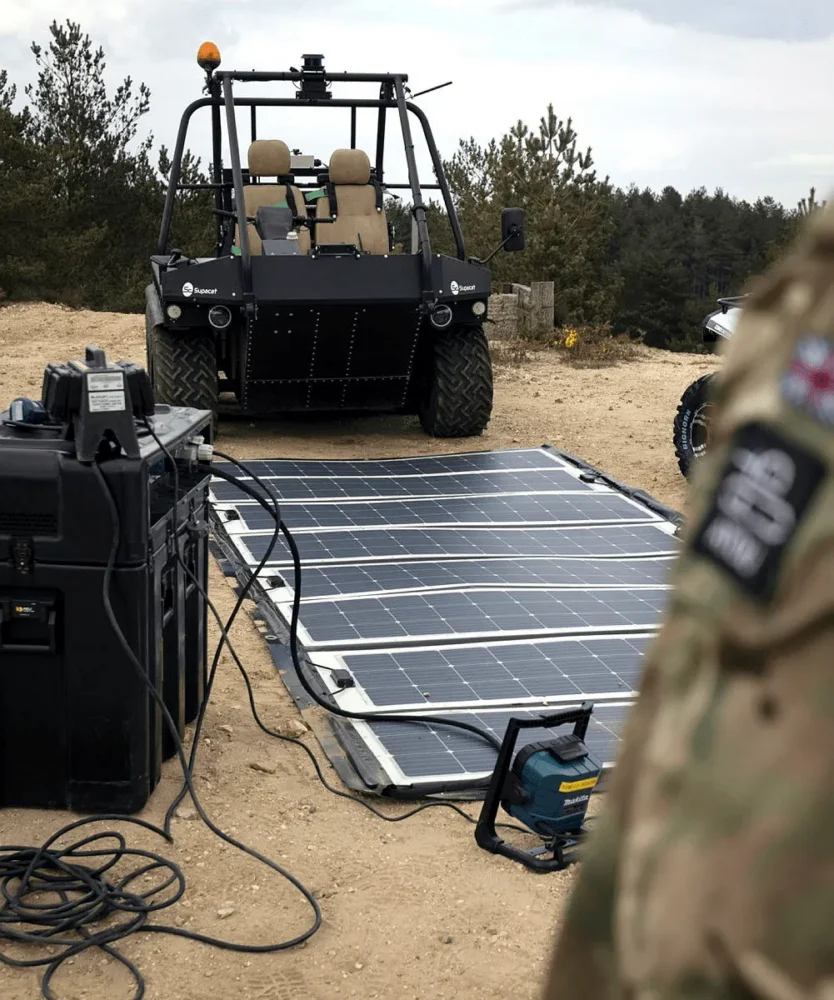
Click here for more information on KTPs at the University of Exeter.
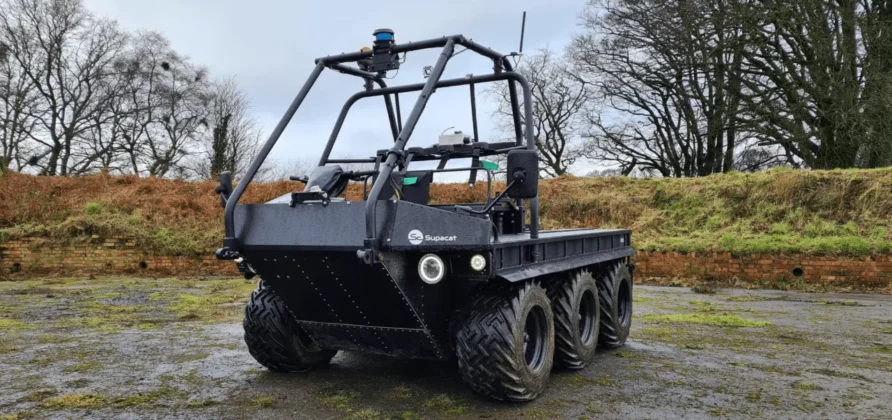
Because the focus for ATMP was air manoeuvre and logistics, a great deal of thought was put into cargo handling ad weight/dimensional compatibility with in-service aircraft.
Towing and Load Handling
With a drawbar pull of 2.1 tonnes, ATMP has an impressive towing capacity.

In addition to clearing landing sites, the ATMP was also used for towing the L118 105 mm Light Gun complete with ammunition trailer, total carried and towed payload being exceeding 3,500 kg.
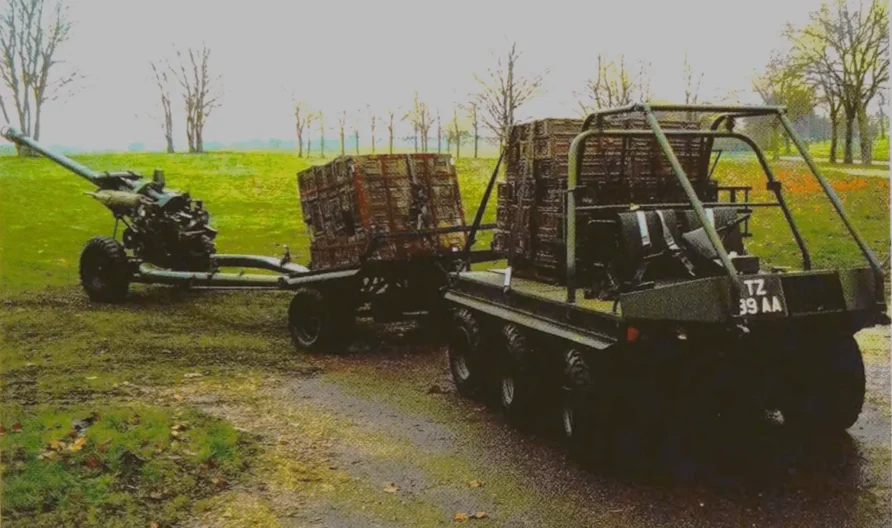
ATMP can tow a standard 3/4 Tonne Land Rover trailer

An ATMP-specific GS-type trailer fitted with the same tyres was also available.
To increase carrying capacity and flexibility, a pair of specially developed trailers were also introduced…
- FLPT (Fork Lift Pallet Trailer)
- SLLPT (Self-Loading Lightweight Pallet Trailer).
Although there are several variations, the basic trailer had a hydraulic tipping mechanism and pallet forks.

The driver would simply tilt the trailer into the down position, reverse onto the pallet, tilt the trailer back up, and drive away.

The maximum payload for the ‘flipit’ trailer was 1,400 kg, and it could also be converted to carry three stretchers.

Demountable corner posts could also be used to form sides for loose loads, with ratchet straps used to secure the load.

A 910 Litre Water Carriage Pack (WCP) was also available.
The conversion took only a few minutes and the posts were carried on the trailer.
Both of these are unique, no other military all-terrain vehicle has this, loads have to be manually broken down or some form of external handling equipment or loaders used, as the image of Springer below shows well

It’s the little things.
The stowable ramps and winch could be used to haul loads onto the load deck.


Hydraulic lifting jibs were fitted to the Canadian export models for use by their Disaster Assistance Relief Team (DART)
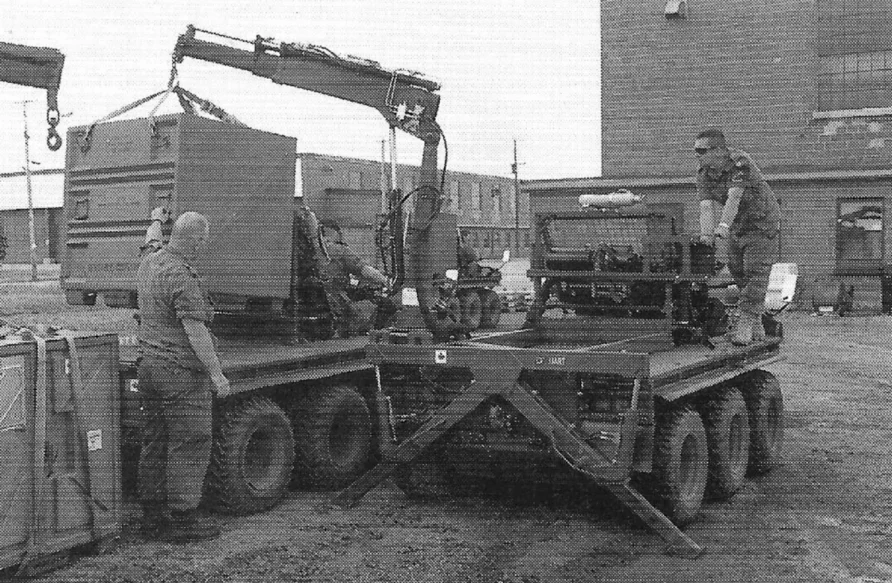
Other users have also fitted similar equipment, able to lift a tonne at 2m outreach.

Although a civilian conversion, there is even a tipping load bed available.


Transportability and Deployability
The stowable ramps could also be used for short gap crossing, although Vickers Defence did create an MLC30 Short Gap Crossing systems that could be carried by ATMP.
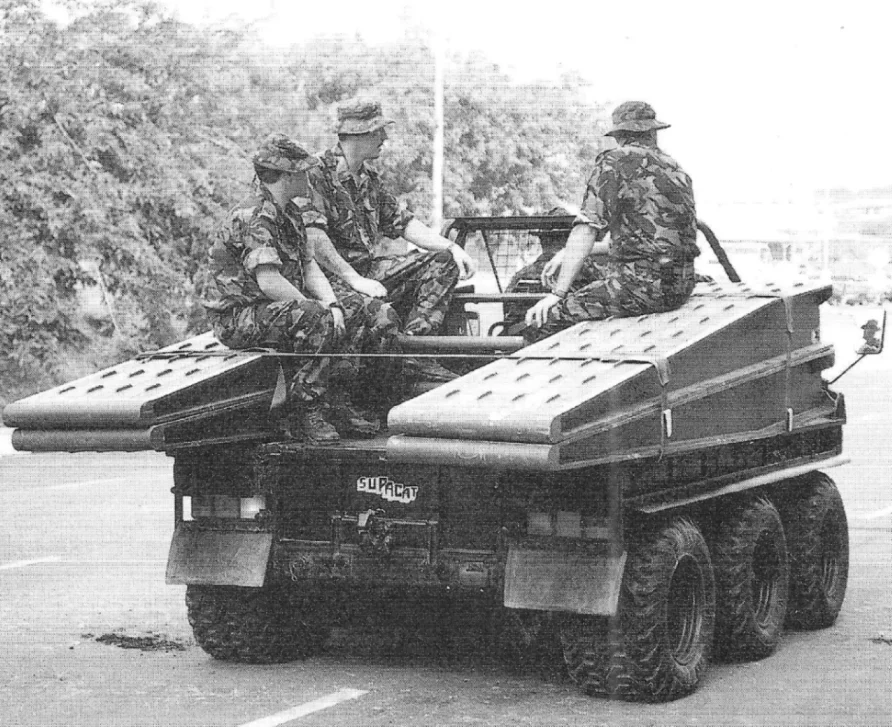
The total weight was 710 kg but no single piece was heavier than 140 kg, the overall length was 5.2m, the maximum gap that could be spanned being 4m.
The bridge could be emplaced by a team of six in less than 15m.
Air portability was a key requirement
Between 1992 and 1993, ATMP was authorised for Medium Stressed Platform use, either two vehicles or one vehicle and a 105 mm Light Gun or trailer.
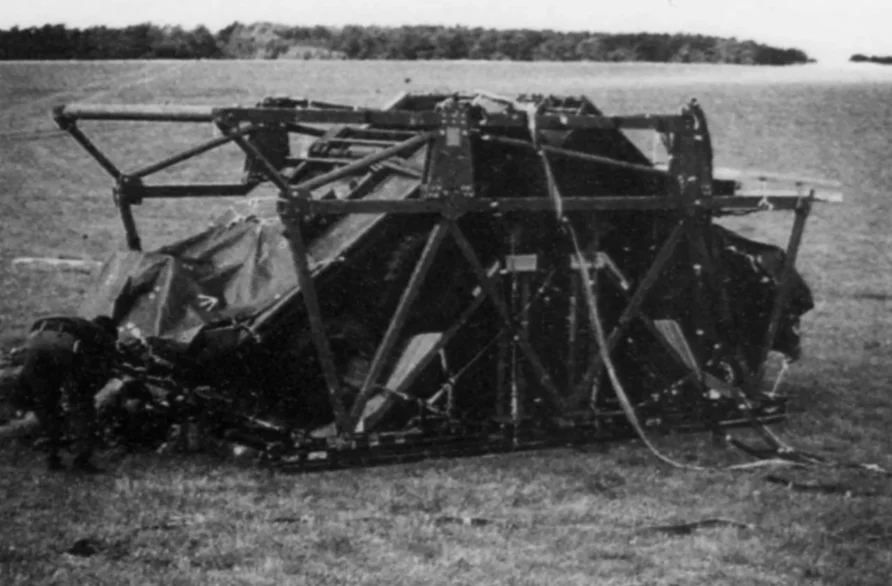

An Air Mobile Infantry Battalion would typically be scaled for 15 ATMP.
They could be carried by various helicopters as a sling or netted load.

Given the length of time that ATMP was in service, all necessary Joint Air Transport Establishment (JATE) clearances were obtained.
Chinook can carry four ATMP as an underslung load, two on the front hook and two on the rear hook, rigged as pairs. Sea King, Puma, Merlin, and even Blackhawk carriage schemes were approved.


Merlin and Chinook internal carriage were also certified.


Multiple stacking options also exist for carriage in larger aircraft such as the C130 and C17 on 463L pallets.
These stacking options also facilitated efficient vehicle transport.

It can even be moved by a forklift or telehandlers.

Specialist Versions
A fire tender version was produced.

The final ATMP version of relevance is the GKN FuelCat.
This was a system designed to support Forward Arming and Refuelling Point (FARP) operations for helicopters and fixed-wing aircraft.
One vehicle contains a generator, pumping equipment and fuel tank, and the other, a crane and trailer for another fuel container and pipelines.

GKN make the Air Portable Fuel Containers, currently in service in the Mk5 guise. The balloon-like, Kevlar-reinforced, containers, can hold up to two tonnes of fuel.

When full, the containers are 1.37m in diameter and can be towed, slung load under various helicopters and parachuted from tactical transport aircraft.

Between the two vehicles, they can carry 4,000 litres of fuel, pump it to multiple aircraft simultaneously, and provide aircraft towing and a gas turbine starting rig.

Summary
It is hard not to be impressed by the Supacat ATMP and yet, it is a good example of the British Army’s somewhat poor capability husbandry.
By not making timely investments in support and development, it had to resort to asking industry for an alternative when it was most needed because the OEM was busy with other things. Springer was a multi-million Pound mistake when a fraction of that money invested on a more timely basis would have prevented the waste.
The British Army has also invested considerable sums of time and money investigating alternative, mostly non-UK, vehicles. For exactly the role it invested in ATMP, the Robotic Platoon Vehicle (RPV) and more recently, the Low Technology Mobility Platform — Light and Low Technology Mobility Platform — Medium.
£4.5 million for the former and £2.5 million for the latter, perhaps these will include ATMP?
Over the years, they have seen service with airborne forces, the Royal Artillery, Royal Air Force and Royal Marines, and with the MoD on range duties.
It is mature, flexible, adaptable, strategically and tactically deployable, and extremely capable, and now right up to date with electric and autonomy features.

Whilst 6×6 and 8×8 high mobility vehicles are common enough, none have the military heritage of the ATMP or have design features so well suited to practical load handling and transportation optimisation.
As I said above, it is the little things, that few notice, that make the difference, payload, load handling and transportability.
Nothing else comes close.

You might find this interesting. I gave up looking for your article on quads and ATV's.
https://www.youtube.com/watch?v=Me-Ayh-7whY
Your search facility is crap BTW.