
 Doc Summary

The Reynolds Boughton RB44 was a British Army multipurpose 4×4 light utility truck manufactured by Reynolds Boughton.
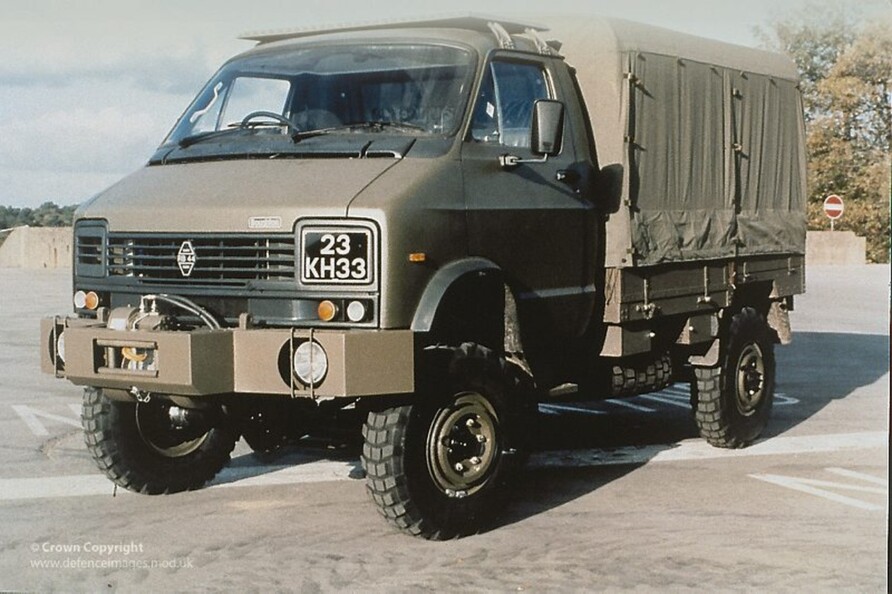
It was withdrawn in 2010.
RB44 History #
The Land Rover 101 Forward Control (One Tonne Land Rover) was developed in the late 1960s and entered service with the British Army in 1975.
It had permanent four-wheel drive with vacuum-operated differential locks, a 101-inch (2.56m) wheelbase, and a forward-control cab layout to optimise load space within a 13 ft 6 in (4.12m) overall length.
With a 1-tonne payload and towing capacity up to 2.5 tonnes, it served in multiple roles, such as a tractor for the L118 105 mm Light Gun, ambulance, command vehicle, and general purpose utility vehicle.
A replacement for the 1 tonne Land Rover, the RB44 was manufactured by Reynolds Boughton, leveraging the chassis and cab of the Dodge 50 Series, a light commercial vehicle produced in the UK by Chrysler Europe and later Renault Véhicules Industriels between 1979.
The procurement process began in June 1988, with a contract worth £25 million placed with Reynolds Boughton for 846 RB44 vehicles.
The RB44’s service history was marked by significant challenges, particularly with its braking system.
The design was accepted in May 1990 after mandated changes costing £940,000, primarily addressing transmission and braking efficiency.
Deliveries were suspended in September 1992 after further issues, and by August 1993, 37 out of 57 in-service vehicles deviated left when braking at 35 mph (ca. 56 km/h), prompting a full withdrawal in December 1993.
Rectification efforts were substantial, with Reynolds Boughton incurring costs of £250,000 between January 1994 and September 1995, while the MoD faced £1.5 million in total costs, excluding additional storage costs of £1.7 million.
It should be noted that because the Ministry of Defence (MoD) accepted the vehicle into service, liability for rectification was split between it and Reynolds Boughton.
This ‘fix’ was complex because the issue was rooted in a combination of factors: the permanent four-wheel-drive system, the massive rotating mass of the Perkins Phaser engine, and the unequal lengths of the front half-shafts, which created a ‘torque steer’ effect under heavy braking.
The specific mechanical adjustments involved upgrading the dual-circuit, vacuum-servo-assisted drum brakes and addressing the inconsistencies in the hydraulic actuation.
A Parliamentary question in December 1995 revealed more details on its issues.
Dr. David Clark: To ask the Secretary of State for Defence on what date his Department withdrew from service the RB44 Army light vehicle; and on what date his Department was first alerted to the problems with braking mechanisms of the RB44.
Mr. Arbuthnot: The issue of braking first arose during trials in 1989, but the shortcomings were addressed before the production contract was placed in 1990. The vehicles were temporarily withdrawn from service in June 1992 following problems with braking performance reported by the Royal School of Artillery in May 1992; after modifications, they were restored to service in November 1992. Following the results of further testing under stringent conditions in August 1993, the vehicles were withdrawn from service in December 1993, but were accepted again for service in August 1995.
These persistent issues with the RB44 led to its eventual replacement by other vehicles.
RB44 was withdrawn from service in 2010, leaving the Land Rover and Pinzgauer vehicles remaining, joined by a Mowag Duro for specialised roles and in a similar weight class.
The original Truck Utility Heavy (TUH) Defender XD was dropped in favour of the RB44, but after this was withdrawn, the Pinzgauer was used in its place.
RB44 Capabilities #
RB44 was officially called the Truck Utility Heavy RB44.
The RB44 was based on the chassis of the Dodge 50 Series, which was later rebranded as the Renault 50 Series following changes in ownership.
| Feature | Specification |
| Engine Type | Perkins Phaser diesel |
| Power Output | 80 kW (107 hp), likely four-cylinder, though six-cylinder possible |
| Transmission | Chrysler Torqueflite A727 three-speed automatic |
| Top Speed | 95 km/h (58 mph) |
| 0-80 km/h Acceleration Time | 61.5 seconds |
| Noise Levels (Cab) | 74–78 dB(A), depending on terrain |
Towing capacity was reported to be 2.5 tonnes, with a payload of 2.5 tonnes, or twelve personnel on simple bench seats.
If you found value in this article, help me keep Think Defence going.
Think Defence is a hobby, a serious hobby, but a hobby nonetheless. I have removed those annoying adverts, but hosting fees, software subscriptions and other services add up.
To help me keep the show on the road, I ask that you support the site in any way you can. It is hugely appreciated.
You can click on an affiliate link, Buy Me a Coffee at https://ko-fi.com/thinkdefence, download an e-book at https://payhip.com/thinkdefence or even get some TD merch at https://www.redbubble.com/people/source360/
Youtubers, if you are going to lift content from here, the decent thing to do would credit me


