
ESARCO vehicles were innovative high-mobility all-terrain vehicles developed in the UK in the 1980s.
The unusual ESARCO vehicles were developed by Major Michael Somerton-Rayner as a private initiative in response to lessons identified by the British Army in the 1982 Falklands Conflict, namely, the need for lightweight high mobility load carriage for infantry units.
Using simple construction, the designs utilised off the shelf Land Rover components to produce a range of high mobility vehicles that included the following variants
- ESARCO 8×8
- ESARCO 6×6
- SS300
- HUGO
None saw widespread use.
Table of Contents
ESARCO 8×8 Variant
The Esarco 8×8 was developed by Major Michael Somerton-Rayner (Esarco Ltd of Ludgershall, Wiltshire) as an ultra-high-mobility tactical load carrier. Designed around standard, readily available Land Rover One-Ten running gear, the chassis was engineered to deliver extreme cross-country mobility and low ground pressure across peat, bog, and soft sand without requiring specialised tracks.
Initial development explored multi-wheel amphibious concepts capable of swimming with minimal preparation.

As trials progressed, the concept shifted to a more rugged, conventional utility platform capable of wading to 800 mm, traversing a 1.0 m trench gap, and travelling at up to 60 mph (100 km/h) on roads. The production-standard Esarco 8×8 made its public debut at the British Army Equipment Exhibition (BAEE) in Aldershot in June 1984. By July 1985, Esarco Ltd had concluded a manufacturing agreement with specialist bodybuilder Marshalls of Cambridge, who established capacity to assemble up to 300 vehicles per year commencing in 1986.
The vehicle was built around a high-strength mild steel box-section chassis frame with four substantial crossmembers supporting the suspension, drivetrain, and powertrain:
- Split-Transfer Drivetrain: Powered by an 85 kW (114 hp) 3.5-litre Rover V8 petrol engine paired with a Land Rover 5-speed manual synchromesh gearbox. Power distribution was handled via two transfer cases. The primary transfer box was bolted directly to the main gearbox, driving Axle 1 (front) and Axle 3. A secondary PTO-style shaft exited the rear of the main gearbox to drive a second transfer box powering Axles 2 and 4. In road mode, the secondary transfer case was uncoupled to run as an 8×4 (driving Axles 1 and 3), while all-wheel 8×8 drive and inter-axle differential locks could be engaged on the move via a single lever.
- Four-Wheel Steering: To eliminate the severe tyre scrub typical of multi-axle rigid vehicles, both the front axle (Axle 1) and rearmost axle (Axle 4) were steered in counter-phase using standard Land Rover hydraulic power assistance. This gave the 4.5 m vehicle a remarkably compact 9.1 m (30 ft) turning circle.
- Suspension & Braking: All four live axles were suspended on long-travel coil springs located by radius arms and Panhard rods, providing 215 mm (8.5 in) of ground clearance. Brakes were Land Rover hydraulic units—discs on the steered axles (Axles 1 and 4) and drums on the centre fixed axles (Axles 2 and 3)—with a transmission park brake on the front transfer case.
- Engine Options: In addition to the standard Rover V8, a 124 kW (168 hp) Italian VM Motori turbocharged diesel was offered as the heavy-duty option, with Perkins Phaser four-cylinder diesels adopted on later development models.
- Weights & Pressures: The 8×8 had a Gross Vehicle Weight (GVW) of 4.47 tonnes, an unladen kerb weight of approximately 2.47 tonnes, and a nominal payload rating of 2.0 tonnes (or up to 2.5 tonnes with a reinforced crew cab). Fitted with fat, low-profile 31×15.50-15STG high-flotation tyres, ground pressure was just 4.4 psi unladen and 7.8 psi (54 kPa) at maximum payload.
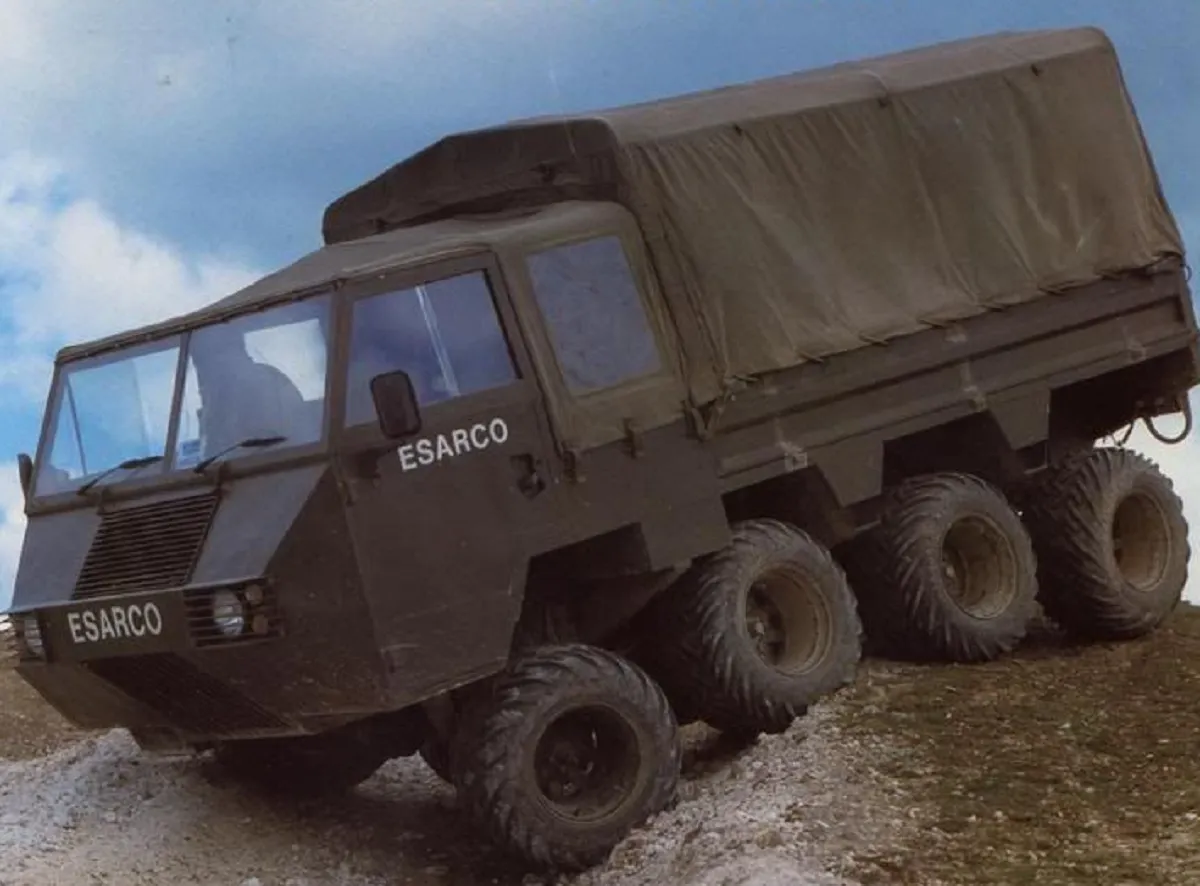
The load bed measured 3.0 m long by 1.9 m wide—specifically dimensioned to carry two standard NATO pallets with drop sides and a canvas tilt. Cross-country operational range was 240 miles (386 km) at an average of 10 mpg.
Tactical air transportability was a central design driver. With the soft-top cab folded flat, overall height dropped from 2.6 m to just 1.33 m:
- A Boeing CH-47 Chinook could transport two vehicles internally within its cargo hold, or carry two as an underslung load.
- A Lockheed C-130 Hercules could carry up to eight vehicles internally, and the platform was fully stressed for low-velocity parachute airdrop

The load bed and 4-tonne towing capacity made the 8×8 an effective artillery limber. In the 105 mm Light Gun tractor role, it could tow the L118, transport a gun detachment of three personnel in the cab, and carry two full NATO pallets of 105 mm ammunition on the cargo deck, with companion vehicles acting as high-capacity ammunition carriers.

Additional vehicles could carry more ammunition.

A specialist crash-rescue and airfield fire protection variant was also developed. This model was equipped with a 1,000-litre pre-mixed foam tank, high-pressure pumping gear, a 25 m hose reel, and rescue tools. The monitor could discharge 500 litres of foam per minute with an effective throw distance of 25 metres.

For air defence, Esarco proposed a lightweight self-propelled anti-aircraft variant mounting a single 20 mm Oerlikon automatic cannon with 2,000 ready rounds. Retractable hydraulic outriggers were incorporated into the chassis to stabilize the platform during sustained automatic fire.

The most ambitious military application was a wider, heavy-duty 8×8 variant developed to transport the towed Rapier Field Standard B (FSB) surface-to-air missile system:
- Vehicle 1: Carried 21 Rapier reload missiles and towed the missile launcher / optical tracker unit.
- Vehicle 2: Transported the detachment generator, operational support gear, and towed the Blindfire tracking radar trailer.
A complete four-missile Rapier fire unit comprising both Esarco vehicles, trailers, and reloads could be airlifted in a single C-130 sortie.


Esarco produced design studies for a wide family of additional variants, including forward battlefield ambulances, electronic warfare and radio relay shelters, command posts, recovery winches, and cargo tankers, though few progressed beyond drawings before the company entered receivership.


ESARCO 6×6 Variant
A smaller 6×6 version was developed after the 8×8, in response to the MoD requirement that would eventually be met by the Supacat ATMP.

It was, essentially, a smaller and lighter version of the 8×8.

This version did actually enter service with the Portuguese Paratroop Regiment.

In 1988, the ESARCO 6×6 was evaluated by the Singapore Army for use as an artillery tractor. Trials included different terrain, where it was said to have performed very well.
The image below shows it on the test area (towing a Light Gun) with a Humvee and Supacat ATMP behind it.

It was also tested for air mobility using an RSAF Puma.

Singapore eventually selected Land Rover and Unimog vehicles.
Stewart and Stevenson SS300 Variant
The US company, Stewart and Stevenson, subsequently developed the vehicle under licence, called the SS300.
Only a handful were produced.
Heavy Use Global Operation (HUGO) Variant
In the UK, the MWG group also purchased the design rights and developed the vehicle further into the Heavy Use Global Operation (HUGO) All-Terrain Vehicle.
The Hugo 8×8 could carry a payload weighing 2 Tonnes, had a crew cab and diesel engine.

Both were said to be highly mobile, yet very stable.

The first, and only, production model, entered service with Oil Spill Response.

Comparison Table
| Variant | Length (m) | Width (m) | Height (m) | Payload (tonnes) | Top Speed (mph) | Kerb Weight (tonnes) |
|---|---|---|---|---|---|---|
| Esarco 6×6 | 3.86 | 2.0 | 1.61 (to steering wheel) | 1.25 | 60 | 1.376 |
| Esarco 8×8 | 4.5 | 2.0 | 1.33 (cab folded) / 2.6 (erected) | 2.5 | 60 | ~2.46 (CMV data) |
| SS300 | 5.59 | 2.31 | 2.36 | 2.27 | 60 | 4.04 |
| HUGO | 5.37 | 2.2 | 2.36 (cab) | 2.0 | ~60 (est.) | 3.55 |
Restorations
In May 2021, restorers succeeded in starting one of the few surviving UK barn-find examples after 25 years in storage:
Nick Steggel documented a walkaround and running demonstration of another surviving operational vehicle:
Sources & Further Reading
Jane's Military Vehicles and Logistics (1990–1991)
Contains contemporary manufacturer specifications, chassis schematics, and trials data for the Esarco 6×6, 8×8, and Stewart & Stevenson SS300.
Military Land Rover: 1948 Onwards (Series I–III, Defender, 'Wolf')
Authoritative guide to the Rover V8 drivetrains, Stage 1 axles, and transfer cases adapted by Major Somerton-Rayner for the Esarco chassis.
Special Forces Vehicles
Contextual study of post-Falklands lightweight tactical mobility requirements, airborne load carriers, and the competition that led to the Supacat ATMP.
