
The ARTEC Boxer is fielded in a large family of mission-module variants, and in a smaller number of versions that also require a modified drive module. This article describes those modules and national versions, with the British Army fleet set out in detail at the end.

Boxer is produced by ARTEC GmbH (ARmoured vehicle TEChnology), a joint venture of KNDS Deutschland and Rheinmetall Landsysteme, under the overall management of the Organisation for Joint Armament Cooperation (OCCAR).
Table of Contents
Most United Kingdom vehicles are built in Britain, at Rheinmetall BAE Systems Land (RBSL) in Telford and KNDS UK in Stockport, after an initial batch of 117 from German production lines. The first two UK vehicles were delivered in December 2023. 1st Battalion The Royal Regiment of Fusiliers, of the 20th Armoured Infantry Brigade Combat Team, is the first British Army unit to receive Boxer. On 25 June 2026, Defence Equipment and Support announced that the 100th Boxer Mechanised Infantry Vehicle had been delivered to the Ministry of Defence.
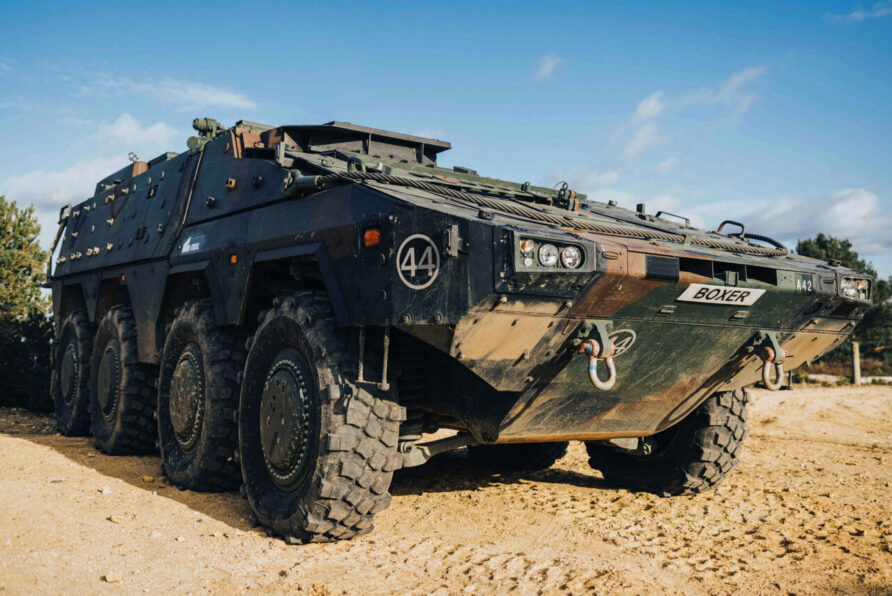
The British programmes that led to this purchase, the Multi Role Armoured Vehicle (MRAV), Future Rapid Effects System (FRES) and Mechanised Infantry Vehicle (MIV), are described in their own documents. The drive module, protection, mobility and automotive description is in the Boxer vehicle details document.
Boxer Variants In Service and Proposed
The table below summarises Boxer variants in service, on contract or publicly planned with customer nations. Status and quantities change as orders are placed or cancelled. ARTEC’s March 2025 brochure listed more than 1,700 vehicles ordered for Germany, the Netherlands, Lithuania, the United Kingdom, Australia and Ukraine.
| Nation | Variant | Status | Details |
|---|---|---|---|
| Germany | APC / Group Transport Vehicle (GTF) | In service / Upgrades ongoing | Basic infantry carrier for up to 11 personnel; modular armour up to STANAG 4569 Level 4; remote weapon station (RWS) with 12.7mm MG or 40mm grenade launcher. A0-A2 configurations. |
| Germany | Command Post Vehicle (CPV) | In service / Upgrades ongoing | Equipped with enhanced communications and battle management systems for command and control. |
| Germany | Ambulance | In service / Additional deliveries | Medical evacuation variant with capacity for 3 litter patients or 7 seated; upgraded fleet for improved battlefield support. |
| Germany | Driver Training Vehicle | In service | Dual-control configuration for operator training. |
| Germany | Joint Fire Support Team (JFST) / Artillery Observer | In service | Equipped with advanced sensors for fire direction and targeting; series production from 2026-2028. |
| Germany | Skyranger 30 (Air Defence) | Planned (deliveries 2026+) | Hybrid turret with 30mm cannon, missiles, and sensors for short-range air defence. |
| Germany | Combat Reconnaissance Vehicle (CRV)-based | Planned (deliveries 2025-2030) | Adapted from Australian CRV; likely reconnaissance with Lance 30mm turret. |
| Germany | RCH-155 (Self-Propelled Howitzer) | Planned (3 prototypes + 80 production + 149 additional; deliveries 2026+) | Wheeled artillery with 155mm gun; fire-on-the-move capability up to 40+ km range. |
| Germany | Schakal IFV | Planned (deliveries 2027-2031) | IFV with 30mm turret (likely RCT30 or Lance); co-developed with Netherlands. |
| Germany | Total (across 8+ variants) | In service / Expanding | Additional engines (350 mtu Series 199) ordered for new vehicles; total programme value exceeds €10bn. |
| Netherlands | Engineer Group Vehicle / Pioneer | In service | Supports engineering tasks with tools for obstacle clearance and EOD. |
| Netherlands | Command Post Vehicle (CPV) | In service | Similar to German variant; enhanced C4I systems. |
| Netherlands | Cargo Carrier | In service | Logistics transport with modular cargo bay. |
| Netherlands | Ambulance | In service | Medical variant. |
| Netherlands | Driver Training Vehicle | In service | Training configuration. |
| Netherlands | Schakal IFV | Planned (deliveries 2027+) | IFV variant with 30mm turret; joint procurement with Germany. |
| Netherlands | Total (across 5+ variants) | In service / Expanding | Interoperable with German and Lithuanian fleets; common drive module. |
| Australia | Combat Reconnaissance Vehicle (CRV) – Turreted Reconnaissance | In service | Lance 30mm turret; surveillance and fire support. |
| Australia | Multifunction (Command, Surveillance, Ambulance, Repair, Recovery) | In service | Various support roles; modular adaptations. |
| Australia | Total (across 8 variants) | In service | Part of Land 400 Phase 2; local production elements. |
| United Kingdom | Infantry Carrier | On contract / deliveries underway | 146 vehicles contracted under the Mechanised Infantry Boxer Programme (written answer, 18 December 2025). |
| United Kingdom | Specialist Carrier | On contract / deliveries underway | 200 vehicles contracted. |
| United Kingdom | Command | On contract / deliveries underway | 212 vehicles contracted. |
| United Kingdom | Ambulance | On contract / deliveries underway | 65 vehicles contracted. |
| United Kingdom | RCH 155 | On contract | 72 Remote Controlled Howitzer systems, announced on 13 May 2026, valued at nearly £1 billion including training and in-service support. First deliveries expected in 2028. Built at Telford (gun) and Stockport (drive module). |
| United Kingdom | Armoured Mortar, Repair and Recovery, Mounted Close Combat Overwatch | No longer being pursued | No longer being pursued in the Mechanised Infantry Vehicle programme, as confirmed in a written answer on 14 October 2026, as part of Military Strategic Headquarters reprioritisation. |
| United Kingdom | Total | 623 MIV plus 72 RCH 155 | MIV order unchanged as of 27 October 2026, with over 500 of the 623 built in the UK. First two vehicles delivered in December 2023; 100th MIV delivered on 25 June 2026. Production at RBSL Telford and KNDS UK Stockport. |
| Lithuania | Vilkas IFV | In service | Samson Mk2 turret with 30mm cannon and Spike LR missiles. |
| Lithuania | Command Vehicle | In service | Command configuration. |
| Lithuania | Driver Training Vehicle | In service | Training variant. |
| Lithuania | Prototypes / Other Support | In service | Including additional command or support roles. |
| Lithuania | Total (across 5 variants) | In service | Interoperable with German/Dutch fleets. |
| Ukraine | Vehicles ordered | On order (ARTEC, beginning of 2025) | Listed by ARTEC among the six customer nations with vehicles ordered. A public, official breakdown by variant was not confirmed for this review. |
| Qatar | Not listed by ARTEC | Not confirmed | ARTEC’s March 2025 brochure did not list Qatar among the six customer nations with vehicles on order. |
| Portugal | APC | Planned (deliveries 2026-2030) | Troop carrier for medium brigade; via EU SAFE programme. |
In addition to the vehicles in the table, numerous other variants have been proposed.
| Proposer | Variant | Status | Details | Potential Users |
|---|---|---|---|---|
| Rheinmetall / ARTEC | Heavy Weapon Carrier | Proposed | Anti-tank focus with missile launchers; modular for rapid integration. | Germany, Netherlands |
| Rheinmetall / KNDS | Boxer Tracked | Demonstrator | Tracked version for enhanced mobility in soft terrain; hybrid power pack option with MTU mt 881 CR engine; potential for IFV or MBT support. | India (FICV/AFV-LT), general export |
| KNDS / Krauss-Maffei Wegmann | Boxer UAV Carrier | Demonstrator | Mothership for reconnaissance UAVs; carries 3 long-range and 10+ small drones; 3-man crew; integrated with Milrem Type-X RCV wingman. | Germany, NATO partners |
| Rheinmetall / EOS | Directed Energy Weapon (T2000-DE) | Proposed | Turret with laser for counter-UAS and loitering munitions; addresses escalating drone threats. | Australia (Land 400 Phase 3), general |
| Rheinmetall / Kongsberg | Anti-Drone (Counter-UAS) | Proposed / Delayed | 40mm grenades via RWS for micro-UAS; supply chain issues delayed roll-out to 2024; RF sensors for detection. | Germany |
| ARTEC / OCCAR | Bridgelayer | Proposed | Engineering variant for gap crossing; MLC100 bridge capability; complements TITAN. | United Kingdom, Germany |
| Rheinmetall / Patria | Mortar Carrier (Nemo 120mm) | Proposed | Turreted mortar for indirect fire; competes with Patria 6×6 CAVS alternative. | United Kingdom, Germany |
| Rheinmetall / KNDS | SHORAD (Multi-Variant) | Proposed | Three configurations: 35mm counter-small gun (C-SAT), STARStreak/LMM missiles, C2/sensor with Giraffe 1X radar. | United Kingdom, Germany |
| Rheinmetall / Hensoldt | EW Jammer | Proposed | Electronic warfare for jamming; co-developed with Netherlands. | Germany, Netherlands |
| Rheinmetall / KNDS | RCT30 IFV | Proposed | 30 mm turret (RCT 30). A public, official confirmation of donated vehicles in service was not available for this review. | Ukraine, Germany |
| Rheinmetall / KNDS | Schwerer Waffenträger | Trials / Delayed | Heavy fire support with Lance Mk2 turret and 30mm cannon; trials ongoing, production delayed for issue resolution; alternative to wider RCT30 IFV adoption. | Germany |
| Rheinmetall / MARSS | UAV Countermeasures | Proposed | Perimeter radars and interceptor containers for anti-drone operations. | General export |
Some of those proposals are shown in the second table, and in the sections below.
Boxer Module Variants
Boxer has been improved and modified to the current A2 configuration and several module variants are in service, in development or proposed.
Driver Training
Germany and the Netherlands share a common driver training module, but Lithuania has a slightly separate design for this role (shown below).

The module provides space for an instructor with all-around vision and the ability to bring the vehicle to a halt quickly.

Two passenger seats are also provided for additional trainees and other personnel.

Armoured Personnel Carrier
The most common armoured personnel carrier module has blast-protected seating for the commander, gunner and eight dismounted personnel.

The commander and gunner are provided with vision systems and three additional hatches for the dismounted personnel.
Command and control systems, equipment charging and storage support extended-duration missions, the German configuration, for example, has enough stores for a 10-day mission.


Dutch vehicles are fitted with the Kongsberg M151 Remote Weapon System, mounting a 12.7 mm Heavy Machine Gun.

German vehicles have the KMW FLW-200 Remote Weapon System that can also mount a 12.7 mm HMG, 7.62 mm GMP or 40 mm GMG. Later revisions mount this on an extended height ring to allow greater depression.

The 400 kg FLW-200+ has also been shown with a 20 mm automatic cannon. A slightly heavier variant called the FLW-500 can be fitted with the ATK/Alliant 30 mm M230-LF and use the same ammunition as the Apache attack helicopter.
Australian Block 2 vehicles will be fitted with the EOS R400 HD Mk2 RWS, although the final selection of weapon seems likely to be a 12.7 mm HMG

Seating has also been improved over the years, focussing on blast attenuation following experience in Afghanistan, situational awareness cameras have also been added.

Personnel can also be provided with a range of creature comforts, from integral toilets to the ubiquitous boiling vessel (or ration heater), depending on the customer’s optional equipment fit.


Infantry Fighting Vehicle/Cavalry
The Lithuanian ‘Vilkas’ variant of Boxer uses a Rafael 1.5 tonne Samson Mk II RWS

The Samson is fitted with a 30 mm Bushmaster cannon and Spike missiles. The commander and gunner have separate sights (daylight and thermal imaging) and can operate in hunter-killer mode. The gun can also be unloaded from the inside.
Boxer was originally demonstrated with the RCT 30 unmanned turret as fitted to the German Puma infantry fighting vehicle. ARTEC still offers the RCT 30 as an infantry fighting vehicle module, with a stabilised MK30-2/ABM 30 mm cannon, a 7.62 mm coaxial machine gun and a Spike LR anti-tank missile launcher, and a crew of three plus up to seven dismounts. Germany and the Netherlands have also publicly associated a 30 mm Boxer infantry fighting vehicle, referred to as Schakal, with later delivery planning.

Lithuania has ordered 88 vehicles in total, 82 in IFV, 2 Driver Training and 4 Command variants. The total contract value for the Lithuanian vehicles is 386 million Euros, or roughly £3.9m each, with KMW making 53 and Rheinmetall, the remainder.
The Australian CRV uses a Lance modular manned turret with a dual belt-fed Rheinmetall 30 mm MK-30/2 ABM automatic cannon and 7.62 mm GPMG. It also has an RWS with a 7.62 mm weapon. The main gun can use programmable ammunition.
With the manned turret, the dismounted personnel seats are reduced to four. The Australian CRV uses larger 27″ Michelin XML tyres and various other changes, reflecting both national requirements and the availability of modern systems when compared to the original design, fabric air conditioning ducting and improved exhaust management in dusty terrain for example.
Block II CRVs are planned to be fitted with turret-mounted Spike LR2 ATGW.
A number of other turrets and RWS have been proposed and demonstrated on Boxer.

Including with Javelin missiles.
Boxer has also been shown with Kongsberg RT60 remote turret.
The RT-60 mounts a 30×173 mm Bushmaster XM813 cannon, coaxial 7.62×51 mm MG, RWS with 12.7×99 mm HMG and a twin retractable ATGM launcher (with Javelin, MMP or Spike ER)

John Cockerill has also integrated its 3105 turret with a Boxer module.


At the same time as unveiling the Boxer Tracked Drive Module, KMW showed it off with their RCT120 turret.

Ambulance
Both Germany and the Netherlands have different ambulance variants.

The higher roof provides 17.5 m³ of protected volume and a floor-to-roof height of 1.85m.
Whilst the layouts and equipment fits differ, their flexibility allows combinations of 7 seated casualties, 3 stretcher casualties, 2 stretchers and 3 seated casualties or 1 stretcher casualty accessible from both sides and above.


Command
The two command post variants are specific to Germany and the Netherlands, each configured with country-specific communication and other electronic systems.

In addition to the vehicle commander and driver, there is accommodation for three command personnel.


The German version has a roof-mounted manually operated jib used to load and unload tentage.
Engineering and Cargo
The Cargo variant can carry two 1-tonne pallets with full protection and a cargo floor system that includes a movement and stowage system.


Derived from the Cargo variant, the Cargo/C2 variant has a flexible interior that can be used for command functions (with seating for 3 extra passengers, cargo transport for one and a half tonnes of cargo or casualty transport with a NATO stretcher and casualty.
The Armoured Engineer Group vehicle has a crew of two and carries six combat engineers for mining, demining, and related activities, including their stores, some of which are carried on the roof in specialist racking.
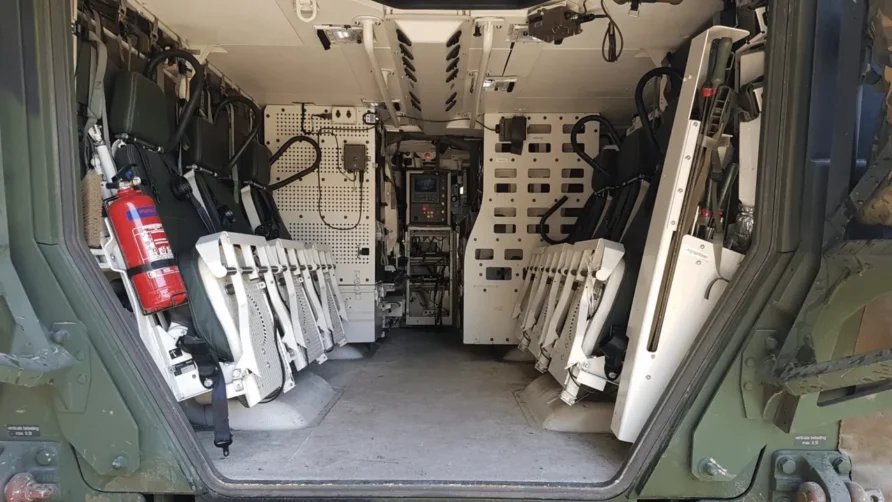
A Battle Damage Repair variant has seating for the commander/driver and two engineering personnel, stores and equipment to effect forward repairs.

Pearson Engineering has also released many concept images for fitting Boxer with various attachments for lane marking, route proving and mine clearance.


Pearson Engineering have also shown Boxer with their Bridge Launch Mechanism for conventional assault bridges that does not need the hull modification used in the drive module bridging variant shown below.

Recovery
Flensburger Fahrzeugbau Gesellschaft mbH (FFG) has produced an armoured recovery module for Boxer, equipped with both a straight pull winch and slewing crane.

The module weighs approximately 13 tonnes and has seating for two (commander and gunner, it is assumed an RWS of some sort will be specified by the customer).
The recovery equipment can be used independently of the drive module, as an integral battery powers the hydraulic system.
The capstan winch has a straight pull of 20 tonnes and is fitted with 60m of Kevlar-reinforced rope. The boom crane is 5.3m long and has a lifting capacity of 20 tonnes, enough to complete a pack or module change, both can be operated remotely from outside the vehicle.

The module also contains various pneumatic and other hand tools. When the crane slews sideways, outriggers can be deployed, retracting into the module in the stowed position.
The British Army assessed the FFG Armoured Recovery Module as an option for a Boxer repair and recovery capability, but is no longer pursuing a Boxer Repair and Recovery variant. In a written answer on 14 October 2026, Luke Pollard said:
Ben Obese-Jecty MP
To ask the Secretary of State for Defence, with reference to the National Infrastructure and Service Transformation Authority Major Projects Annual Report 2025 to 2026, Tables, Mechanised Infantry Programme, what elements have been cut from the programme as part of the £1858.38 million funding removal and budget reprioritisation.
Luke Pollard MP, 14 October 2026
As part of reprioritisation within the Military Strategic Headquarters, the Armoured Mortar, Repair and Recovery and Mounted Close Combat Overwatch capabilities of the Mechanised Infantry Vehicle programme are no longer being pursued.
The Army is considering how the underlying capability requirements will be addressed.
On 26 October 2026 he added that the department had concluded a generic Heavy Wheeled Recovery Vehicle would provide greater utility and affordability across the force structure than the FFG module, alongside other assets used to support Boxer and other fleets. Until that project is delivered, recovery is provided by other Boxers (peer-to-peer), supplemented where required by the Support Vehicle (Recovery) and the Challenger Armoured Repair and Recovery Vehicle.
The Heavy Wheeled Recovery Vehicle project sits in the Materiel Distribution Land Programme and, as of 3 November 2026, was in its pre-concept phase, with the delivery timeline still being established. On 20 October 2026, Pollard said the Boxer Equipment Support variant is operated by Royal Electrical and Mechanical Engineers Light Aid Detachments to provide forward repair support to Boxer-equipped units.
Image Required: Boxer Equipment Support variant.
Mortar
RBSL has developed a mortar module, called Ragnarak, that can use a Rheinmetall 81 mm or 120 mm tube.


It was live-fired with 120 mm natures in 2022

A concept using the Patria Nemo turreted 120 mm mortar has also been modelled. ARTEC publishes data sheets for both a hatch mortar and a Nemo turreted mortar.
An Armoured Mortar variant of the British Mechanised Infantry Vehicle programme is no longer being pursued, as confirmed in the 14 October 2026 written answer quoted above. The Army is considering how the underlying mortar requirement will be addressed.


MLRS and Land Precision Strike
These only exist as illustrations, shown below.

Land Precision Strike is a UK-specific programme that may employ several effectors, not just GMLRS (not to be confused with Mounted Close Combat Overwatch (MCCO).

Weapon Locating and Joint Fires Surveillance
SAAB has shown an illustration of a Boxer module equipped with a combination of their ARTHUR weapon locating and Giraffe 3D radar systems.

Again, concept art is only at this stage.

Germany is planning a heavy Fire Support Team vehicle, a larger version of their Fennek. It is planned to be equipped with a Hensoldt BAA II surveillance system.
Australia has also planned a surveillance and joint fires variant, the Land 400 Close Combat Storyboard illustrates the requirement.

Mounted Close Combat Overwatch (MCCO)
In May 2021, the UK Defence Science and Technology Laboratory (DSTL) released details of the Army’s requirements for Battle Group Organic Anti-Armour (BGOAA). Briefly, it comprised;
- Close-In Self Defence (CISD): portable lightweight munitions carried by Infantry sections
- Mounted Close Combat Overwatch (MCCO): a long-range system providing anti-armour coverage to the battle group, with concepts carrying multiple missiles weighing up to 50 kg with a range of up to 10 km or more
- Close Combat Anti-Armour Weapons (CCAAW): Mounted and Dismounted, capable of destroying armoured vehicles even if hidden from view
MBDA responded with a Brimstone-armed version.
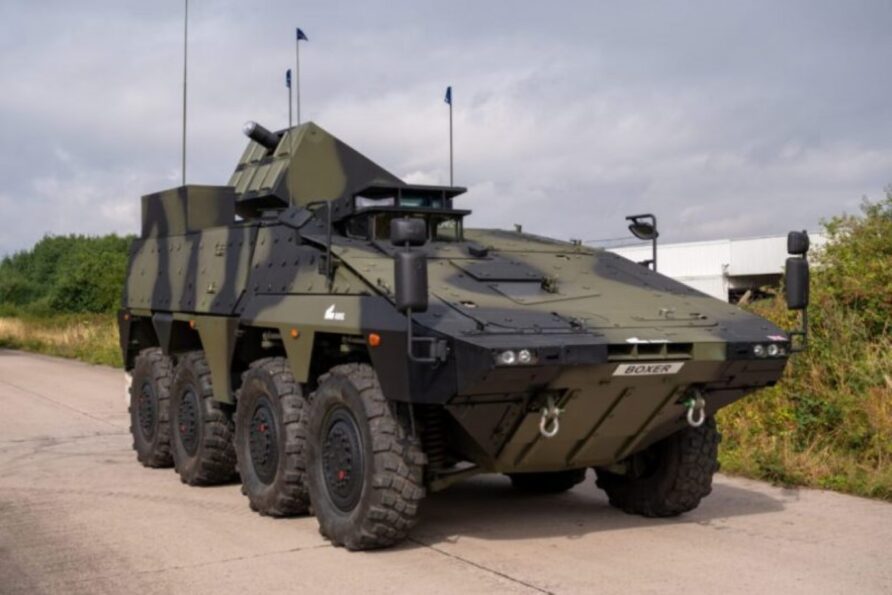
MBDA showed a slightly updated version of this at an exhibition in early 2026.
Hero Loitering Munitions and the Lockheed Martin JAGM are also proposed.
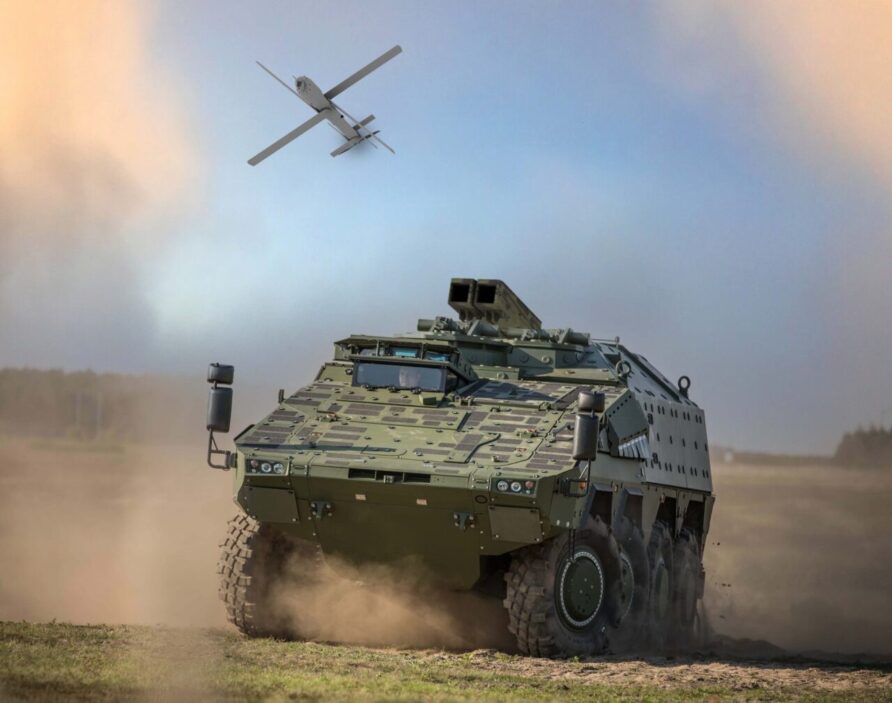
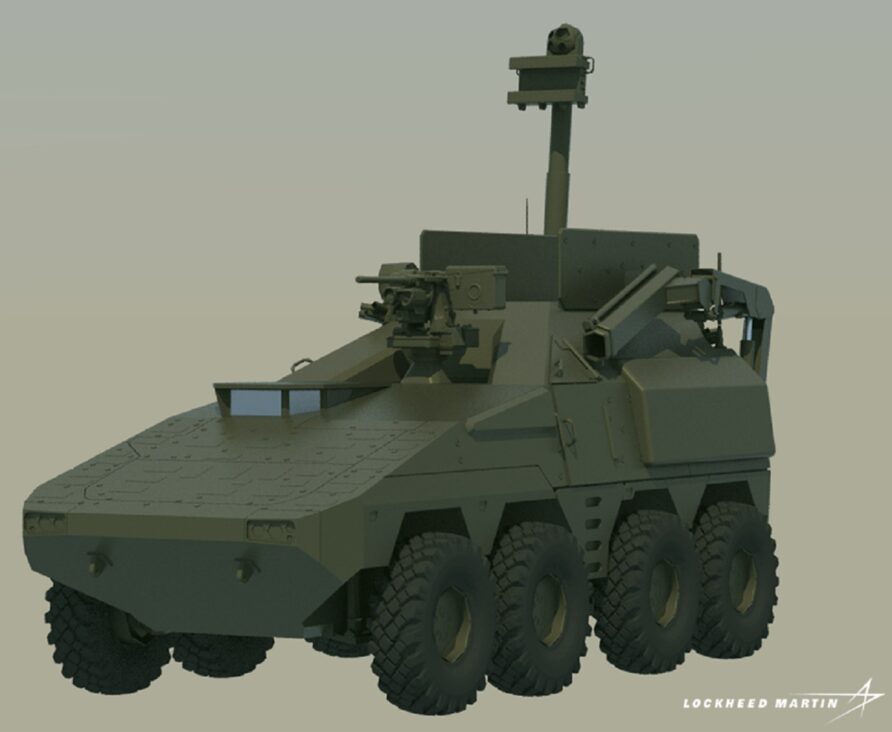
Mounted Close Combat Overwatch is no longer being pursued as a Mechanised Infantry Vehicle capability, as confirmed in the 14 October 2026 written answer. The Army is considering how the underlying anti-armour requirement will be addressed. The concepts and illustrations above therefore record proposals, not a current British Army Boxer programme of record.
Air Defence and C-UAS
Manufacturers have either proposed or developed prototypes and demonstrators.
The Skyranger is a mature system based on a 35 mm revolver cannon.

New versions of the well-established Skyranger turret have also been developed, a later version utilising a lighter turret with a 30 mm revolver cannon, AMMR (AESA Multi-Mission Radar) S-band radar, an optical-electronic station FIRST (Fast Infrared Search and Track) system, a High Energy Laser (HEL), and a twin missile launcher.
The uncrewed turret weighs much less (2.5 tonnes) compared to that shown above (4.5 tonnes)

The radar system uses five flat antennae to provide 360-degree coverage with a detection range of 20km for small UAS.

The effective range of the main gun is 3 km. ARTEC’s Skyranger 30 data sheet gives a 30 mm Oerlikon KCE-ABM revolver cannon, a rate of fire of up to 1,200 rounds per minute (or 200 rounds per minute in rapid single shot), an AESA search radar, and an option for two integrated short-range missiles with an effective range of up to 6,000 m.
Missile-based systems have also been proposed using the RBS-70, MBDA Mistral, and IRIS-T


The ‘Neuentwicklung Feuerleitpanzer’ variant will also provide battery command and control for the accompanying FlaRakPz vehicles.
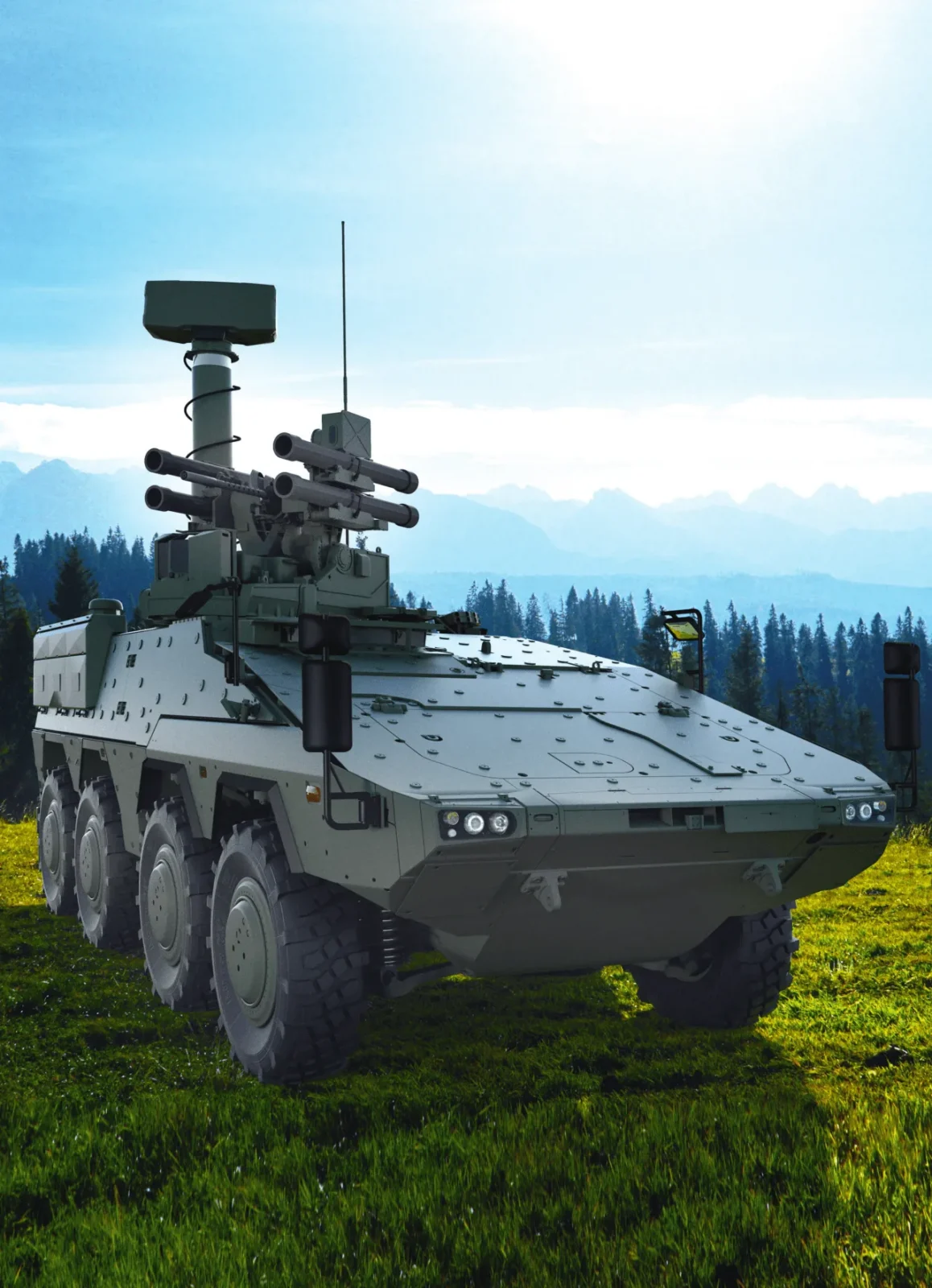

A High Velocity Missile (Starstreak) fit has also been proposed.

Valhalla Turrets also proposed their Nimrod RWS for the air defence role on Boxer

Hensoldt has received a German army order for 10 Spexer 2000 3D radar systems that will be integrated on Boxer and combined with a Kongsberg Protector RWS for counter UAS for their VJTF.

In 2013, Rheinmetall demonstrated a Boxer with a 5kw High-Energy Laser (HEL) module, development of the concept has continued.

UAV/UAS
A joint operational demonstrator for advanced applications (JODAA) was used for the operational development of new systems, manned/unmanned teaming and command and control.
Since then, the Mittlere Kräfte variant has been developed to provide UAS carrier capability, equipped with three large UAS and up to ten smaller drones.
Boxer Drive Module Variants
These are variants that will make use of a non-standard drive module, although component commonality will be high.
Bridging
KNDS Deutschland, formerly Krauss-Maffei Wegmann, has developed and demonstrated a bridging module for Boxer that can use the Leguan bridge system to span a 13 m gap at MLC100 or 22 m at MLC50.

Artillery
KNDS Deutschland, formerly Krauss-Maffei Wegmann, has integrated its 155 mm Artillery Gun Module on Boxer as the Remote Controlled Howitzer 155 (RCH 155).
ARTEC’s product data give a crew of two, a 155 mm/L52 gun, 360° traverse, elevation from −2.5° to +65°, a magazine of 30 fused rounds and 144 modular charges, and a rate of fire of up to 9 rounds per minute.
Effective range is given as up to 40 km with HE-BB, up to 54 km with V-LAP, and up to 70 km with VULCANO, with the system prepared for future ammunition. The vehicle can fire on the move and carry out shoot-and-scoot and Multiple Round Simultaneous Impact missions. Length is 10.50 m.

It can fire with up to six modular charges before needing additional vehicle support. A previously published maximum weight of 39 tonnes remains on record; that is well over the practical payload of an A400M, and the complete vehicle is also too high to fit.

On 13 May 2026 the Ministry of Defence announced a contract, valued at nearly £1 billion including initial training and in-service support, for 72 RCH 155 systems for the British Army. The contract was awarded by OCCAR to ARTEC. The weapon system is to be manufactured at Rheinmetall’s Telford facility, using steel from Sheffield Forgemasters, and the Boxer drive module at KNDS UK in Stockport.
First deliveries are expected in 2028. The RCH 155 is the long-term close support artillery solution after AS90 was granted in kind to Ukraine, with Archer remaining the interim gun until the new system enters service.
UK Boxer Variants
In a written answer on 18 December 2025, Luke Pollard gave the contracted Mechanised Infantry Boxer Programme fleet as 623 vehicles, in four variants. United Kingdom vehicles use the higher-output 600 kW MTU 8V199 TE21 engine.

The four contracted build variants are:
