The Warrior infantry fighting vehicle encompasses a family of specialised variants developed for armoured warfare.
From the standard FV510 Infantry Section Vehicle, equipped with a 30 mm RARDEN cannon, to dedicated command, repair and recovery, artillery observation, and export configurations such as the Desert Warrior, this article describes each.
Like CVR(T), Warrior is a family of vehicles built with a common hull and automotive components.
Rolls-Royce Motors formed a new company with Self Changing Gears called Trackpower Transmissions to develop a new power pack for MCV-80.
A Warrior power pack consists of a 550hp Rolls-Royce/Perkins CV-8TCA Condor diesel engine and a General Motors X-300-4B automatic transmission. The same engine, albeit in 12-cylinder format, was used for the Challenger and the Scammel Commander tank transporter.

Hull armour is welded aluminium, designed to provide protection against 155 mm shell splinters, 14.5 mm armour piercing rounds and 9 kg anti-tank mines. Torsion bar suspension and aluminium road wheels enable a cross-country speed of 35kph.
Other mobility characteristics include a ground clearance of 0.48m, 1.3m fording depth, 2.5m trench crossing distance, a maximum vertical obstacle height of 0.75m, a maximum gradient of 60% and a side slope of 40%. The 82 link tracks are 0.48m wide and maintain a contact length of 3.82m for those interested in in-ground pressure per square metre.
Although the prototype had two fuel tanks in side-mounted external panniers, the production models use a translucent polythene fuel tank underneath the turret that delivers a range of approximately 600 km. During the Gulf War, it was reported that the movement of fuel in the tank induced motion sickness, so it is often painted.
The basic infantry section vehicle is 6.3m long, 3m wide, 2.8m high, and with a combat weight of 28 tonnes. This combat weight has, of course, increased with those still in service. Fuel capacity is 772 litres, which provides a maximum range of 660 km.
Several variants came into service with the British Army, and GKN developed and proposed some others.
| Designation | Name/Role | Key Features | Numbers Built | Operator | Notes/Status |
|---|---|---|---|---|---|
| FV510 | Infantry Section Vehicle | Unstabilised 30 mm RARDEN cannon and L94A1 7.62 mm chain gun; carries 7 infantry + 3 crew | 489 | British Army | In service |
| FV511 | Infantry Command Vehicle | Similar to FV510 but with map boards, additional radios and antennae | 84 | British Army | In service |
| FV512 | Mechanised Combat Repair Vehicle | 6.5-tonne hydraulic crane; no turret | 105 | British Army | In service |
| FV513 | Mechanised Recovery Vehicle (Repair) | Winch (20–38 tonnes pull) and earth anchor; no turret | 39 | British Army | In service |
| FV514 | Mechanised Artillery Observation Vehicle | Dummy cannon; MSTAR radar, BATES system, observation sights | 52 | British Army | In service |
| FV515 | Battery Command Vehicle | Dummy cannon; for AS90 battery command | 19 | British Army | In service |
| — | Ambulance | Converted from Battery Command Vehicles | Not specified | British Army | In service |
| Desert Warrior | Infantry Fighting Vehicle (export) | 25 mm M242 Bushmaster cannon, dual TOW ATGMs, air conditioning | 254 | Kuwait | In service |
| Arctic Warrior | Infantry Fighting Vehicle (variant) | High-capacity diesel heater | Not specified | – | Prototype/optional |
| Mortar Carrier | Mortar Carrier | 81 mm or 120 mm mortar | Not specified | – | Proposed/prototype |
| Warrior DRV | Defence Reconnaissance Variant | 25 mm cannon, TOW launchers, sensor mast | Not specified | – | Proposed |
| VERDI-1 | Technology Demonstrator | Data fusion, navigation systems | 1 | – | Prototype (1990) |
| VERDI-2 | Technology Demonstrator | 2-man crew concepts, CTA 40 mm cannon | Not specified | – | Prototype |
| Anti-Tank | Anti-Tank Vehicle | Milan/Javelin or proposed TRIGAT/HOT missiles | Limited conversions | British Army | Proposed |
| Battlegroup Support/APC | Armoured Personnel Carrier/Support | GPMG, additional stowage, mine clearance options | Not specified | – | Proposed |
| Low Profile/Lightweight | Lightweight Vehicle (LOVATT) | Reduced size for air transport | Not specified | – | Prototype |
| Air Defence | Air Defence Vehicle | Proposed ADATS or Rapier | Not specified | – | Concept |
| Warrior 2000 | Improved Infantry Fighting Vehicle | 30 mm Bushmaster II, enhanced protection, digital systems | Not specified | – | Private venture/proposed |
British Army total across variants: 789 (delivered 1987–1995)
FV510 Infantry Section Vehicle #
The most common variant is used to transport an infantry section, and defeat enemy APC’s and positions.

Housed in a Vickers Defence developed 2-man welded steel turret is an unstabilised 30 mm RARDEN cannon and McDonnell Douglas EX-34 chain gun, designated L94A1.
Traverse is powered, but the elevation is manual, 360 degrees traverse and +45 degree -15 degree elevation, storing 200 rounds for the RARDEN and 2,000 for the chain gun. The turret also mounts a pair of smoke grenade launchers.

Distinguished from the other turreted variants by its single-powered door, the infantry section vehicle carries 7 infantry soldiers in addition to the 3 crew (commander, gunner, and driver).
The Pilkington Optronics RAVEN combined Day/Night sight provided the gunner and commander with a 24-hour capability for surveillance, fall of shot, target acquisition and firing the cannon and machine gun.

Total orders for the FV510 numbered 384 plus an additional 108 placed after the Gulf War. These 108 were to be equipped with the TRIGAT anti-tank missile but were fitted with Milan in the interim. There were 3 replacement vehicles for those that were destroyed, leaving a final total of 492.
These main variants came into service between 1988 and 1990.

FV511 Infantry Command Vehicle #
Double rear doors, four externally mounted antennae and a rear compartment full of map boards and various radios distinguish the 84 FV511 Infantry Command Vehicles from their siblings.

The radio fit differs depending on whether the vehicle is intended for the Platoon, Company, or Battalion command role.
Other than those changes, the FV511 is designed to look just like the FV510.
FV512 Mechanised Combat Repair Vehicle #
The 107 FV512 Mechanised Recovery Vehicle (Repair)can tow the T4 High Mobility Trailer, which is used to carry two complete Warrior power packs (or one for a Challenger for that matter).

The FV512 is used by the REME Light Aid Detachment supporting the Armoured Infantry Battalion. The FV512’s hydraulic jib can lift 6.5 tonnes at 4.5m outreach, with a 360-degree traverse.

The vehicle carries 2 crew and 3 fitters.
FV513 Mechanised Recovery Vehicle (Repair) #
The 39 FV513 vehicles are similar to the FV512, but have a large earth anchor and winch.

The hydraulically operated winch has a straight pull capacity of 20 tonnes, and 38 tonnes when double-reeved. A suspension lockout facilitates winching and it has a 200m rope length.
Both FV513 Mechanised Recovery Vehicle (Repair) and FV512 Mechanised Combat Repair Vehicle have a small commander’s cupola instead of a manned turret.
FV514 Mechanised Artillery Observation Vehicle #
The 52 MAOVs were to be used by Royal Artillery and Royal Horse Artillery forward observation teams. Intentionally designed to look like the more numerous Infantry Fighting Vehicle, the MAOV contains a collection of electronic fire control and communications equipment.

Whilst the assistant observer has the same RAVEN combined day/night sight as found on the Section vehicle, the lead observer has the more sophisticated OSPREY, also from Pilkington Optronics.

In addition to improved thermal imaging and day/night optics, they were also fitted with the Thorn-Emi J Band Pulse-Doppler Man-Portable Surveillance and Target Acquisition Radar (MSTAR), Battlefield Artillery Target Engagement System (BATES)
A navigation and attitude reference system called the Azimuth Positioning Elevation System (APES) completes the fit.
The MSTAR radar could be dismounted and used remotely from the vehicle.

FV514 also has a dummy RARDEN cannon.
FV515 Battery Command Vehicle #
The 19 FV515 Battery Command Vehicles were the final Warrior variant, providing AS90 battery commanders with armoured mobility.

Like the Artillery Observation Vehicle, it has a dummy RARDEN cannon.
Ambulance #
Although not a formal variant, a number of Battery Command Vehicles were converted to ambulances for use in Afghanistan.


Other Warrior Variants And Concepts #
Warrior was an adaptable base vehicle and in the years following its entry into service, there would be many proposed variants, different turrets and incremental improvement projects, as ownership moved from GKN to Alvis Vickers and finally, BAE.
These are not in strict chronological order and overlap with the operations section later in this article, many are just concept drawings or models.

Desert and Arctic Warrior #
Even before in-service variants were finalised, GKN had an eye on the Middle East market and produced a variant that would later go on to become Desert Warrior.
This first iteration had the standard Vickers RARDEN turret but included firing ports for the crew.

After a sales campaign, 245 were ordered by Kuwait in 1993, with the final vehicles manufactured in 1997, the last time any new Warriors were built. Unlike the image above, the Kuwaiti Desert Warrior had a turret based on that of the US LAV-25, equipped with a stabilised 25-mm M242 Bushmaster automatic cannon and dual TOW ATGMs.

Additional air conditioning and a different driver’s hatch/periscope also differentiate it from British Army vehicles.
The Arctic Warrior featured a high-capacity diesel heater, although extensive testing was carried out, the modifications remained as an optional extra.
Mortar #
Designed with a large split rear hatch and a turntable for the in-service 81 mm mortar.

A later proposal moved beyond a drawing and into a working version of the Royal Ordnance 120mm breach loading mortar called Thor

Turrets #
Despite having a relatively small turret ring (to accommodate the 7th crew member), Warrior had all manner of turrets either proposed or built for demonstration.
One of the first, in 1984, was a Cockerill 90 mm Mk3 turret, moved 25 cm so that it was mounted on the vehicle centreline.

The turret was also fitted with a 7.62 mm coaxial machine gun and smoke dischargers.
A later 105 mm version used an uprated Warrior 2000 and a South African-developed turret with a stabilised main gun and coaxial 7.62 mm GPMG. Both gunner and commander had stabilised day/night sights and fire control that enabled fire on the move. The combat weight was 29 tonnes.

An earlier version of the same turret was also proposed with a 120 mm GT12 main gun
The image below shows another Cockerill turret but this one with an Oerlikon KBB 25 mm automatic cannon.

With a 30 mm Bushmaster automatic cannon and stabilised turret

Warrior Defence Reconnaissance Variant (DRV) #
As part of its proposal for the FFLAV competition, GKN developed a smaller Warrior, like the 5-roadwheel APC described below. This would eventually be more widely known as Warrior Reconnaissance as it developed further, although the correct term was Defence Reconnaissance Variant (DRV)
The first iteration featured a stabilised turret with an M-242 25 mm Bushmaster cannon and twin TOW ATGW launchers. The vehicle carried 500 rounds of ammunition for the cannon and an additional four TOW missiles in the rear compartment.

A later version featured new radar-absorbent appliqué panels and was equipped with an elevating sensor mast with a multispectral surveillance system utilising radar, thermal imaging, day/night sights and a laser rangefinder/target designator.

The reduction in size and payload over a normal Warrior, but retention of the same power plant improved the power-to-weight ratio significantly. Additional communications equipment and an integrated sensor management system completed the specification.

An interesting development that echoes the much later ASCOD and CV90 proposals for FRES/SV.
VERDI-1 and VERDI-2 #
In 1987, the Vehicle Electronics Research Defence Initiative (VERDI) built on this previous research work.
It examined how modern vetronics (a portmanteau of the words vehicle and electronics), sensors and communications equipment could be exploited to improve performance and reduce crew numbers. VERDI was a technology demonstrator using an FV510 Warrior as the base vehicle.
Concluding in 1990, VERDI demonstrated many technologies including data bus multiplexers, navigation, data fusion, positioning, display and engine monitoring.

VERDI-2 was also designed to de-risk some systems thought likely to be included with the new Tactical Reconnaissance Armoured Combat Equipment Requirement (TRACER).
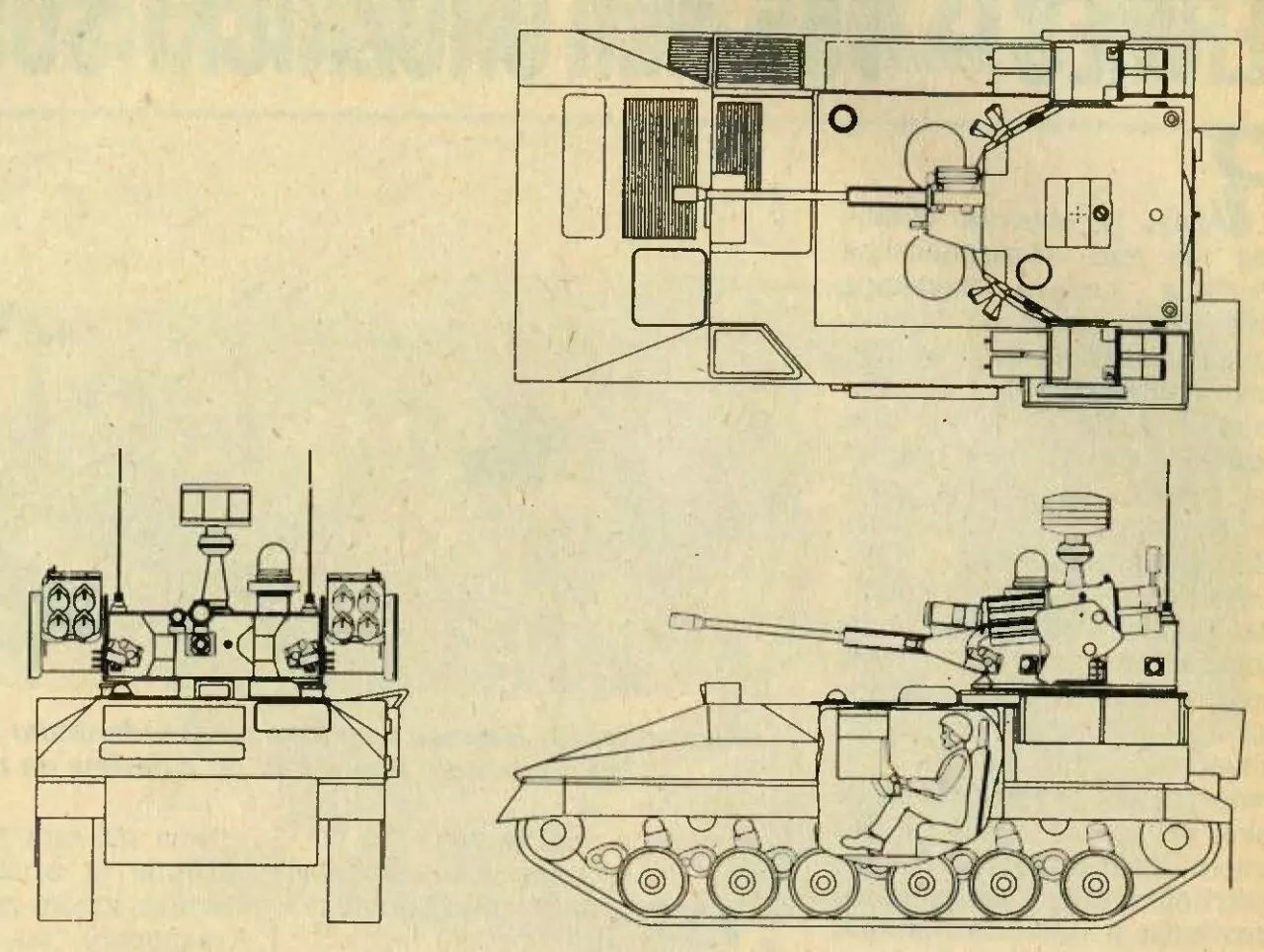
The VERDI-2 Warrior was designed to test 2-man crew concepts and the ability to manoeuvre using only indirect vision.
The turret was also armed with a mockup of anti-aircraft missiles, Air Defence Alerting Device (ADAD) and CTAi 40 mm cannon.
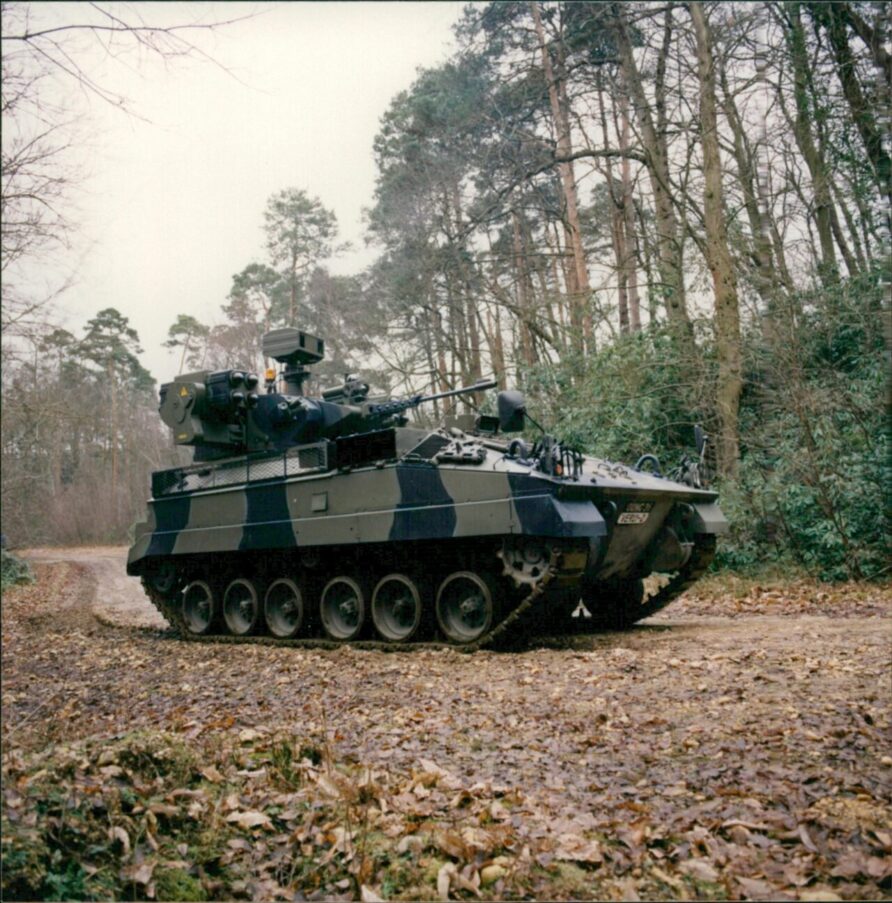
The choice of Warrior for use as the base vehicle for the VERDI demonstrator seems to suggest an explicit recognition that CVR(T) did not have space or electrical generation capacity for modern sensors and computing equipment.
Anti-Tank #
Of the 489 FV510 vehicles, 105 were intended to carry TRIGAT-MR in the man-portable role, these were later simply used to carry Milan teams, and Javelin when it replaced Milan.
To replace Swingfire-equipped FV438, Warrior anti-tank envisaged either a TRIGAT-LR or HOT missile.
First shown in 1982, the 4,000m range HOT missile version had 4 missiles mounted on the 1-man Euromissile Hot Compact Turret and another 14 stored in the hull. Reloading was carried out external to the hull.

The turret had a powered elevation of -18 to +23 degrees and could traverse 30 degrees left or right.
The TRIGAT-LR proposal used an elevating mast that allowed reloading under armour.

The shorter-range TRIGAT-MR was also proposed by GKN, using a non-elevating turret.
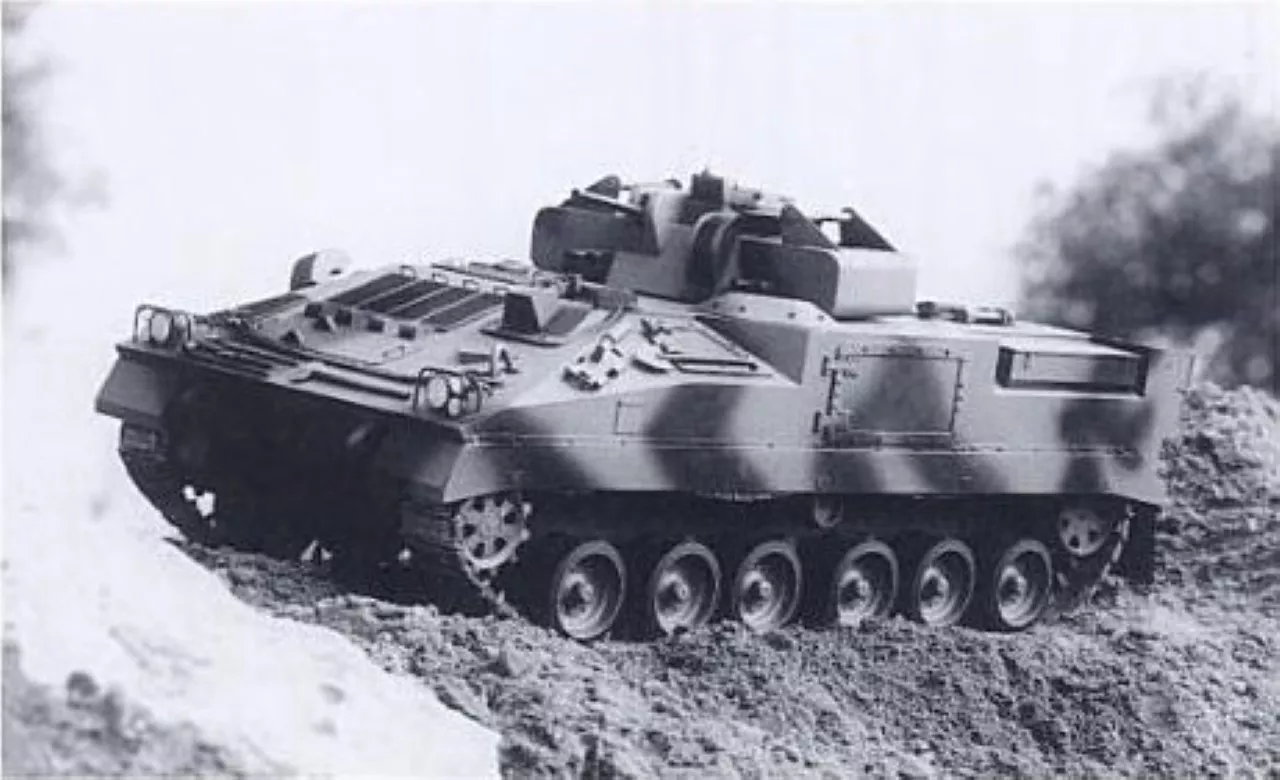
Neither of these TRIGAT concepts progressed beyond the model/drawing stage.
For operations in 1991, 10 Warrior section vehicles were converted to fire a Milan ATGW.

These were reverted to section vehicles when Milan was withdrawn and replaced with Javelin.
Battlegroup Support and Armoured Personnel Carrier (APC) #
The first APC variant suggested had the 2-man turret replaced with a simple cupola with a 7.62 mm GPMG. It also had one less road wheel than the section vehicle.

Another version retained the road wheel

This version was also armed with a one-man cupola mounted 7.62 mm GPMG, with additional space from the removal of the turret used for stowage.
The Battlegroup and Armoured Battlegroup Support Vehicle has been an ongoing and unfulfilled requirement, essentially, Warrior variants replacing FV432 variants.

Various versions of this have been shown through the years, the latest with Soucy continuous rubber tracks.

Mine clearance blades and bridge launching mechanisms have also been fitted to this version.


There was also an engineer variant designed that mounted a Ranger anti-personnel mine dispenser on the roof and could tow a Barmine plough.
A command post demonstration also saw this fitted with a GIAT FINDERS (Fast Information, Navigation, DEcision and Reporting System) battle management system, BOWMAN radios, and several computer systems.
Low Profile and Lightweight #
One of the more unusual and lesser-known variants, GKN produced a lightweight Warrior designed for carriage by C-130 Hercules.
GKN proved this during US trials when it was flown back to the UK.

The designation for this version was LOVATT, and it was marketed as part of GKN’s response to the British Army’s Future Lightweight Armoured Vehicles (FLAV) requirement in the late eighties.
Air Defence #
The Low Profile variant was also used to demonstrate an ADATS fit

Although only in the concept stage, Warrior was also proposed as a Rapier missile carrier.

Warrior 2000 #
Warrior 2000 was developed as a private venture in response to a Swiss Army requirement (that would eventually be won by CV90)
Warrior 2000 was of all aluminium construction and had a range of improvements including better protection, a digital fire control system, an all-round camera system, a more powerful engine
A hydraulic engine deck lift, double pin tracks, reduced thermal and acoustic signature and an electric drive fully stabilised turret fitted with an ATK Bushmaster 30 mm automatic cannon.

The hull was slightly longer with inward-sloping sides and smoother upper surfaces to reduce the radar signature.
Combat weight was 31 tonnes, and had a range of 500 km with a top road speed of 75kph.
A later version was also shown, fitted with the same turret as the CV90-30.
If you found value in this article

Think Defence is a hobby, a serious hobby, but a hobby nonetheless. Hosting, security and other support software all adds up.
E-books and merch
Downloadable PDFs, and the Redbubble shop.
Amazon links in posts are affiliate. Firearm designs on Redbubble may be marked mature.
Thank you for reading, and for any support. It really is appreciated and helps me keep the show on the road.


