
 Doc Summary

The Alvis Stalwart was a unique British amphibious load carrier from the 1960s.

The Alvis Stalwart was a high-mobility amphibious vehicle developed by the British firm Alvis in the early 1960s for the British Army during the Cold War era.
Alvis Stalwart Development #
Stalwart shares much of its early history with Saladin and Saracen, especially the 6×6 ‘Punt Chassis’ developed by the Fighting Vehicle Design Establishment (FVDE) and Alvis in the fifties. There is also some shared history with Crossley Motors.
In the early fifties, the British Army was considering options to support an increasingly armoured force in Germany. A reliable means of delivering stores to forward units was needed.
High mobility was a fundamental requirement, a version of the FV432 was evaluated, but wheels had many advantages for the supply role.
In 1957 Alvis put forward the idea of a load carrier based on the Salamander hull.
Although the hulls of the Saladin, and Saracen are entirely different, they shared the drivetrain and many components. The Salamander fire tender was also developed from the same drivetrain, with the Pyrene company.
Stalwart was arguably a development of Salamander.
Alvis put their money where their mouth was, developing the Prototype High Mobility Load Vehicle in 1959.

From this first prototype, and perhaps a bit of the ‘Old boy’s network’ in defining a demand, an official requirement was issued in 1960 that included a 5-ton payload, and superior off-road performance.
It should be noted that at this stage, it was a high mobility load carrier, not amphibious. The amphibious requirement emerged during initial testing and discussions between Alvis, MEXE and the FVRDE.
The PV1 was shown at the 1961 Farnborough Air Show.

The War Office then issued the General Staff Operational Requirement (GSOR) 1108 for a high mobility artillery limber vehicle, based on the Alvis design, not the other way around.
A second prototype was developed that incorporated a great many changes to meet the GSOR 1108 requirement., PV2, is shown in the video below.
A number of additional prototypes continued the development effort, including evaluations by both the British Army and Swedish Navy (for shore battery resupply), the second and subsequent being amphibious.

The video below also shows PV2 in action in Sweden.
Testing continued against the Gun Limber and Ammunition Supply requirements.


Fifteen prototype vehicles were eventually produced.
Alvis Stalwart Production #
The continual improvements over the fifteen prototype versions eventually resulted in a 1962 British Army order for 125 vehicles, to be designated the FV620, and named Stalwart.

A number of the later prototypes also entered service as they were extremely close to the production version.
Stalwart entered service in 1963.
Again, additional fine-tuning took place as the vehicles entered service and in 1964, another 325 were ordered.
The Mk2 version (FV622) had improved visibility (larger windows), driver layout, self-recovery winch and modifications to improve air carriage.
Over a thousand Stalwart vehicles were produced between 1965 and 1971, mostly the Mk 2.
Alvis Stalwart Operational History #
Stalwart was primarily used for forward resupply of fuel and ammunition.
The vehicle was integral to Royal Artillery regiments, Royal Engineer squadrons, and armoured brigades.
Outside Germany and the UK, six vehicles sent to Belize in March 1978 to bolster British forces amid regional tensions, where they facilitated supply movements in tropical terrain before returning to the UK in mid-1979.
The British Army retired the fleet between 1991 and 1993 due to a number of factors.
Amphibious capabilities were removed in the early eighties after the introduction of the Medium Girder Bridge in 1971, changes in Royal Artillery ammunition supply requirements, the introduction of the Demountable Rack Offload and Pickup System (DROPS), and general life of the vehicles.

Alvis Stalwart Variants #
Additional variants of the Mk2 included REME (FV624) vehicles, gun limber (FV623),
Unit Bulk Refuelling Equipment (UBRE)

Various cranes and hydraulic loader jibs

Concepts were also proposed for a Blue Water missile carrying variant

An AA missile carrier

There was a proposal for a Swingfire launcher.
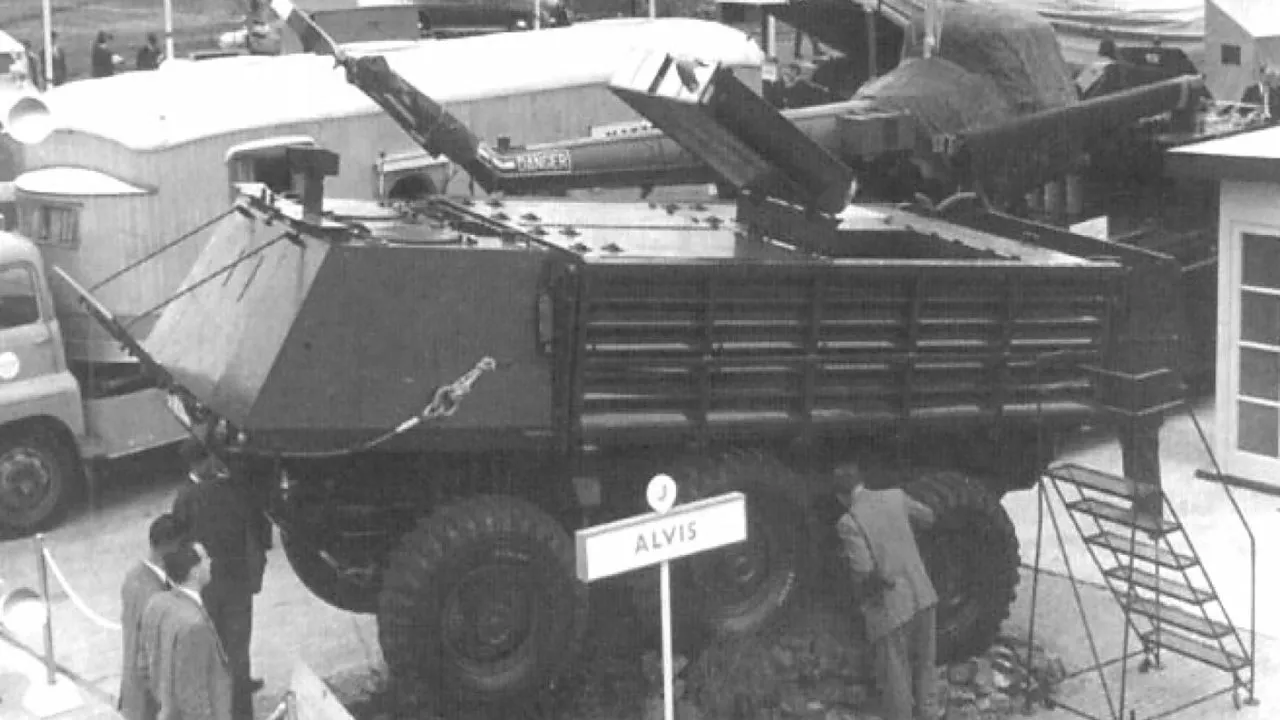
AF Budge, a UK company, developed a diesel-engined variant.

The Military Experimental Engineering Establishment (MEXE) conducted trials with a rocket powered extraction system, as fitted to the Combat Engineering Tractor (CET).


Although this did not enter service.
Alvis Stalwart Characteristics #
Below is a detailed compilation of its key technical specifications, categorised for clarity.
Dimensions #
- Length: 6.36 m (20 ft 10 in)
- Width: 2.62 m (8 ft 7 in)
- Height (cab top): 2.31 m (7 ft 7 in) for FV620/FV622 variants; up to 3.1 m (10 ft 2 in) for FV623/FV624 crane-equipped models
- Wheelbase: 3.05 m (10 ft) total, with two intervals of 1.524 m (5 ft) each
- Track: 2.04 m (6 ft 8 in)
- Ground clearance: 0.42 m (1 ft 4.5 in)
- Approach angle: 44 degrees
- Departure angle: 40 degrees
Weights #
- Kerb weight (unladen): Approximately 8,636 kg (8.5 long tons)
- Gross vehicle weight (laden): 14,224 kg (14 long tons)
- Payload capacity: 5 tonnes (11,000 lb)
Engine and Powertrain #
- Engine: Rolls-Royce B81 Mk 8B inline eight-cylinder, liquid-cooled petrol engine
- Displacement: 6.5 litres (6,523 cc)
- Power output: 220 bhp (164 kW) at 4,000 rpm
- Transmission: Five-speed manual gearbox with transfer case and forward/reverse selector
- Drive system: Permanent 6×6 with H-drive layout, bevel gear units at each wheel station, and transverse differentials per axle (no inter-axle compensation)
- Steering: Hydraulic servo-assisted
- Braking: Hydraulic servo-assisted disc brakes
- Suspension: Independent torsion bars on all six wheels
Performance #
- Maximum road speed: 64 km/h (40 mph) at 4,000 rpm
- Operational range: 640 km (400 miles) on roads
- Fuel capacity: 454 litres (100 imperial gallons)
- Gradient capability: 1 in 2.25 (44%) in bottom gear
- Maximum tractive effort: 1,292 lb/ton in top gear
- Fording depth: Fully amphibious with seamless land-to-water transition
Amphibious Capabilities #
- Hull: Frameless, all-welded watertight aluminium construction with flotation screens and rubber seals on sideboards
- Water propulsion: Two Dowty vectored-thrust water-jet units, mechanically driven from the engine via power take-off on the transfer box
- Water speed: 11 km/h (6 knots)
- Steering in water: Independent control of jet units for manoeuvrability
Crew and Armament #
- Crew: Driver plus up to two passengers in the cab
- Troop capacity: Up to 10 personnel in the cargo area (variant-dependent, and not widely by the British Army)
- Armour: None
Variants such as the FV623 (limbered) and FV624 (recovery) included optional hydraulic cranes with capacities up to 3 tonnes
These specifications reflect the Mk 2 production standard, with minor variations across prototypes and export models.
The Stalwart Channel Dash #
No story about Stalwart is complete without the oft-told tale of one attempting a Channel dash.

The urban legend is Robin Painter finished his career in the Army as a Staff Sergeant and then joined Alvis.
He also seems to have been recommended for a British Empire Medal (BEM) in 198.
There was also a later incident in 1988, when a soldier stole a Stalwart and drove it from Germany to Belgium, only being stopped by armed police.
Further Reading #
Extensive and authoritative: Alvis Stalwart & Bedford Files – Alvis Stalwart HMLC Section
Active community: Alvis HMLC 6 x 6 Stalwart Group | Facebook
If you found value in this article, help me keep Think Defence going.
Think Defence is a hobby, a serious hobby, but a hobby nonetheless. I have removed those annoying adverts, but hosting fees, software subscriptions and other services add up.
To help me keep the show on the road, I ask that you support the site in any way you can. It is hugely appreciated.
You can click on an affiliate link, Buy Me a Coffee at https://ko-fi.com/thinkdefence, download an e-book at https://payhip.com/thinkdefence or even get some TD merch at https://www.redbubble.com/people/source360/
Youtubers, if you are going to lift content from here, the decent thing to do would credit me


You really need a 'finds' open thread as I have said more than once TD.
https://www.youtube.com/watch?v=VJgzdhVeq2g