
 Doc Summary

County Tractors were a British agricultural vehicle manufacturer, with some of their vehicle briefly used by the British Army.
County Tractors History #
Established as County Commercial Cars Ltd in Fleet, Hampshire, in 1929 by brothers Ernest and Percy Tapp, both former officers in the British Army during the First World War, the company initially specialised in modifying commercial vehicles before transitioning to tractor production post-Second World War.
The Tapps’ expertise in drivetrain and chassis modification stemmed from early work converting twin-axle Ford lorries into triple-axle configurations to enhance load capacity, a service extended to other operators following successful trials with their own vehicles.
County commenced production in 1948 with track-laying (crawler) models derived from Fordson Major skid units, overcoming the limitations of two-wheel drive tractors on soft or hilly ground prevalent in regions such as the Scottish peatlands or southern English downs.
These initial adaptations featured reinforced tracks for superior traction and stability. By the 1950s, County had earned a solid reputation for reliability and toughness, with use in the agriculture, forestry, and civil engineering sectors.
Launched in 1961, their four equal-wheeled 4WD tractors defined the brand.
The equal-wheel design offered enhanced weight distribution and traction, proving ideal for forestry applications on steep inclines and uneven surfaces.
New models followed, including articulated skidders for forestry.
| Model | Year Introduced | Key Features |
|---|---|---|
| County Crawler (Fordson Major-based) | 1948 | Track-laying, Ford 4-cylinder diesel |
| Super 4 | 1960s | 4WD equal wheels, improved traction |
| 1164 | 1970s | Ford 6-cylinder engine, high output |
| Forward Control | 1965 | Cab-forward for visibility |
After being purchased by The Benson Group, manufacturing continued until 1995, the last one going to St Helena.
County Tractors Characteristics #
County’s engineering emphasised durability and adaptability, principal features encompassed:
Drivetrain and Axles #
The signature 4WD system employed equal-sized wheels (commonly 18.4-34 agricultural tyres) powered via a transfer box distributing torque to front and rear axles. Custom front axles often incorporated epicyclic reduction gears for amplified torque.
Early variants utilised the Fordson Major’s 4-cylinder diesel engine (circa 45-50 horsepower), while later models integrated potent Ford 6-cylinder engines, such as in the 1164, yielding up to 116 horsepower.
Chassis and Construction #
Ladder-frame chassis were fortified for heavy duties. Forestry models included winches, protective enclosures, and elongated wheelbases for stability. The Forward Control variant, introduced in 1965, positioned the cab ahead of the engine for superior visibility in confined woodland settings, with its 60th anniversary noted in 2025.
Track-laying types, like the County Full Track, extended Ford chassis with rubber or steel tracks for exceptional flotation on marshy terrain.
Engine and Transmission #
Ford-sourced engines were refined for dependability. Gearboxes offered 6- or 8-speeds, with optional high-low ranges for low-speed forestry operations. Fuel consumption averaged 15–20 litres per hour under load, varying by model.
Hydraulics and Implements #
Standard three-point linkages interfaced with British and global attachments. Hydraulic capacities spanned 1,500 kg in early iterations to over 2,500 kg later, accommodating ploughs, loaders, and forestry gear.
Falkland Islands and The British Army #
While chiefly agricultural, County’s skills in heavy-duty vehicle modifications led to engagements with the British Army
During WWII, the firm secured contracts for small one- and two-man tanks, but wartime output was mostly for adapted Ford chassis for logistics, building on pre-war six-wheel truck conversions.
A notable prototype was the “Praying Mantis,” a private development by Ernest Tapp, patented in 1937. Inspired by his First World War machine-gun service, it featured an elevating armoured body for elevated firing while reducing exposure.
Post-1945, the Royal Engineers employed normal-control models for soil stabilisation (e.g., rotavators mixing lime) and sweepers.
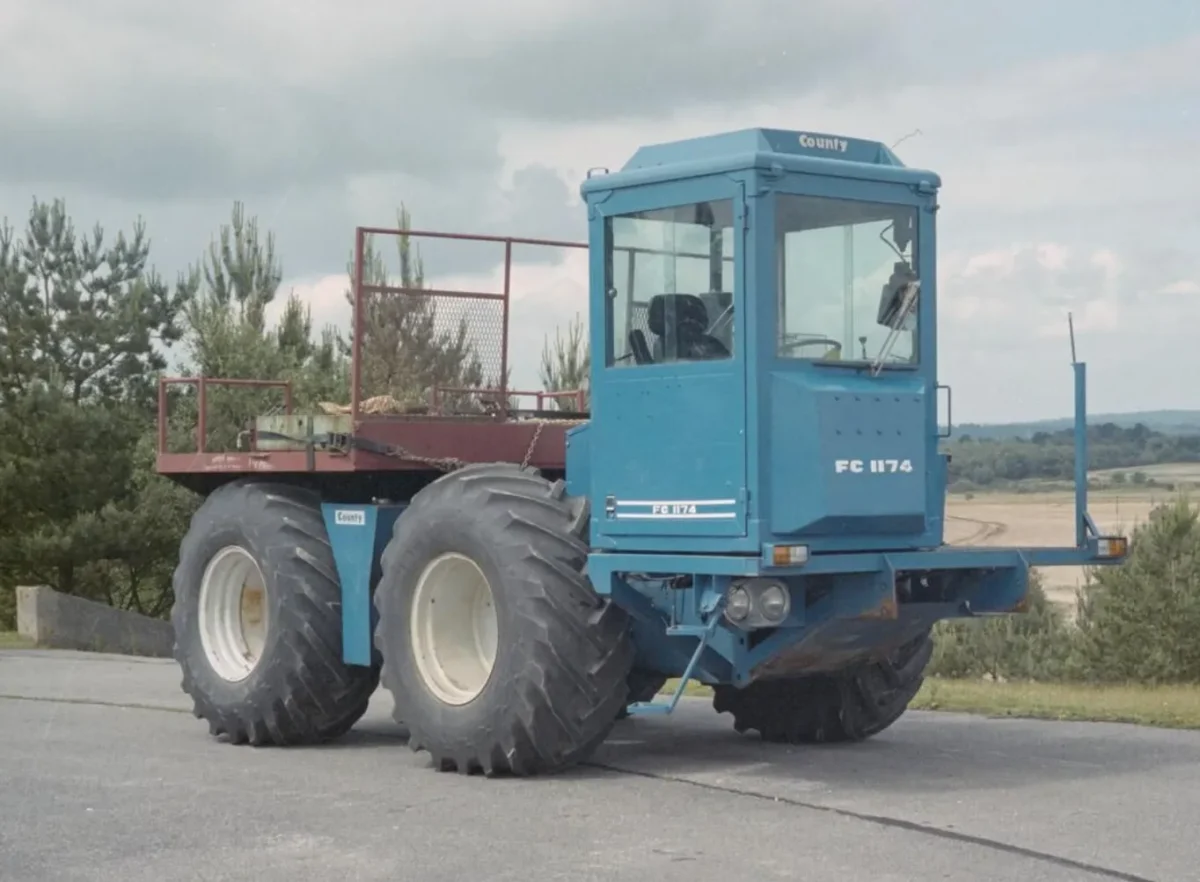
Forward-control types, such as the FC 1174, were MOD-tested with three-line air brakes and some were modified for boat-launching.
A March 1982 article in the ‘Wagoneer’ journal of the Royal Corps of Transport examined their use as a Stalwart replacement, when coupled with an articulated trailer.
One way to get the required lift would be to place the 25 STALWARTS in each RCT squadron with a lesser number, say 20, commercial articulated vehicles.
These could deliver their trailers direct to the gun lines during intense rates of fire shoots. On arrival the trailers could be dropped by their low mobility road tractors and be picked up by a powerful cross-country tractor, such as the County, issued on a scale of one per battery.
This tractor would be capable of hauling the semi-trailers around the gun sites over any reasonable ground. Pallets could then be ground-loaded next to the gun by MHE or, if time allowed, be broken on the trailers allowing shell and cartridge to be off-loaded direct into the gun turrets
The image below appears to be a County Crawler
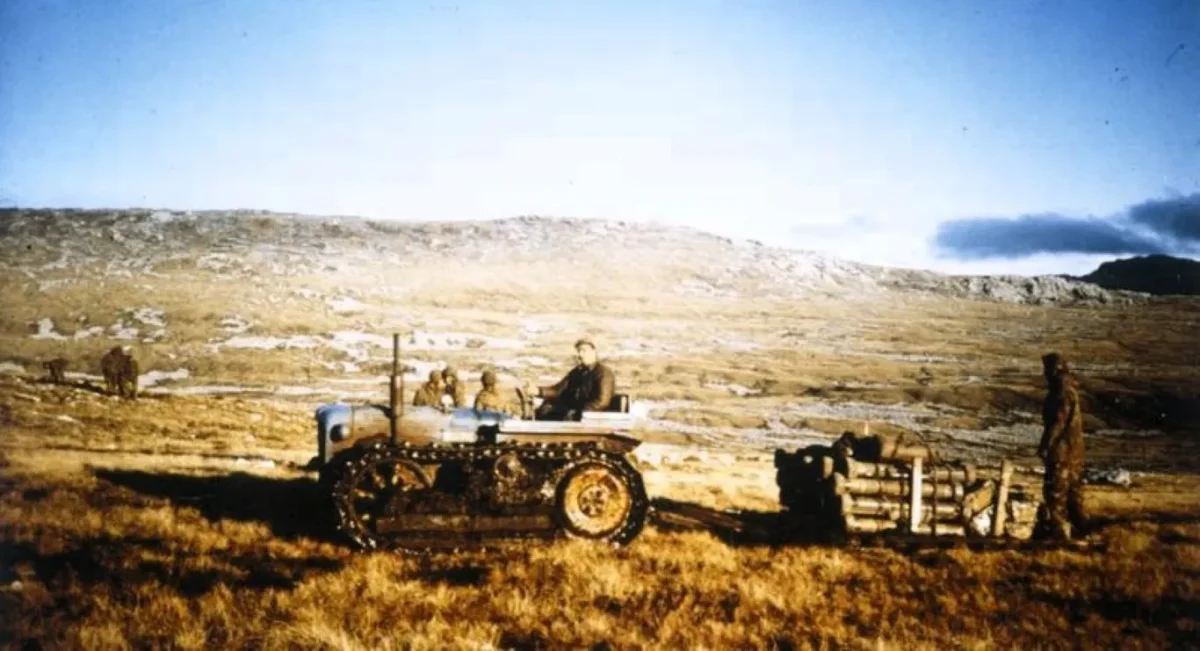
This vehicle may also be seen at this link in 2008.
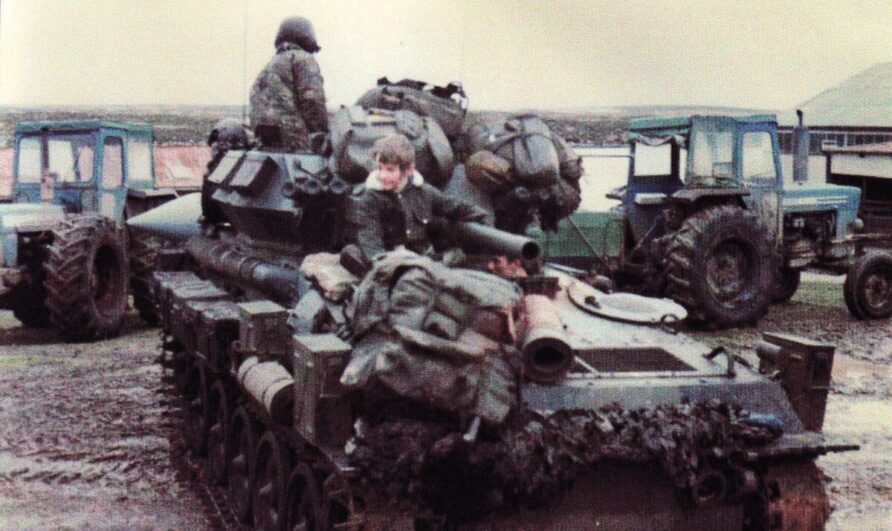
Two County tractors in the background here
Post-1982 Falklands War, the MOD acquired at least three forward-control County tractors (likely 1184 models), joining civilian users on the islands.
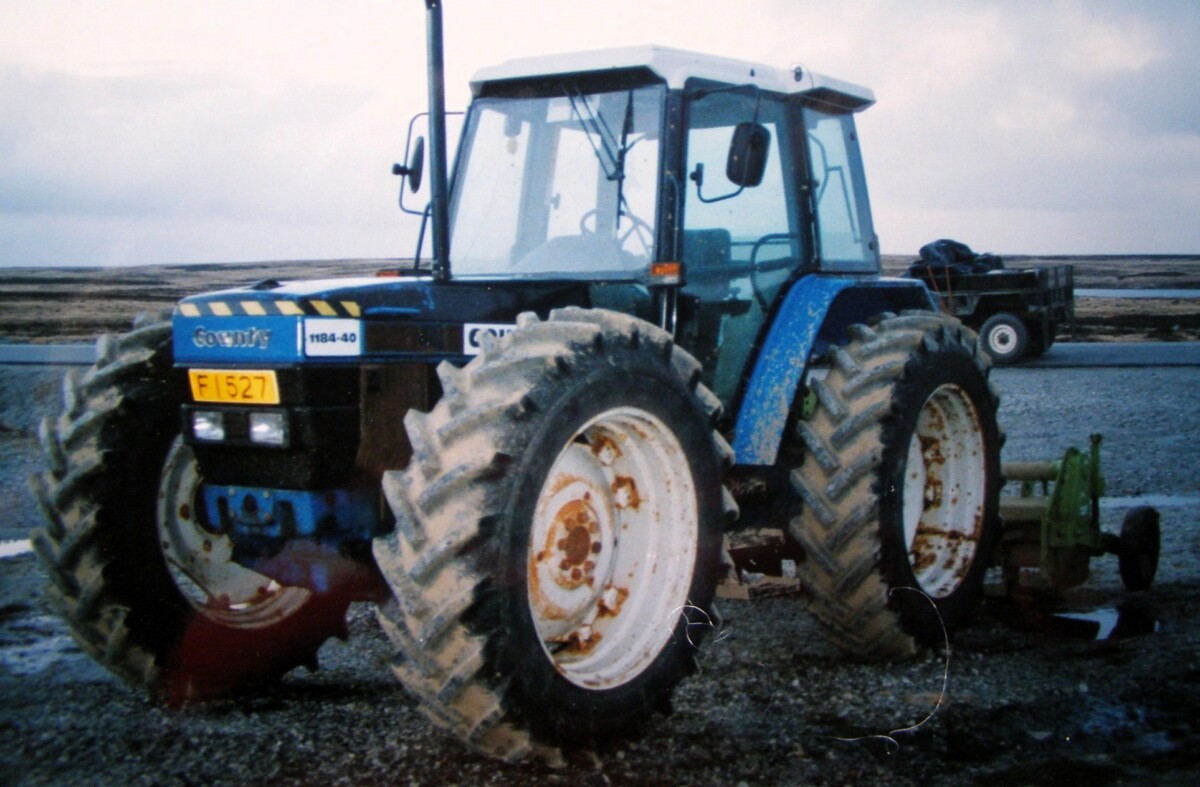
County Tractors FC 1184 Forward Control vehicles would also be used by the British Army with trailers for transferring heavy stores from Port Stanley to the airfield during its rehabilitation and extension phase.
Seven 1184TW units were procured, six with Brockhouse torque converters, for remote-controlled de-mining on the poor terrain of the Falkland Islands.
Redeployed to Cyprus for soil work, they faced PTO shaft failures under load, prompting conversions to Ford Series 10 dual-power gearboxes via A.T. Osborne’s.
If you found value in this article, help me keep Think Defence going.
Think Defence is a hobby, a serious hobby, but a hobby nonetheless. I have removed those annoying adverts, but hosting fees, software subscriptions and other services add up.
To help me keep the show on the road, I ask that you support the site in any way you can. It is hugely appreciated.
You can click on an affiliate link, Buy Me a Coffee at https://ko-fi.com/thinkdefence, download an e-book at https://payhip.com/thinkdefence or even get some TD merch at https://www.redbubble.com/people/source360/
Youtubers, if you are going to lift content from here, the decent thing to do would credit me


