
The Bushmaster Protected Mobility Vehicle (PMV) is a 4×4 mine-protected armoured vehicle developed in Australia by Australian Defence Industries (ADI), later Thales Australia, and produced at Bendigo in Victoria.
It entered Australian Army and Royal Australian Air Force service as the Infantry Mobility Vehicle under Project Bushranger (LAND 116), and has since been exported to several allied forces, including a small British fleet obtained for special forces use.
Thales describe Bushmaster as…
The Bushmaster is a combat proven vehicle that is in service with the Australian Defence Force and eight other nations, and has been successfully deployed on operations in the Middle East, Europe, Africa, and the Pacific. Ongoing design enhancement, a wide range of user selectable mission equipment and mature through life support have ensured that Bushmaster continues to meet evolving customer requirements.
Table of Contents
Bushmaster History
Project Bushranger
The Australian Defence White Paper of 1987 stated a requirement for improved infantry mobility.
The 1991 Force Structure Review then defined a requirement for an Infantry Mobility Vehicle (IMV).
The 6th Royal Australian Regiment had investigated the use of Project Perentie 4×4 and 6×6 Land Rovers.
The Perentie was based on a Land Rover 110 but used an Isuzu engine and many other changes. The 6×6 version was a distinctly Australian configuration.

Additional Project Perentie vehicles were designed and built by BAe Australia between 1994 and 1998.
LAND 116 Project Bushranger Phase 1 fielded a modified Perentie as the Interim Infantry Mobility Vehicle (IIMV).
The 1994 Australian Defence White Paper further emphasised the vehicle requirement.
5.57 New land force vehicles will be acquired to give greater mobility and better personnel protection. The fleet of Ml 13 tracked armoured vehicles will also undergo a limited modification program to overcome existing deficiencies and extend their life well into the next century. New light reconnaissance vehicles based on commercial standards will be acquired this decade, and a lightly armoured transport vehicle will be acquired to provide mobility to infantry brigades. The present fleet of trucks will be replaced early in the next decade. These projects will be managed to provide opportunities for Australian industry and reduce subsequent through-life costs, including adopting civil standards to the maximum extent practicable.
Phase 1 Perentie vehicles were purchased in both 4×4 and 6×6 variants, totalling 276 vehicles, produced by Australian Defence Industries (ADI). The Registry of Ex Military Land Rovers maintains a detailed Perentie resource.
Towards the end of the manufacturing phase, BAE Australia sold its interests to Tenix.
1994 also marked the start of Phase 2A, the search for a purpose-built IIMV replacement. Thirteen companies expressed interest and five were shortlisted.
ANI teamed with Reumech OMC Austral to form Australian Specialised Vehicle Systems (ASVS), offering a modified Reumech Mamba (Kobra) known as Taipan on a Unimog chassis, related in lineage to the South African Mamba family covered in the Alvis 4 and Alvis 8 article.

Transfield Defence Systems teamed with Thyssen Henschel to offer the TM-170.

Perry Engineering teamed with Timoney to offer a version of their Mk 6 APC.

Westrac teamed with TFM to offer the RG-12 Nyala.

BAE Australia offered the Shorts Brothers-developed Foxhound (not the later British Foxhound).
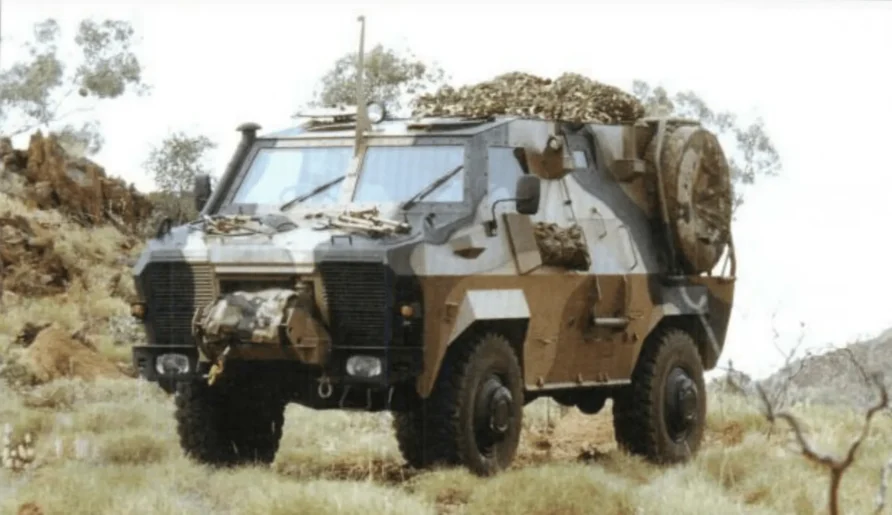
The BAE Foxhound used the Unimog U2150L rather than a Land Rover chassis. At a maximum weight of 12.5 tonnes it could carry nine passengers. Jane’s Armour and Artillery later recorded the related Tenix / BAE Systems Australia S600 4×4 Internal Security Vehicle as continuing that Shorland / Unimog line.
By the end of 1996, Transfield and Westrac had withdrawn, leaving BAE Australia, ANI and Perry Engineering.
The Perry Engineering concept was based on the Timoney Technology MP44 and made extensive use of automotive components from the Stewart and Stevenson Family of Medium Tactical Vehicles (FMTV).

Of the three remaining contenders it had the highest weight, at about 14 tonnes, but its welded steel monocoque hull, rather than a conventional truck chassis, offered protection advantages. There was also a growth path to a 6×6 variant, the MP66.

Phase 2B was the Request for Tender; Phase 3 covered manufacture and introduction to service. BAE then withdrew, leaving Perry Engineering and ASVS.
In September 1996 Perry Engineering sold the intellectual property rights to the Bushmaster design, together with Timoney intellectual property and Perry’s option to compete, to government-owned ADI. Bob Roach and the prototype moved to Bendigo, where ADI redesigned the vehicle. The Perry prototype had been an armoured box on wheels with air conditioning and three days’ stores; the blast-deflecting V-hull was developed in the Bendigo redesign. By early 1998 prototypes had completed extensive testing. In February 1998 the Army took three vehicles for a 44-week comparative trial against the ASVS Taipan.
Jane’s International Defense Review reported the public launch of the ADI Bushmaster IMV in Canberra in November 1997 as one of two shortlisted Project Bushranger vehicles for the motorised 6th Brigade at Enoggera. Contracts went to ASVS and ADI for three IMVs each for trials, with a preferred tenderer then expected to supply an initial 341 IMVs and options for 230 more.
ADI claimed the vehicle could withstand a 19 kg explosive charge under any wheel. Contemporary Jane’s Armour and Artillery development notes recorded a requirement for protection against 9.5 kg of TNT under any wheel or under the hull, with ballistic protection against 5.56 mm and 7.62 mm rounds, upgradeable against armour-piercing ammunition.

Neither vehicle fully met the requirement, especially on reliability. Trials finished at the end of 1998, and in March 1999 the Australian Minister for Defence announced that the ADI Bushmaster was the winner.

The production contract was signed on 1 June 1999 for 370 Bushmasters at A$170.04 million. In October 1999 Defence required 23 major engineering changes, including stretching the vehicle to insert a tenth seat, which added weight and forced a driveline redesign. Reliability and schedule problems followed. In July 2002 the contract was renegotiated to 299 vehicles plus 12 prototypes, at a higher price and with a later delivery schedule.
A pair of early vehicles were modified and sent to East Timor in 1999 as VIP transport for INTERFET.

In November 1999 ADI was sold for A$346.78 million to a 50:50 partnership of Transfield (one of the original losing bidders) and Thomson-CSF, later Thales. In October 2006 Thales bought Transfield’s share and renamed the company Thales Australia.
The Australian National Audit Office later examined the acquisition in detail. Contemporary press coverage was harsh. An Australian tabloid wrote:
The Australian Defence Force’s much-anticipated Project Bushranger appears set, like Ned Kelly himself, for a gruesome ending. The project, to build more than 300 landmine-protected infantry vehicles, is massively over budget and ridiculously behind schedule. Our defence forces have run out of patience, giving the manufacturers until the end of the year to sort the mess out.
An April 2004 Sydney Morning Herald story summed up the situation:
The army’s new Bushmaster troop carrier sums up what can go wrong with defence purchases. The prototype vehicles were 10 times less reliable than the army wanted. But the army bought them anyway because the only alternative was 20 times less reliable. The original cost was supposed to be $170 million for 370 vehicles. In the end, taxpayers will get 299 vehicles for $329 million. And though taxpayers’ money has been used to develop the vehicles, the army has no patent over any part of the project and no royalty agreement with ADI if the company sells the vehicles overseas. Now that the wrinkles have been ironed out using taxpayer money, that looks likely
By 2004–2005 the Australian Army had a workable medium protected mobility vehicle in service. Subsequent production periods under LAND 116 and related programmes raised Australian orders well above the renegotiated 299, and the type was exported in significant numbers. The ANAO Project Bushranger audit remains the principal official account of the early acquisition problems.
Production has continued at Bendigo under Thales Australia, with later Australian orders extending manufacture into the 2030s.
Operations
The first ten production Bushmasters went to the Al Muthanna Task Group in southern Iraq in 2005. Deployments to Afghanistan followed, and the type became central to Australian mounted movement in Uruzgan province. Brendan Nicholson records that no Australian soldier died inside a Bushmaster, though gunners in roof hatches were vulnerable to large blasts and many crews were badly injured.
The V-shaped monocoque hull was intended to deflect mine and improvised explosive device (IED) blast. Australian crews survived repeated strikes in Uruzgan in 2010–2012, often with serious injuries but with the vehicle preserving a survivable crew space. One widely documented example is ARN 203361 ‘Debbie’, which served in Iraq from October 2006 to January 2008 and in Afghanistan from August 2009 until an IED strike in Deh Rawud district on 10 July 2012. All six occupants survived; the damaged vehicle is held by the Australian War Memorial.

Exports
More than a thousand Bushmasters were delivered to the Australian Defence Force across successive production periods. Later Australian orders and backfill contracts have kept the Bendigo line open after vehicles were transferred to partners.
The Netherlands became the second-largest operator. After taking responsibility for Uruzgan in 2006, Dutch forces asked to buy Bushmasters; the ADF sold 25 back to Thales for the Netherlands, most flown direct to Tarin Kowt with two sent to the Netherlands for driver training, and later received 26 vehicles from Thales as makeweight. Dutch roles included troop carrier, command, electronic warfare and medical evacuation. A further 20 were ordered in 2014, bringing Dutch purchases to 106. The United Kingdom obtained vehicles under the Escapade programme for special forces use (Australian production records cite 24 diverted from the line). Japan’s Ground Self-Defense Force took eight for the Central Readiness Regiment. Jamaica ordered 12 from December 2013, later increased to 18. New Zealand and Fiji also took vehicles, the latter largely for United Nations peacekeeping.
Indonesia operates Bushmasters and a locally produced Pindad Sanca variant. Australia donated further vehicles for Indonesian peacekeeping. By the end of 2018, Nicholson recorded 171 Bushmasters exported in total. From April 2022 Australia donated Bushmasters to Ukraine, later rising to 120 vehicles including ambulance variants, with subsequent Australian production used in part to backfill the fleet.
In Indonesia the type is known as Sanca and is associated with Pindad manufacture under arrangements with Thales.
Oshkosh Truck offered Bushmaster to United States forces as the Assured Mobility Vehicle, available in 4×4 and 6×6 form, citing more than 150,000 miles of reliability development testing and Australian combat service in Iraq and Afghanistan. The brochure, dated February 2006, stressed C-130 and helicopter transportability and commonality with other theatre vehicles through Oshkosh support.
UK Bushmaster Use
Anecdotally, United Kingdom Special Forces favoured the Pandur 2 6×6 vehicle, as per the US Armoured Ground Mobility System (AGMS).

To meet delivery timescale and protection requirements, the Bushmaster was selected instead under the Escapade programme. Vehicles diverted from Australian production were used for protected movement by UK special forces in Iraq, including around Basra, and were later reported in further Middle East operations, including Syria.

Bushmaster was also offered against the Operational Utility Vehicle System (OUVS) programme, which was cancelled.

In early 2018 Thales unveiled the Bushmaster MR6 at IAV 2018, aimed in part at the then Multi Role Vehicle – Protected (MRV-P) programme, which was also cancelled. Bushmaster has since been offered again for the Land Mobility Programme (LMP).
Bushmaster Capabilities
The Bushmaster uses a welded steel monocoque V-hull with the fuel and hydraulic tanks placed outside the crew compartment, plus a protected emergency fuel tank. Early Jane’s requirements for the Perry / ADI design included weapon stations up to .50 calibre, three days’ endurance for ten personnel, 270 litres of water, about 1,000 km of fuel endurance, air conditioning, smoke dischargers, and the option to expand the design to 6×6.
An ADI manufacturer data sheet for the production vehicle lists a crew of up to ten including the driver, full-time 4×4, a kerb weight of 12,400 kg and a gross vehicle weight of 15,000 kg. Overall dimensions are length 7,180 mm, width 2,480 mm, height 2,650 mm, wheelbase 3,900 mm and ground clearance 430 mm. Road range is given as 800 km, fording depth 1,200 mm without preparation, and governed road speed 100 km/h.

The powertrain on the ADI sheet is a Caterpillar 3126E 7.2 litre six-cylinder turbocharged and aftercooled diesel rated at 246 kW at 2,200 rpm and 1,166 Nm at 1,440 rpm, with a ZF 6HP502 Ecomat G2 six-speed automatic (Allison MD 3066 optional), Fabco TC170 transfer case, and Arvin Meritor 4000-series independent coil suspension. Tyres are Michelin 395/85 R20 with bead locks and dual-channel central tyre inflation.
Ballistic protection is stated to exceed STANAG 4569 Level 1 as standard, with Level 3 as an option; mine protection is stated to exceed STANAG 4569 Level 3. Options include a spall liner, run-flats, a 10 tonne winch, remote weapon station, NBC/CBR protection and a 211 litre water tank.
Bushmaster MR6
The Bushmaster MR6, unveiled by Thales in early 2018, adds an extended rear compartment, a wider rear door, reconfigurable seating, new driver and commander doors, a digitised dashboard, improved central tyre inflation, ABS, Euro 3 emissions compliance and a deeper V-hull. Troop capacity is quoted as two crew plus ten, with an 800 km road range, a 300–330 hp engine and a six-speed automatic. Fording depth is given as 1.5 m.


Thales lists more than twelve MR6 variants, including troop carrier, command, maintenance, mortar, C-IED / EOD / route clearance and ambulance. Options include a remote weapon station or manned gun ring, RPG protection packages, extra payload, GVA-compliant C4I, and lethality fits up to a 30 mm cannon, guided rockets or missiles, or a 40 mm automatic grenade launcher. Most MR6 options are described as retrofittable to earlier vehicles.
The New Zealand-standard vehicle is among the more recent production configurations.
Specifications
| Item | Figure |
|---|---|
| Crew / capacity | Up to 10 including driver (ADI); troop 2+8 common in Australian service |
| Configuration | 4×4 full-time |
| Kerb weight | 12,400 kg |
| Gross vehicle weight | 15,000 kg (ADI sheet); 17 tonnes (later Thales brochure) |
| Length | 7,180 mm |
| Width | 2,480 mm |
| Height | 2,650 mm |
| Wheelbase | 3,900 mm |
| Ground clearance | 430 mm |
| Internal volume | 11.2 m³ |
| Turning circle | 17.7 m |
| Engine | Caterpillar 3126E 7.2 l diesel, 246 kW / 1,166 Nm |
| Transmission | ZF 6HP502 six-speed automatic (Allison optional) |
| Max road speed | 100 km/h governed |
| Range | 800 km |
| Fording | 1,200 mm (no preparation); MR6 1.5 m |
| Gradient / side slope | 60% / 36% static |
| Vertical obstacle | 457 mm |
| Fuel | 300 + 19 litres |
| Protection (ADI sheet) | Ballistic exceeds STANAG 4569 L1 std, to L3 option; mine exceeds L3 std |
Figures above are taken from the ADI Bushmaster specifications sheet unless noted. A later Thales multi-role brochure quotes a gross weight of 17 tonnes, a 224 kW / 300 hp turbo-diesel and max speed / range of 100 km/h and 800 km, with cabin volume about 11 m³ and occupants up to ten. Early Jane’s International Defense Review launch coverage quoted a Caterpillar 3126 of 224 kW, a combat weight of 14,000 kg and a range above 1,000 km. Australian Army public data align closely with the ADI sheet on length, width, height and the Caterpillar 3126E.
Variants
Australian production variants have included troop, command, mortar, assault pioneer, direct fire weapon, ambulance, air defence and repair / fitter configurations across successive production periods. Thales lists troop carrier, command and control, ambulance, route clearance, heavy weapons, mortar carrier, air defence, maintenance, electronic warfare, C-IED / EOD and logistics among current multi-role options, with manned gun-ring or remote weapon station fits up to 30 mm cannon, guided rockets or missiles, or a 40 mm automatic grenade launcher.
Further detail is published by Thales.
Netherlands EOD variant:

Electronic countermeasures variant:
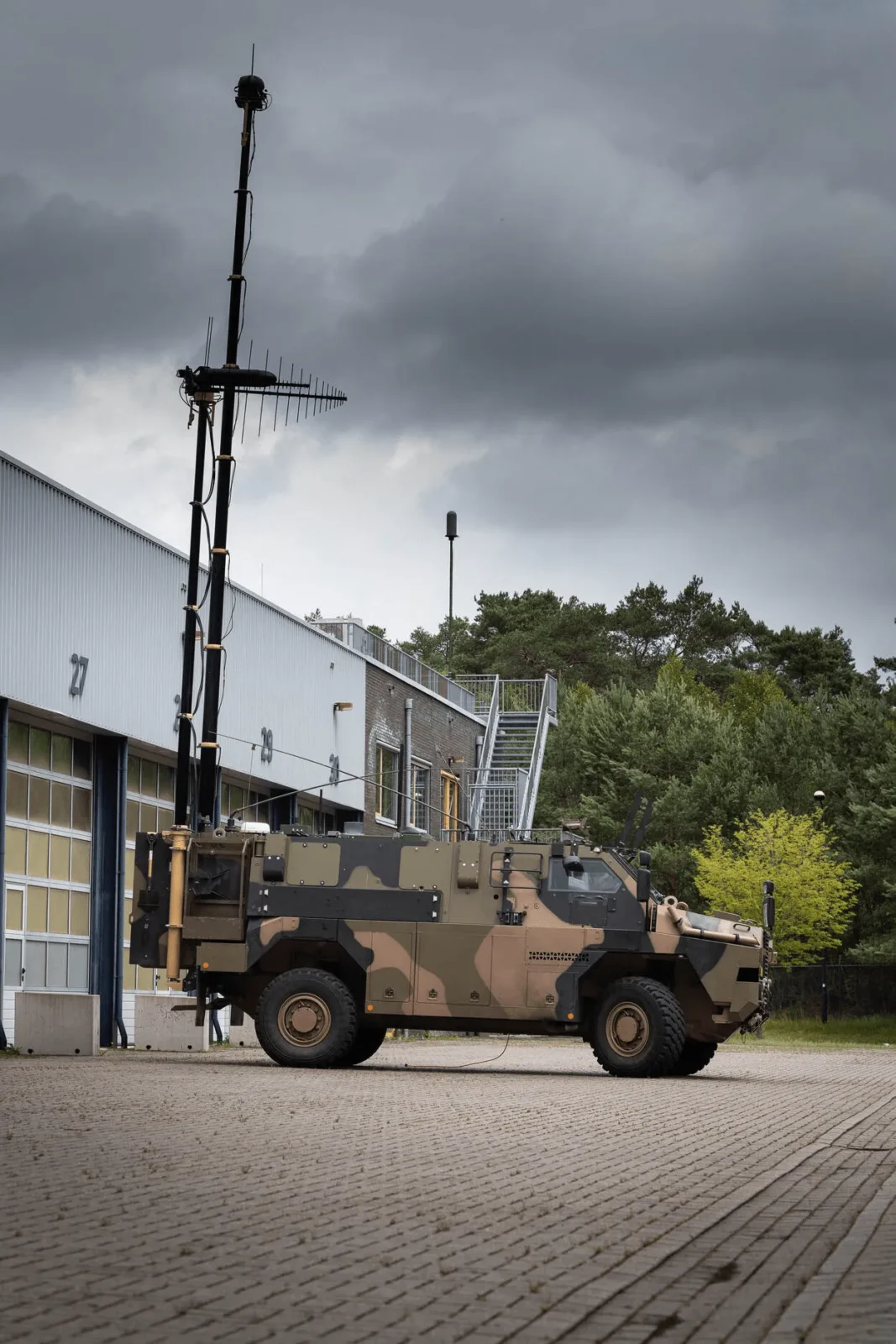
Thales has also completed concept work on a 6×6 variant. A version fitted with the Kongsberg Naval Strike Missile has been demonstrated as the Strikemaster. The related Hawkei light protected mobility vehicle, also from Thales Australia, later filled the Army’s requirement for a smaller, helicopter-portable protected vehicle.

Document Information
| Date | Change |
|---|---|
| 7 January 2026 | Initial Issue |
| 9 November 2026 | Reviewed and expanded from ADI manufacturer data, Jane’s Armour and Artillery / IDR, ANAO and open service reporting; further pass from Brendan Nicholson, The Bushmaster: From concept to combat (ASPI, 2019), Thales and ADI brochures, and Oshkosh Assured Mobility Vehicle brochure. Corrected Perentie spelling and Perry/ADI sale to September 1996; V-hull as Bendigo redesign; contract 370/A$170.04m and July 2002 renegotiation; Dutch 25+20 / 106; Al Muthanna first ten; US Oshkosh offer; Thales current specs note; Nicholson added to Further Reading; NSM internal link. |
Sources and Further Reading
Primary references for this update include Brendan Nicholson, The Bushmaster: From concept to combat (ASPI, 2019); the ADI Bushmaster specifications sheet and Reliability brochure; the Thales Bushmaster Multi-Role Protected Vehicle brochure; the Oshkosh Assured Mobility Vehicle brochure; Jane’s Armour and Artillery 2011–2012 and Jane’s International Defense Review 1/1998; the ANAO Project Bushranger audit and Project Data Summary Sheet; Australian Army equipment pages; and Australian War Memorial material on IED-damaged vehicles.
Additional Reading


