
 Doc Summary

The 40 mm CTAS, developed by the UK and France, is a medium calibre automatic weapon. It includes the CT Cannon, Ammunition Handling System, Controller, Gun Control Equipment, Gun Mount, and different types of ammunition.
CTA International (CTAI) results from a collaborative effort between BAE and NEXTER.
Cased Telescoped Armament System (CTAS) History #
As described brilliantly in this paper from Armament Research Services, cased telescoped small arms ammunition has a history dating back to the mid-eighteen hundreds.
The US Department of Defense completed significant research for medium calibre cased telescoped weapons, starting in the fifties.
Early programmes included the Control Tube Telescoped Cartridge, developed by the USAF Armament Laboratory and Gard Incorporated, the Hughes Lockless, and the Army Materiel Command Advanced Medium Caliber (AMCAWS-30), all described by Tony Williams in his book on automatic cannons (with many other examples).
None of these entered service, but towards the middle of the seventies, DARPA began work on several design approaches for defeating Soviet armour without using HEAT rounds.
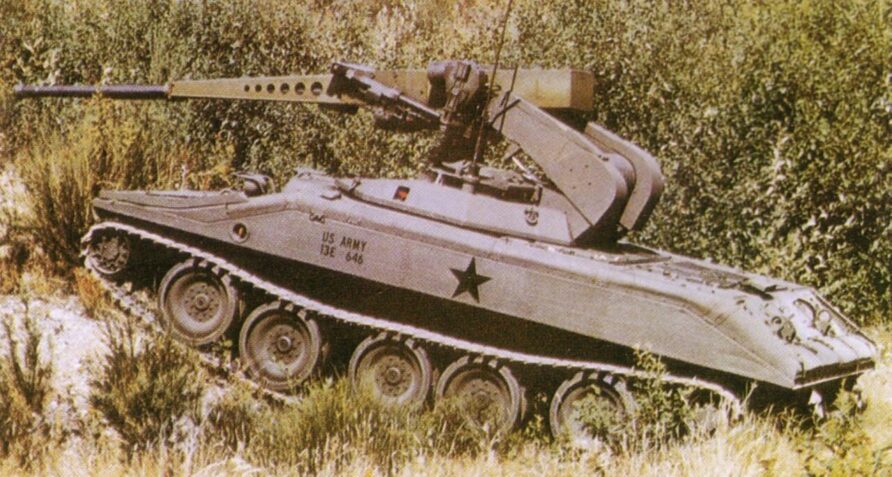
Development of the rapid-fire 75 mm smooth bore rotating breach XM-274 (designed by Eugene Stoner) started in 1973, sponsored by the ARDC Large Calibre Weapons Laboratory at Picatinny Arsenal.
ARES was awarded a $31m contract in 1981 to develop the weapon, and AAI a $28m contract to develop the ammunition.
Subsequently, it was tested on several vehicles but did not enter service.
The research effort also funded a medium-calibre weapon system called COMVAT.
Building on an earlier programme called Combat Vehicle Armament System Technology (CVAST) that used a conventional 35 mm automatic cannon called TALON, between 1986 and 1994, Ares Incorporated in the USA worked on the Combat Vehicle Armament Technology (COMVAT) programme that used a 45 mm cased telescoped weapon turret on a Bradley infantry fighting vehicle.
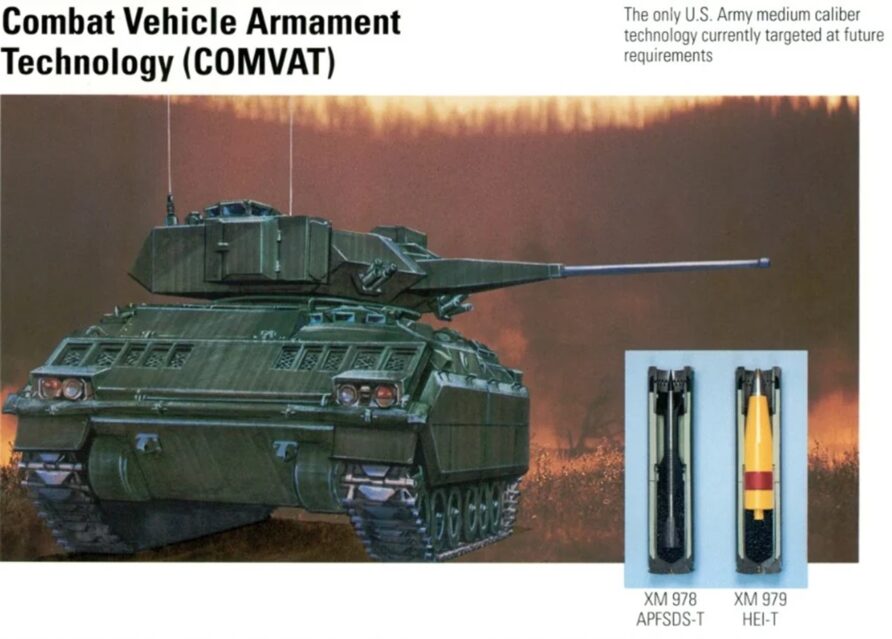
COMVAT used the XM-294 weapon system in a 2-man turret.
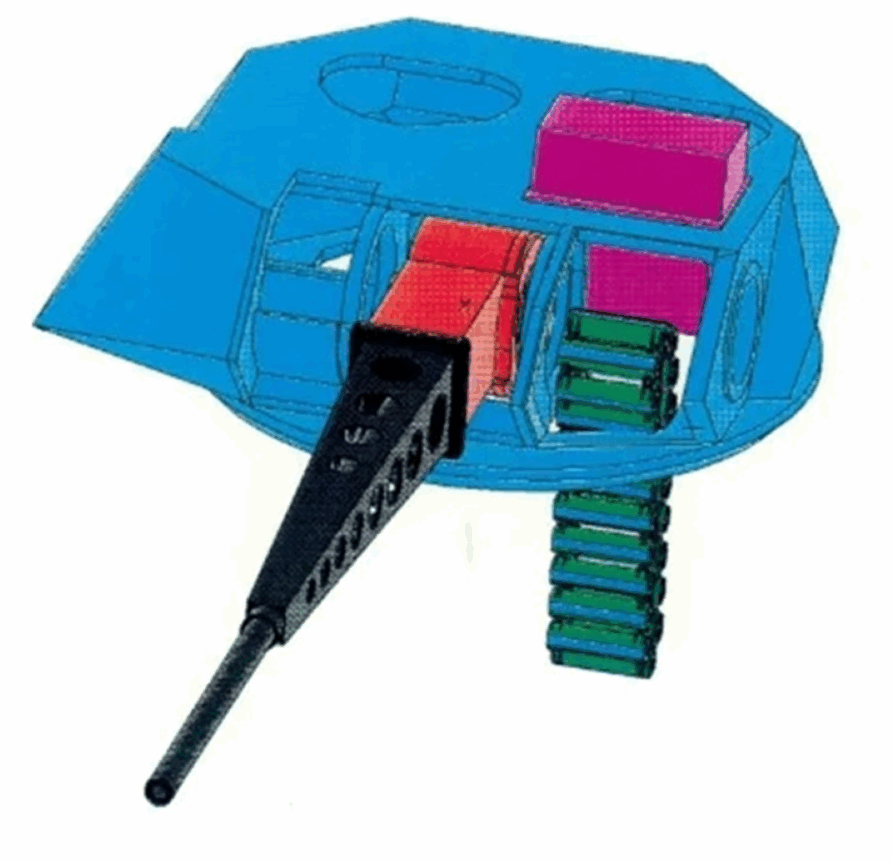
The Armament Research and Development Center (ARDEC) designed the ammunition, with Alliant Techsystems as the prime contractor.
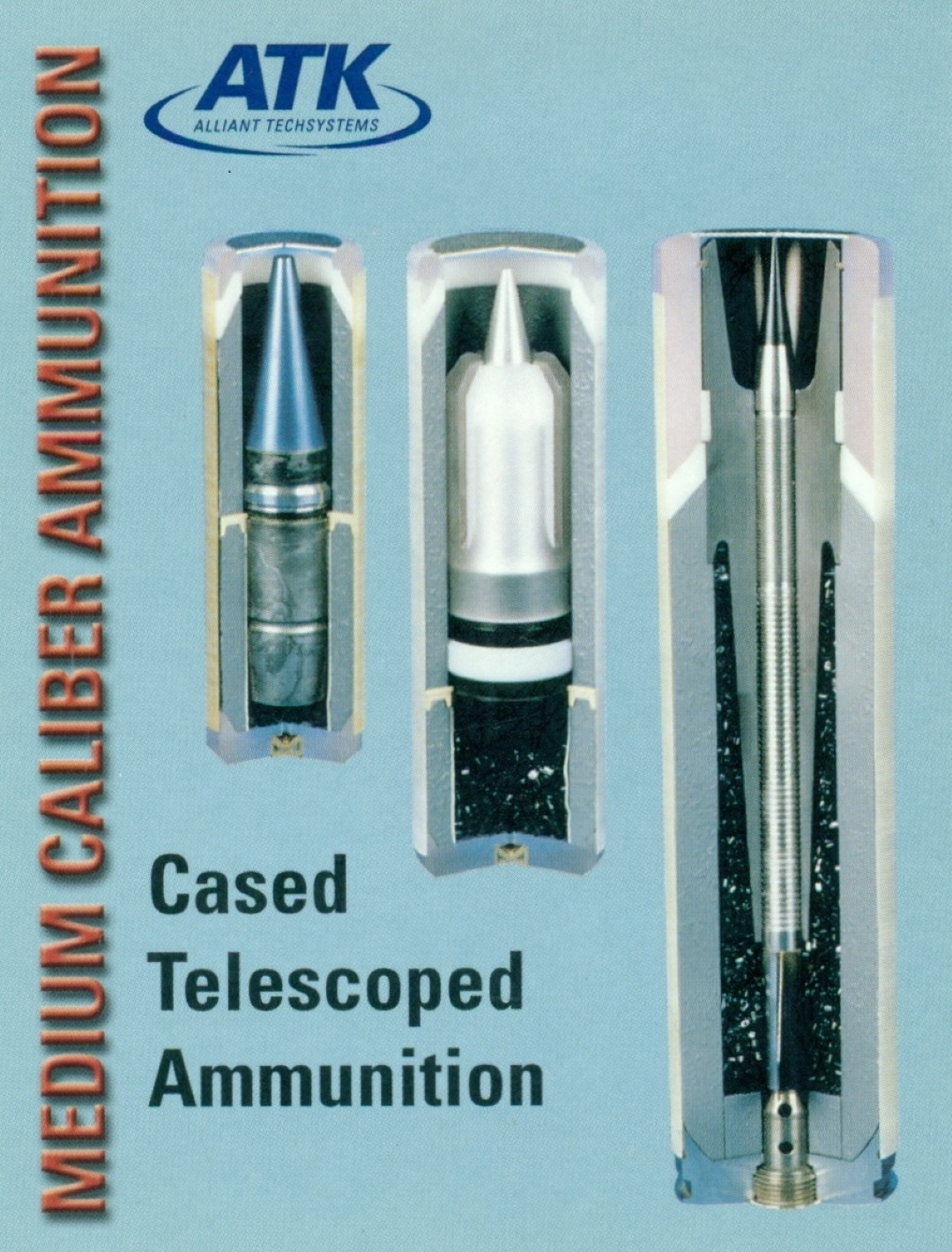
COMVAT used a linkless feed mechanism with a rate of fire of 200 rounds per minute.
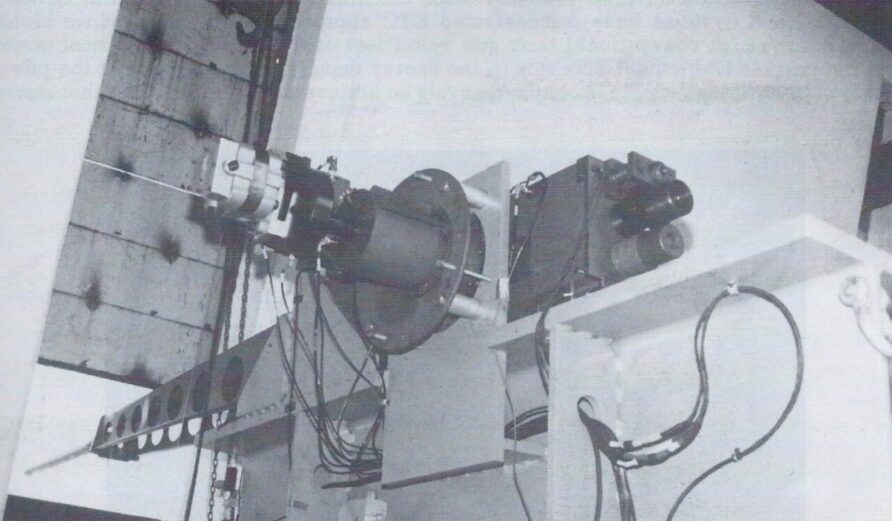
ARES would go on to develop the 45 mm ammunition for their Rarefaction Wave Gun Programme project.
In the mid-eighties, GIAT started work on 12.7 mm cased telescoped ammunition for use in a Gatling-type weapon called DECO, progressing to a larger calibre (35 mm) weapon called the XT2000.
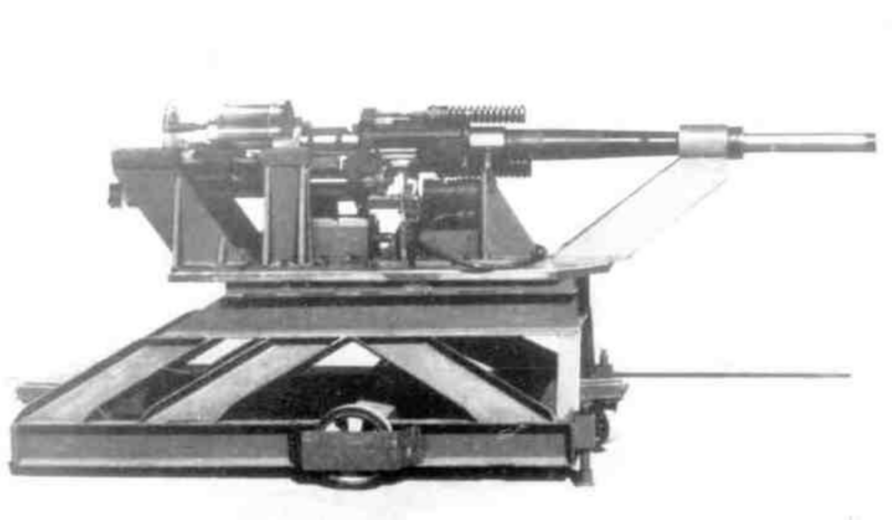
XT2000 used a rotating cylinder chamber that carried three rounds.
This video from 1988 with Eugene Stoner (of ARES Inc) provides some additional background to the early US efforts.
In a September 1989 briefing to the NATO Panel III at Bourges in France, specifications and progress on COMVAT were shared with the GIAT Corporation, GIAT also shared programme details of their XT2000 Cased Telescoped Weapon, then in early development.
In the late eighties in the UK, recognising the approaching obsolescence of the 30 mm RARDEN cannon, the MoD started a series of trade studies to develop the concept for a medium calibre weapon to replace it, one suitable to deal with emerging Russian combat vehicles.
Royal Ordnance plc was purchased by British Aerospace (BAe) in April 1987, although the brand would continue to be used for many years.
In April 1990, a French delegation visited ARDEC in the USA to share additional details on their XT2000, having already agreed that Giat Industries and Alliant Techsystems would undertake an interoperability demonstration with French Ammunition being fired in the American Gun and vice versa.
This was completed in 1991 and a summary comparison is shown below, resulting from these trials.
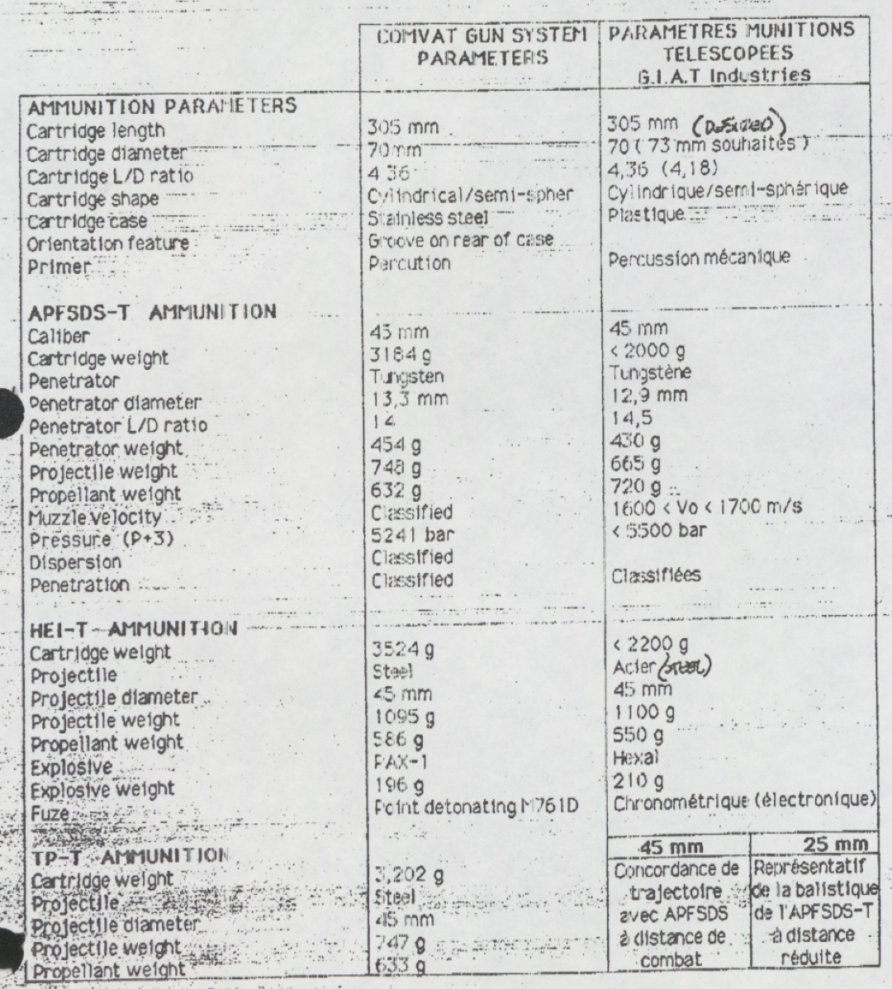
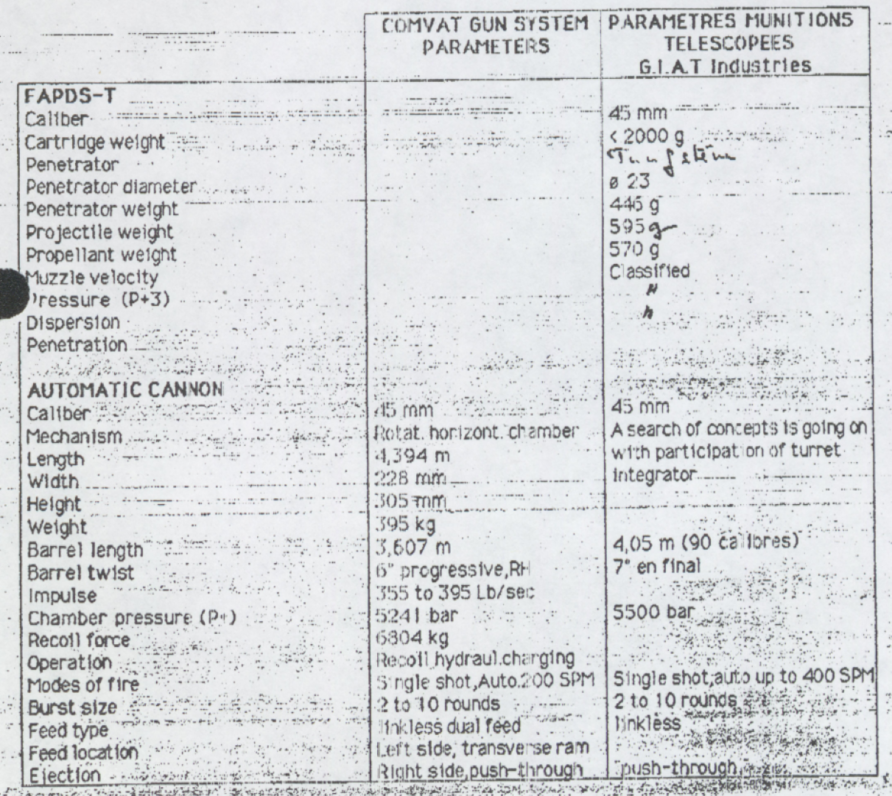
The UK MoD trade studies and the outputs from the ATK/Giat interoperability studies prompted GIAT and Royal Ordnance to explore options for a collaborative development programme.
The GIAT 45 mm Cased Telescoped Weapon System (CTWS) demonstrator was completed in 1991 with the prototype shown the following year.
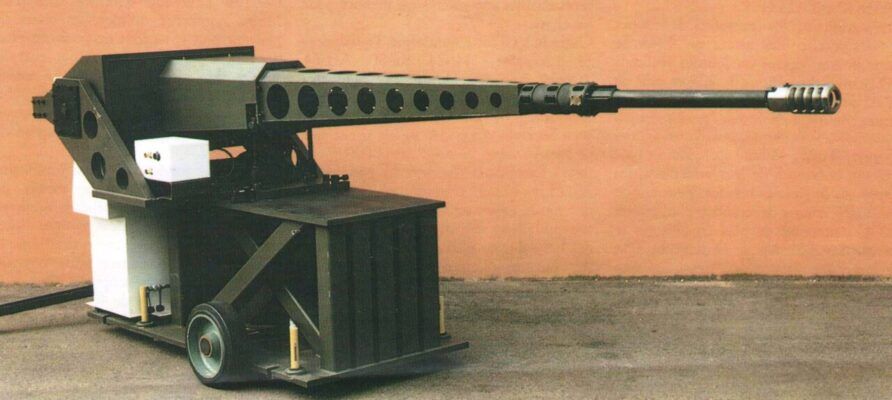
Test firing of the weapon commenced in 1992, with marketing materials extolling its capabilities.
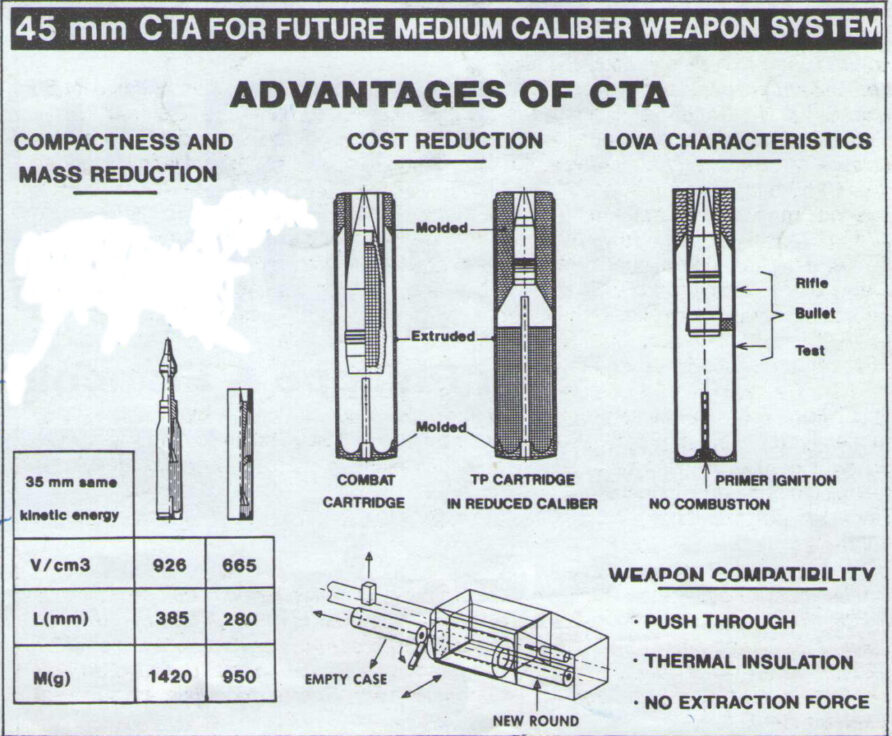
This demonstrator had some input from the ARES 45 mm weapon that had been in development in the USA.
Differences from the US system included changing from a metallic to a plastic case and using an electrical drive rather than being gas-operated.

In 1992, the UK quickly established a research programme between BAE and DRA to examine the feasibility and generate its IPR/technical understanding, launching TDP (Technical Demonstrator Programme to research the ammunition configuration the same year)
Alliant Techsystems (ATK) and Giat International signed a cooperation agreement in late 1992 to promote the 45 mm weapon system, this did not progress and the Giat/RO relationship was further developed.
As US interest waned, BAE, GIAT (industry), MoD/DRA and French Government/DGA decided to develop the concept further.
The CTWS was then positioned for TRACER, a midlife Warrior upgrade, and the French Véhicule d’Appui Direct (VAD) requirement that would use the Moyen Calibre Futur (MCF) weapon.
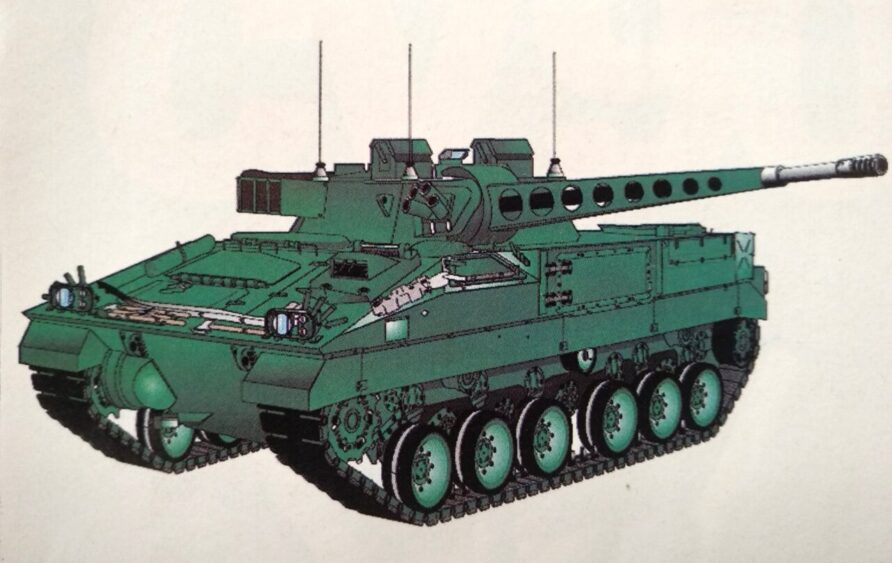
In 1992, Staff Target (Land) 4061, more commonly known as TRACER, Tactical Reconnaissance Armoured Combat Equipment Requirement, was released.
It was to meet a requirement for CVR(T) replacement.
TRACER was intended to utilise the 45 mm CTWS.
In 1994, the joint development of the 40 mm CTAS was formalised by creating a 50/50 Joint Venture between GIAT and Royal Ordnance, and DRA/DGA called Cased Telescoped Ammunition International or CTAI for short.
30% of the funding for this joint venture was from the MoD and French Defence Ministry.
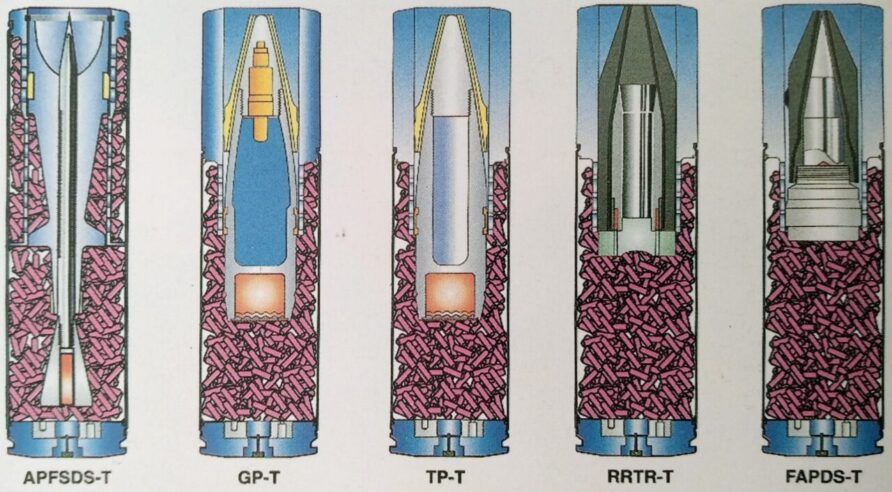
By the end of 1996, ammunition natures planned for the 40 mm CTAS included Armour Piercing Fin Stabilised Discarding Sabot-Tracer (APFSDS-T), General Purpose-Tracer (GP-T), Training Practice-Tracer (TP-T), Reduced Range Training Round-Tracer (RRTR-T), and Frangible Armour Piercing Discarding Sabot-Tracer (FAPDS-T).
This 1996 document from the US Office of the Inspector General evaluated development activity.
Cased Telescoped Ammunition and Gun Technology. Air Force laboratory personnel conceived the cased telescoped ammunition concept in 1954. The cased telescoped concept places the ammunition projectile completely within the cartridge, instead of protruding from the top of the cartridge as in conventional ammunition. Further, the cased telescoped ammunition cartridge is formed into a right-circular cylinder, instead of a tapered cylinder as in conventional ammunition.
The report was published in response to a ‘Defense Hotline’ complaint that the DoD has been wasting money on cased telescoped ammunition and systems for ’41 years’.
Ouch.
The report concluded…
Our evaluation substantiated the inherent technical problems that prevent the successful development and fielding of a cased telescoped ammunition and gun system. Cased telescoped ammunition is ballistically inefficient with inherent performance, weight, volume, and cost problems. Cased telescoped guns have not been fully demonstrated and possess inherent operational and barrel-life problems.
In addition to the technical problems, the technology faces cost and Service requirements problems. The life-cycle costs of a cased telescoped ammunition and gun weapon system are significantly greater than those for a conventional weapon system. Further, no known Service requirements provide the impetus to pursue cased telescoped ammunition and gun technology.
The final report is reproduced below
https://media.defense.gov/1996/Jun/14/2001715295/-1/-1/1/96-164.pdf
This document effectively signalled the end of US cased telescoped weapons system development efforts.
In the same period, the US Army started looking at a replacement for its Bradley M3 in Cavalry squadrons, and the M1114 HMMWV ‘Humvee’ in scout platoons, in a programme called the Future Scout Cavalry System (FSCS).
The 45 mm CTAS was modelled against various 30 mm, 35 mm, and 40 mm systems, although it was established that conventional systems would be adequate against the most likely target set, performance fell away rapidly if those targets employed reactive armour.
Two initial architectures were shared with vehicle manufacturers involved with TRACER and VAD, one optimised for existing turrets (Architecture 4- Warrior, unbalanced mass), and another for newer designs (Architecture 6 – TRACER, balanced mass).
Testing continued, including some rounds fitted with an Oerlikon Advanced Hit Efficiency and Destruction (AHEAD) fuze.
The TRACER and FSCS programmes were subsequently harmonised, and a joint project was created.
Both requirements would be met by a single vehicle, the Armoured Scout and Reconnaissance Vehicle (ASRV).
The Armoured Scout and Reconnaissance Vehicle specifications were described in a Memorandum of Understanding signed by the US and the UK in July 1998, the original Operational Requirements Document having been agreed in December 1997.
France and Germany requested observer status on TRACER, although neither had a comparable requirement.
In 1997, the decision was made to move the CTAS calibre to 40 mm and rename it the CT2000.
The ammunition was reduced from 70 mm x 305 mm to 65 mm x 225 mm.
Work to inform this decision had been carried out in parallel with testing the 45 mm version.
The design effort was completed for a Bradley M2A3 turret integration.
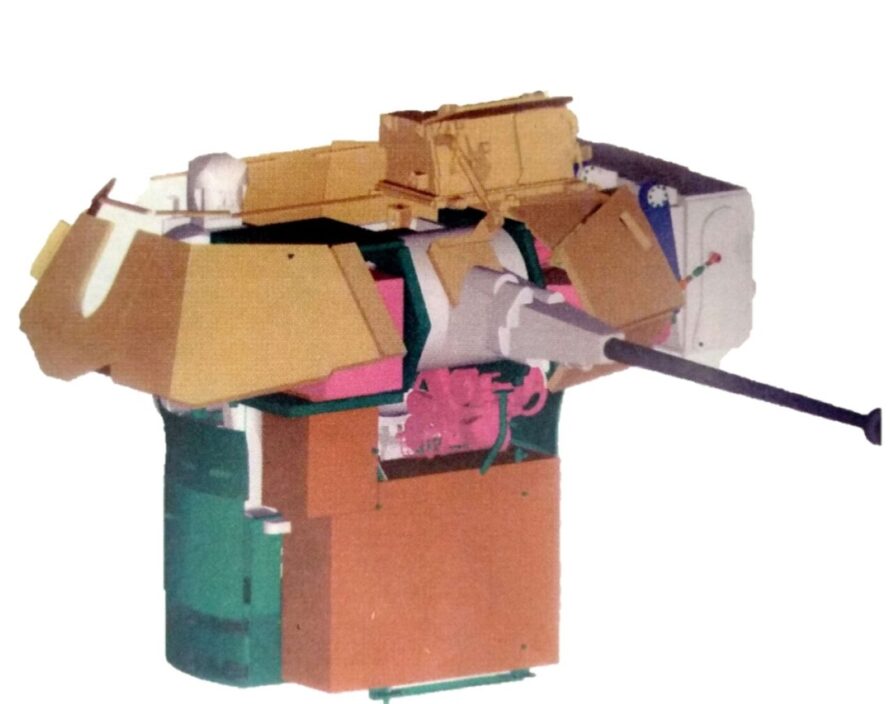
This turret had 124 rounds, not requiring any major modification to the turret structure, displays, or drivelines.
CTAI and GEC Marconi started work on the Remote Weapon Station Concept in 1996, with additional work completed in 1997. The stabilised RWTC used the 40 mm CT2000 and could carry 96 ready rounds (36 APFSDS-T and 64 GPR-T). Fully loaded, it weighed 892 kg, was equipped with a 7.62 mm GPMG, and had an elevation range of -12 degrees, and +45 degrees.
Contracts for an initial TRACER study phase were signed with two consortia, each composed of a mix of UK and US companies, in January 1999.
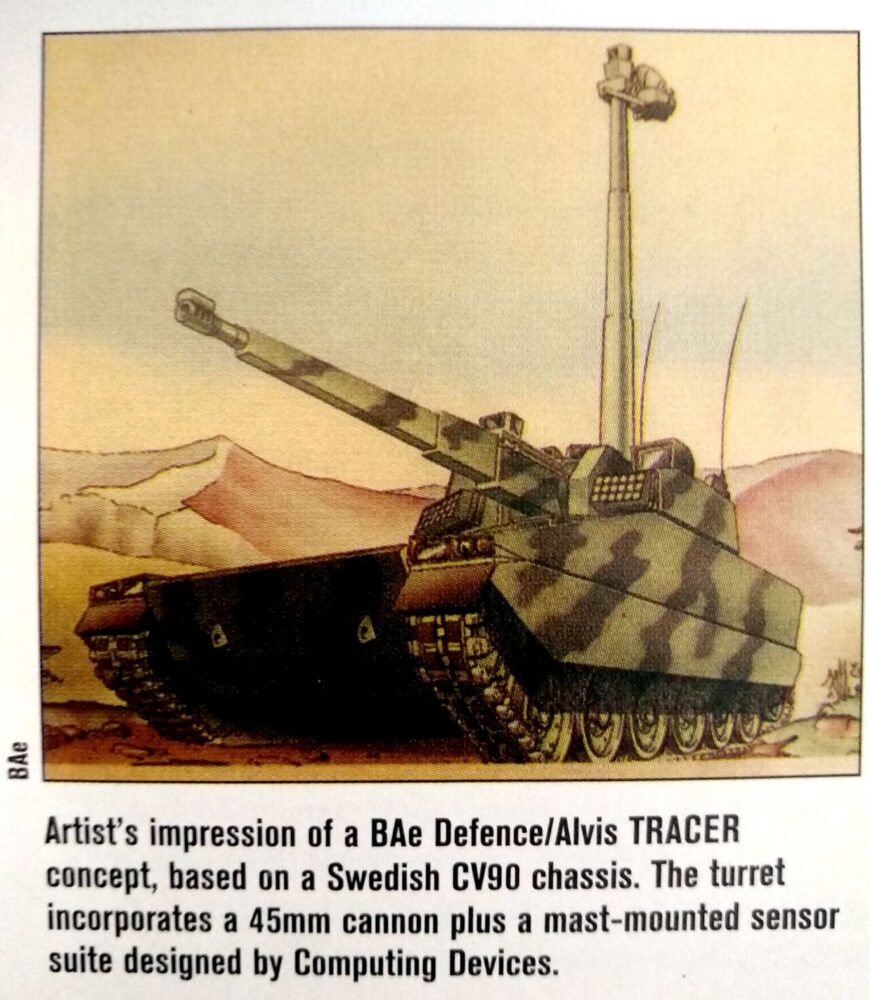
The two competing consortia for the Project Definition Phase were:
- SIKA International (British Aerospace, Lockheed Martin, Vickers Defence, Smiths Industries, Computing Devices Company, Pilkington Optronics, Shorts Missile Defence and General Dynamics)
- LANCER (Marconi, Alvis, United Defence and Raytheon).
Each was required to produce detailed specifications, training requirements, production plans/costs and an integrated demonstrator vehicle.
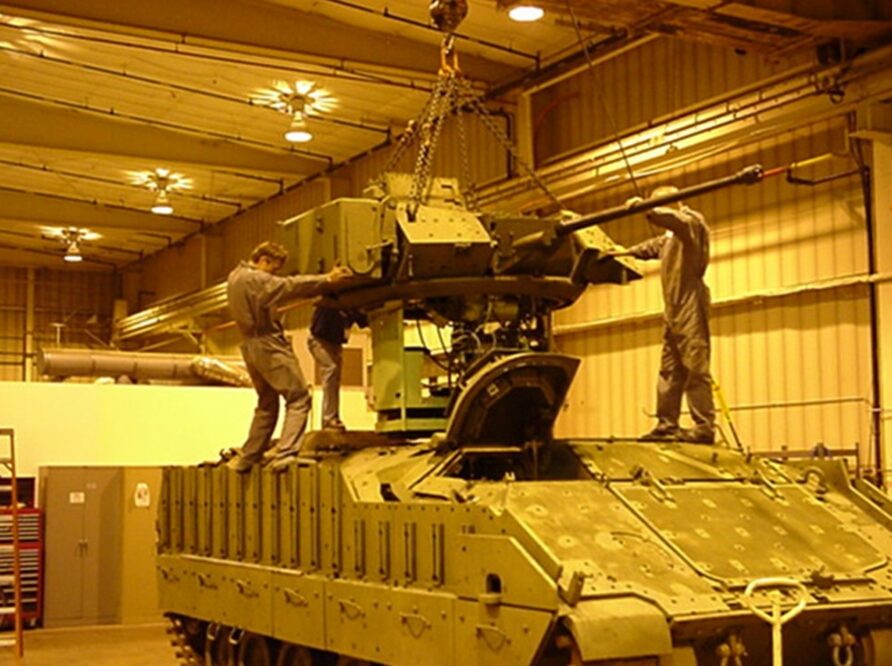
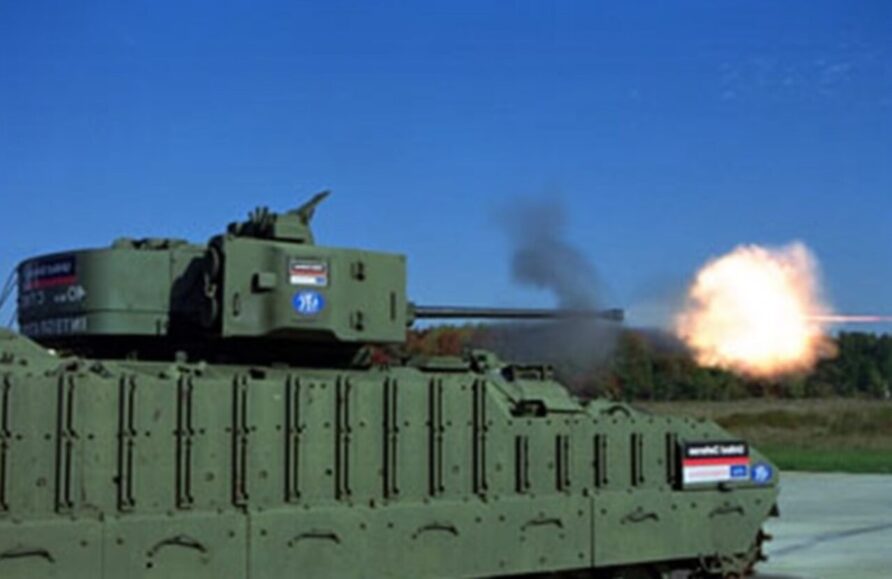
Two years after the Inspector General report, in 1999, further interest from the USA resulted in a representative turret containing the 40 mm CTAS integrated into a US Army Bradley infantry fighting vehicle.
Firing trials were conducted soon after.
The US Army Research Laboratory published an evaluation report following the test programme.
https://apps.dtic.mil/sti/tr/pdf/ADA381396.pdf
Work on TRACER continued with both consortia testing their prototypes, each with CTAS weapons.
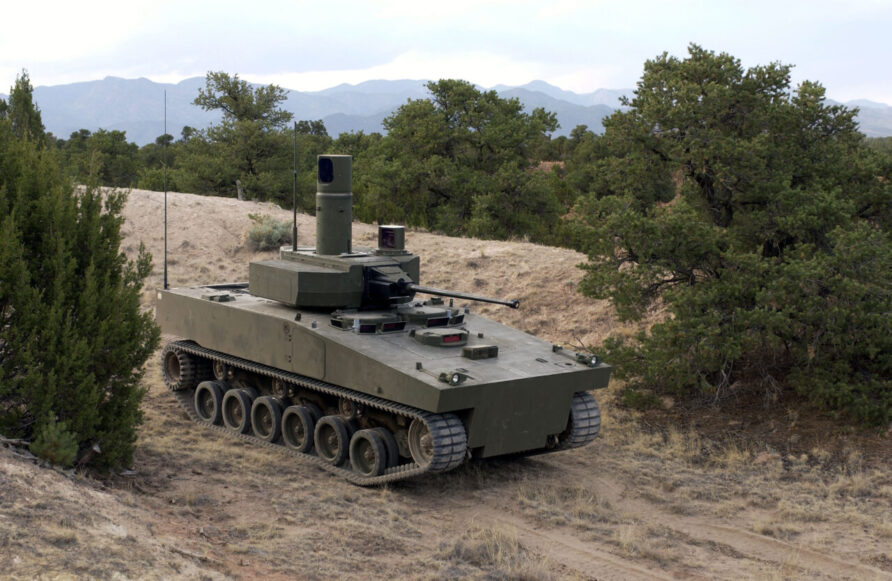
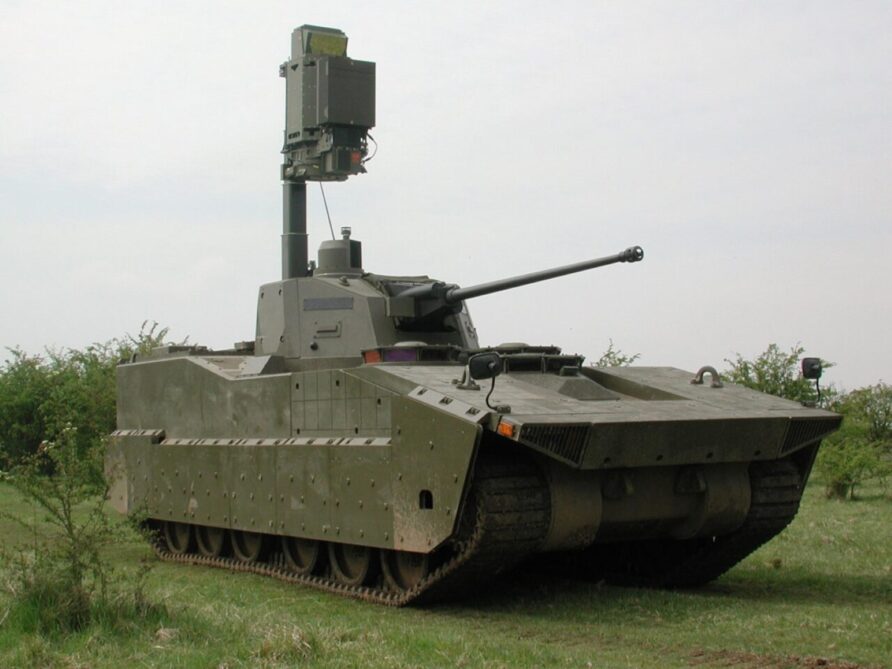
Only limited firing trials were completed by both vehicles.
To make way for the US Future Combat System (FCS), the UK FRES, TRACER was cancelled in 2001, completing their contracted work at the end of 2002.
Because CTAS 40 was still in development under separate contracts it was not directly impacted by the cancellation of TRACER and would likely form part of the FRES programme.
Therefore, various testing activities continued; icing, resistance to impact and fire, aircraft carriage and compound angle firing.
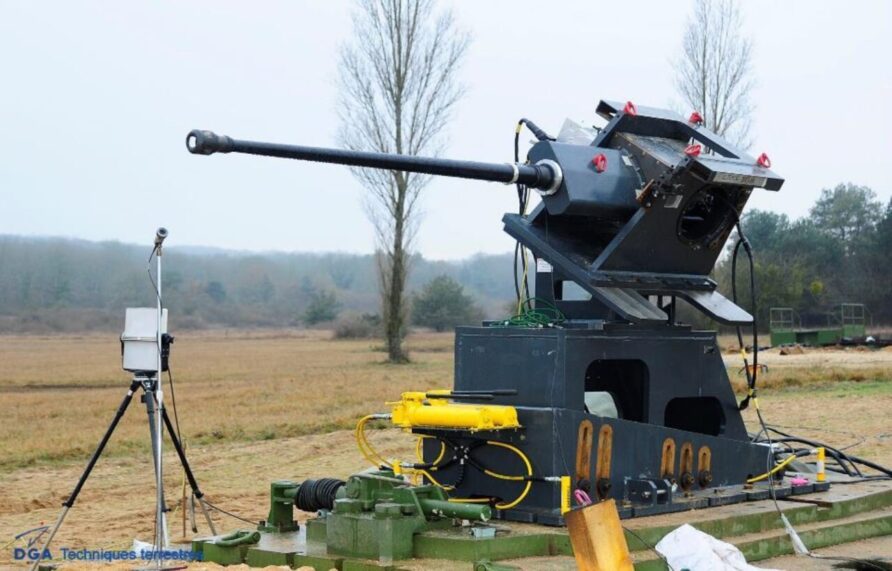
In October 2000, CTAI carried out the first ballistic firing trials involving a a round which incorporated a steerable 25 mm diameter kinetic-energy dart, derived from the Thales Air Defence Ltd (formerly Shorts Missile Systems) Starstreak air-defence high-velocity missile (HVM).
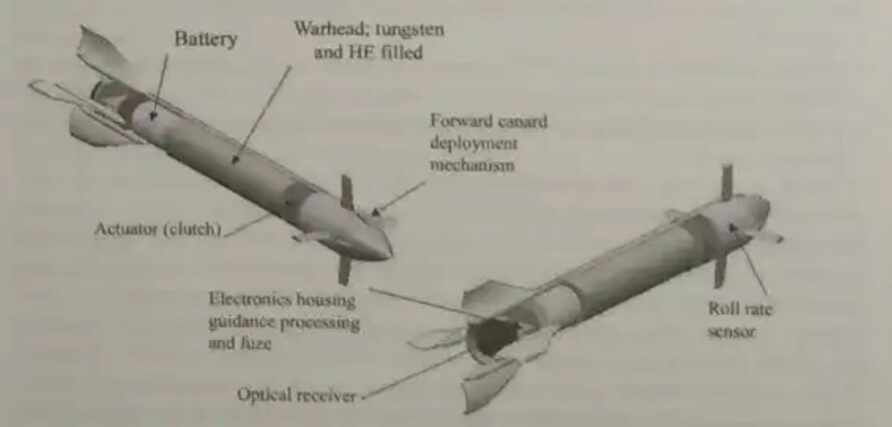
Effective range was intended to exceed 4 km.
The Warrior upgrade programme started in 2001 and again planned to include the CTAS.
The Objective Future Cannon Programme (OFCP) was started in 2002, a joint programme between the UK MoD and French DGA, to further develop CTAS and bring it to maturity.
Objective Future Cannon Programme (OFCP) defined the future programme activities and some key user requirements and specifications;
- Rate of Fire 200 Shots per minute
- Fire two ammunition types selectable <3s
- Remote operation
- Low integration volume <80 litres total swept volume
- Dispersion > <0,35 mil APFSDS > <1 mil GPR
- Minimum Fatigue Safety Life 10,000 rounds
- Operates in safety –46°C to +63°C
- Satisfies prevailing UK MoD and French DGA safety standards
- STANAG 4439 insensitive
- Reliability >98%
- Supports ‘coincidence’ fire control solution
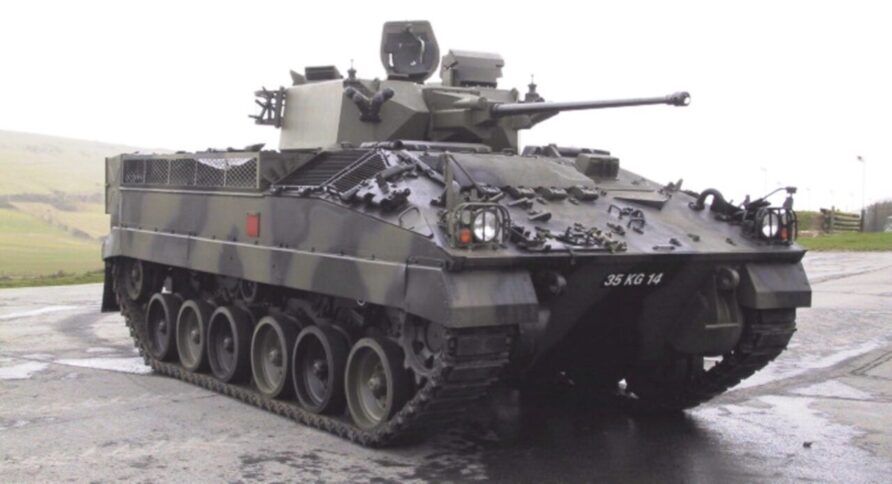
The first firing demonstration of the CTAS on a Warrior was in January 2002, in the ‘Xena’ turret, shown below.
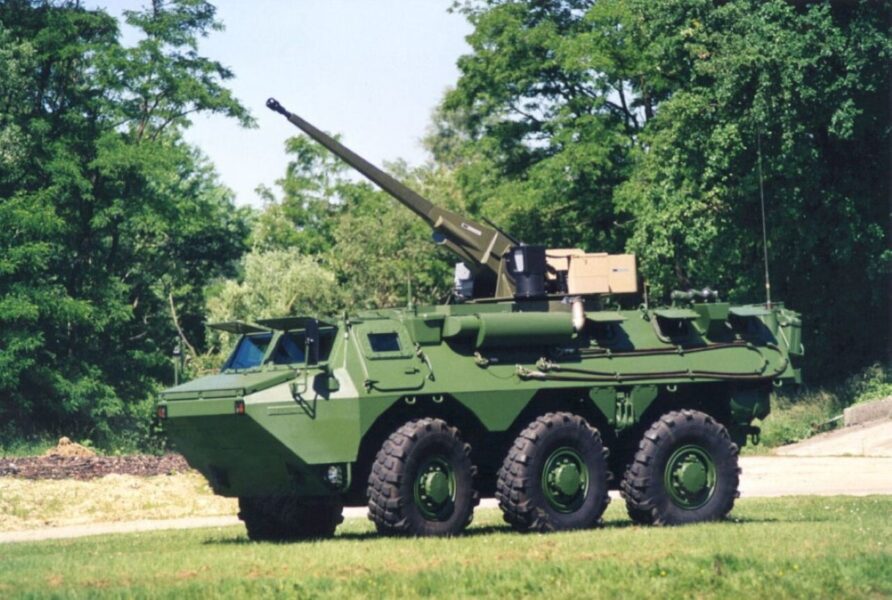
The Remote Weapon Station Concept design was tested, using a 6×6 VAB.
CTAI and BAE had been working on turret integration, already having demonstrated early models of both crewed and uncrewed turrets on Warrior, the crewed turret providing Level IV protection at a weight of 3.8 tonnes and the uncrewed turret providing Level III protection but at a lower weight of 1.5 tonnes.
The uncrewed turret also had all the ammunition within the turret and a simpler feed mechanism, a carrying capacity was 68 rounds, compared to 42 for the manned turret.
The MoD placed a £6m contract with CTAI on June 7th 2004 for the Manned Turret Integration Programme (MTIP).
This presentation from CTAI in 2005 provides a good overview of the testing activity.
https://ndiastorage.blob.core.usgovcloudapi.net/ndia/2005/garm/wednesday/duckworth.pdf
The slides above also show a VBCI with a crewed 40 mm CTAS turret and some imagery of the turret internals.
Although not specifically aimed at Warrior, the contract required CTAI to produce a two-man turret for crew clearance and development work on a Warrior, with a target completion of 2006.
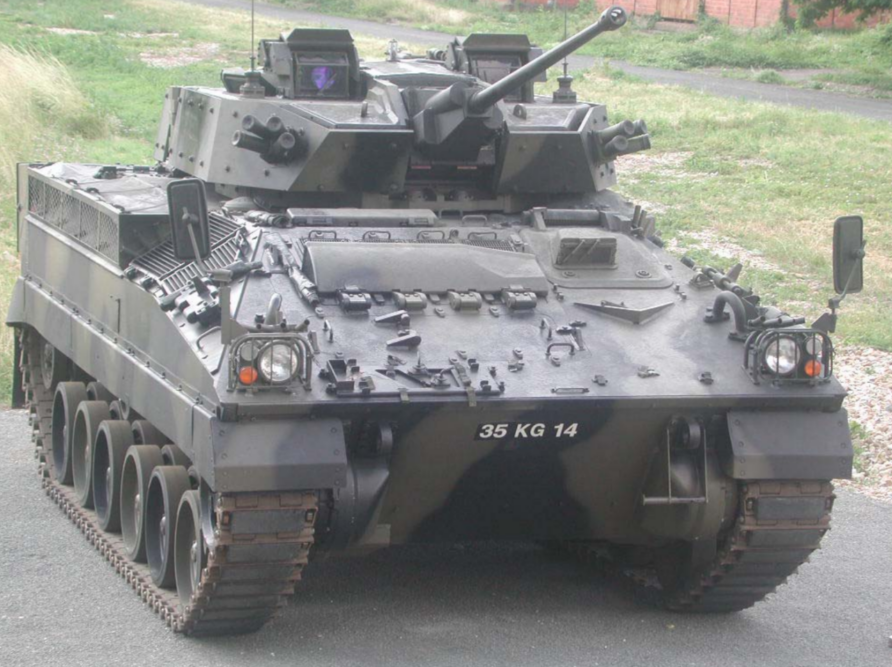
The image below shows the MTIP turret with a hinged rear bustle containing the power management system for Gun Control Equipment.
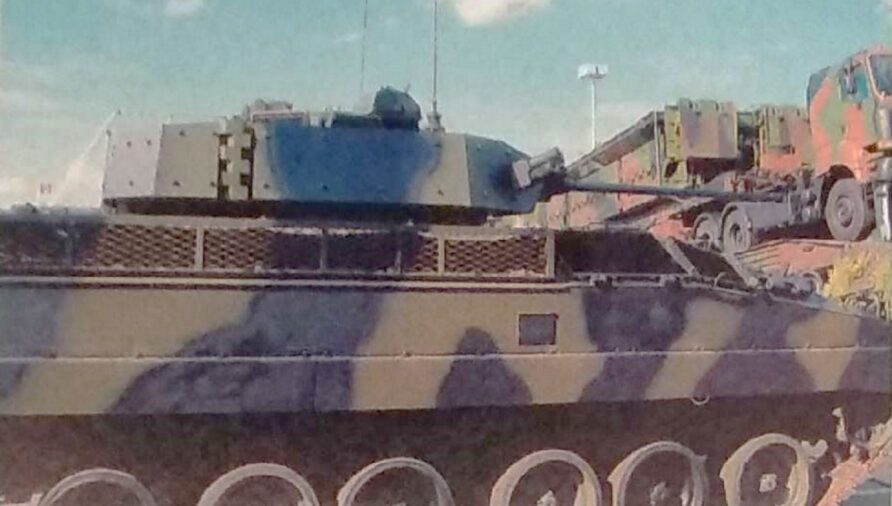
At the same time, the French Délégation Général pour l’Armement (DGA) also placed a contract with CTAI for an uncrewed turret called TOUTATIS, again, to be trialled on Warrior.
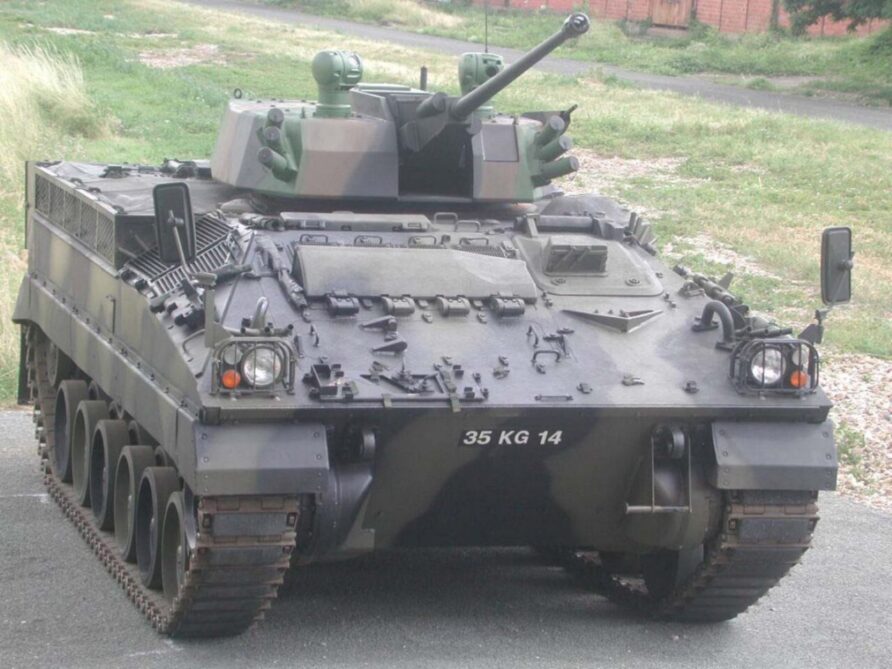
The two contracts were intended to move CTAS to SRL 6 (System integration Readiness Level).
Additional firing trials were carried out in 2004 at Ridsdale Ranges with the MTIP turret.
The original intent was that the 40 mm CTAS would be central to the Warrior Fightability and Lethality Improvement Programme (WFLIP).
In 2005, the MoD announced an open competition, despite the significant investment in the CTAS since the early nineties.
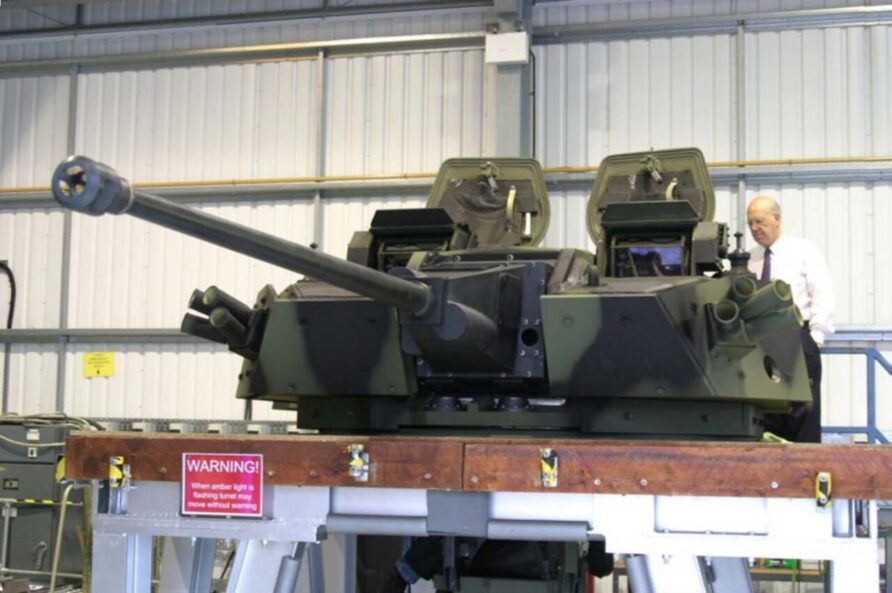
The competition originally specified a minimum calibre of 35 mm, but this was subsequently changed to 30 mm to allow other guns to compete.
Competing bidders included General Dynamics with a version of their Mk46 turret, as fitted to the proposed USMC Expeditionary Fighting Vehicle and now used in naval applications
Selex offered a Mk 44 Bushmaster in the Oto Melara HITFIST turret.
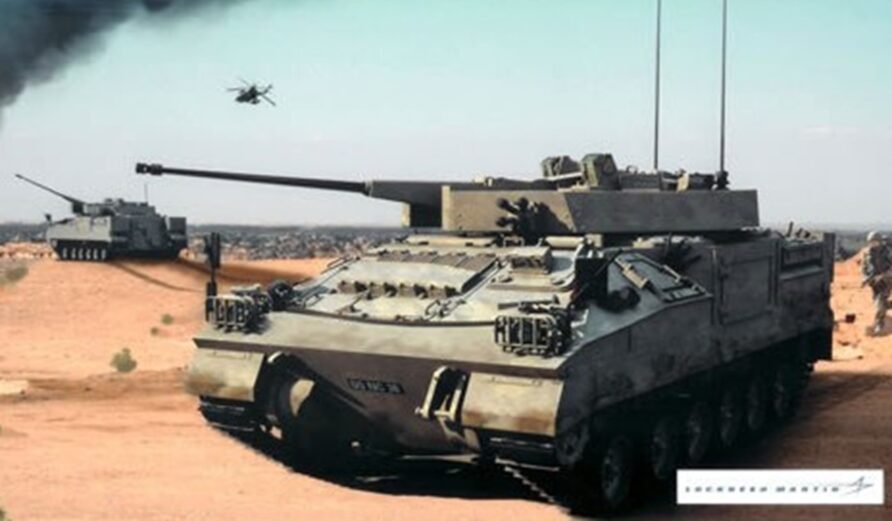
Lockheed Martin/Rheinmetall is a modification of the existing Warrior turret using the Mk44 Bushmaster 30 mm weapon.
CTAI/BAE, with 40 mm CTAS in MTIP-2, was an evolved version of their mature design.
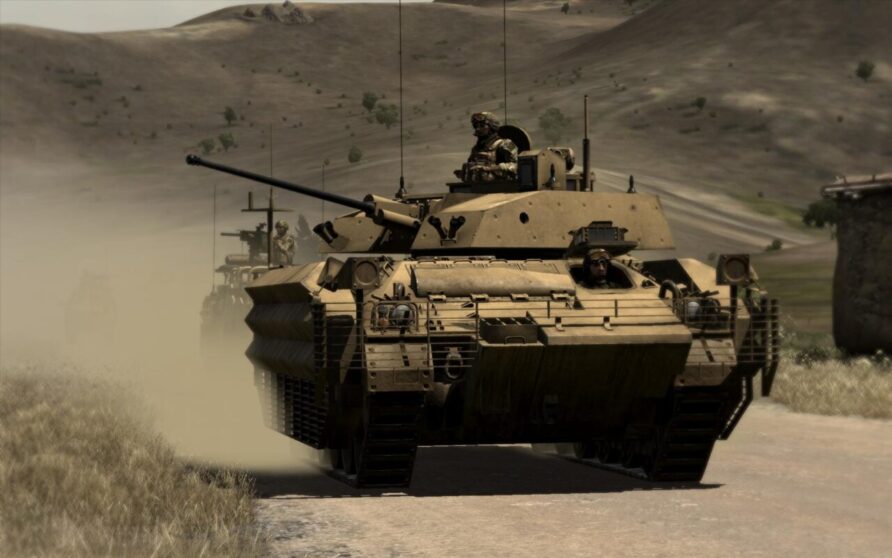
Based on a decade of experience, both BAE (also Warrior OEM) and CTAI insisted that a new turret would be needed, not a modification of an existing turret.
France and the UK agreed on a common certification process for the 40 mm CTWS in March 2006, with initial firing trials at Lulworth that year, with the MTIP-2 turret.
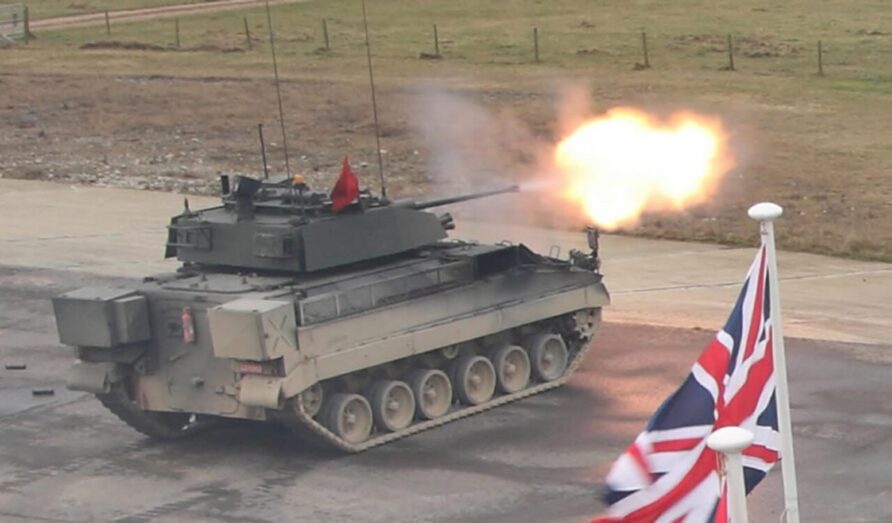
In April 2008, the MoD announced that the CTA International 40 mm CTWS had been selected for both the Warrior and FRES Scout, although the MoD did not select a turret design.
In response to the MoD’s earlier requirements, the industry had bid for both cannon and turret, now they would have to bid for only the turret, with the CTAS being provided as Government Furnished Equipment (GFE).
This did not go down well with the bidders.
General Dynamics then withdrew from the competition, leaving Selex, BAE and Lockheed Martin, all but one now facing the prospect of redesigning their turrets to include the now-mandated 40 mm CTAS.
Selex withdrew later in the year, leaving Lockheed Martin and BAE to compete for the requirement, the former now having to use the 40 mm CTAS rather than their earlier 30 mm offering (shown below)
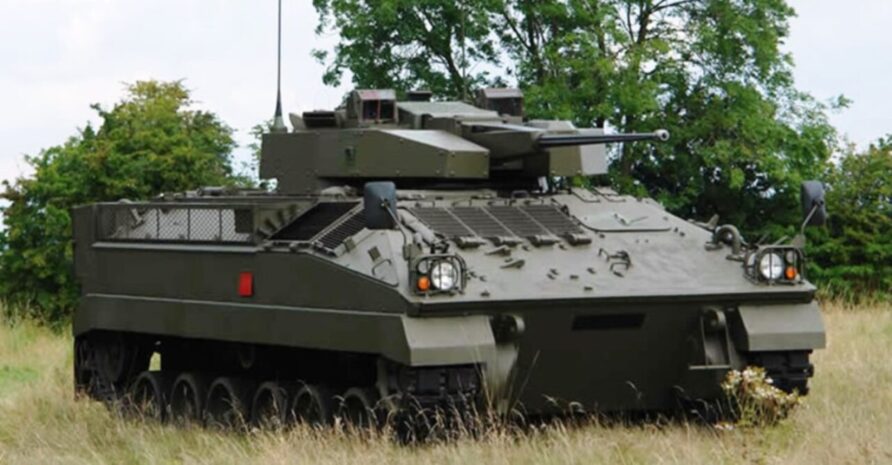
At the June 2009 Eurosatory show, BAE showed their largely self-funded MTIP-2 turret on a Warrior chassis.
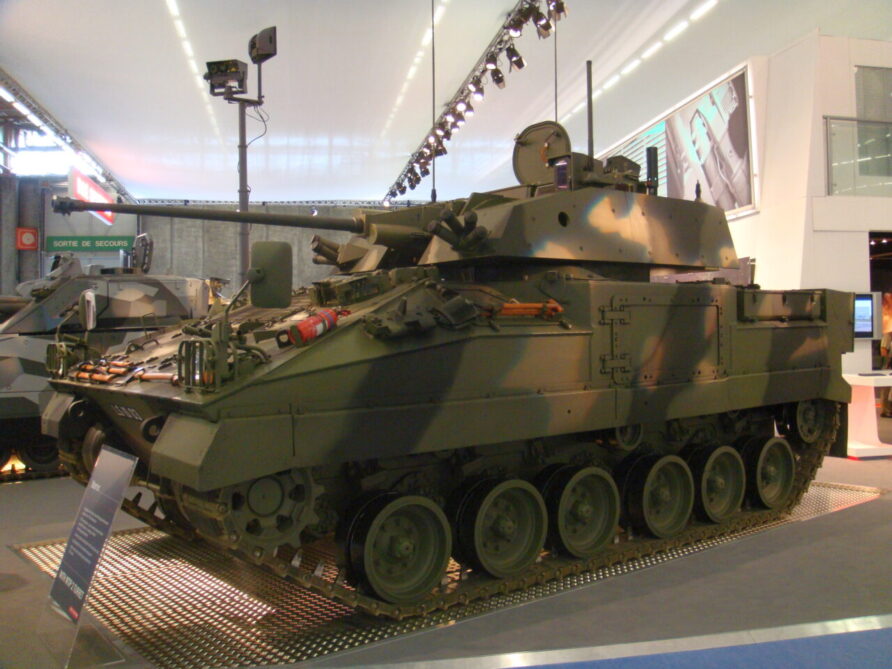
The MTIP-2 turret was a brand-new design with a fully stabilised 40 mm CTWS and applique armour package that provided the same protection level as the hull.
BAE marketing materials emphasised that the same turret could be used for Warrior and the then, FRES Scout.
By the end of 2009, after Lockheed Martin had been awarded a study contract to investigate a common Warrior/FRES turret, it became clear that there would be two turret variants, one for Warrior and the other optimised for the reconnaissance role.
Some observed that this conveniently undercut the benefits offered by the common BAE design, with Lockheed Martin marking their homework and providing themselves with a commercial advantage.
BAE and General Dynamics promoted their respective entries for FRES SV at the beginning of 2010, BAE again emphasised the benefits of a common turret based on their MTIP-2, although with minor differences depending on the role.
Outwardly there was little to distinguish the two, both used already in service infantry fighting vehicles of nineties origin as the base platform. Both were equipped with the mandated 40 mm CTA cannon, a range of C4ISTAR, protection and various automotive and protection upgrades.
BAE announced their investment of £4.5 million in a Turret Test Rig for both Warrior and FRES programmes in February 2010.
The £4.5m Turret Test Rig (TTR) will mimic the field testing of turrets for Future Rapid Effect System (FRES) Scout and Warrior vehicles by subjecting them to tests under extremes of temperatures. The tests are expected to take a turret through a 20-year lifespan in 12-18 months.
The facility is closely modelled on BAE Systems’ Mission Equipment Vibration Table (MEVT) in Minneapolis, built for the US FCS programme. Until now this was unique. The vibration created by tracked vehicles makes attaining good reliability very challenging, particularly for electronic components. Testing in the field, while necessary, is time-consuming, expensive and inefficient. Systems modelling and analysis manager Vince Whelan has relocated from Minneapolis where he worked on the MEVT to commission and use the new facility. He explains:
“The TTR will replace a large proportion of field trials with testing under tightly-controlled conditions. We will be able to begin these trials much earlier in the development process so that field trials become a matter of verification rather than investigation. We will also be able to test and iron out any snags in suppliers’ equipment earlier. “Having the TTR where the design team is based will help us pinpoint – and therefore solve – the source of any problems much more quickly and easily, so that we and the MoD can have confidence in meeting their demanding reliability targets.”
The rig was ordered four months ago and the facility is expected to be commissioned in September this year and will sit alongside the Systems Integration Facility which is already being heavily used for work on FRES and Warrior upgrade.
France and the UK agreed to further development and qualification for the 40 mm CTA weapon in February.
In March 2010, it was announced that General Dynamics had been selected for FRES SV Recce Block 1, or more accurately, were chosen as the preferred bidder.
It also emerged that General Dynamics would use a turret provided by Lockheed Martin, the actual design based on the Rheinmetall LANCE medium calibre turret. The selection of Lockheed Martin as the turret supplier was greeted with surprise by many in the industry as they had very little or no experience with the CTA system and the decision ignored both BAE and Nexter designs that were relatively mature.
With the 2010 General Election out of the way, the MoD and General Dynamics announced successful negotiations in June 2010 and the award of a £500 million contract for the Demonstration and Manufacture phase of FRES SV Recce Block 1.
In February/March 2010, alongside FRES, the MoD was also considering the future of the Warrior Capability Sustainment Project (WCSP), a competition between BAE and Lockheed Martin. Lockheed Martin proposed an upgrade of the existing Warrior turret and BAE, their MTIP 2 design,
In late March 2010, the MoD Investment Approvals Board recommended a year-long delay to WCSP.
Before the year was out, Lockheed Martin was awarded the Warrior Capability Sustainment Programme (WCSP) contract in October 2010.
The demonstration phase was expected to cost £200 million and manufacture £642 million. WCSP was designed to extend the service life of Warrior beyond 2040.
At this point, Lockheed Martin insisted that an upgraded Warrior turret would be used for the WCSP vehicles, with a new turret design for Scout SV.
By the end of 2011, Lockheed Martin had been selected by General Dynamics to provide the Scout SV turret and by the MoD to provide the WCSP turret, as part of the wider programme.
Both, with different turrets, were to have the same 40 mm CTAS.
CTAI and Thales revealed a vehicle-based anti-aircraft system based on the 40 mm CTAS, called Rapidfire.
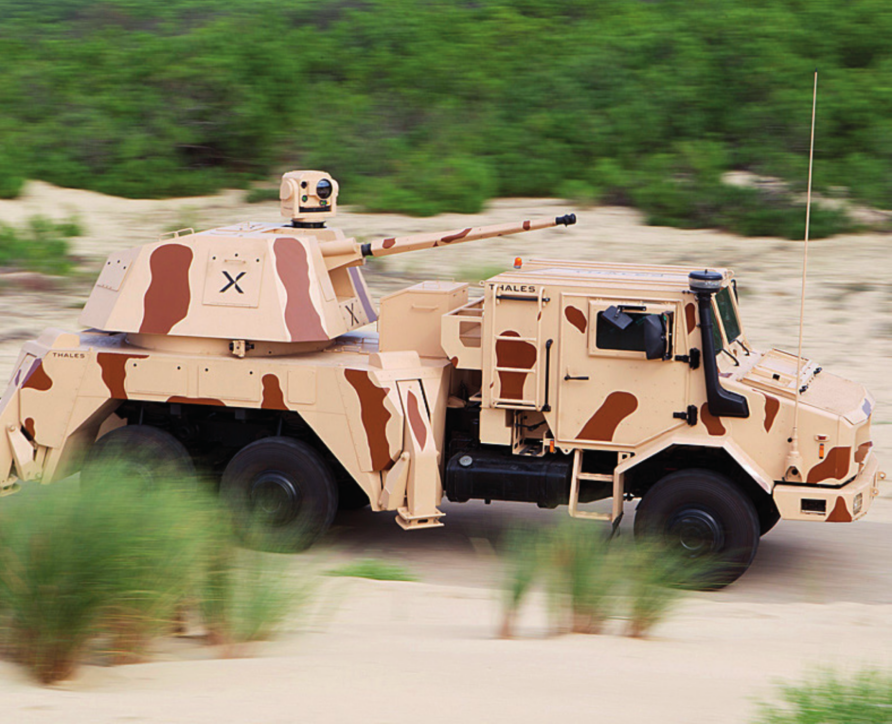
In the summer of 2013, a further purchase of CTAS ammunition was announced, to support both Scout and Warrior programmes.
Procurement of Cased Telescoped Cannons (CTC) Ammunition
The Specialist Vehicle Cannon Project Team, part of the UK Ministry of Defence, intends to place a further buy of ammunition, with CTA International through an Amendment to Contract No FRES/0075, to support the demonstration phases of the Cased Telescopic Cannon which will be provided to Prime Contractors for integration into the Scout Specialist Vehicle (SV) and the Warrior Capability Sustainment Programme (WCSP)
Total final value of contract(s)
Value: 25 629 034 EUR Including VAT. VAT rate (%) 20
Towards the end of 2013, news of problems with the Scout turret emerged.
Defense News reported that General Dynamics had agreed to pay Lockheed Martin several million pounds for failing to keep to a timetable on requirement delivery. It also reported problems with weight growth and a delayed ISD.
Also in 2013, Aviation Week reported interest in an aircraft version;
Someone was looking at putting the gun on a C-130 gunship,” he says, declining to identify the individual. “It was a U.S. company that got our data somewhere, and maybe it will give them an advantage over other bids. I was surprised when I got it. But the cannon is 300 kg (ca. 661 lb lb.) and has very short recoil. Of course, you have to control the pulse, but why not [put it on an aircraft]? We’ll see what happens next.”
After successful design reviews and 40 mm CTA qualification in early 2014, the WCSP achieved Initial Design Approval in January 2014.
Qualification firings included the APFSDS-T and practice rounds.
News emerged in 2014 that confirmed a decision by Lockheed Martin to abandon the Warrior turret conversion and proceed with a new turret design, this was no doubt cold comfort to BAE, who had insisted from the start that a new turret would be needed.
The whole programme was ‘re-baseline’.
In 2015, the MoD finally placed a production order for the CTWS, although there was an announcement in 2015 for a £75m order
The deal with the joint BAE/NEXTER company CTA International was for £150m and was to provide 515 weapons for the SV Scout and Warrior vehicles.
The contract also included initial spares, test equipment, specialist tools and some training.
There were planned to be 245 for the Scout and 245 for Warrior, the balance being used for training, trials, and ammunition qualification.
Defence Secretary Michael Fallon said;
Today I can announce we have signed a £150 million contract to fit the Scout with a new Cased Telescope cannon providing it with unrivalled firepower and a new ‘airburst ammunition’ capability.
France has also selected the CTAS 40 for use on their EBRC (Engin Blindé de Reconnaissance et de Combat) vehicles that were planned to replace the AMX-10RC and Sagaie vehicles, both using a common 2-man turret, the Nexter T40.
The Nexter Jaguar (VBMR) was planned to join the Griffon (EBRC) in the 5 Billion Euro Scorpion programme, announced in December 2014.
Nexter has also shown a VBCI-2 equipped with a T40 turret, the same turret that is used on their Engin Blindé de Reconnaissance et de Combat (EBRC) vehicles.
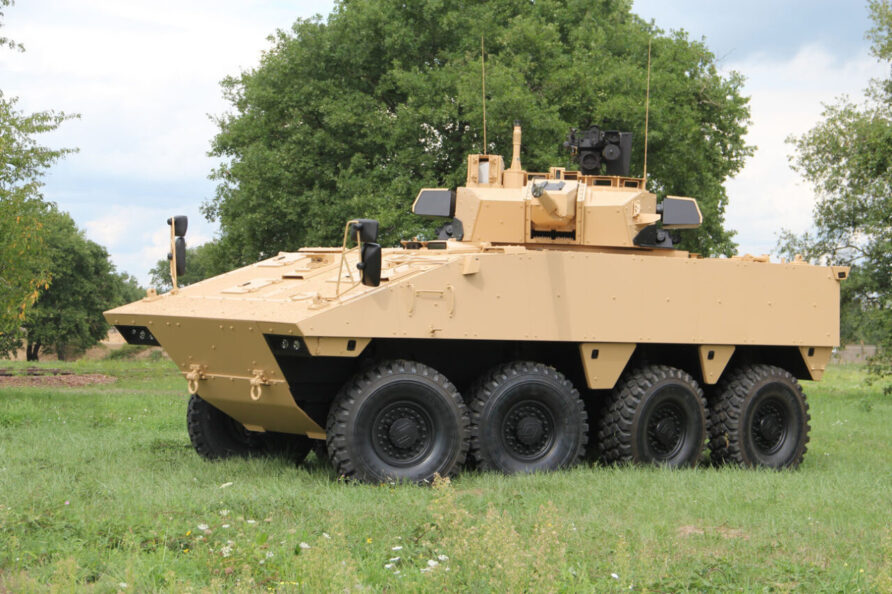
Lockheed Martin released a video of Warrior CSP live firing the 40mm CTAS in April 2015
In early April 2016, AJAX completed its first instrumented static live firing at Radnor Ranges in Powys, Wales.
Testing and qualification continued and in June 2016, the MoD issued a £12.9 million contract extension to CTAI for additional qualification.
The DE&S Specialist Vehicles Cannon Delivery Team, part of the Ministry of Defence (MOD) intends to place an amendment to contract MATT/CCAP/003 (Common Cannon and Ammunition Project — 40mm Cased Telescoped Cannon and Ammunition Qualification Programme) with CTA International (CTAI), the designer and manufacturer of the Cased Telescoped Cannon and Ammunition (CTCA) to provide services required to conduct the qualification of a Target Practice Reduced Range (TPRR) type of ammunition on behalf of the United Kingdom and French Authorities. The qualification services will comprise an initial confirmatory phase of ammunition firing trials, plus options to undertake full ammunition firing trials, testing, evaluation activities and commissioning of a production facility thereafter
In July 2016, Nexter announced the private development of a new turret family built around the CT40.
The MoD issued a contract amendment to CTAI for further qualification of the Target Practice Reduced Range round
Amendment to contract MATT/CCAP/003 with CTA International (CTAI) to provide services required to conduct the qualification of a Target Practice Reduced Range (TPRR) type of ammunition on behalf of the United Kingdom and French Authorities
The cost of this was 16.5 million Euros.
In March 2016, the first production systems were handed over
The first production standard Cased Telescoped Cannon System has been handed over to the UK Ministry of Defence (MOD) in Bourges, France by CTA International (CTAI) – a 50/50 joint venture company between BAE Systems and Nexter Systems
Ajax crewed live firing trials commenced in September 2017, a spokesperson from General Dynamics said:
The start of the CT40 cannon manned industry firing phase is a significant milestone in the AJAX programme. This cutting-edge capability that enables AJAX to pack a significant punch, alongside its wide-range of best-in-class sensors that makes it an Information Age platform, ensures that the British Army has everything they need to do their job effectively
Production and qualification continued on both Ajax and Warrior, and the Lockheed Martin Modular Turret was tested on both Boxer and AMV vehicles.
In March 2018, CTA International demonstrated the 40 mm CTWS to US Army personnel at Fort Benning, Georgia. 80 rounds were fired, including a number of the A3B air bursting nature. One of the scenarios demonstrated a typical wall breaching operation, two rounds of point detonating to create a hole that was followed by an air bursting type fire through the hole.
Belgium ordered 60 Jaguar vehicles from Nexter/KNDS in 2018.
In evidence sessions to the House of Commons Parliamentary Select Committee on Defence, both Lockheed Martin and General Dynamics laid the blame for delays with Ajax and Warrior CSP on the 40 mm CTAS; however, this was countered by the MoD.
Warrior CSP entered reliability and growth trials, nearing the end of its development programme.
A comprehensive set of test and evaluation activities of the 40mm CTAS was carried out by QinetiQ up to 2019, click HERE to read more.
In 2020, France ordered an additional 42 Jaguar vehicles, the same year the first Tranche started to enter service.
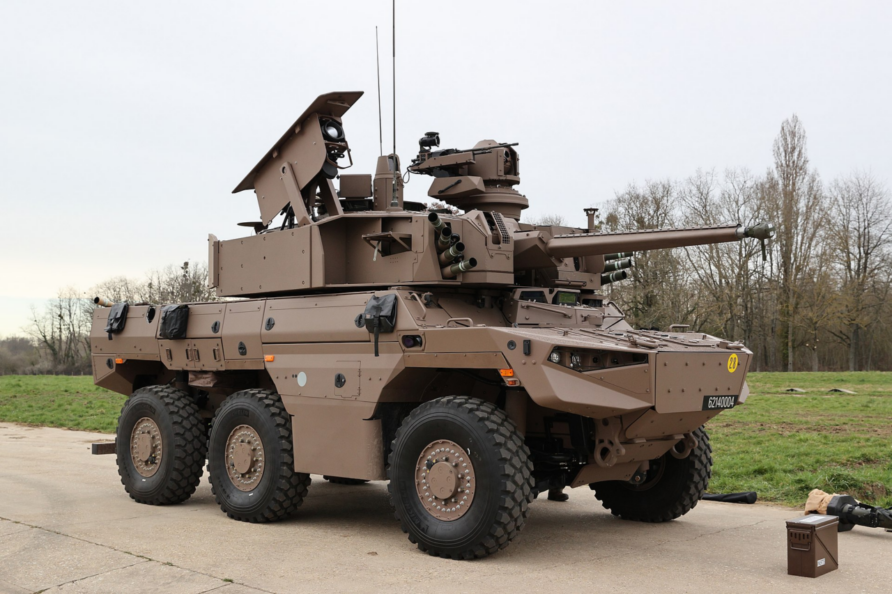
Also in 2020, it was announced that the French Navy had selected Rapidfire for close in defence.
We’re delighted to be supporting the French Navy as it enhances the self-defence capabilities of its warships. With its combination of fast-into-action time and firing accuracy, RAPIDFire, developed in cooperation with Nexter, provides the best response for protecting Navy vessels against modern threats. It has the potential to become a key component of our offering of advanced force protection solutions
Thomas Got, Vice-President Integrated Airspace-protection Systems, Thales
Warrior CSP was cancelled in 2021, the same year as the last of the 515 ordered systems were delivered.
After the cancellation of Warrior CSP, it was reported that surplus weapons might be disposed of and an investigation into improving the lethality of Boxer was carried out.
The Army is conducting an analysis on potential lethality enhancements of Boxer vehicles. As outlined in the recent Integrated Review, modernizing our armoured capabilities is not replacing ‘like for like’ but integrating our new technologies and ways of operating
Ajax continued its development through 2023, entirely a different story, with no decision on the surplus systems yet made public.
A new increment of EBRC Jaguar was announced in 2023 that would address gun stabilisation issues.
Rapidfire was shown with the Thales Lightweight Multirole Missile (LMM) in 2023.
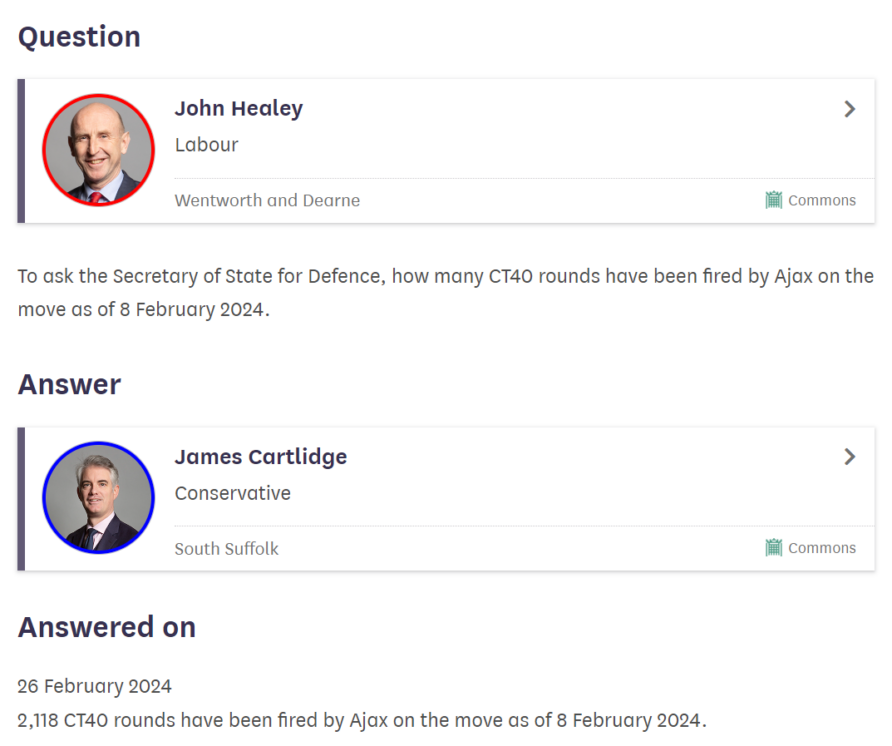
KNDS showed a model of a flatrack mounted Rapidfire system on a vehicle at the Eurosatory 2024 exhibition in Paris.
In 2025, British Army Ajax vehicles 40mm CTAS weapons were fitted with a thermal sleeve.
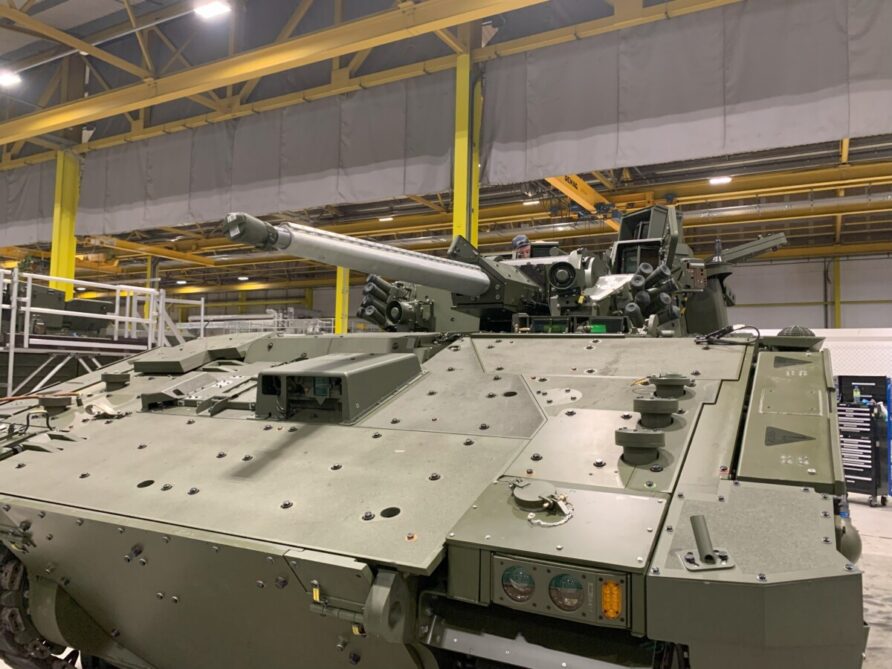
Belgium announced it had selected the 40 mm CTAS in 2025.
Capabilities and System Description #
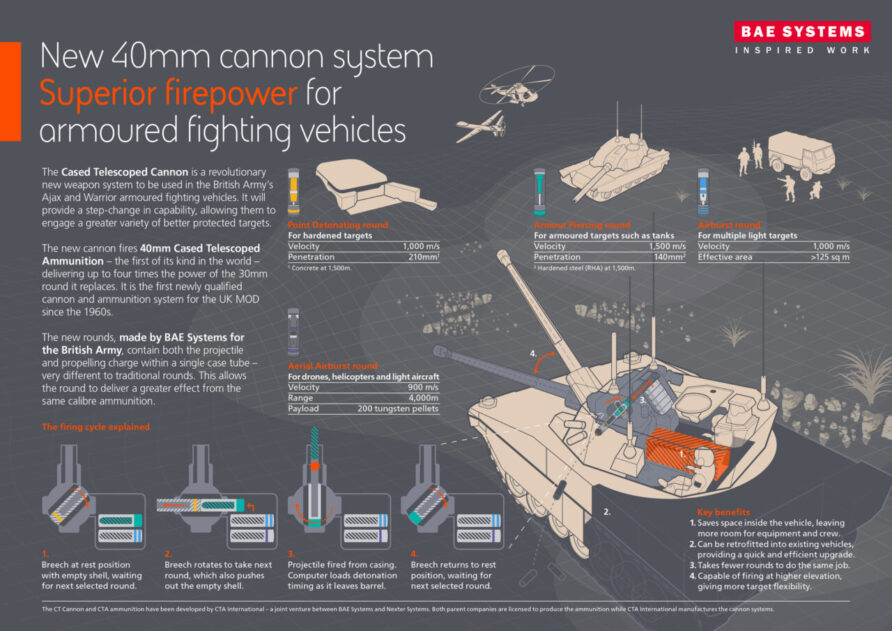
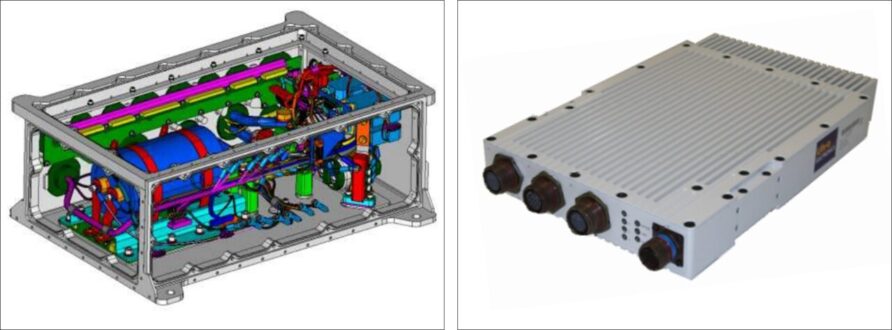
The CTAS is described by several components; 40 mm CT Cannon (CTC), Ammunition Handling System (AHS), CTAS Controller (CTAS-C), Gun Control Equipment (GCE), Gun Mount and a range of ammunition.
Gun System #
The gun is designed to be compact.
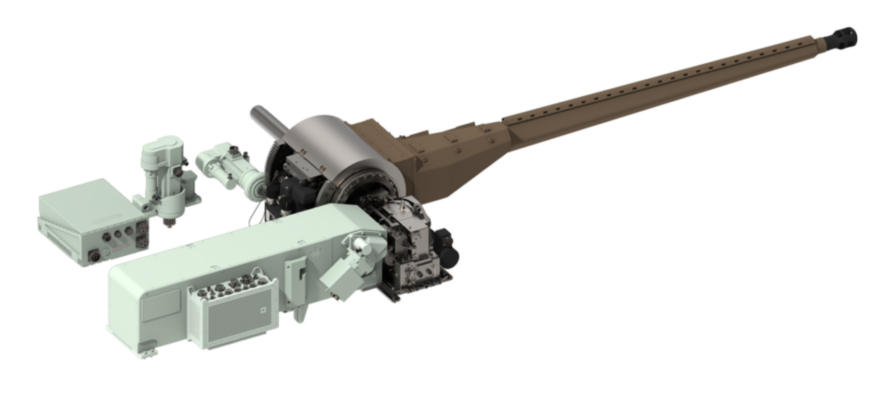
The round is inserted into the breech block through the trunnion and the rotating breech block then aligns it with the barrel, thus eliminating the need for flexible feed guides.
There are a couple of variations but the UK version will have a dual-feed system, most likely loaded with the APFDS and GPR, although other mixes may be used depending on requirements.
The system can swap from one to the other in less than 3 seconds.
A fire control system designed and manufactured by Ultra is the final component of the UK system.
Ammunition #
CTAI is marketing seven ammunition natures, described in the video below.
Armour Piercing #
The first of these is the 1.9 kg Armour Piercing Fin Stabilised Discarding Sabot — Tracer (APFSDS-T) that is designed to defeat armoured vehicles such as infantry fighting vehicles and legacy tanks.
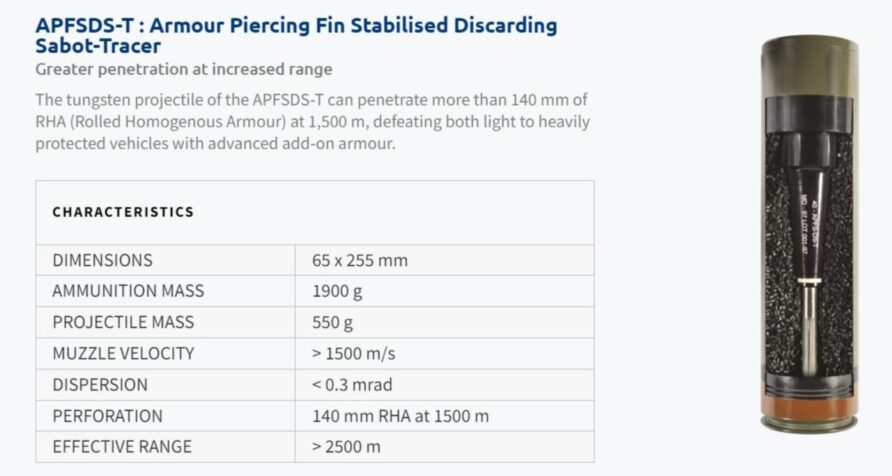
Able to penetrate 140 mm of RHA (Rolled Homogeneous Armour) at 1500m, it has a muzzle velocity of over 1,500m/s, the projectile weighs just over 500g, and has an effective range of greater than 2,500m.
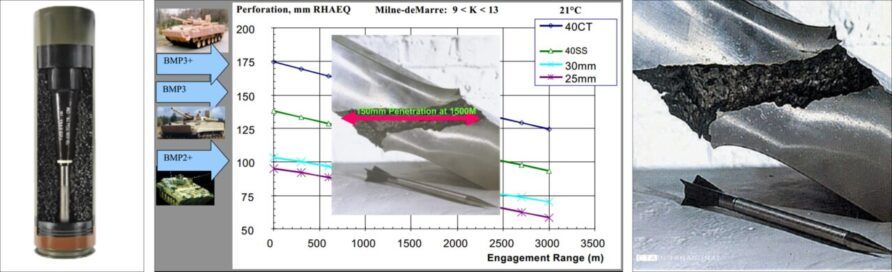
Muzzle energy is reported to be 576kJ.
A more conventional 2.4 kg KE round (GPR-KE-T) provides a lower-cost option for light armoured vehicles, fixed defences and similar targets.
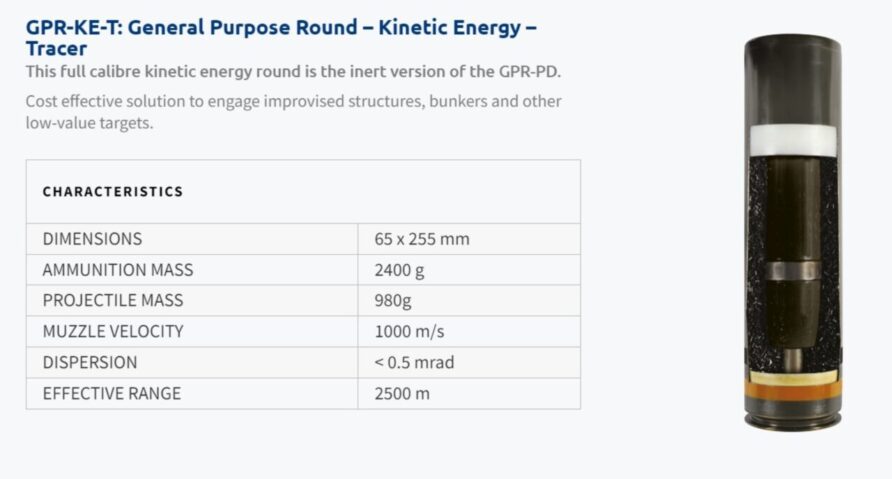
The effective range is 2,500m.
General Purpose #
For use against lighter vehicles, personnel, and other fixed targets, there are two general-purpose rounds, air bursting and point detonating.
General Purpose Round — Air Burst-Tracer (GPR-AB-T) can be used against troops on a reverse slope or behind light cover, it can also be used in point detonating mode.
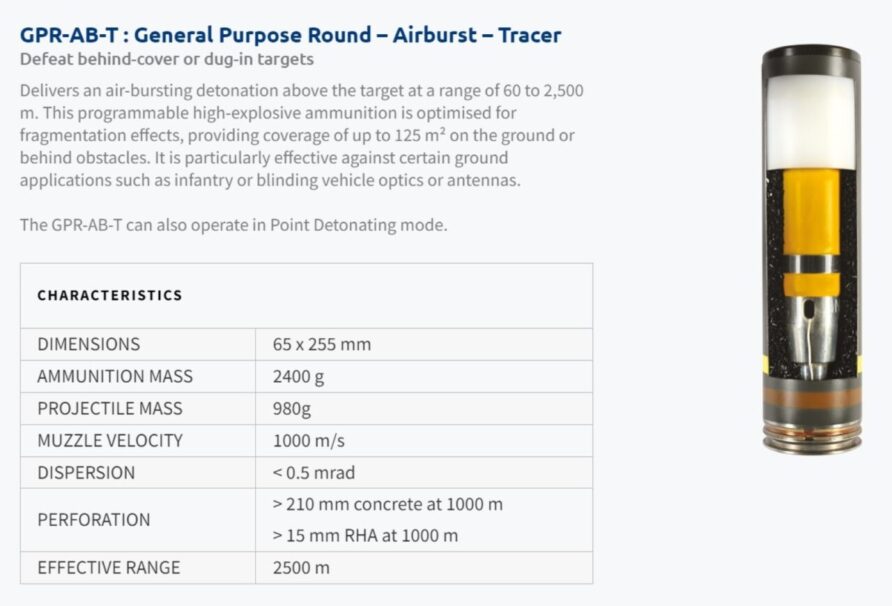
The effective range is 2,500m
The image below shows a fragmentation comparison between a 30mm airburst round (left) and the 40mm GPR-AB
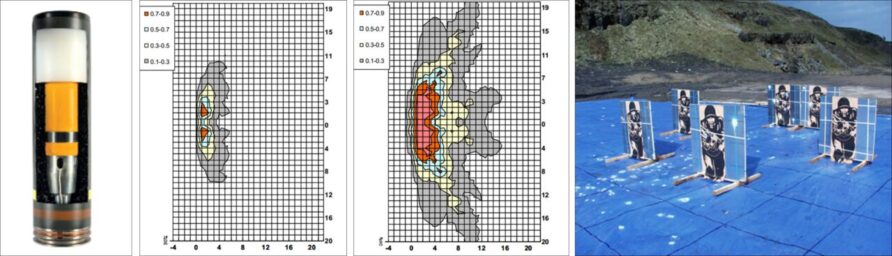
The lethal area for the airburst nature at 1,500m is 125 m2.
The General Purpose Round — Point Detonating — Tracer (GPR-PD-T)
The 2.4 kg point detonating nature can penetrate 210 mm of reinforced concrete at 1,000m.
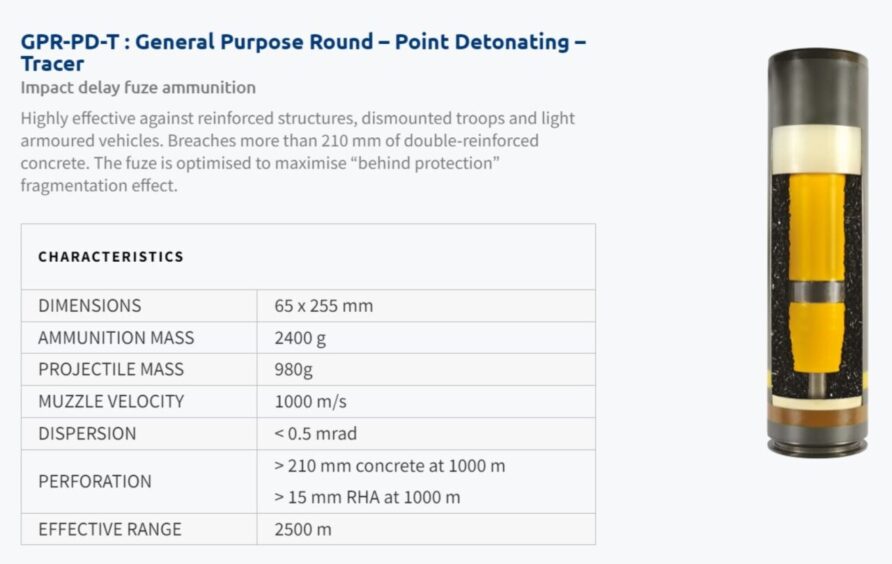
The effective range is the same as the air-bursting nature, 2,500m.
Air Defence #
The most recent ammunition type is mostly used for air defence, projecting tungsten pellets forward.
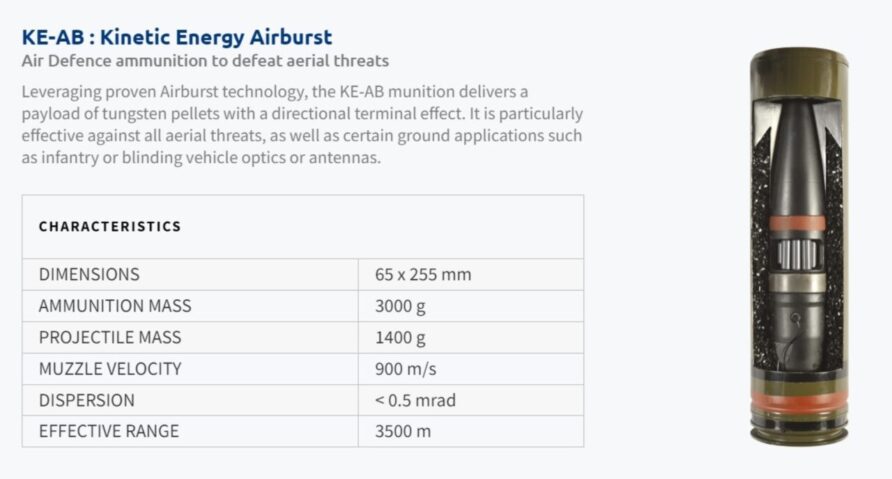
The effective range is between 3,500m and 4,000m.
Training #
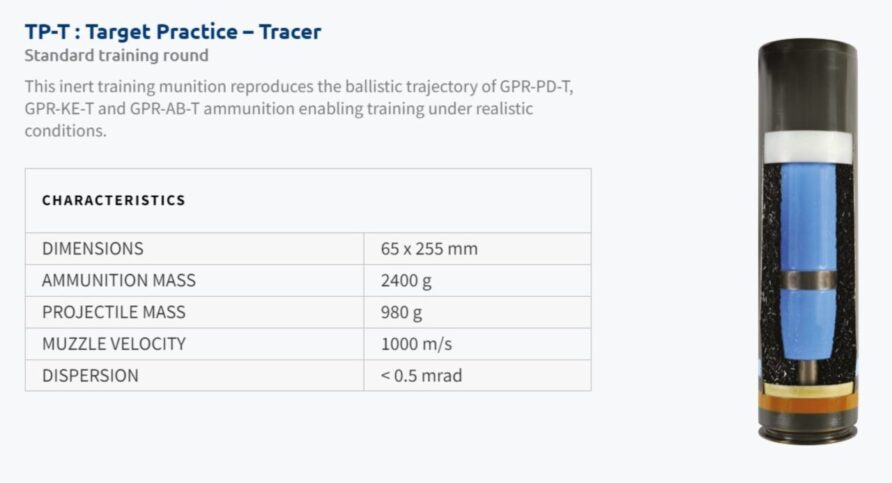
The Target Practice Reduced Round-Tracer (TPRR-T) is used for training, is cheaper, and results in much less barrel wear.
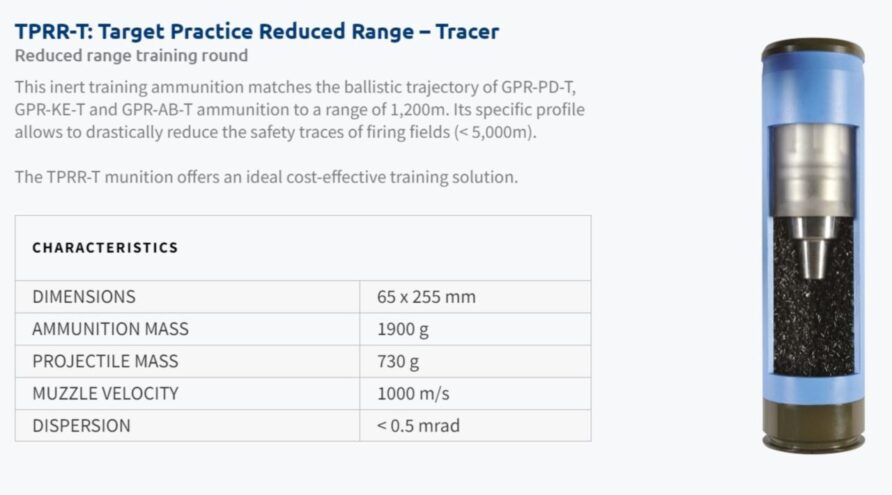
A normal-range Target Practice — Tracer (TP-T) is also available.
Turrets #
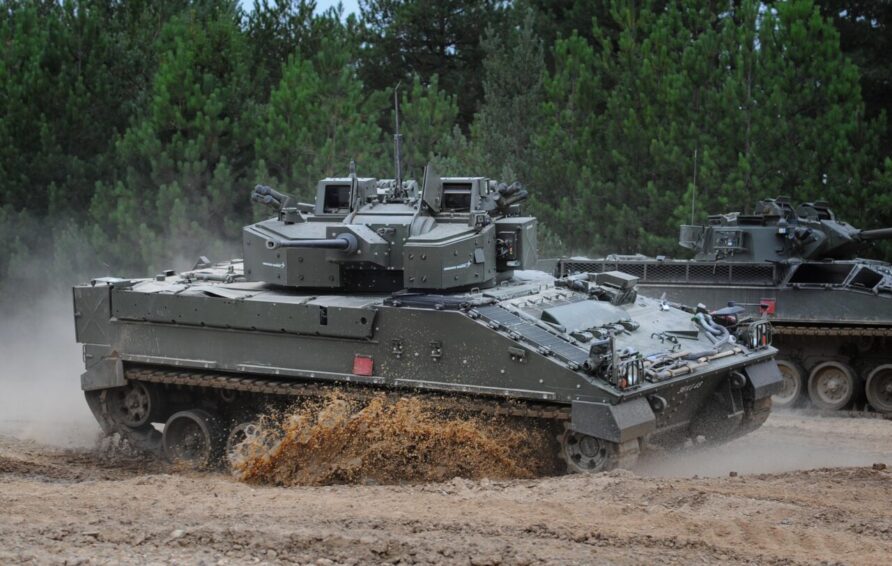
The Lockheed Martin CSP Turret was ready for manufacture, within a hairs’ breath of completing reliability and growth trials, before the programme cancellation.
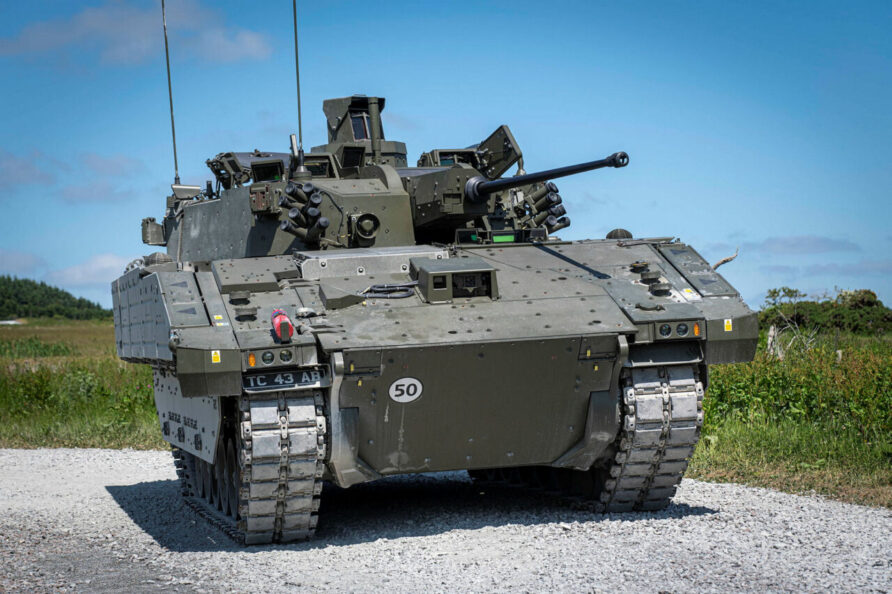
The Lockheed Martin Ajax turret will likely enter service in 2025/26 with the wider Ajax programme.
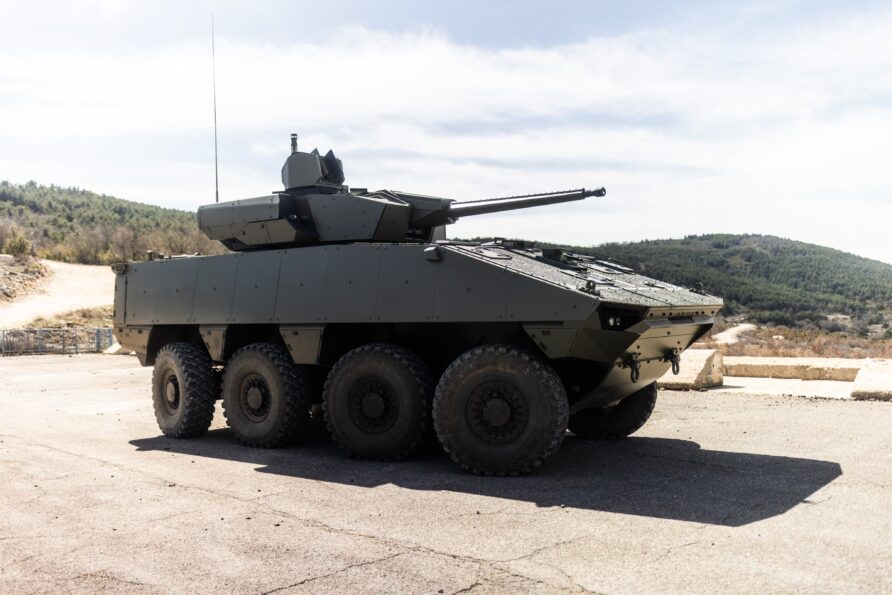
The Nexter T40M has been continually developed and is now a relatively mature system, integrated with both VBCI and Jaguar, the latter now in service.
Click here and here to read more about the T40.
Remote Mounts #
Apart from the initial work done in the late nineties on the RWSC and TOUTATIS, no other similar system has been developed.

Nexter presented the RCT40 turret at DIMDEX in early 2024, a development of the Jaguar and Rapid Fire turrets, and similar to the PHILOCTETES VBCI variant.
Air Defence #
In the very early development of the CTAS, an air defence variant with a higher rate of fire (400 RPM) was designed, but preference was given to the slower firing version for use against vehicle targets.
CTAI and Thales have also more recently developed CTAS into an integrated air defence system using a common turret architecture for both land and naval requirements, called RAPIDFire.
Land #
Effective range is claimed to be 4,000m and up to 6 vehicles can be integrated with a single control module for wide-area coverage, including fire control for Starstreak/HVM missiles.
An independent EO/IR sensor can also be used with detection ranges greater than 18 km.
Using the KE-AB ammunition, it has an effective range of up to 4,000m
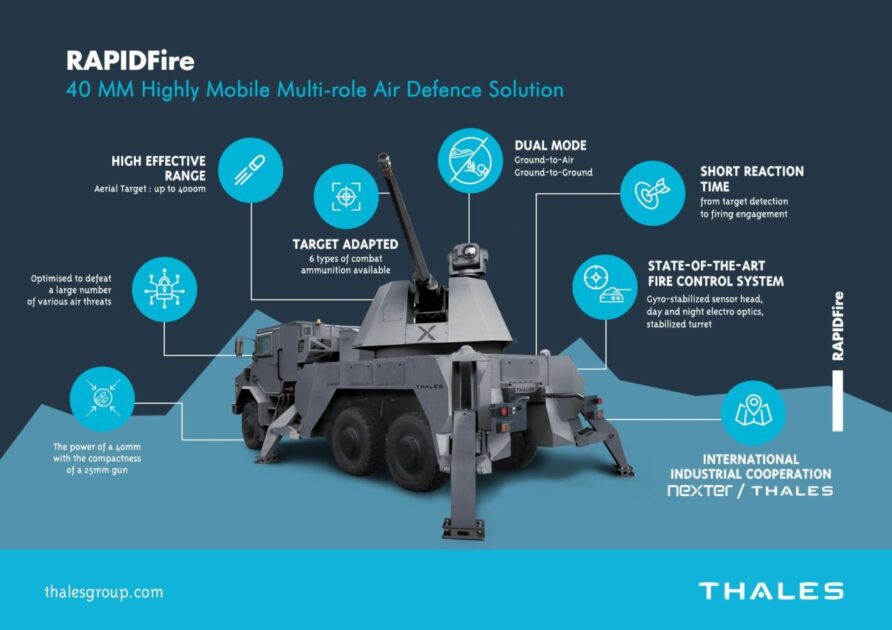
The RAPIDFire vehicle can be integrated with air defence systems and uses air defence ammunition that contains 200 tungsten pellets. Rather than using a very high rate of fire, RAPIDFire is designed to fire fewer but more effective air-bursting rounds at the target.
It can carry 140 rounds in the turret, ready to fire.
Video below.
In June 2024, KINDS France revealed this model of the Rapidfire
Naval #
The naval system was first integrated with a Marine Nationale vessel in April 2023, the (BRF) Jacques Chevallier
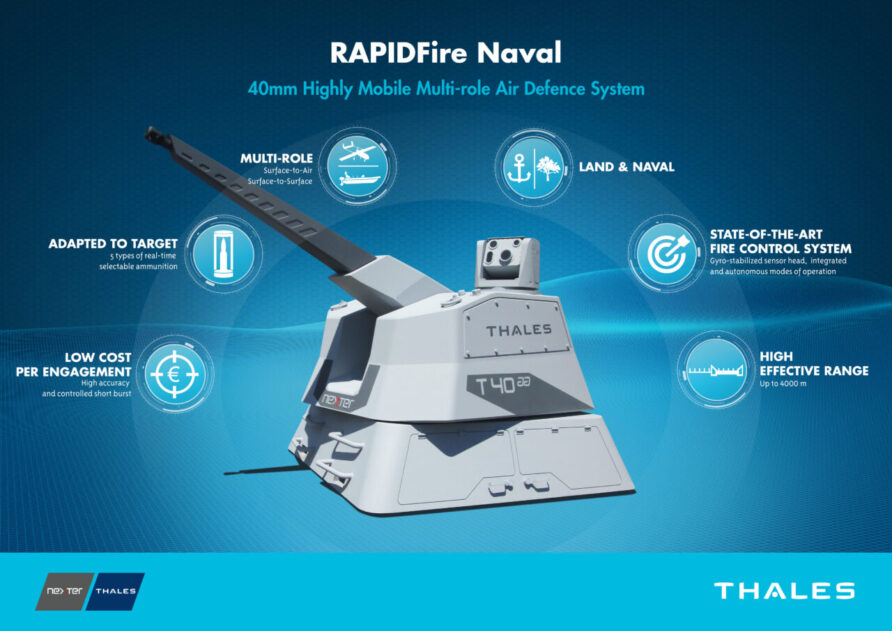
RAPIDFire Video
More pictures here
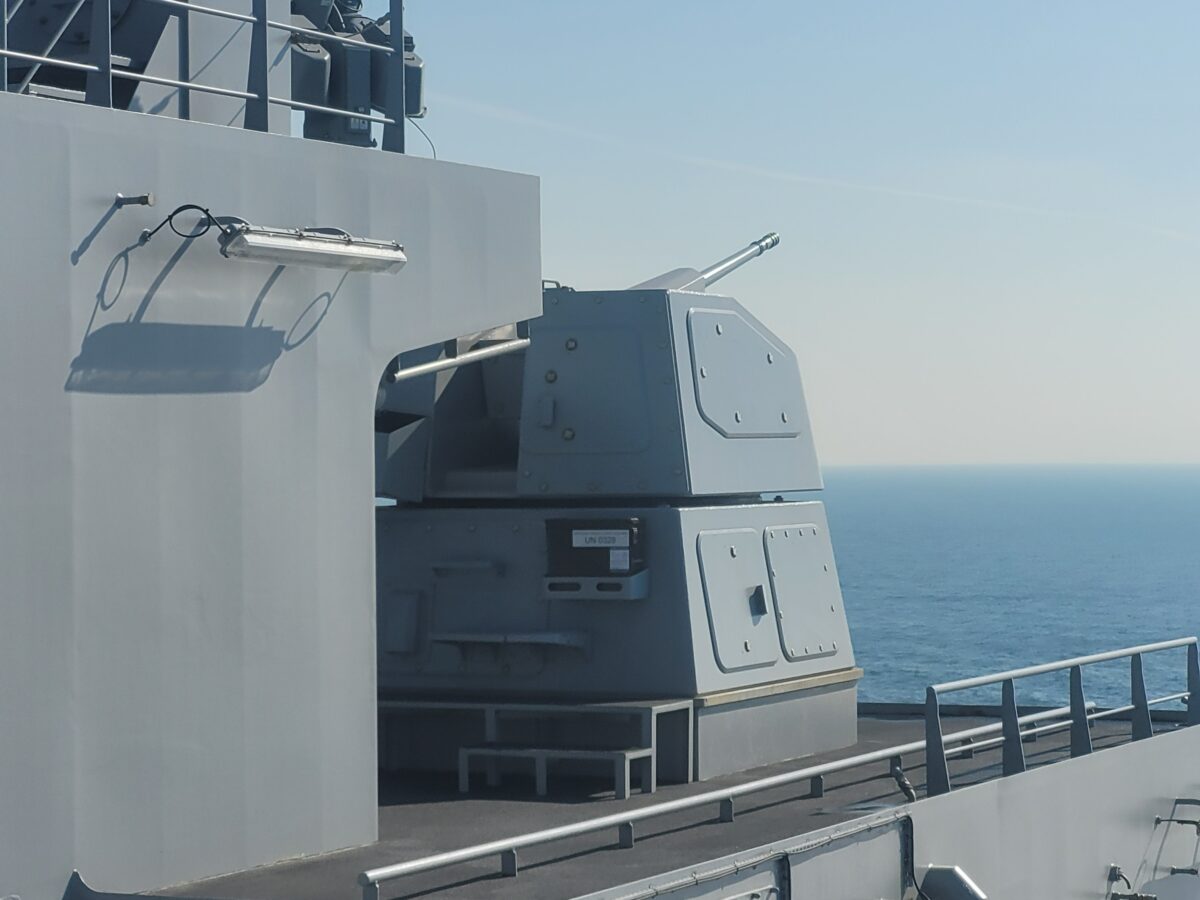
and a video showing firing trials, at approximately 1 minute in
Another video, showing its integration with the Thales LMM/HVM
A Few Closing Thoughts #
Is the 40 mm CTAS a case of Europe bringing a concept into service after the USA spent a small fortune and many decades deciding it was a bad idea, or a stubborn refusal to join the Bushmaster/Bofors/Rheinmetall club?
One can see why CTAS attracts so much debate.
The simple fact is that cased telescoped systems are not the norm, and so far, only the UK, France and Belgium plan to have it planned to be in service, some thirty-plus years after development started.
It has been a long journey and expensive journey for the UK and France.
Why then has the UK and France persisted with this approach?
Two reasons, I think, space and armour-piercing performance.
Modern vehicles need modern electronics, and contrary to popular belief, modern electronics, at least in combat vehicles, are not getting any smaller. Modern vehicles also need modern people, and modern people are larger and wear combat body armour, we also can no longer insist armoured vehicle crews are small in stature.
All this places a premium on internal turret volume, so anything that reduces the volume of one of the main turret components means more room for ammunition, electronics and ergonomics, i.e., a good thing.
As adversary vehicles utilise reactive armour and other protection systems, the significant armour-piercing performance of the 40 mm CTAS Armour Piercing Fin Stabilised Discarding Sabot makes a lot of sense, especially at longer distances, i.e. outside the effective range of adversary weapons.
Its muzzle energy is very high and armour penetration, are excellent.
If there is room for a third and an area that covers both the land and maritime domain, it is the quality of the KE-AB 40 mm CTAS nature.
This comes at a cost, however, the CTAS is expensive (regardless of arguments about the cost per stored kill) and unless others purchase it, only in service in small numbers.
The burden of ongoing qualification and development will fall on France and the UK.
France has kept the faith better than the UK, bringing a naval air defence variant into service whilst the UK chose the 40 mm Bofors system, and cancelling Warrior CSP means it will only equip one vehicle type, Ajax.
That said, whether anyone thinks the CTAS is a good idea or not is irrelevant, to coin a phrase, we are where we are.
The UK’s question is whether to double down or continue with the CTAS in service on just one vehicle type.
To maximise commonality, realise economies of scale and provide confidence and impetus to an export campaign.
Export customers mean shared development costs and lower ammunition costs.
For the UK, the key question is what to do with the already purchased systems for Warrior CSP.
One would hope, they appear in a turret on Boxer someday.
Time will tell, I guess.
If you found value in this article, help me keep Think Defence going.
Think Defence is a hobby, a serious hobby, but a hobby nonetheless. I have removed those annoying adverts, but hosting fees, software subscriptions and other services add up.
To help me keep the show on the road, I ask that you support the site in any way you can. It is hugely appreciated.
You can click on an affiliate link, Buy Me a Coffee at https://ko-fi.com/thinkdefence, download an e-book at https://payhip.com/thinkdefence or even get some TD merch at https://www.redbubble.com/people/source360/
Youtubers, if you are going to lift content from here, the decent thing to do would credit me


