 Doc Summary

Sea Venom is an advanced replacement for the battle-proven Sea Skua air-to-surface missile, equipping Royal Navy Wildcat helicopters
Sea Venom is the name for the Future Air to Surface Guided Weapon – Heavy (FASGW(H)), a replacement for Sea Skua.
MBDA describe it as;
Capable of defeating the most challenging target set presented by today’s open water and littoral maritime operations, the new weapon features significant advances on both Sea Skua and AS15TT. The new design will maintain some of the characteristics of Sea Skua and AS15TT and retain compatibility with existing logistic footprints, thereby allowing current users of these systems to upgrade easily.
Sea Venom is in service with the Royal Navy Fleet Air Arm (FAA) on the Wildcat helicopter.

Sea Venom History #
Future Air to Surface Guided Weapon (Heavy) FASGW(H) emerged in 2001 intending to be a straight replacement for Sea Skua and Wildcat, with Sea Skua leaving service between 2012 and 2014.
FASGW(H) envisaged a smaller missile, at 100 kg, but one with a range of additional targeting options able to be used in the ‘cluttered littoral’ with complex and restrictive rules of engagement (ROE)

MBDA proposed the Sea Skua IR, which swapped the Semi-Active Radar guidance for an infrared seeker in cooperation with Kongsberg who was at the time in the initial development stages of their Naval Strike Missile (NSM).
Sea Skua 2 was another option, details released in 2006 indicated a longer range (40 km), an active radar seeker, digital electronics and a new body form.
The active radar seeker would provide a ‘fire and forget capability, improving the survivability of the launch aircraft.
A Sea Skua replacement was part of the original Team Complex Weapons initiative involving the MoD, Roxel, Thales and the MoD, but this changed later to include a collaborative development with France to meet their emergent Anti-Navire Léger (Light Anti-Ship) requirement.
FASGW(H) became FASGW(H)/ANL

The programme then became ensnared in the complexities of Anglo-French defence politics, not made easier by being a few years apart in timing.
A £35 million Assessment Phase contract was awarded in 2008 with both nations sharing the cost.
Minister for Defence Equipment and Support, Quentin Davies, said;
This announcement demonstrates our commitment to deepen the co-operation between our two countries, particularly where requirements are closely aligned, as they are in this case. By bringing together industry expertise from across the nations we are strengthening our technical knowledge, allowing us to equip our forces with the best highly-advanced anti-surface missile for them to use for years to come
A £500 million demonstration and manufacturing contract was awarded to MBDA on March 27th, 2014, the UK’s share being approximately £280 million.

The Minister for Defence Equipment, Support and Technology, Philip Dunne, said:
This highly sophisticated complex weapon system will provide our new Royal Navy Wildcat helicopters with unparalleled strike capabilities.
Not only will the contract protect around 200 specialist engineering jobs in the UK, but is also an important plank in building the strength of our relationship with France through joint procurement of common equipment, which will provide interoperability and other benefits of working in partnership
The design changed over this phase, but the essential details remained.
In addition to the Development and Manufacture contract, the MoD let a £90 million contract for Wildcat integration in 2014. This contract also included integration for FASGW(L), the smaller Martlet missile.
Initial flight trials were completed in 2015, and the missile, by now called Sea Venom, was qualified using a Dauphin helicopter.

Initial Royal Navy Wildcat firing was scheduled for 2018 with IOC planned for 2020.

With the £35 million Assessment, £280 million Development and Manufacture and the £90 million Wildcat integration contract, Sea Venom has been a relatively modest investment; just over £400 million.
In July 2016, Leonardo Helicopters awarded a contract to General Dynamics to upgrade the Stores Management System on Wildcat to enable control of Martlet and Sea Venom.
The scope of the contract included;
- Develop new safety-critical software to control the complex MIL-STD-1760 missile interfaces.
- Implement plug-and-play software architecture, which will significantly reduce the cost of integrating future weapons.
- Introduce hardware design changes to the existing SMS design to support two additional weapon stations on the helicopter.
- Design and manufacture a handheld test set to allow the helicopter electrical interfaces to be rapidly tested with the SMS Built-in-Test capability.
- Re-test and certify the overall SMS functionality in accordance with UK safety standards DEF-STAN 0055/56.
- Update the existing in-service SMS equipment to the ‘FASGW standard.
Also in July 2016, the MoD announced financial support to MBDA and Leonardo to integrate Martlet and Sea Venom on legacy Lynx aircraft to enhance export opportunities.
On February 25th 2017, the Royal Navy conducted the last firing of Sea Skua.
Three missiles were fired by a Fleet Air Arm Lynx HMA.8 flying off HMS Portland. The following month, Lynx helicopters were also withdrawn. The missile was formally withdrawn in March 2017.
IOC slipped to 2022
A new weapons wing for Wildcat completed its first flight trials in 2019, this was an advancement from previous versions and added additional lift.
Each wing has two hard points.

Sea Venom completed its qualification firings on the 17th of November 2020.
The Sea Venom/ANL anti-ship missile has completed its qualification firings trials, with a successful final firing at the French Armament General Directorate (DGA) test site at Ile du Levant on 17 November.
Soon to start equipping the Royal Navy’s AW159 Wildcat and Marine nationale’s H160M Guépard shipborne helicopters, the Sea Venom/ANL anti-ship missile is a co-operation project developed under the Lancaster House treaty between France and the United Kingdom. The Sea Venom/ANL missile is the first programme to take full advantage of the cross-border centres of excellence on missile technologies launched by the Lancaster House treaty, which celebrated its 10-year anniversary this month.
The final qualification trial tested the missile’s advanced target discrimination within a complex and cluttered naval scenario.
Image below

Although not fully in service, Sea Venom was deployed on CSG21
in October 2022, Sea Venom and Martlet were subject to additional trials as they both entered service
Martlet and Sea Venom – the Navy’s two new air-to-surface anti-ship missiles – have completed extensive tests in the hands of expert aviators and scientists and a Wildcat helicopter.
The trials in the Atlantic and Mediterranean will help write the manual for using the weapon in various weather and sea conditions – allowing Fleet Air Arm aviators to take out small and large threats to the Fleet.
Both missiles come under the banner of the Future Anti-Surface Guided Weapon:
• Martlet, a light missile weighing just 13kg, intended for smaller/lightly-protected targets
• Sea Venom, with ten times the punch of Martlet for larger, more heavily armoured warships.
Fitting either on special ‘weapon wings’ affects the way the helicopter handles, so to determine the boundaries for safe flying – known as Ship Helicopter Operating Limits – a specially-modified Wildcat, packed with sensors, joined aviation training ship RFA Argus for a month.
A myriad conditions impact on the performance of a helicopter: wind speed, direction and air flow over the deck, humidity, temperature, the sea state, pitch and roll of the deck, as well as the weight and configuration of the aircraft itself.
Argus sailed more than 8,000 miles in the Atlantic, mostly between the Canary Islands and Cape Verde, and then into the Mediterranean, chasing different weather conditions.

Total expenditure for Sea Venom, as of September 2022, was assessed as
Alec Shelbrooke The Minister of State, Ministry of Defence
Sea Venom was assessed at £945.3 million and remains within the programme risk tolerance levels.
It was reported in December 2022 that MBDA had started work on a surface-launched variant of Sea Venom.
In Service Date (ISD) was delayed to 2026, as confirmed by a Parliamentary Written Answer in June 2023
Aircraft certification is currently forecast to be delivered in 2026. This is the point at which the full weapon system capability for SEA VENOM will be provided to the Royal Navy (RN) and the final modification of Wildcat can commence.
The RN already has a number of aircrew trained in the operation of the current capability of the SEA VENOM weapon system. For ground crew, SEA VENOM handling and loading already forms part of the core WILDCAT weapons course delivered by the Wildcat Training Centre.
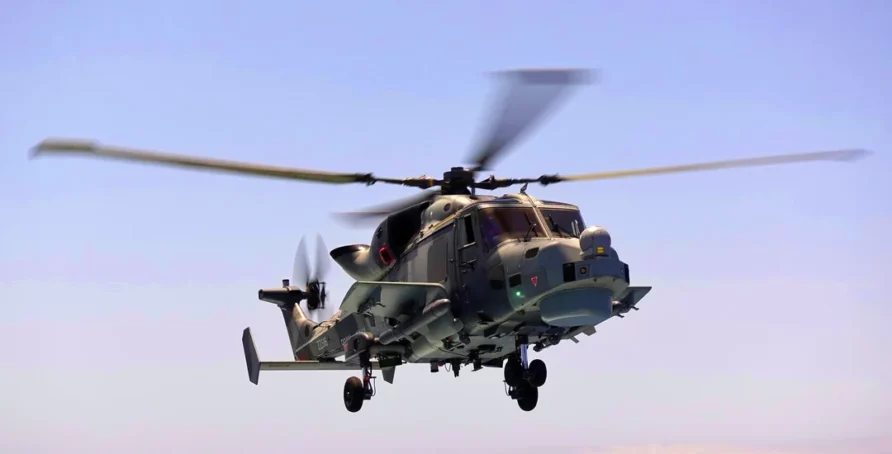
The Royal Navy confirmed in November 2024, another Sea Venom test firing, from a Wildcat helicopter, the first live guided release.
In October 2025, the MoD confirmed Sea Venom had achieved Initial Operating Capability (IOC)
MBDA released two concept images in late 2025 of Sea Venom, showing a shore-based battery and Uncrewed Surface Vessel (USV) implementation.


Sea Venom Capabilities #
Sea Venom weighs 120 kg, is 2.5m long and is 200 mm in diameter.

The semi-armour-piercing warhead weighs 30 kg, and Sea Venom has a range exceeding 20 km.
A 2-way RF data link can be used for in-flight monitoring, and the uncooled imaging IR seeker includes an advanced image processing system. The two-way tactical data link provides positive target identification and ‘man in the loop’ retargeting aim point correction and abort.
Sea Venom is intended for targets in the 50 to 500 tonnes with a range exceeding Sea Skua, and a high subsonic speed.
Sea Venom also has a land-attack capability.

The 28 Royal Navy Wildcat helicopters will be able to carry four Sea Venom missiles each, no other UK aircraft are currently planned to carry it.

If you found value in this article, help me keep Think Defence going

Think Defence is a hobby, a serious hobby, but a hobby nonetheless. Hosting, security and other support software all adds up.
E-books and merch
Downloadable PDFs, and the Redbubble shop.
Amazon links in posts are affiliate. Firearm designs on Redbubble may be marked mature.
Thank you for reading, and for any support. It really is appreciated and helps me keep the show on the road.


