
 Doc Summary

The L21A1 RARDEN is a British 30 mm autocannon used as a combat vehicle weapon used principally on Scimitar, Fox, and Warrior.
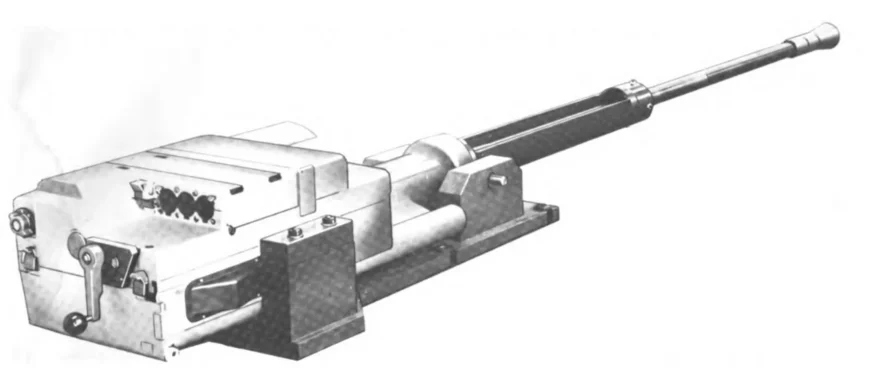
Development of the 30 mM L21 RARDEN Cannon #
The 30 mm RARDEN cannon (acronym derived from Royal Armament Research and Development Establishment–Enfield) originated in a British Army requirement of the mid-1960s for a new vehicle-mounted autocannon to equip the then forthcoming Combat Vehicle Reconnaissance (Tracked) CVR(T) and Combat Vehicle Reconnaissance (Wheeled) [CVR(W)] families.
Design work started in 1966 at the Royal Small Arms Factory (RSAF) Enfield, conducted jointly with the Royal Armament Research and Development Establishment (RARDE) at Fort Halstead.
Norman Brint, a senior engineer at the RSAF, served as the principal designer.
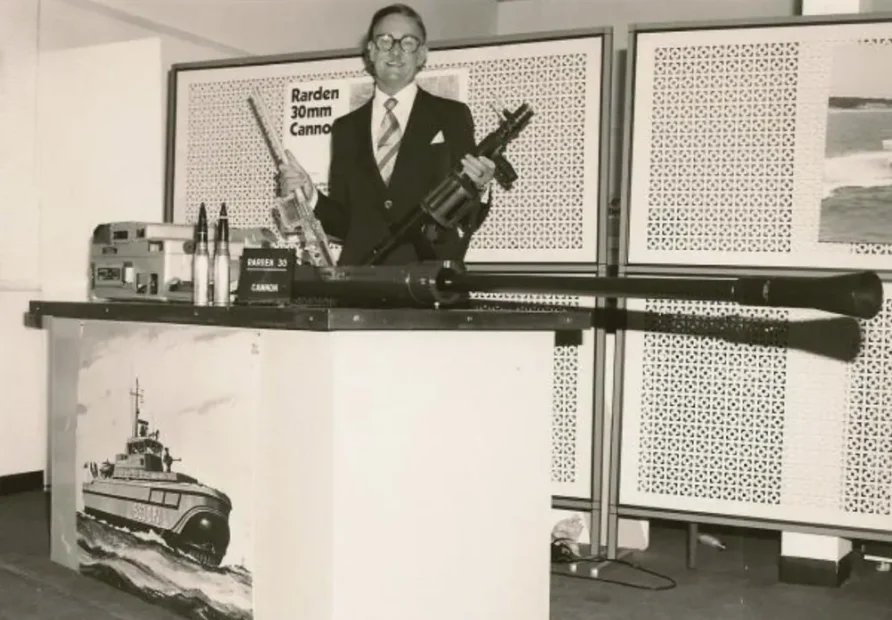
The project adapted elements from the earlier 30 mm ADEN aircraft cannon for ground-vehicle application, with the developmental designation 30 mm Gun L21E2.
RARDEN was designed to counter the Soviet APC’s and other light armoured vehicles such as the BTR50P, which had frontal armour 14mm thick, sloping back at 45 degrees and vertical side plates of the same thickness. It was determined that a gun of at least 30mm calibre would be required with an armour piercing discarding sabot (APDS) round.
Existing designs such as the Hispano-Suiza 30mm 831SLM cannon were discounted because of high trunnion pull and long inboard length.
By early 1970 the programme had advanced to the point where the weapon was publicly associated with the new reconnaissance vehicles.
In the House of Commons debate on the Army Estimates 1970–71 (12 March 1970), the Under-Secretary of State for Defence for the Army stated that
Production orders will shortly be placed for Fox, a wheeled vehicle fitted with the new 30 mm RARDEN gun, and Scorpion, the tracked vehicle with a 76 mm gun, is now entering the final phase of development.
Two months later, in the House of Lords debate on the Defence Estimates (13 May 1970), it was announced that
An order has recently been placed for the first members of a family of lightweight, well-armed, tracked reconnaissance vehicles; the first two vehicles are Scorpion, fitted with a 76 mm gun, and Scimitar, fitted with the 30 mm RARDEN cannon.
Manufacture of the RARDEN cannon began at the RSAF Enfield in the early 1970s.
With the Scimitar and Fox both in regimental service by the mid-1970s, the RARDEN cannon completed its development cycle and achieved introduction into operational use with the British Army.
Significant events following the introduction of the 30 mm RARDEN cannon into British Army service #
Following its initial operational deployment with the FV107 Scimitar and FV721 Fox in the mid-1970s, the RARDEN cannon continued to equip successive generations of British armoured vehicles and participated in multiple conflicts.
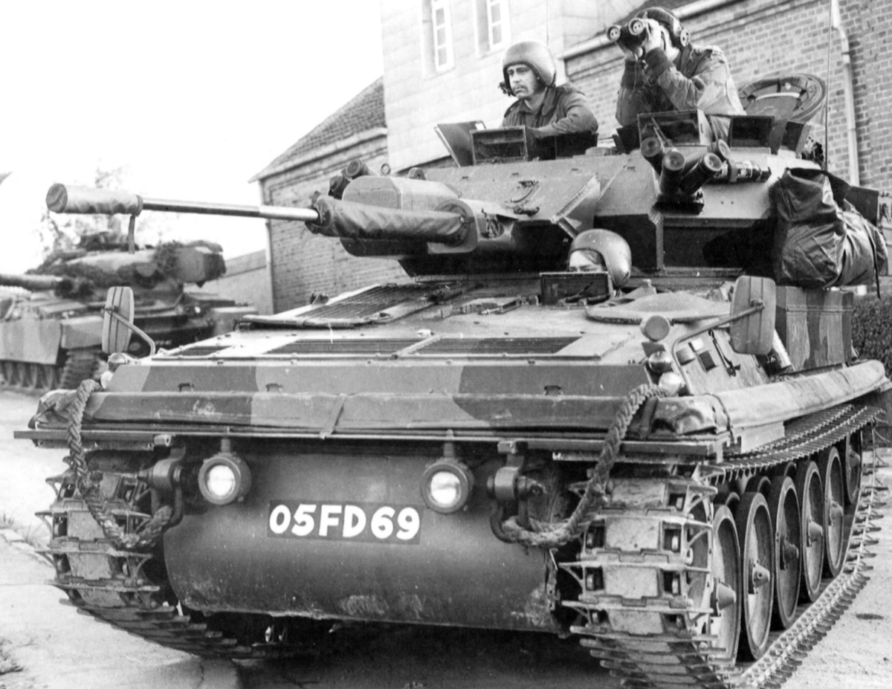
In the late 1970s, a limited number of FV432 armoured personnel carriers (approximately thirteen) received RARDEN turrets salvaged from the Fox programme.
These vehicles served primarily with the Berlin Infantry Brigade and at the School of Infantry, Warminster, remaining in use until the early 1990s.
An improved model of the cannon, designated L21A2, entered service during the 1980s.
The cannon saw its first combat use in the Falklands War of 1982.
Scimitar reconnaissance vehicles from B Squadron, Blues and Royals, operated alongside Scorpions as the only British armoured vehicles committed to the campaign, providing direct fire support during operations including the assault on Mount Tumbledown and contributing to anti-air engagements.
Laurence Scott Defence Systems developed a naval mount for RARDEN, but it did not enter service.
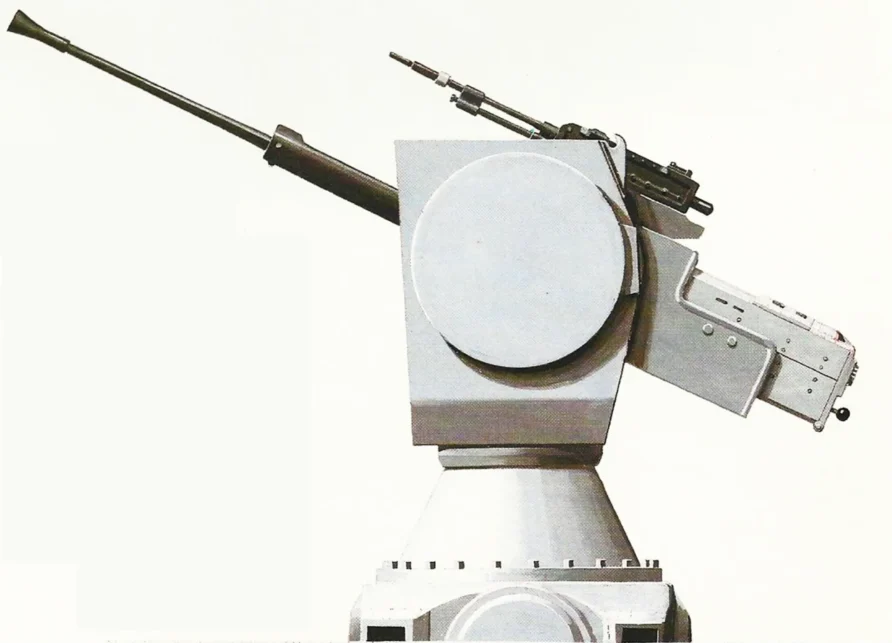
The most significant expansion of the RARDEN’s operational footprint occurred with the entry into service of the FV510 Warrior infantry fighting vehicle.
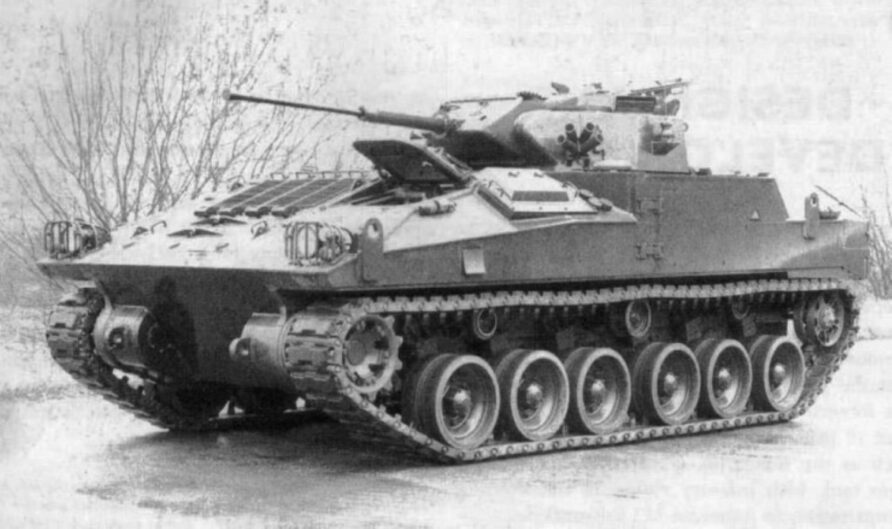
The first production examples were accepted in 1987, with final deliveries to the British Army completed in February 1995. This substantially increased the number of RARDEN-armed platforms within mechanised infantry Battlegroups.
A Remote Weapon System (RWS) version was developed, but like the naval mount, it did not enter service.
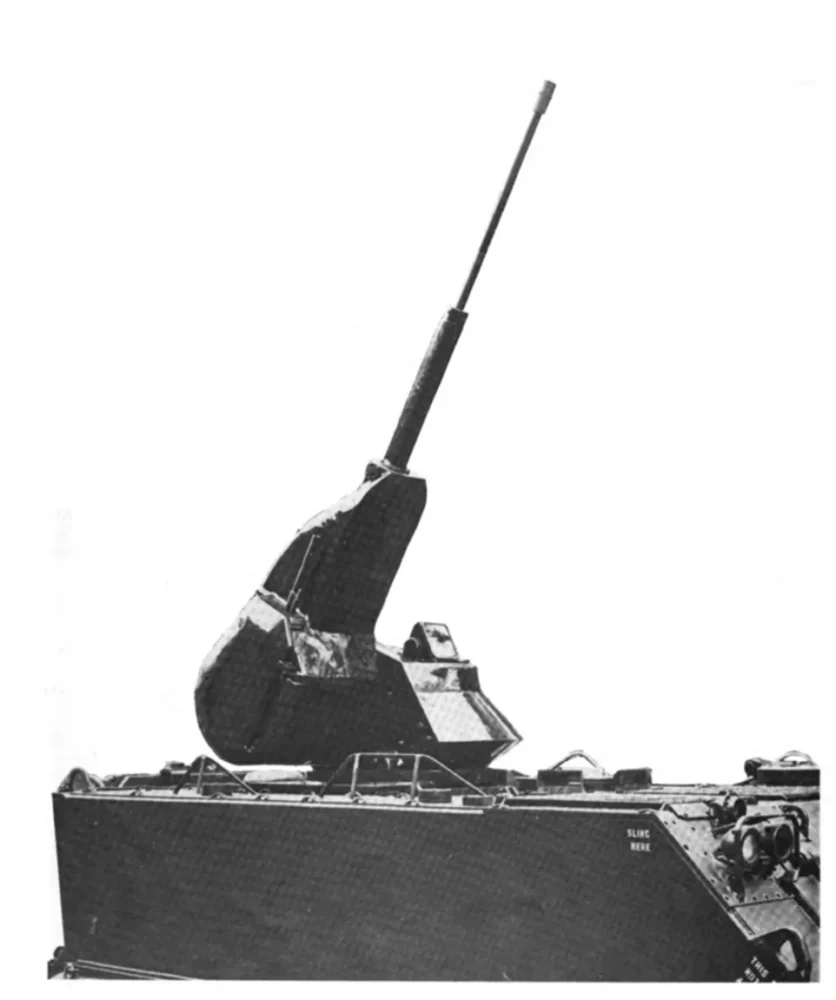
To rationalise the Combat Vehicle Reconnaissance (Tracked) fleet after the withdrawal of the Fox, approximately 136 Sabre reconnaissance vehicles were produced in the 1990s by mating refurbished Fox turrets (retaining the RARDEN) to Scorpion hulls.
These hybrids served as an interim reconnaissance asset into the early years of the following decade.
The 1991 Gulf War (Operation Granby) marked the cannon’s next major operational employment.
Both Scimitar and Warrior vehicles formed part of the 1st (British) Armoured Division’s reconnaissance and infantry elements, engaging Iraqi positions in combined-arms operations.
Further deployments followed in the Balkans during peacekeeping missions in Bosnia and Kosovo.
In the 2003 invasion of Iraq, Scimitars from C Squadron, 1st The Queen’s Dragoon Guards, participated in the Battle of Al Faw.
Scimitars were also deployed to Afghanistan under Operation Herrick, where they operated in standard troop formations or composite units with additional theatre-specific protection.
In March 2008, the Ministry of Defence announced the selection of the 40 mm cased-telescoped armament system, developed by CTA International, as the successor to the RARDEN for both the Warrior upgrade programme and the forthcoming Ajax family of vehicles.
Normal Brint, the RARDEN designer, died in 2010.
The FV107 Scimitar was retired from British Army service in April 2023, after which the Warrior provided an interim reconnaissance and infantry capability pending the Ajax achieving full operational status.
Parliamentary records from late 2025 state that, on current planning, the RARDEN cannon will be removed from service in December 2027.
A reference to “Project Rarden” in the Ministry of Defence’s 2024–2025 annual accounts, recorded as a £3.7 million constructive loss, was subsequently identified as an accounting error; the entry related instead to an unproceeded armour-piercing fin-stabilised discarding sabot munition programme, with no expenditure or activity under the legacy Project Rarden occurring in the preceding decade.
30 mm L21 RARDEN Cannon Details #
The 30 mm L21 series RARDEN cannon (Royal Armament Research and Development Establishment–Enfield) is a manually loaded, long-recoil-operated autocannon developed specifically for integration into lightweight armoured vehicle turrets.
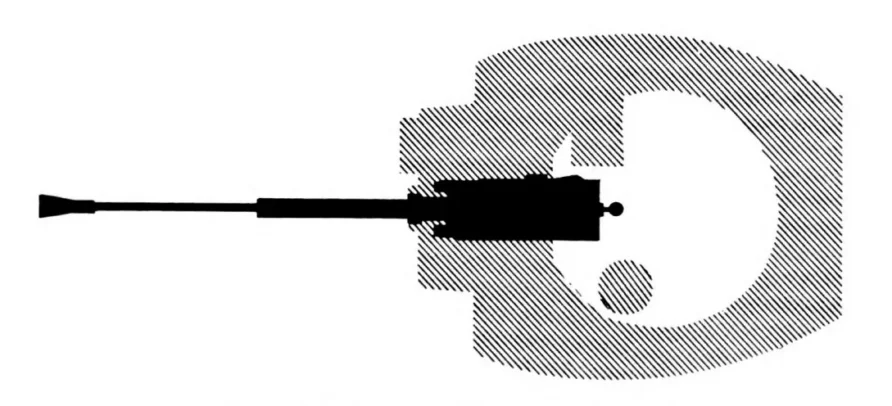
The principal service variant is the L21A1, with the L21A2 representing a minor upgrade introduced during the 1980s that incorporated a redesigned barrel and associated internal refinements for improved reliability and maintainability while retaining full interchangeability with the earlier standard.
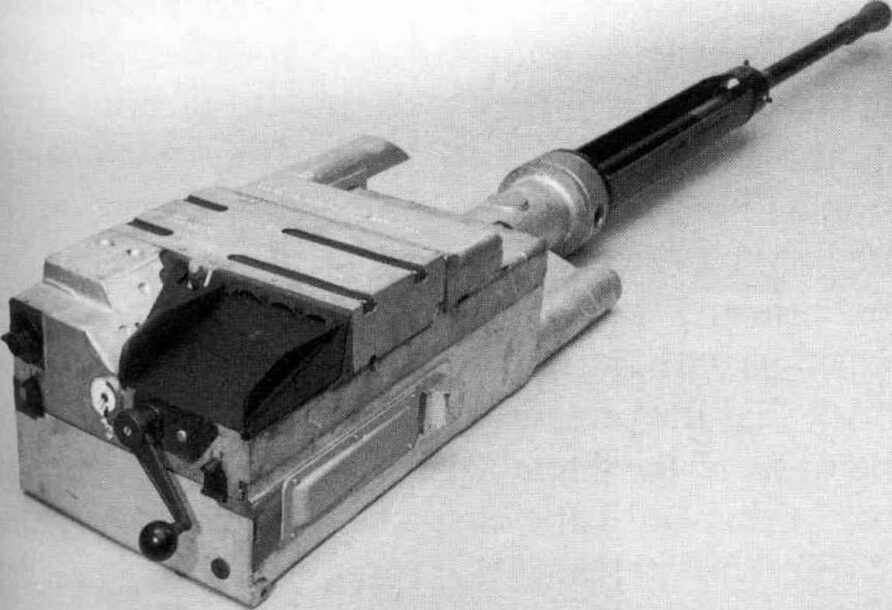
Principal characteristics are as follows:
- Calibre: 30 mm
- Cartridge: 30 × 170 mm (brass-cased derivative of the Oerlikon KCB / Hispano-Suiza 831-L family; not interchangeable with steel-cased variants)
- Action: Long recoil
- Weight (complete weapon): 113 kg
- Overall length: 3 150 mm
- Barrel length: 2 430 mm (81 calibres)
- Barrel weight: approximately 24.5 kg
- Inboard length (intrusion into turret): 430 mm
- Rate of fire: 90 rounds per minute (cyclic)
- Muzzle velocity: 1 175 m/s (APDS); 1 070 m/s (HE, HEI, APSE)
- Feed system: Manual, 3-round clips loaded into a dual-clip magazine providing 6 rounds ready-to-fire; forward ejection of spent cases
- Effective range: up to 2,000 m (ammunition- and target-dependent; proven accuracy yields 1 m groups at 1,000 m)
- Elevation (typical turret installation): –10° to +45°
- Power requirement: None (self-contained mechanical operation)
- Design features: Low trunnion pull for compatibility with light-armoured platforms; vibration damper on barrel; no gas escape into crew compartment; compact receiver optimised for constrained turret volumes.
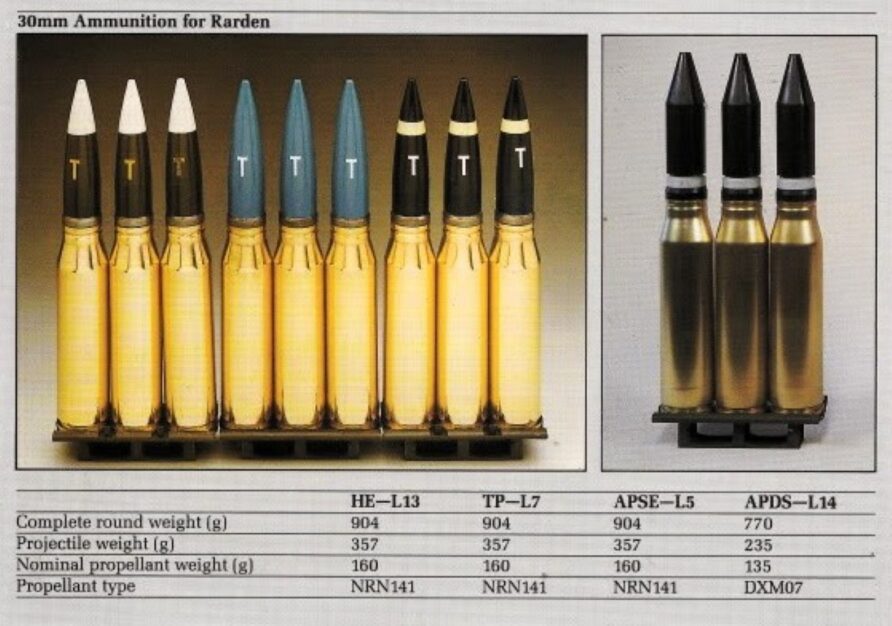
Standard ammunition natures include armour-piercing discarding sabot (APDS, e.g., L14), armour-piercing secondary-effect tracer (APSE-T, e.g., L5), high-explosive incendiary tracer (HEI-T, e.g., L13), and associated practice and drill rounds.


good morning! I am a soldier with the Nigerian Army and a weapon technician currently working on CVR(T)s families like the 76mm L23 A1 and about to work with Fv107 L23A1 30mm RARDEN auto canon which I don't have the maintenance document, I tried many assets no way. The gun system is difficult to be cocked and even when it cocked for it to released to forward position is a problem. If there is a way to assist me please help.