
 Doc Summary

Saxon was a wheeled armoured personnel carrier used by the British Army from 1984 to

Saxon History #
The GKN AT-105 Saxon can trace its development back to the seventies’ era AT-104 and AT-100 vehicles.
Although the AT-100 did not gain any orders, the AT-105 was still developed by GKN Sankey as a private venture successor starting in 1975.
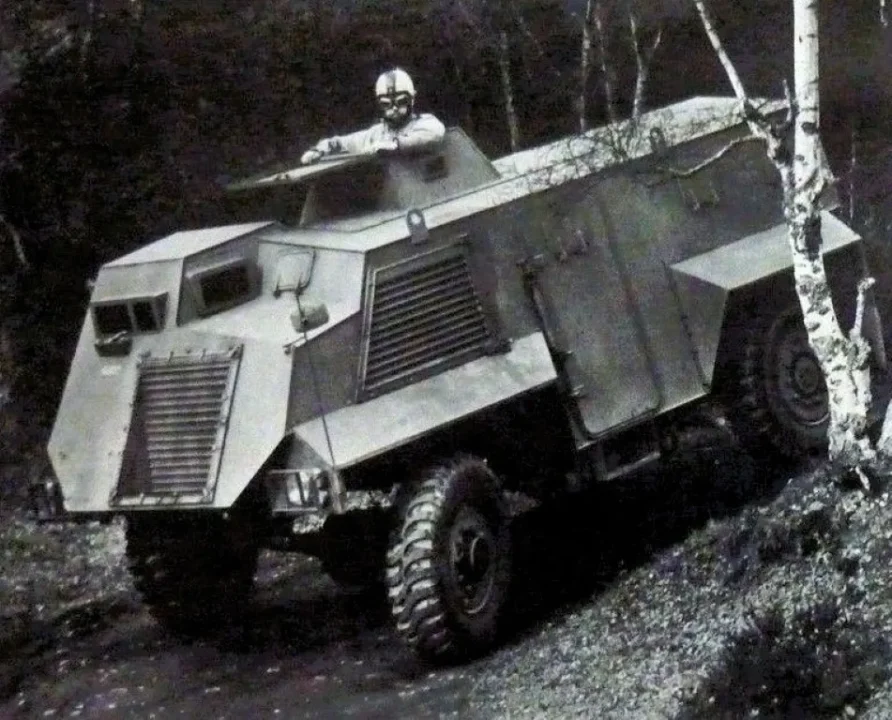
It was renamed Saxon in 1983 when the Ministry of Defence placed an initial order for 47 vehicles in 1983
Infantry mobility will be improved by the introduction of the Saxon — the new wheeled armoured personnel carrier for the infantry earmarked to reinforce BAOR. Production orders have been placed with GKN Sankey for the first 50 vehicles.
Parliamentary Motion, 17 November 1983
This initial order was followed by 200 more in 1985, including command and recovery variants.
Saxon was designed for one purpose, to provide some measure of protection for personnel deploying from the UK to the continent in response to a Warsaw Pact invasion, at as low a cost as reasonably possible.
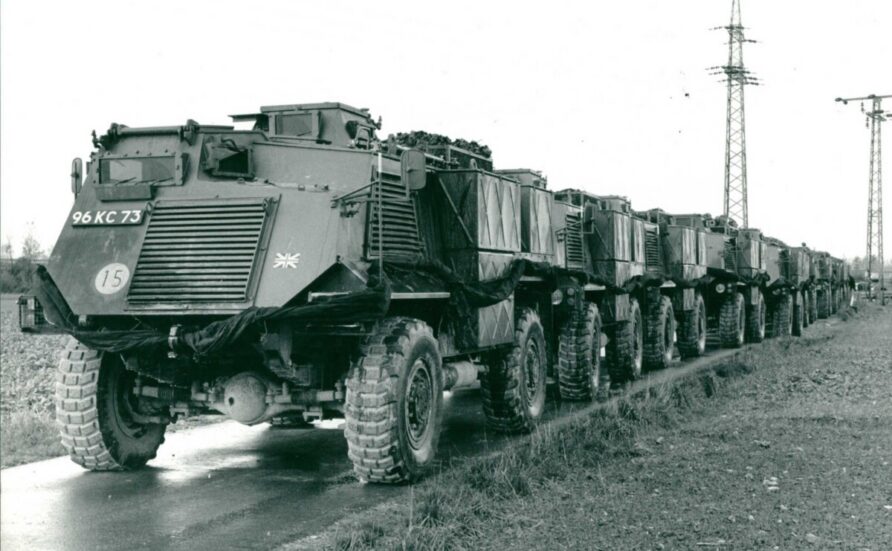
30 more were ordered for the Royal Artillery for use with Rapier in 1987, and an additional batch of 100 was ordered in 1990, including ambulance variants.
By the beginning of 1990, the British Army had approximately 500 Saxons in service in the UK (including Northern Ireland) and Germany.
An upgrade programme in 1990 introduced a Cummins 6BT 5.91-litre turbo diesel engine, replacing the original Bedford 500 unit.
Another 100 were ordered in 1991, bringing the British Army total to 524 vehicles.
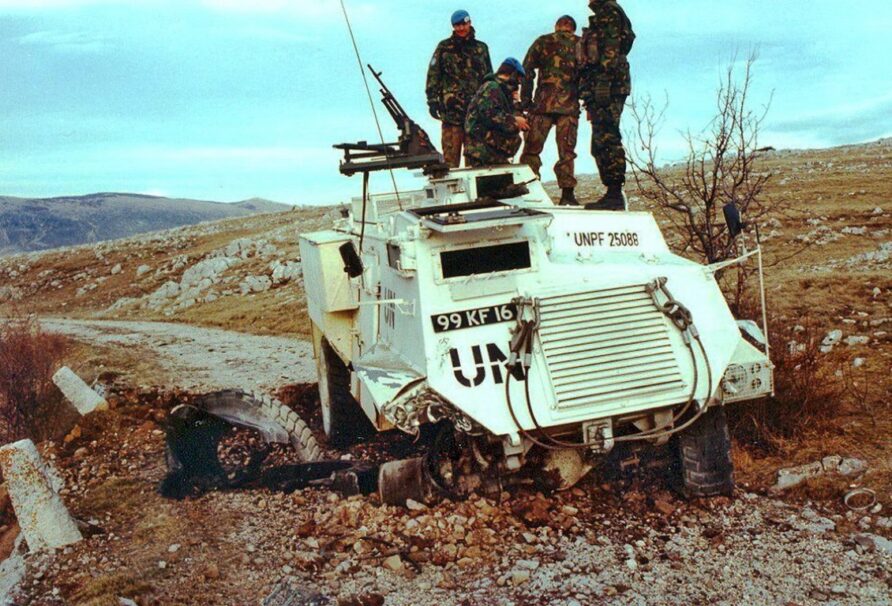
The image below shows the aftermath of a TMA3 mine strike on a Saxon in the hills above Rama Lake, Bosnia, in 1994.
Some were fitted with surplus Peak Engineering FV432 turrets for additional protection.

Saxon vehicles were also deployed to Iraq in 2003.

Saxons would also see service in Kabul where they deployed supporting ISAF, mostly at Camp Souter/Kabul Airport area.

Saxon was withdrawn from Iraq in 2006.
577 eventually entered service with the British Army, and it was exported to Abu Dhabi, Bahrain, Hong Kong, Kuwait, Malaysia, Nigeria and Oman.
Saxon was included in replacement discussions as part of the following programmes
- Family of Light Armoured Vehicles (FLAV)
- Future Family of Light Armoured Vehicles (FFLAV)
- Multi Role Armoured Vehicle (MRAV)
- Future Command and Liaison Vehicle (FCLV)
Ukraine took delivery of the first of 20 AT-105 Saxon vehicles in February 2015, surplus from the UK. The total procurement cost was approximately £2.8 million.
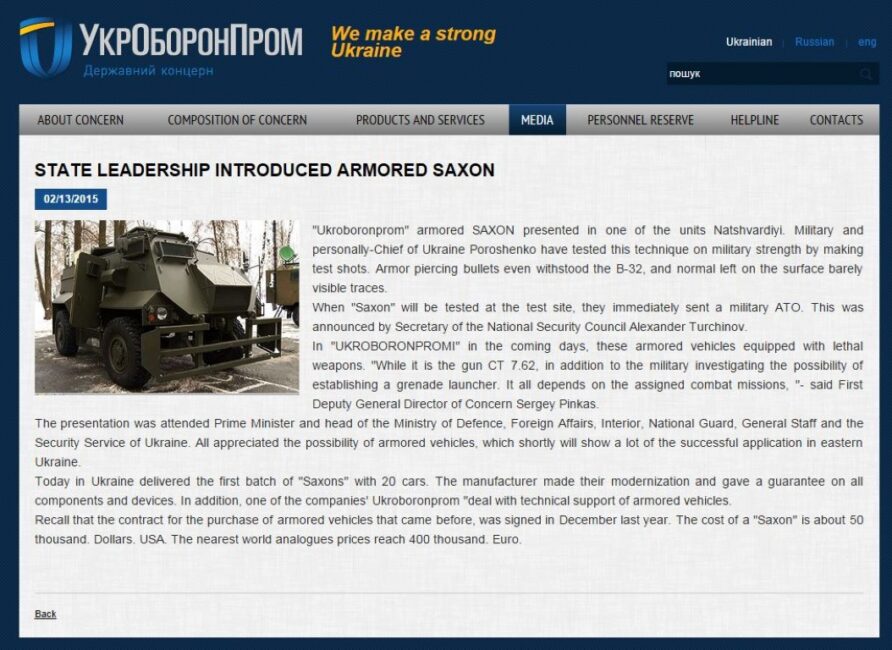
A second batch of 55 followed in June 2015.
They were initially used by the 25th Airborne Brigade, 79th Airmobile Brigade, 81st Airmobile Brigade, 95th Airmobile Brigade, and 36th Naval Infantry Brigade.

Despite some critical media reports, they reportedly went on to prove useful and well regarded as a low-cost and reliable interim solution.
Most have been withdrawn, following the introduction of more modern vehicles.
Saxon Capabilities #
Built on a modified Bedford TM truck chassis, Saxon emphasised simplicity, reliability, and affordability.
| Parameter | Details |
|---|---|
| Crew and Capacity | 2 (driver and commander) + up to 8 troops |
| Weight | 11,660 kg (combat loaded) |
| Dimensions | Length: 5.17 m; Width: 2.49 m; Height: 2.63 m; Ground Clearance: 0.29 m |
| Engine | Cummins 6BT 5.91-litre turbo diesel (160 hp, 541 Nm torque); earlier models used Bedford 500 (164 hp) |
| Transmission | Allison automatic (4 forward, 1 reverse); 2-speed transfer case |
| Performance | Max speed: 96 km/h; Range: 480 km; Gradient: 66%; Fording: 1.12 m; Vertical obstacle: 0.41 m |
| Armament | Typically, pintle-mounted 7.62 mm GPMG; optional turret with L37 (from FV432) or vehicle-launched missiles |
| Tyres | 13.00×20 or 14.00×20 run-flat |
| Electrical System | 24 V (two 12 V batteries) |
| Fuel Capacity | 150-153 litres |
The basic variant was a 2+8 armoured personnel carrier, providing protection against 7.62mm AP and 155mm shell fragments at 10m.

Variants included…
Command

Internal Security (for Northern Ireland), also called the Patrol variant

Ambulance

Additional variants included…
- Recovery Vehicle: For towing and repair, with a Hudson Wharton 5 tonne winch
- Mortar Fire Control: Integrated mortar support.
- Air Defence Command: With rear-mounted generator
- Forward Observer/Surveillance: With additional observation and radio equipment
- Water Cannon: This did not enter service with the British Army
Upgrades were also performed by Ukroboronprom in Ukraine, including the installation of communications systems and weapons. Most vehicles were fitted with a 12.7 mm DShKM heavy machine gun and dual 7.62 mm PK general-purpose machine guns (GPMGs).
Some were also modified as drone control stations and for command staff.
If you found value in this article, help me keep Think Defence going.
Think Defence is a hobby, a serious hobby, but a hobby nonetheless. I have removed those annoying adverts, but hosting fees, software subscriptions and other services add up.
To help me keep the show on the road, I ask that you support the site in any way you can. It is hugely appreciated.
You can click on an affiliate link, Buy Me a Coffee at https://ko-fi.com/thinkdefence, download an e-book at https://payhip.com/thinkdefence or even get some TD merch at https://www.redbubble.com/people/source360/
Youtubers, if you are going to lift content from here, the decent thing to do would credit me


