
 Doc Summary

The British Army’s Multi Role Armoured Vehicle (MRAV) programme was a 1990s multinational initiative with Germany and the Netherlands, aiming to procure modular 8×8 wheeled armoured vehicles to replace FV432 and Saxon fleets but was abandoned by the UK in 2003.
A bilateral UK-German contract was awarded in November 1999 to the ARTEC GmbH consortium, encompassing Alvis Vehicles Ltd, for the development and initial production of vehicles capable of accommodating interchangeable mission modules for roles including armoured personnel carrier, command post, ambulance, and repair/recovery, with an emphasis on high levels of ballistic and mine protection, strategic air transportability, and interoperability within NATO frameworks.
However, the UK withdrew from the programme in July 2003 due to concerns over the vehicle’s weight—exceeding 30 tonnes—limiting its deployability via C-130 Hercules aircraft, incurring £57 million in sunk costs and delaying modernisation efforts that later pivoted to the Future Rapid Effect System (FRES) and ultimately the rejoining of the Boxer programme in 2018 for the Mechanised Infantry Vehicle (MIV) requirement.
Before the Multi-Role Armoured Vehicle (MRAV) Programme #
The international program that delivered Boxer was referred to as The Multi-Role Armoured Vehicle (MRAV).
The early history of Boxer is definitely international, with UK, German and French industry each playing key parts.
Boxer starts off with three national requirements.
- UK: Family of Light Armoured Vehicles (FLAV) and Future Family of Light Armoured Vehicles (FFLAV)
- Germany: Gepanzerte Transport-Kraftfahrzeug (GTK)
- France: Véhicule Blindé Modulaire (VBM)
Development concepts, test vehicles and national and multinational programs eventually came together with the French deciding to go their own way.
FFLAV #
However, the UK’s component of this program was informed and preceded by another program, the Future Family of Light Armoured Vehicles (FFLAV)
Although FFLAV was cancelled in 1994/5, one of its features that stayed was its numeric classification system for Mobility and Protection.
- Mobility: 1 to 3, with the highest mobility being 1
- Protection: 1 to 3, with the highest protection being 1
For instance, M1P1 would correspond to Warrior.
The British Army endorsed a new approach called the Light Armoured Vehicles Strategy after FFLAV was closed out in 1994/5.
The first component of this strategy proposed a life extension program for CVR(T), the withdrawal of CVR(W) Fox, and a medium-term programme to replace Scimitar and Striker CVR(T) with a new family of vehicles under the Tactical Reconnaissance Armoured Combat Equipment Requirement (TRACER) programme.
Alongside proposing the Warrior as an FV432 replacement, GKN would also propose ‘Recce Warrior’ as a CVR(T) replacement under TRACER.
Ferret to Future Command and Liaison Vehicle (FCLV)
Under the Future Command and Liaison Vehicle (FCLV) programme, the Ferret would be replaced by a new wheeled vehicle.
This would eventually be Panther.
Saxon and FV432 to Multi Base Armoured Vehicle (MBAV)
The Multi Base Armoured Vehicle (MBAV) would replace both tracked and wheeled vehicles, including Saxon and FV432, as well as those CVR(T) not replaced by TRACER.
Two vehicle specifications were included in the MBAV.
Replacing FV432 and some CVR(T), M1P1 would be met with a nationally procured tracked vehicle, using the FFLAV mobility and protection classification.
M2P2 would require an international programme to replace Saxon and some FV432 variants.
M1P1 became the Armoured Battlegroup Support Vehicle (ABSV) in service by 2006, initially projected to be further Warrior variants.
M2P2 became MRAV, but it could be upgraded to P1 without affecting its M2 mobility rating.
Below, roles and quantities (where defined) are shown.
- Armoured Personnel Carrier (470)
- Command Vehicle (180)
- Communication Vehicle (110)
- Armoured Treatment and Evacuation Vehicle (185)
- Armoured Repair and Recovery Vehicle
- Armoured Mortar Vehicle
- Mortar Fire Control Vehicle
The in-service date was planned for 2007.
Véhicule Blindé Modulaire (VBM) #
France has a lot of experience with multi-axle combat vehicles, like those from Panhard, GIAT, Renault, Berliet, and Lohr.
In 1991, the French army began exploring concepts for a replacement for the AMX-10P infantry fighting vehicle. The initiative was ultimately referred to as Véhicule Blindé Modulaire (VBM)
Gepanzerte Transport-Kraftfahrzeug (GTK) #
In the early eighties, Daimler Benz carried out trials with heavy wheeled vehicles partly funded by the German government, the EXperimental Fahrzeug (EXF) was an 8×8 vehicle weighing just over 22 tonnes.
EXF had a wheel travel of +200 mm/-300 mm, and all wheels were steerable. However, early trials included a concrete weight representing a turret, bringing the weight up to a more representative figure.
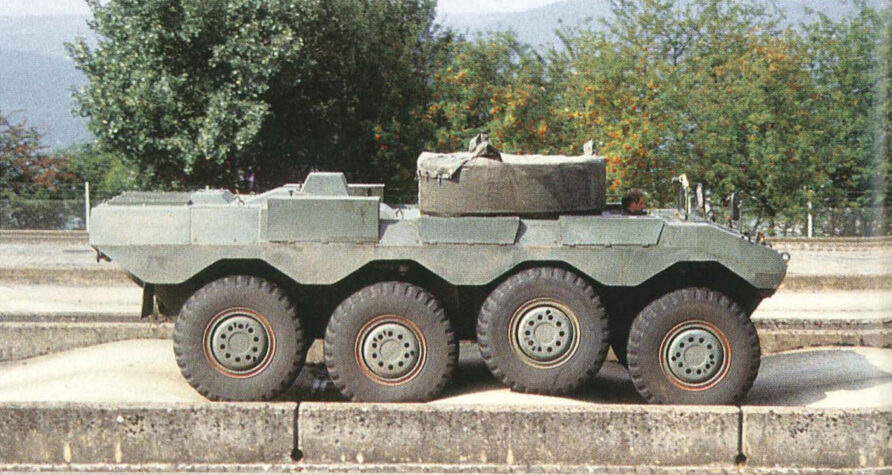
The objective of the programme was to demonstrate that wheeled vehicles could have the same mobility as a tracked vehicle at weights above and beyond the accepted maximum norm of 20 tonnes.
Furthermore, it featured an advanced centralised tyre inflation system.
To meet the then-emerging requirement for the Panther tank destroyer, EXF was further demonstrated and suggested.
The rear engined Radkampfwagen 90 was fitted with a Leopard 2 prototype turret.
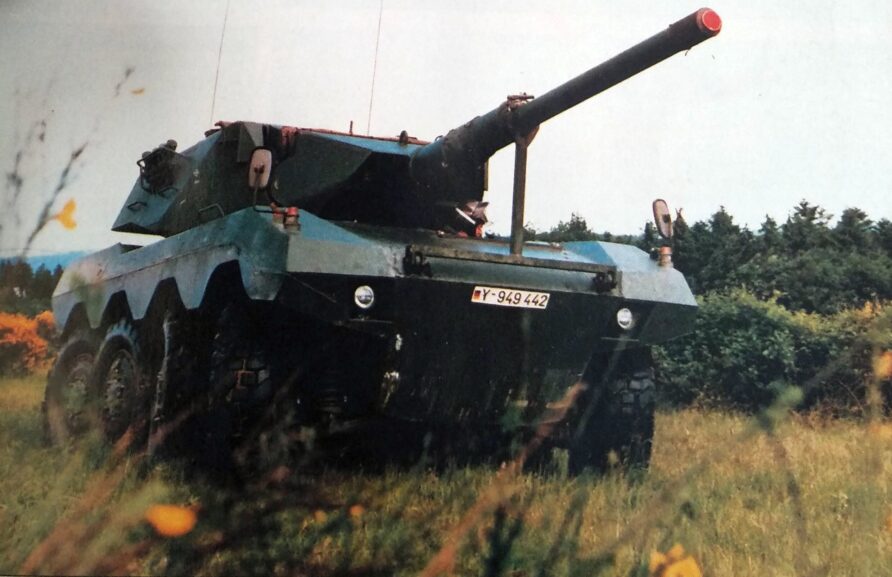
Further design work was completed by Daimler-Benz to describe how the same collection of components could be used in a modular approach for various front and rear engine designs.
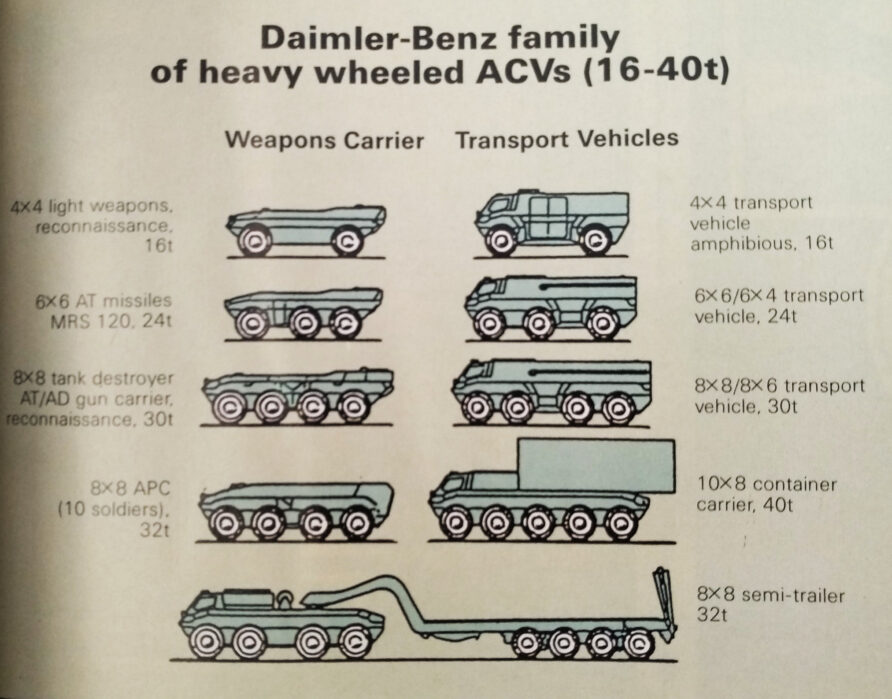
Although EXF was impressive, it was not pulled through into a specific vehicle, although it would inform GTK.
The Panther concept study was awarded to Wegmann with a modified Leopard I chassis and an ATGW launcher. It didn’t enter service either.
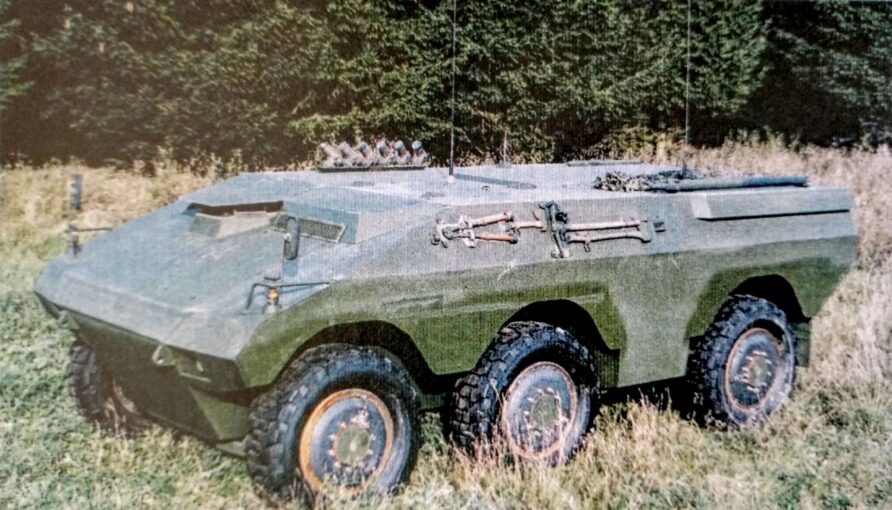
The GTK requirement was to replace Fuchs and M113 in the Heer. Initial requirements and concepts from 1990 were developed until final requirements were released in 1995.
A wooden mock-up was completed to evolve the design and requirements.
VBM and GTK Converge #
In the early nineties, VBM and GTK were still working independently, but they would soon come together.
The two nations then agreed that a jointly designed vehicle would be able to satisfy both nations’ requirements. It would replace the French AMX-10RC, VAB and ERC-90 Sagaie and the German Spahpanzer Luchs, TPz1 Fuchs and M113.
Keeping politics in mind, both France and Germany were also committed to the idea that the vehicle would be used to equip the upcoming Euro Corps.
At a meeting in Bonn in December 1993, Francois Leotard, the French Defence Minister, and Volker Ruhe, the German Defense Minister, agreed to set up a joint arms agency.
It was not a European agency, but a French/German organization to manage a specific number of joint programmes. From this would eventually spring forth OJAC, or, as it was known in the French, the Organisation conjointe de coopération en matière d’armement.
One of these projects was the VBM/GTK.
Two French vehicles emerged from the VBM requirement while the process of convergence continued, one each from GIAT and Renault
In 1992, GIAT provided private funding for the Vextra technology demonstration vehicle to investigate the potential of heavy wheeled combat vehicles.
It was 27 tonnes in weight, powered by a Scania diesel engine, and was capable of carrying nine dismounted personnel or 6 tonnes of cargo.
Initial GIAT Vextra models were fitted with a one-man 25 mm cannon-armed DRAGAR turret.
Through the period, Vextra was extensively tested, including with a 105 mm gun-armed turret.
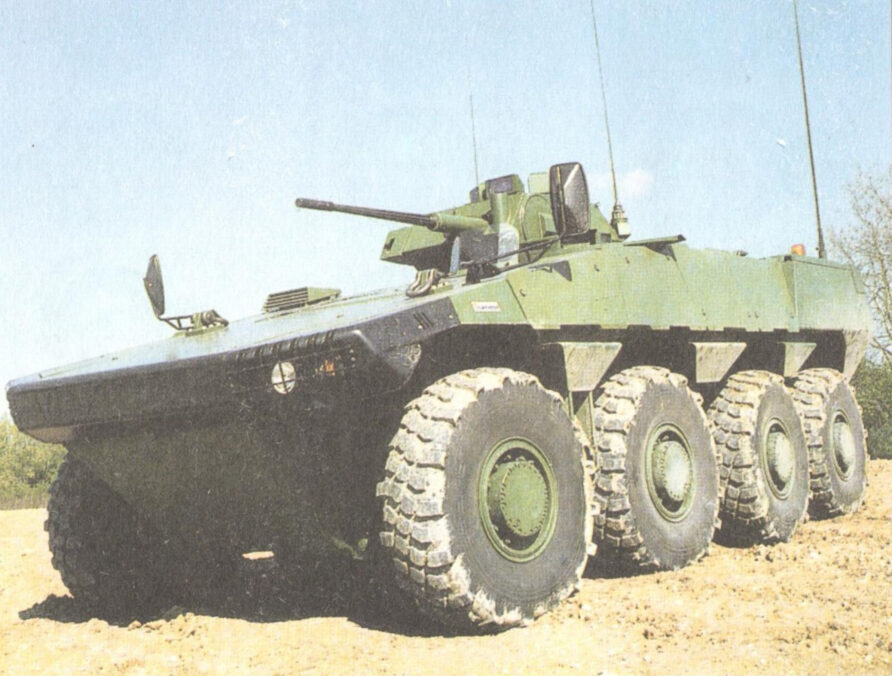
In 1994, the Renault X8A was showcased, although it was not made public until 1996.
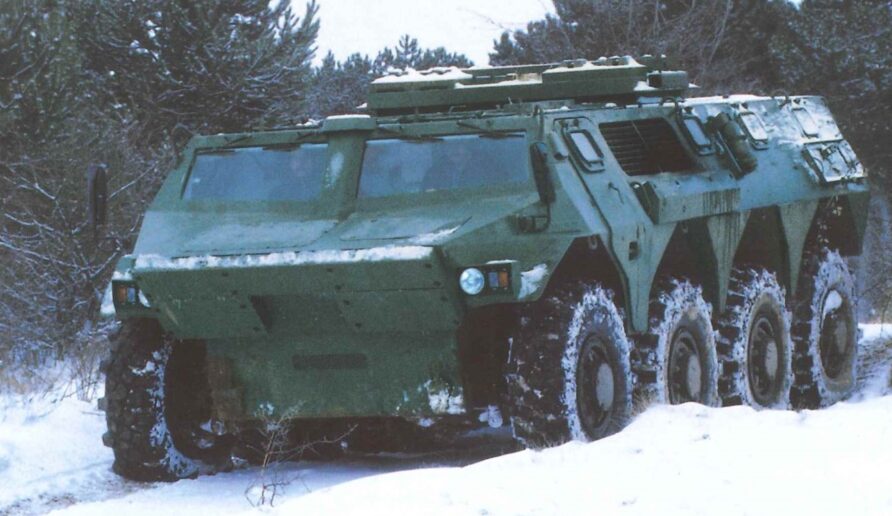
The French GIAT Vextra and German Daimler Benz EXF were on display at Eurosatory 94, described as potential designs for the VBM/GTK program.
A 25-ton wheeled vehicle capable of carrying nine dismounted personnel and achieving a road speed of 120 kilometres per hour was required.
Centralized tire pressure would provide comparable mobility to tracked vehicles, which holds particular significance to the French as they intend the vehicle to replace the AMX-10RC and operate alongside their Main Battle Tanks.
Panhard worked in collaboration with Mercedes-Benz, Krauss Maffei Wehrtechnik, and GIAT Industries to produce a joint concept study for the VBM/GTK requirement.

The vehicle concept was designed to be available in a number of 6×6 and 8×8 variants.
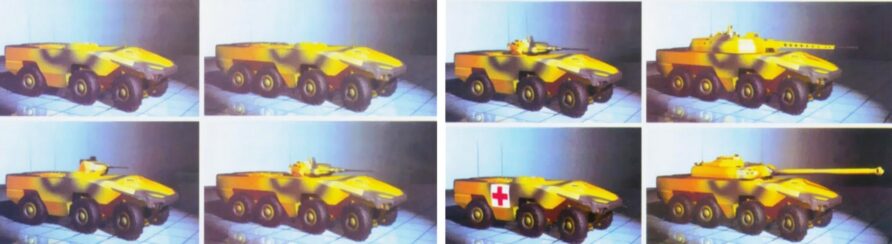
These vehicles included an infantry carrier and a fire support vehicle.
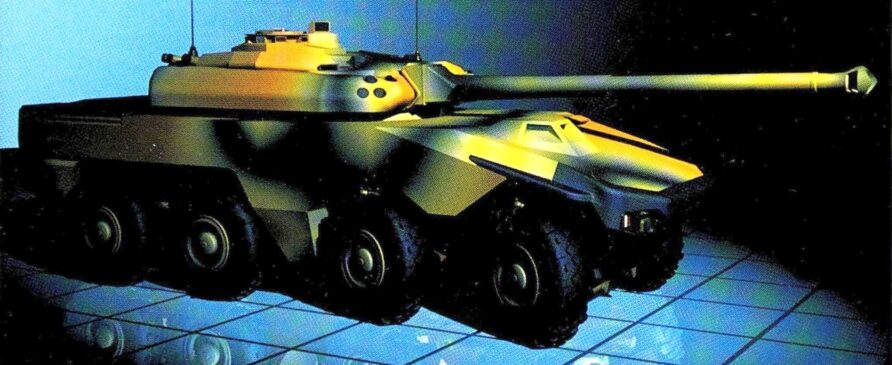
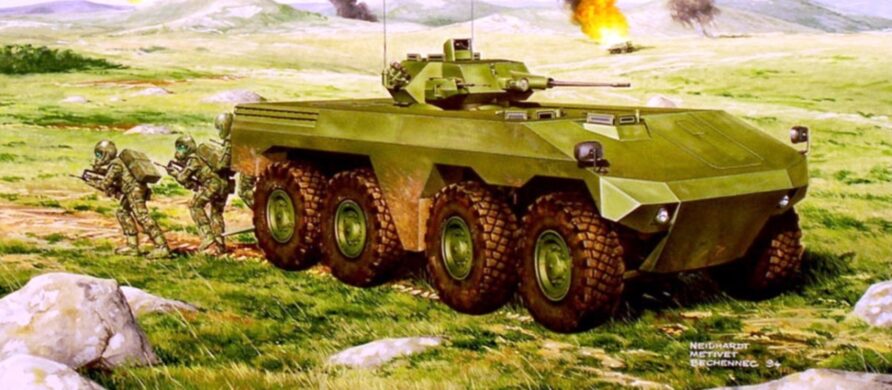
Also on display at Eurosatory 94 (on the GIAT stand) was a 6×6 mock-up referred to as the European Vehicle Armoured (EVA), also intended to showcase what the end product might look like and a realisation of the concepts shown above.
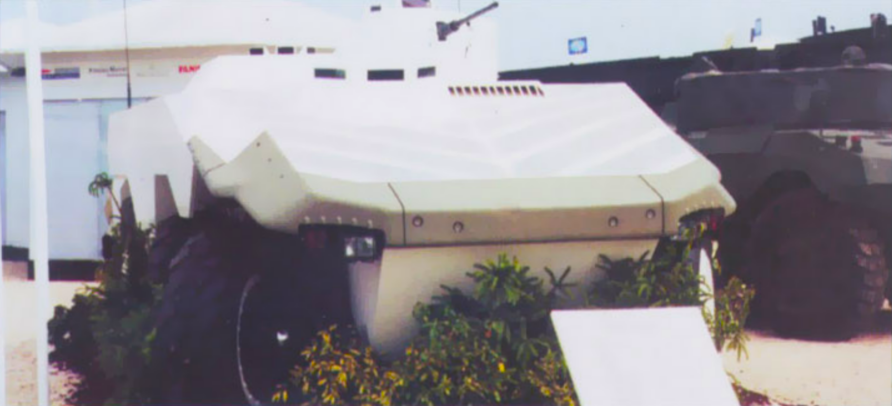
EVA combined elements from both the EXF and Vextra and had a 500hp engine and Renk automatic transmission. It was capable of accommodating 9 passengers and 2 crew, and weighed 22 tonnes in the 6×6 mock-up configuration.
At these stage, 6×6 and 8×8 configurations were included in the concepts, but it was still a French/German programme.
The UK Joins GTK/VBM and it becomes Multi Role Armoured Vehicle (MRAV) #
The UK became involved in the Boxer story in mid-1995 when they were invited to join OJAC.
After the conclusion of FFLAV and the endorsement of LAV, the requirements of MBAV M2P2 were aligned with the French German VBM/GTK.
Three nations agreed in 1996 to develop a vehicle family that would meet the three national requirements using two competing consortia with equal national representation.
The Organisation conjointe de coopération en matière d’armement (OJAC) then became the Organisation for Joint Armament Co-operation, or OCCAR, with the UK, France, Italy, and Germany as founding members.
It’s worth noting that OCCAR has nothing to do with the European Union.
British and German intentions were that OCCAR would manage the programme through open competition, but the French did not agree.
A compromise solution was proposed by the German government, which included multinational consortia with an assured work share in the manufacturing phase.
At the end of the discussion, it was decided OCCAR would not manage the MRAV competition as it wanted and so it was managed by the German defence procurement organisation, Bundesamt für Wehrtechnik und Beschaffung (BWB) with the proviso that GIAT could join whichever consortia won, because France.
All the European manufacturers formed consortia because they understood the implications of losing.
These would eventually coalesce into two competing teams, each submitting their concepts for consideration by the three partner nations.
The requirement by then commonly known as MRAV called for a family of vehicles that could be used for multiple roles, high levels of protection and mobility were specified and an internal usable volume of 11m3, much higher than contemporary vehicles like the FV432, Fuchs or VAB.
It’s important to note that the vehicle was intended to be large.
The two competing consortia (noting that Renault was not in either) were:
Team International

TEAM (Technology for Armoured Mobility) International comprised Vickers Defence Systems, Alvis, Henschel, Kuka and Panhard and Levassor.
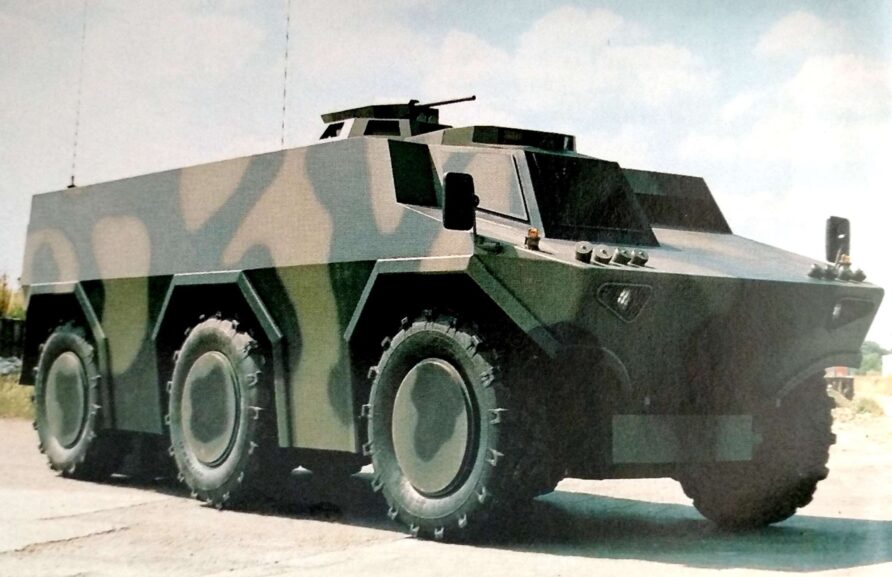
TEAM international adopted a conventional approach, wherein the slightly divergent national requirements were met by varying equipment fittings. However, the horizontally hinged two-part rear door mechanism (shown below) deviated from norms.
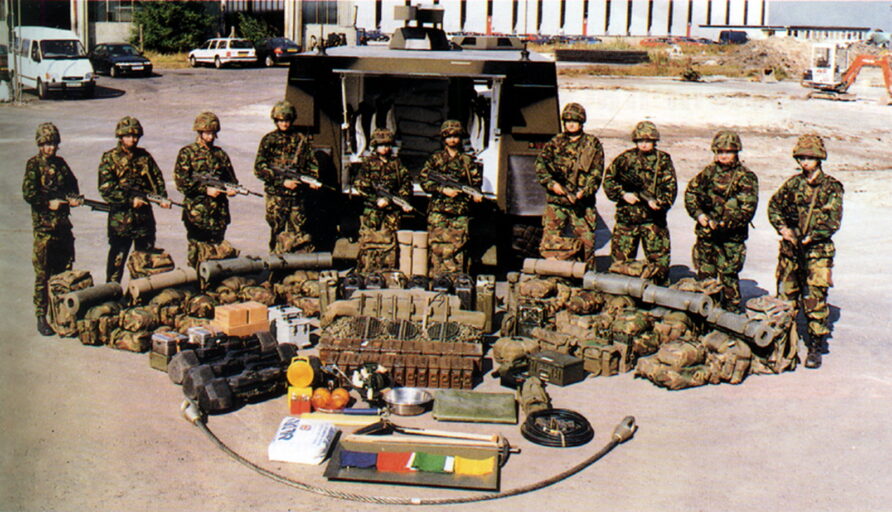
The 23.5 tonnes vehicle was powered by an MTU engine and had a suspension based on the Henschel TH400 6×6 reconnaissance vehicle.
Eurokonsortium
ARGE-GTK (Eurokonsortium) comprised GKN, Krauss Maffei, MaK/Rheinmetall, Wegmann and eventually GIAT (not shown in the graphic below)

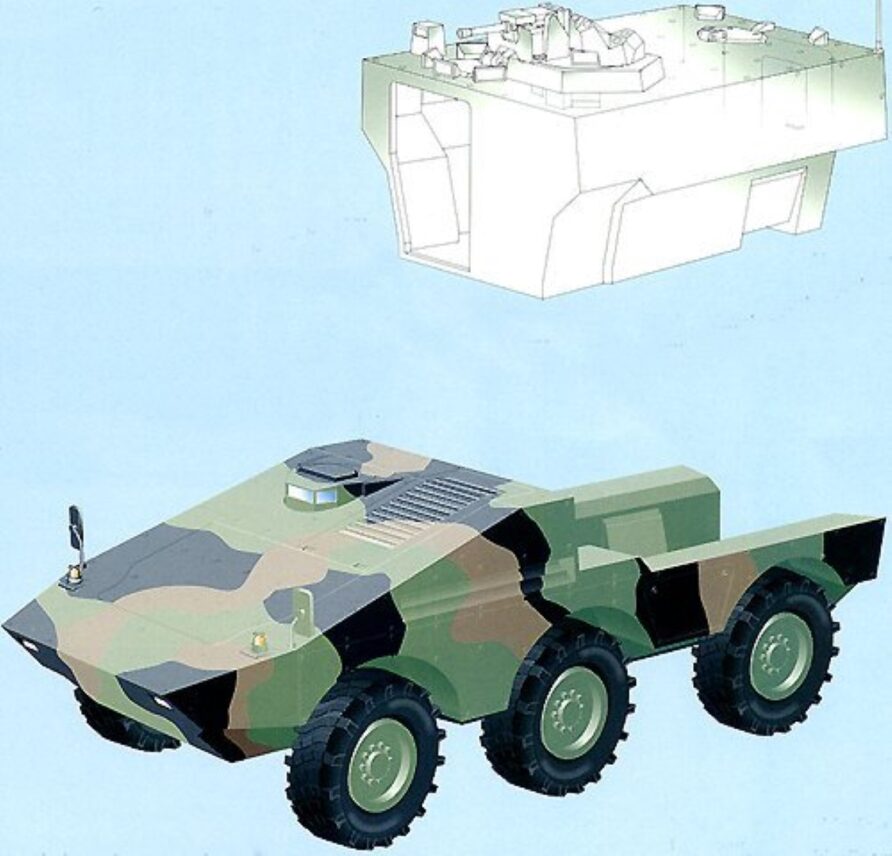
Eurokonsortium would meet different national requirements using modules.
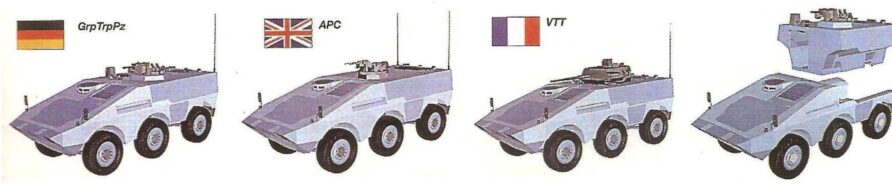
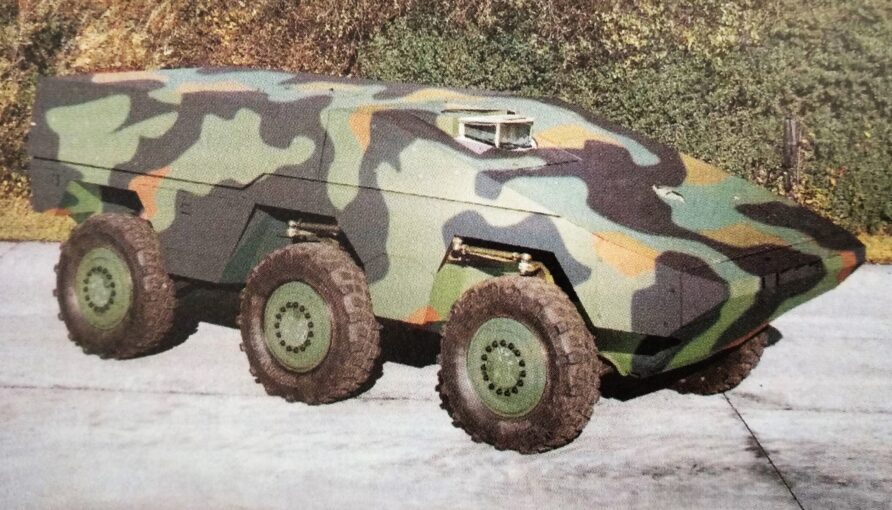
The 26.5-tonne vehicle used the same suspension as that of the Daimler Benz EXF and was powered by a Deutz engine.
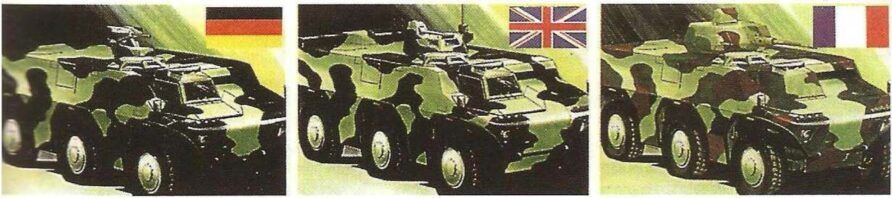
As can be seen above, all were 6×6 designs and had protected driver viewports.
In 1997, the designs were revealed as mock-ups.
As the deadline approached, both consortiums continued their marketing efforts.
Unbeknown to Team International, the ARGE-GTK Eurokonsortium also submitted a proposal for an 8×8 variant.
The Netherlands joined the programme in 1997 as an observer.
New Labour came into power in 1997.
In April 1998, Eurokonsortium was announced as the competition winner.
A House of Lord’s announcement described the decision:
Lord Gilbert: I am pleased to announce that, together with Germany and France, we intend to develop and produce a family of armoured utility vehicles to meet the requirements of all three nations. The UK needs these vehicles to replace FV430, Saxon and Combat Vehicle Reconnaissance (Tracked) utility vehicles.
We plan to sign a Memorandum of Understanding for the joint programme, known in the UK as the Multi-Role Armoured Vehicle, MRAV, covering development and initial production of a total of 600 vehicles.
Subject to the completion of the national approvals processes in Germany and France and the negotiation of satisfactory contract terms and conditions, it is intended to place a contract with Eurokonsortium, a consortium including GKN Defence Ltd from the UK, Krauss-Maffei/Wegmann and MAK from Germany, and GIAT from France.
This programme will be managed within the quadrilateral Organisation for Joint Armament Co-operation, known as OCCAR, and represents a major collaboration with our European allies.
Collaboration will bring a number of benefits, including improved interoperability and financial savings, through sharing of development costs and economies of scale in production. The project also offers UK industry the opportunity to strengthen its links with the leading companies in the European armoured vehicles industry
Team International threatened legal action because the original requirement was for a 6×6 design.
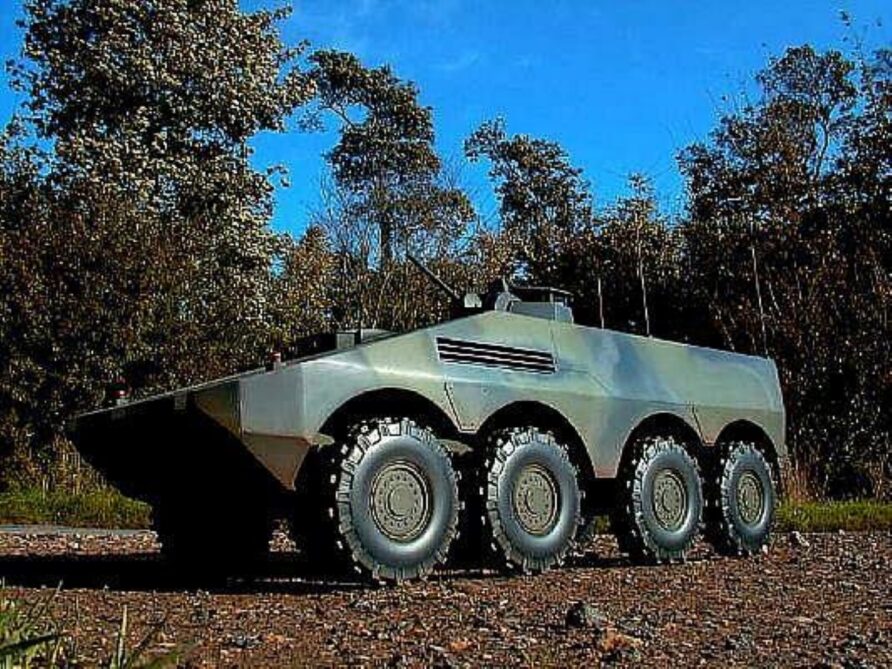
After submitting their own 8-8 proposal, five months after the official closing date, Team International’s protest stalled.
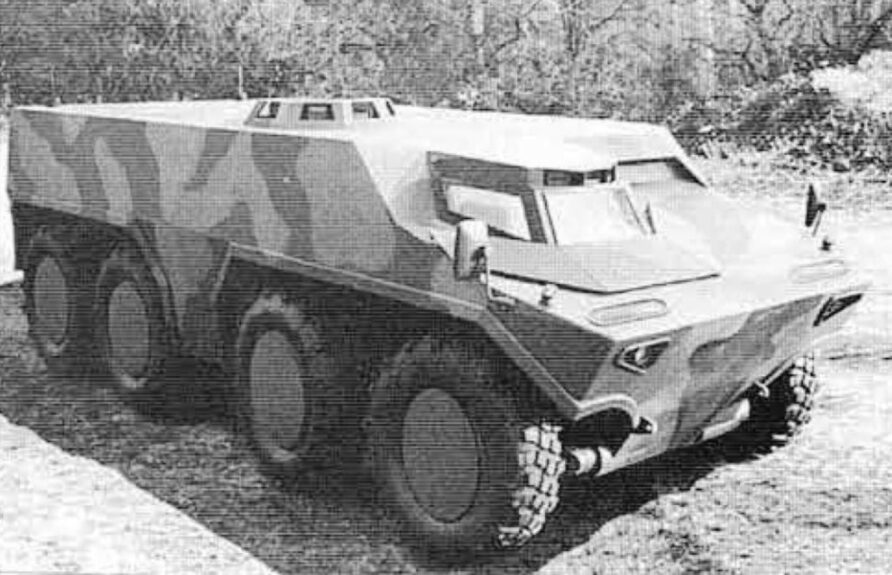
A July 1998 Parliamentary Question elicited this response from the Government:
Mr. Key: To ask the Secretary of State for Defence (1) if he will make a statement on the progress of the MRAV project; (2) how many multirole armoured vehicles he intends to purchase.
Mr. Spellar: Following the joint announcement with France and Germany on 22 April of our intention to proceed with collaborative development and initial production of the Multi-Role Armoured Vehicle, MRAV, and of the selection of the trilateral consortium “Eurokonsortium” as the preferred bidder, we have set work on hand to prepare a Memorandum of Understanding between the three nations. Detailed contract negotiations with the consortium are also proceeding. The initial production order will include 200 vehicles for each nation. No decisions have been taken on the final numbers required.
The competition’s end resulted in a swift convergence of losers, as evidenced by the acquisition of the GKN Defence business by Alvis in September 1998.
The 1998 Strategic Defence Review (SDR) committed the UK to an interventionist foreign policy, recognising a change in the security environment.
The British are, by instinct, an internationalist people. We believe that as well as defending our rights, we should discharge our responsibilities in the world. We do not want to stand idly by and watch humanitarian disasters or the aggression of dictators go unchecked. We want to give a lead, we want to be a force for good.
On the positive side, the collapse of Communism and the emergence of democratic states throughout Eastern Europe and in Russia means that there is today no direct military threat to the United Kingdom or Western Europe…The end of the Cold War has transformed our security environment.
The world does not live in the shadow of World War. There is no longer a direct threat to Western Europe or the United Kingdom as we used to know it, and we face no significant military threat to any of our Overseas Territories
And that forces would need to be more joint, exploit technology and more be expeditionary. Although it is well accepted that the 1998 SDR was a foreign policy led document that failed to win the backing of the Treasury, it set in train a series of projects and programmes that would include FRES, the Future Rapid Effect System.
The Strategic Defence Review also made clear there would be a European element to future defence acquisition. It also described continuing intent with MRAV.
Wherever possible, European governments should harmonise the requirements of their Armed Forces and pursue co-operative solutions. This not only avoids unnecessary duplication of development and production costs but makes sound operational sense. As part of their initiative, the Defence Ministers announced on 20 April that they would give high priority to resolving a number of governmental issues — for example relating to security and intellectual property rights – which could hinder restructuring and would sign a Letter of Intent setting out a timetable for this on 6 July.
The creation of a multinational organisation, OCCAR (Organisme Conjointe de Co-operation en matière d’Armament), involving Britain, France, Germany, and Italy to undertake common procurement also has an important part to play.
The outcome of the Strategic Defence Review fully reflects the importance that the Government attaches to maintaining a strong and healthy British and European defence industry combined with a continuing commitment to competitive procurement.
The Review’s forward equipment plans include a range of major European collaborative projects including Eurofighter, Horizon frigate, and the Multi-Role Armoured Vehicle (MRAV).
We will be seeking to ensure that there are realistic European options to be considered for our longer term-requirements such as the replacement for the Tornado bomber and improved strategic air transport
Following the 1998 SDR and Smart Procurement initiative, the MoD created a single Equipment Capability Customer (ECC) called Deputy Chief of Defence Staff (Equipment Capability), a 3* joint post.
Underneath, were four capability portfolios, each with a single manager;
- Strategic deployment
- Strike
- Manoeuvre
- Information superiority
Spread across these four portfolios were fifteen individual 1* Directors of Equipment Capability (DEC).
The Joint Capabilities Board was chaired by the Deputy Chief of Defence Staff (Equipment Capability) with the four Capability Managers, the Director-General (Equipment) and Director General (Research and Development).
The Director of Equipment Capability Ground Manoeuvre (DEC(GM)) would normally take the lead on requirements setting after consulting various stakeholders. Defence Equipment and Support (DE&S) then delivers the requirement to the user.
The Deputy Chief of Defence Staff (Equipment Capability) was responsible for equipment capability but did not sit on the Defence Procurement Agency Equipment Approval Committee.
Design work continued, including developing the 6×6 and 8×8 concepts
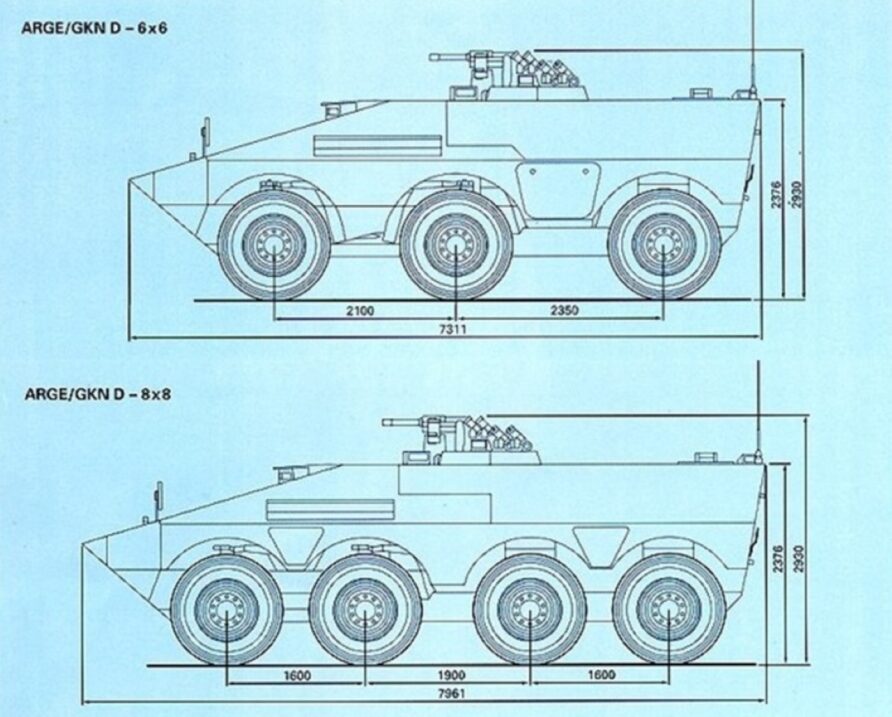
Many variants were proposed.
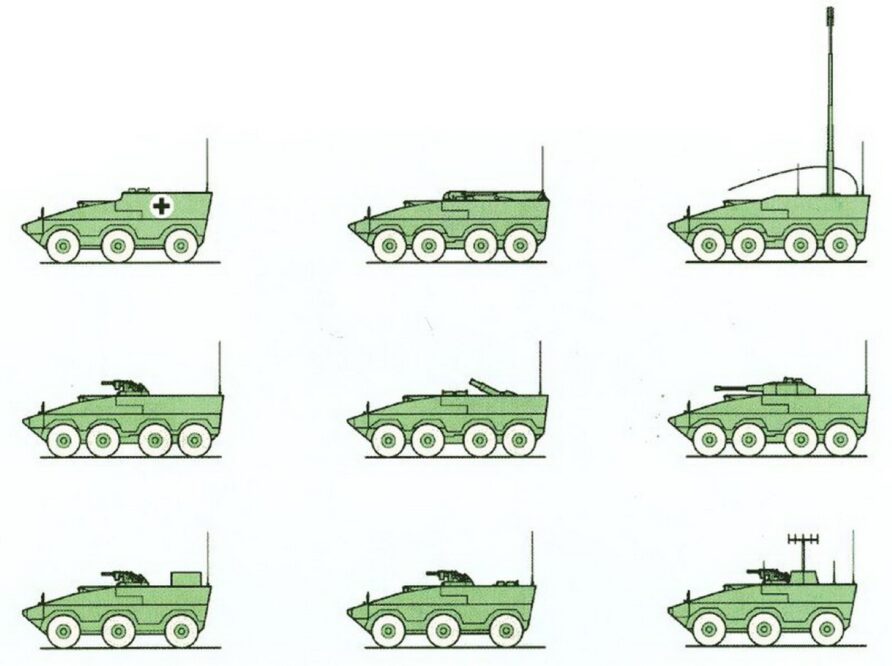
A year after the MRAV winner was announced, a lead nation had not yet been appointed, and there is no doubt that the devil made work for idle hands.
Germany and the UK aligned, while France increasingly moved away from MRAV.
They began to favour a wheeled infantry fighting vehicle, which would work closely with the Leclerc Main Battle Tank, armed with a medium calibre weapon. This role was fulfilled by Warrior and the new Puma vehicle in German service. France was also still smarting from the UK/German decision to insist that GIAT could only be part of one of the competing consortia, despite agreements on manufacturing.
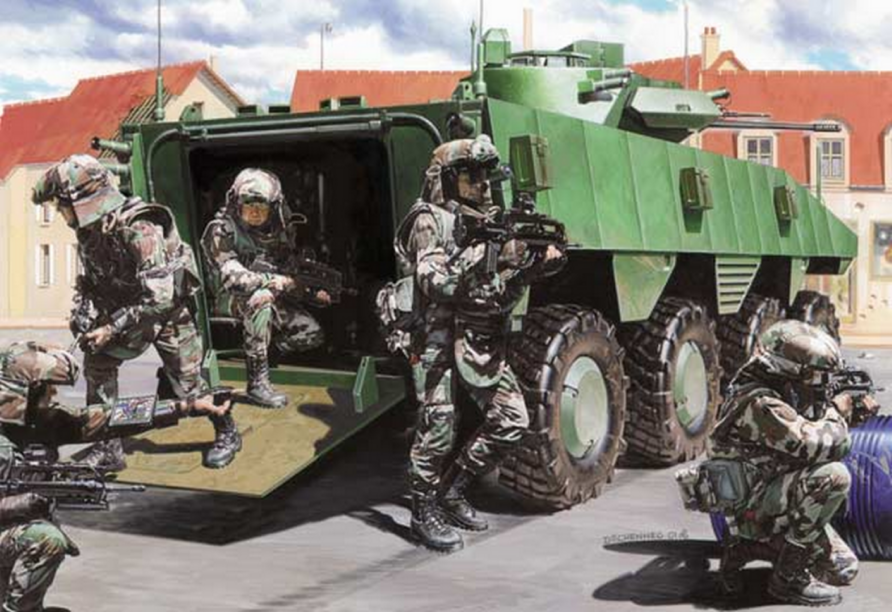
Independently, the French had begun working on the VBM programme, adding an I (Infantry) and creating VBCI.
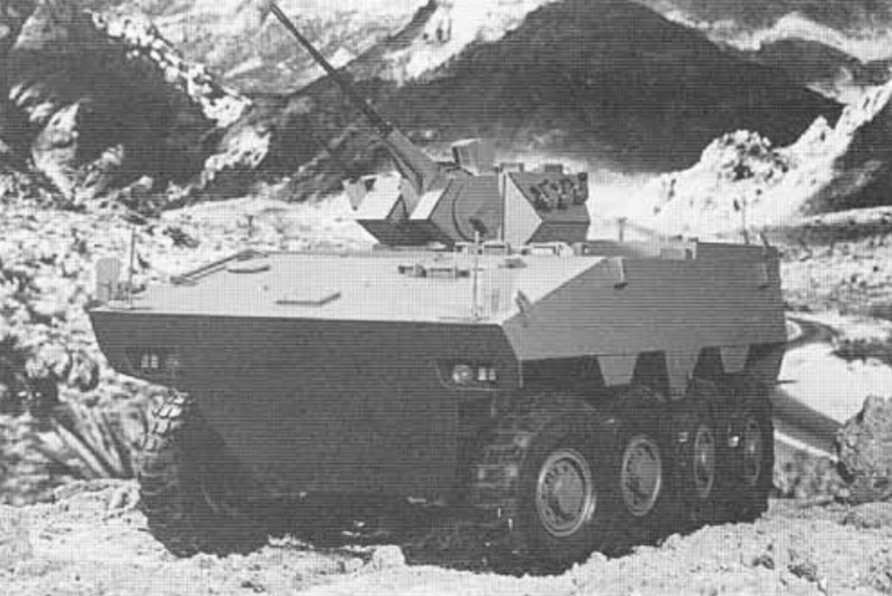
Before MRAV, GIAT wasn’t doing well commercially and the French Government wanted to keep its sovereign production capability.
France left the VBM/MRAV/GTK programme in 1999 to create the VBCI, interestingly, based largely on the Renault X8A, that was not part of the VBM/MRAV/GTK programme.
Helio competed for the VBCI turret with their 25 mm Bushmaster armed FVT925, which was shown below on a CVR(T) Scorpion.
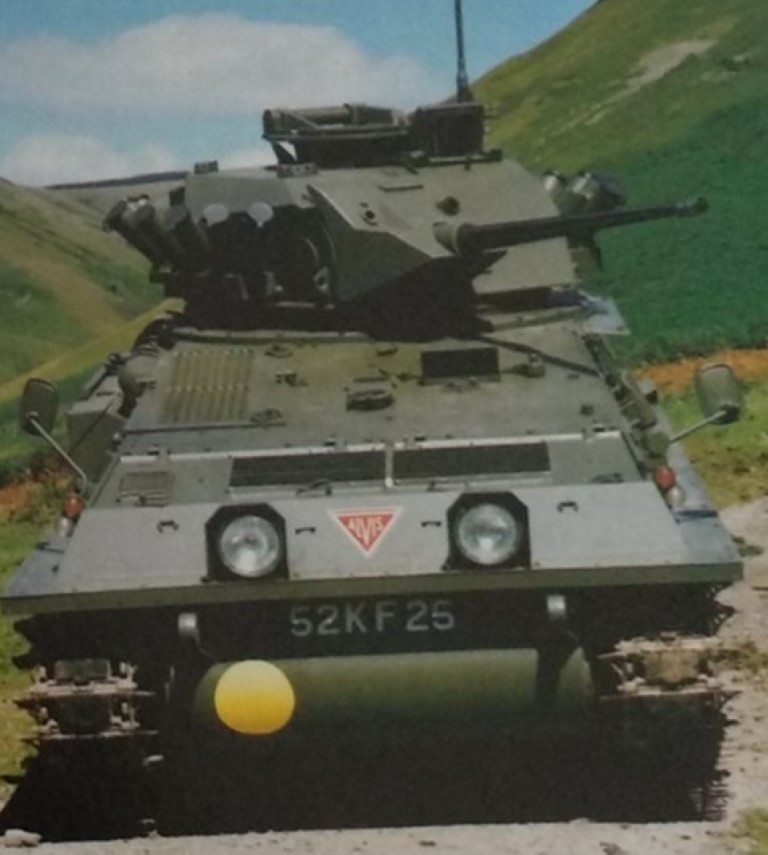
The Direction générale de l’armement (DGA) awarded contracts to GIAT and Helio in 1998 to trials their turrets.
A Side Trip to the Balkans
Although not directly related to Boxer, US operations in the Balkans during the early nineties had created an increasing impetus for change with the US Army’s vehicles.
It was further underlined by the 1999 Operation AGRICOLA. Operation AGRICOLA was the name given to the UK contribution to KFOR. KFOR entered Kosovo on the 11th of June 1999, two days after the adoption of UN Security Council Resolution 1244.
KFOR was to advance into Kosovo via several routes. UK forces were responsible for securing a route to Priština from Macedonia. The crucial Kacanik Defile was included in this route, a narrow gorge with a series of bridges and tunnels. During the rapidly changing time in the lead up to the ceasefire and deployment into Kosovo, as a show of strength and to gain greater influence, 250 Russian personnel in 30 wheeled armoured vehicles moved overnight and took up positions in Priština Airport, blocking access and presenting KFOR with a very delicate situation.
The situation was resolved without any shots being fired, despite some rather aggressive and erroneous directives from General Wes Clarke.
It is a fascinating incident to study. Click here for a good rundown, but what really sent shockwaves around the world was the fact that the Russians had completed a long road march right under the noses of NATO. This one incident would be used as an example many times in forthcoming arguments about medium-weight wheeled forces.
Back to Boxer
On the 5th of November 1999, Alvis released details of the contract:
Alvis plc is pleased to announce that a contract was signed on 5 November between the German and UK MOD, and ARTEC GmbH for the development of the Multi-Role Armoured Vehicle (MRAV.
Alvis is a shareholder in ARTEC, which is a joint venture company established to manage the MRAV programme. The value of the development contract is approximately £70m, and it contains a production option for an initial procurement of 600 vehicles.
The Alvis share of the development phase will be approximately £35m and its share of the initial production phase is expected to exceed £200m. The launch of MRAV is an event of major importance for Alvis.
MRAV is the largest European Armoured Vehicle programme for the next 10 years and beyond, and it will secure and enhance the interests of our employees and shareholders into the long term.
The collaboration with Krauss-Maffei and MaK, the leading land systems companies in Germany, provides an axis for further business development in Europe
The contract covered the full development and a production option for the first 600 vehicles (200 per country) at a value of approximately €750m.
Baroness Symons, the minister responsible for defence procurement, elucidated the announcement as follows:
The MRAV programme strengthens the links between our nations and will provide a springboard for the development of a more cohesive and competitive European defence industry in this sector.
The MRAV programme will provide the British army with a modern and flexible family of armoured utility vehicles that can operate in both high-intensity conflict and in rapid reaction peace support and humanitarian operations world-wide
The base vehicle would use common components, with national-specific variants being produced and assembled locally.
Development of the Eurokonsortium demonstrator was completed.
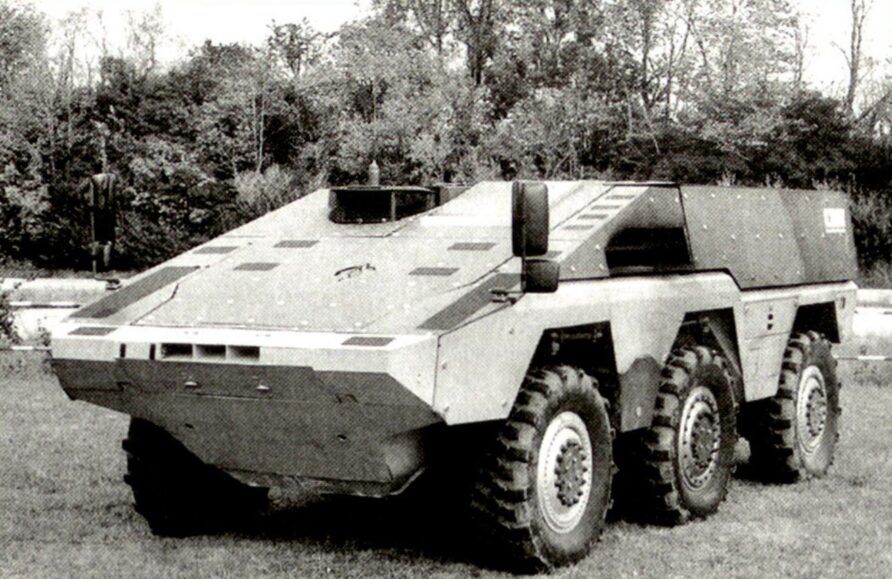
The Netherlands began discussions about joining the programme.
It was decided that the Organization for Joint Armament Co-operation (OCCAR) should inherit MRAV and manage it from there after it gained legal status in 2001.
The joint venture company ARTEC GmbH was formed, replacing Eurokonsortium, which consisted of Alvis Vehicles Ltd, Rheinmetall Landsysteme GmbH, and Krauss-Maffei Wegmann GmbH.
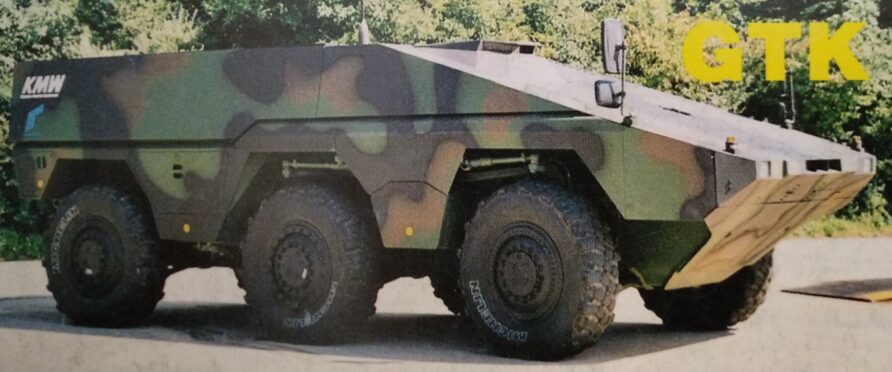
Work continued on the demonstrator.
The Dutch company Stork PWV joined ARTEC in February 2001 to fulfil the Pantser Wiel Voertuig requirement.
An updated logo appeared!

With the 6×6 option gone, all eyes were on the 8×8 variant.
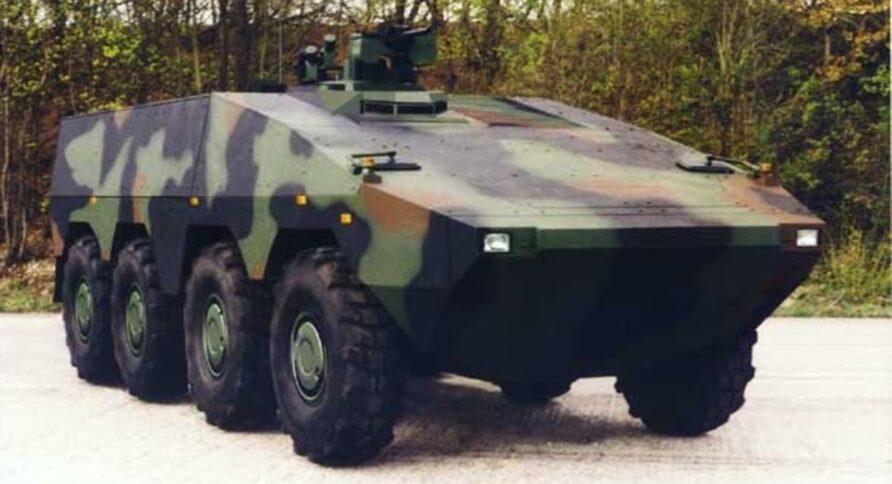
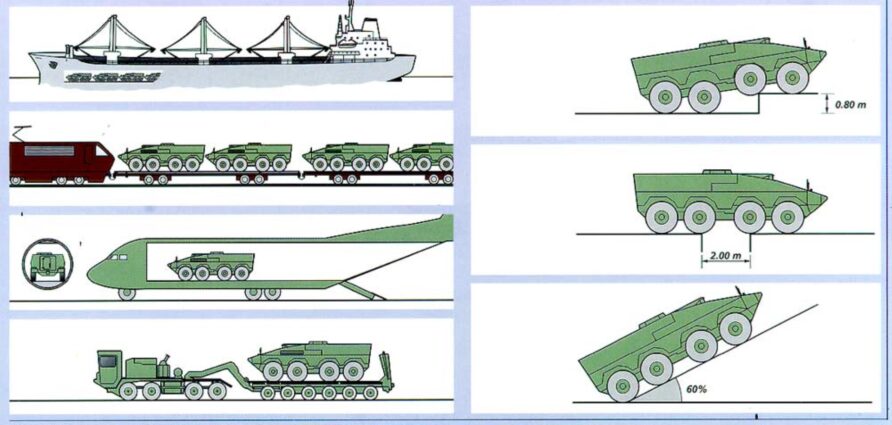
In 2001, the Ministry of Defence requested information from suppliers on how they could contribute to a medium-weight force.
BAE, Alvis Hägglunds, and Vickers responded.
This then happened, and while many would not have realised at the time, it would have a profound impact on US and British Army vehicle programmes.

In 2002, Air Marshal Sir Jock Stirrup was Deputy Chief of Defence Staff for Equipment Capability and Royal Marine Major General Rob Fulton was Director of Equipment Capability for Information Superiority.
Major General Fulton was the one who coined the phrase NEC and produced the NEC plan in 2002. It was endorsed by the Joint Capability Board the same year. In the same period, the Effects-Based Approach to Operations (EBAO) would also be a significant influence on the Future Rapid Effects System (FRES) programme.
The Joint Doctrine and Concepts Centre at Shrivenham, another result of the 1998 Strategic Defence Review, would develop the EBO theory further in the UK.
In 2002, the Director-General of the Joint Defence Command was Air Vice Marshal Ian McNichol.
Would it be fair to say that joint effects-based transformation was being driven solely by the RAF and RN, probably not, but they were very influential and this overall theme would, in turn, influence the Army and its vehicle choices?
While acknowledging the resemblances between FCS and FRES, it’s equally important to note the differences.
FRES saw the network as an enabler, while FCS saw it as the heart of the system. The role of heavy forces was recognized by FRES when FCS was looking to replace the main battle tank concept.
Similar problems often drive different people to find similar solutions. The main changes for both the US Army and the British Army were the same. Even though they had different goals, FCS and FRES were very similar.
Recognising the geopolitical change as a result of the 9/11 attacks, the New Labour government initiated discussions and consultations on a ‘new chapter’ for the 1998 Strategic Defence Review in February 2002.
Following the appalling events of 11 September, the Secretary of State for Defence announced that the Ministry of Defence would look again at how we organise our defence. This will not be a new Strategic Defence Review, but a “New Chapter” building on the review. We need to ensure we have the right concepts, forces, and capabilities to meet the additional challenges we might face from international terrorism.
The MoD requested a new joint approach for FRES from BAE and Alvis in July 2002, with BAE providing systems engineering and Alvis providing vehicle domain expertise.
Alvis was awarded a non-competitive contract by the MoD to develop plans for the Assessment Phase of a future FRES programme.
The target in-service date was set for 2009, seven years away.
If both the Generals commenting above were hoping for a simple solution, they were going to be very disappointed now that the Network Enabled Capability team was on the case.
The Strategic Defence Review – New Chapter was also published in July 2002.
The importance of being able to deploy quickly at a distance was again stressed.
We must retain the ability rapidly to deploy significant, credible forces overseas. It is much better to engage our enemies in their backyard than in ours, at a time and place of our choosing and not theirs. But opportunities to engage terrorist groups may be only fleeting, so we need the kind of rapidly deployable intervention forces which were the key feature of the SDR.
But it also requires the ability to deploy and redeploy rapidly, and it has potential implications for the mix of forces that are used. For instance, some theatres and scenarios, like Afghanistan, may point towards the use of rapidly deployable light forces rather than armoured or mechanised forces and artillery: and we are examining ways of providing such forces with improved mobility and firepower.
Operations in Afghanistan have again demonstrated the key role played by support helicopters. And, as part of our move towards more rapidly deployable forces, we are also pursuing the concept of a Future Rapid Effect System, a family of air-transportable medium-weight armoured vehicles.
We will also be accelerating the introduction of additional temporary deployed accommodation for our troops, and further improving its hot weather capability
The UK’s planning assumptions encompassed a broad range of variants, including but not limited to the armoured personnel carrier, command vehicle, communications vehicle (CommV), mortar carrier (ATV), Anti-Tank Platoon (ATPV), and two configurations of Armoured Treatment and Evacuation Vehicle (ATEV) for a total order of 775 vehicles, replacing FV432, some CVR(T), and Saxon.
54 armoured personnel carriers and 21 command vehicles were defined as the initial capability.
MRAV was intended to be transported by C-17 and the future large aircraft (A400M), but not by the C-130, this flip-flopping between A400M and C-130 turned out to be detrimental.
A great deal of British design expertise was put into MRAV, as well as the concept of operations.
Alvis acquired Vickers Defence Systems from Rolls-Royce in 2002, and the MRAV vehicle was named Boxer.
This was the same Alvis that had also absorbed GKN and was still building the Boxer prototypes.
Alvis also built the first 13 Boxer trials vehicles at its plant in Telford, and designed and built the UK Ambulance and Personnel Carrier modules.
It was doing all this whilst being paid to study a new set of vehicles under the FRES concept.
A June 2003 evidence session at the House of Commons for the Defence Select Committee provided some revealing information on FRES.
Lord Bach: Well, as to the question of whether it is a long way off or not, this is a new generation of capability that we hope to bring in. We are well equipped, we think, at the heavy end and at the light end too, but it is the medium-weight area where FRES fits in and we are moving as fast as we feel we can to initial gate approval and we hope to be able to tell you pretty soon and I will be able to make an announcement soon as to when we will.
There will be some pretty cutting-edge technology with FRES when we decide exactly what it is we want out of this process and with that cutting-edge technology it is absolutely crucial that the design, the technology reaches a certain stage of maturity before we try and apply it to what will be a very expensive and a very important programme which will last for many, many years.
I think it is more important that we get it right than that we rush it in, but we hope there will not be any capability gap. The General will be able to tell you whether there is a risk of a capability gap or not, but we think we have got this about right. General?
Furthermore, in later questions.
Lieutenant General Fulton: You cannot go out into the world anywhere and buy FRES.
The requirement for FRES is very demanding.
What we are seeking to do is to put a medium-weight capability into the field which means getting many of the vehicles down to a C-130 load. We are talking of the order of 17 tonnes. This is not going to be a main battle tank in 17 tonnes because the laws of physics do not allow that.
This is a medium-weight force, but the technology to which the Minister has referred is very demanding and, frankly, I do not know whether it will work because in order to get down there we are dependent, for example, on electric drive, so will that work?
We are dependent on some pretty interesting technologies for protection and survivability where in order to get a level of survivability that is acceptable on the battlefield, there will be some interesting questions on situation awareness, manned and unmanned turrets, for example.
What gives me confidence that we are not dragging our feet is the very, very close link that we have with the American FCS programme which is asking precisely the same questions at precisely the same time, and there are other countries doing the same, for example, Sweden’s SEP programme is also looking at that, so we, in conjunction with the American and the Swedes, clearly have an interest in producing something that is very, very similar.
There were some interesting points to pick out of that.
- The scale of the technical challenge and uncertainty in achieving technology goals,
- Close alignment with US and Swedish programmes,
- Confirmation that FRES was not a 70 tonne Main Battle Tank in a 20-tonne format, but…
- C-130 carriage as a minimum, not Future Large Aircraft as originally
We went from the A400M carriage to the C-130 carriage in less than a year.
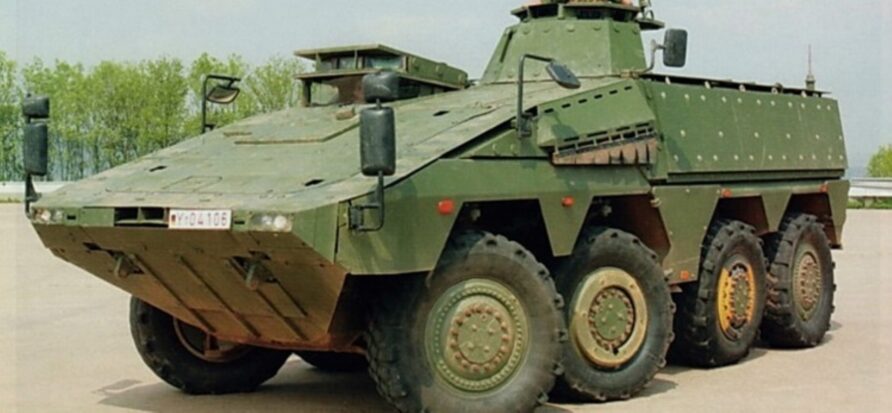
The development of the ARTEC Boxer continued, with PT11 below, as built by Alvis in Telford.
Withdrawal from MRAV #
A month later, the UK withdrew from MRAV to pursue FRES, announcing the MRAV decision on July 17, 2003, Adam Ingram said.
Mr Adam Ingram (Minister of State (Armed Forces), Ministry of Defence; East Kilbride, Labour). We regularly re-visit existing plans for capability enhancements to ensure they remain tailored to the security environment in which we need to operate.
As such, we judge that the Multi-Role Armoured Vehicle (MRAV) is not ideally suited to the type of operations envisaged under the Strategic Defence Review New Chapter and other developing policy work. This, coupled with recent operational experience in the Balkans, Sierra Leone, East Timor, Afghanistan and latterly Iraq, has demonstrated the need for rapid deployability in expeditionary operations.
MRAV is not considered able to meet this capability requirement which will be pursued through the Future Rapid Effect System (FRES).
FRES will be a very significant component of the long-term transformation of the land battle through its contribution to network-enabled capability. We have written to the German and Dutch Governments to inform them of our decision to withdraw from the MRAV collaborative project.
This emphasized that MRAV would not meet the FRES requirement because it was too heavy.
Lord Bach, the Minister responsible for Defence Procurement, stated:
The SDR (Strategic Defence Review) New Chapter, and our experience on recent overseas operations, have shown the need for lighter armoured vehicles that can be quickly sent by air to a trouble spot when a crisis breaks
By the end of 2003, the initial FRES contract with Alvis had been ended after the Investment Approvals Board decided not to approve the investment strategy.
The budget line of £1.15 Billion allocated to Boxer production was deleted.
Major General Rob Fulton was appointed to the new position of Deputy Chief of Defence Staff (Equipment Capability) and thought that NEC would be part of every single programme, FRES being no different.
Against this backdrop was Iraq, and an emerging requirement for increasing levels of protection.
Germany and the Netherlands were left as the “none too happy” partners in the MRAV programme, but they kept going and the first production-ready prototype was delivered in December 2003.
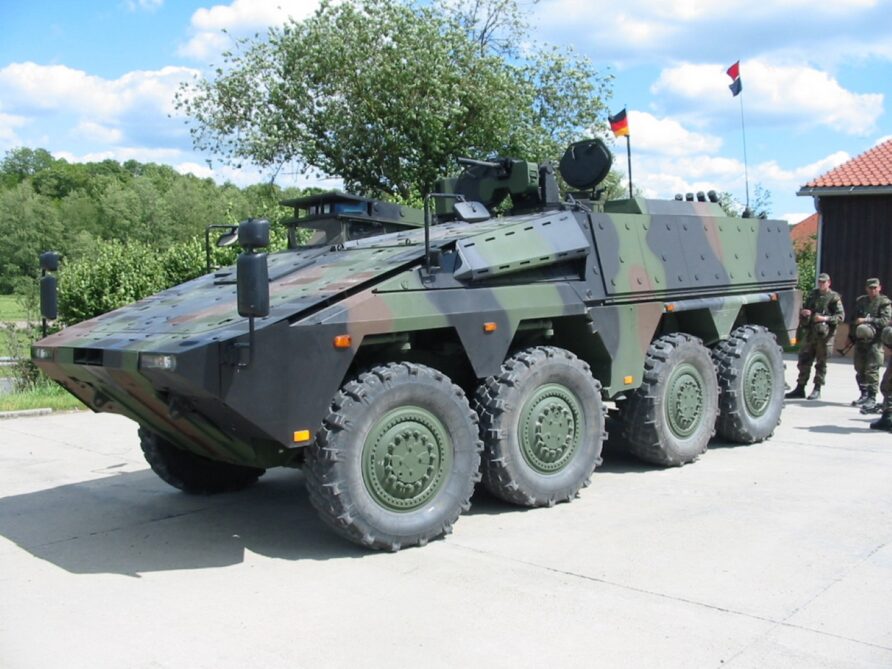
As the first production-ready Boxer model was being unveiled, the United Kingdom published the Delivering Security in a Changing World – Defence White Paper. It repeated many of the arguments found in the SDR New Chapter, but included additional information on medium-weight forces.
UK land forces currently consist of a mix of heavy and light capabilities.
The former offer firepower, integral tactical mobility and protection necessary to carry out ground manoeuvre warfare but require a considerable effort to deploy and support on operations. Light forces in contrast can deploy rapidly anywhere in the world but lack much of the firepower, mobility and protection to conduct decisive operations against an enemy equipped with armour and mechanised forces.
To increase our flexibility in responding to crises, a new set of medium weight forces will be developed, offering a high level of deployability (including by air), together with much greater levels of mobility and protection than are currently available to light forces.
The cost of the UK participation in MRAV was reported as £48 million in 2003. This would rise in subsequent reporting, as it often does.
The first Dutch-made Boxer was unveiled by Stork PWV at the end of 2003.
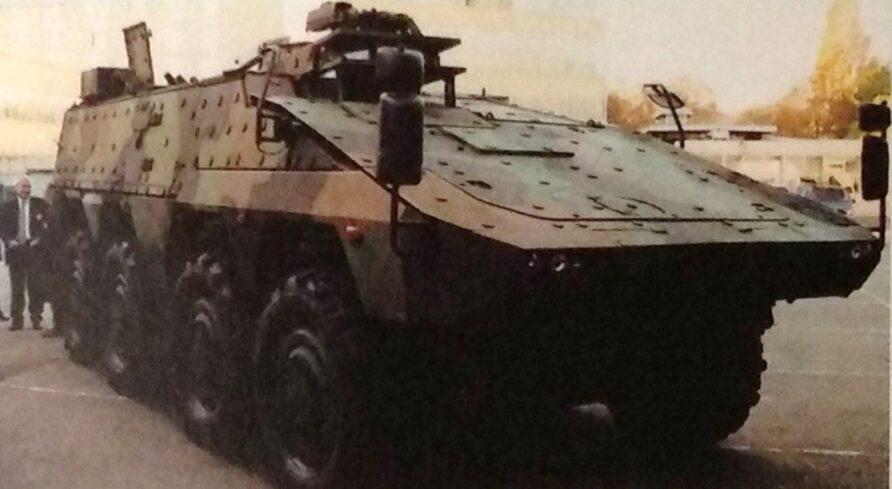
And that was the end of MRAV, at least for the UK.
CVR(T) and FV432 were still in service. Protected mobility, and the words IED and Snatch, were soon to enter the mainstream. The British Army was aligning to the US Future Combat System and saw the 20 tonne plus Boxer as too heavy.
Eighteen years after FLAV, the British Army was no closer to replacing its legacy fleet.
If you found value in this article, help me keep Think Defence going.
Think Defence is a hobby, a serious hobby, but a hobby nonetheless. I have removed those annoying adverts, but hosting fees, software subscriptions and other services add up.
To help me keep the show on the road, I ask that you support the site in any way you can. It is hugely appreciated.
You can click on an affiliate link, Buy Me a Coffee at https://ko-fi.com/thinkdefence, download an e-book at https://payhip.com/thinkdefence or even get some TD merch at https://www.redbubble.com/people/source360/
Youtubers, if you are going to lift content from here, the decent thing to do would credit me
read more (Affiliate link)


