 Doc Summary

The AIM-132 ASRAAM is a high-speed, highly manoeuvrable, heat-seeking, air-to-air missile.
Advanced Short Range Air-to-Air Missile (ASRAAM) is described by the RAF as;
The AIM-132 ASRAAM is a high-speed, highly manoeuvrable, heat-seeking, air-to-air missile. Built by MBDA UK Ltd, the missile is designed as a ‘fire-and-forget’ weapon, able to counter intermittent target obscuration in cloud as well as sophisticated infrared (IR) countermeasures.
It equips Typhoon and Tornado and is integrated with the UK’s F-35’s as a baseline weapon.

Advanced Short Range Air to Air Missile (ASRAAM) History #
To say ASRAAM had a rather convoluted history would be an understatement. It is also fair to say that we really were ahead of our time in the sixties and seventies.
The ASRAAM story starts with the Hawker Siddeley Dynamics Taildog.
Taildog #
The Taildog first emerged in the late sixties as a counter to rapidly manoeuvring aircraft, with US experience in Vietnam being an impetus. It was revolutionary at the time, utilising thrust vectoring and off-boresight launch.

Short Range Air to Air Missile (SRAAM-100) #
Taildog then became the Short Range Air to Air Missile (SRAAM-100) but even at this early stage, the RAF was considering an off-the-shelf purchase of the Sidewinder or Matra 550 missiles.
By 1972, the government had placed initial development studies with Hawker Siddeley Dynamics for the SRAAM-75 missiles, a slightly lower specification design to meet Air Staff Requirement 122.
This was the world’s first thrust vectoring missile and included a novel air carriage system using a low drag canister, rather than free suspension of the missile on a pylon.
The launch tube also contained a rear-facing venturi to accelerate the missile clear of the launching aircraft at high speeds.
SRAAM Image 1

SRAAM Advert

SRAAM Image 2

By 1973, SRAAM had a name, Mongoose.
The missile was built in three sections; the front housed the infra-red seeker, arming unit, warhead and electronics, the centre, the main motor, and the rear, the thrust vector system and fins. Initial ground testing took place in 1973.
All was going relatively well until the 1974 Defence White Paper, which saw significant budget reductions.
The revolutionary SRAAM was downgraded to a technology demonstrator only. The RAF had decided to concentrate its funding on the UK variant (XJ521) of the US Sparrow missile.
A few flight trials from a Hunter were conducted in 1975.


Nearing the end of the development phase, HSD submitted a request for further support from the Government, instead, they were notified that the RAF and RN would be purchasing the AIM-9L Super Sidewinder from the USA.
There was also an anti-radar homing version SRARM (Short Range Anti-Radar Missile)

Some funding was made available to continue development of infra-red technology for future European collaboration on anti-aircraft missiles and a study for a surface-launched variant of SRAAM called Shield.

Shield would have been identical to SRAAM except for a more sensitive seeker, equipping small vessels or as a close-in weapon for larger vessels.
Advanced Short Range Air to Air Missile (ASRAAM) #
Advanced Short Range Air to Air Missile (ASRAAM) was actually a joint USAF/USN requirement for a Sidewinder replacement, first mooted in 1979. The US government proposed that if NATO adopted AMRAAM, British Aerospace could become the ASRAAM prime contractor, with co-production in the USA.
In August 1980, a Memorandum of Understanding was signed by the UK, France, Germany, and the USA. In essence, this committed the UK and Germany to not develop a medium-range air-to-air missile and, instead, purchase the US AMRAAM.
In return, the USA would purchase the UK/German-developed ASRAAM. France, as usual at the time, would decide later it was developing the Mica. The MoU did not force any production decisions, but simply committed each party to only developing one or the other type. The BAe Skyflash 2 was subsequently cancelled in favour of AMRAAM.
A Joint Venture was formed to develop ASRAAM, British Aerospace and Bodensseewerk Geratetechnic (BGT) would work on an ASRAAM pre-feasibility to study to complete by the end of 1981. This study would examine all guidance and aerodynamic control options. The air-to-surface potential would also be considered.

ASRAAM was expected to enter service by 1990, naturally, the US industry was not happy with this turn of events, despite the cessation of European development of medium-range air-to-air missiles to the obvious advantage of AMRAAM. The extended period was largely due to the availability of the Sidewinder AIM-9L, a very advanced version of the older Sidewinder.
Meanwhile, in 1980, SRAAM made another successful series of flight trials at Aberporth.
In 1981, the contract for continued development of the AIM-120 AMRAAM was awarded to Hughes Aircraft. To develop ASRAAM, BAE and BGT formed a joint company in 1983 called Bodenseewerk BAE GmbH (BBG). Canada and Norway also took a small stake.
With large stocks of AIM-9Ls, many thought the likelihood of the US buying ASRAAM was low, and the fact that the US Navy was still pursuing improvements to Sidewinder (instead of waiting for ASRAAM) simply reinforced the doubts.
A two-year definition contract was awarded to BBG in 1985, by then, US-Europe defence industrial relations were cooling.
The MoD’s insistence that the UL elements of the ASRAAM programme were competitively tendered also produced a great deal of managerial and financial friction.
Despite this, by 1986 the AIM-132 ASRAAM was making good progress and inroads into the European Fighter Aircraft (EFA) helmet system for weapon cueing. The emergent design made use of a rail adapter called the Missile Support Unit (MSU) that contained the interface electronics and cooling equipment.
The MSU would be retained on the rail after firing, its main advantage is that it enabled the fitting of ASRAAM to multiple aircraft types with minimal modifications.
After years of disinterest, in 1987, the US DoD raised an objection to the Missile Support Unit concept and demanded a redesign so ASRAAM was directly compatible with all Sidewinder rails. Each of the ASRAAM partners (Norway, Germany, and the UK) proposed their solutions to the MSU issue and in 1988, the UK BAE proposal was accepted by the consortium.
The programme was also now to be led by BAE.
In July 1989, Germany pulled out of the consortium, effectively ending the agreement.
Various reasons are often cited, such as the ending of the Cold War and full realisation of the capabilities of the Russian R-73 missile, but many think this was a smokescreen for issues of finance and defence industrial share.
Despite efforts by BAE to rescue the consortium, by late 1989, the UK had decided to go it alone. This allowed the project to be freed from competing needs and compromises of partners. The runners and riders for SR(A) 1234 were BAE’s new ASRAAM, the German version of ASRAAM (called IRIS-T) and the Matra Mica, a version called MICASRAAM.
This added yet another year’s delay.
During this year, it also emerged that the US would consider offering the latest version of Sidewinder to meet the new ASRAAM requirement if the UK recognised the MoU was effectively dead.
Germany selected IRIS-T, the US, Sidewinder AIM-9X France, Mica, and the UK, the BAE ASRAAM.
In 1992, BAE was awarded a £570 million development and manufacture contract.

Subcontractors included Hughes Aircraft (IR seeker), MBB (warhead and sensors), Thorn EMI (fuzing), Royal Ordnance (rocket motor) and Luca Aerospace (actuators).
The seeker design was transferred earlier to Hughes as part of the work share agreement, but it was originally a UK design product, with the design authority residing in the UK.
The in-service date was expected to be 1997.
By 1992, the MoD had scaled back deployment and quantity options for ASRAAM. This was to the utter dismay of BAE, who had bid based on an assured number of missiles.
Plans for integration with Sea Harrier and Tornado ADV were also dropped.
British Aerospace in 1994 proposed the development of ASRAAM to meet the requirement for a ground attack missile that would eventually go on to be met by Brimstone.
This missile was called Typhoon, confusingly.

Typhoon used the same IR seeker as ASRAAM but incorporated the same tandem-shaped charge warhead as the then-in-development TRIGAT ATGW. The range was reported to be 10 km.
In 1996, the first guided firing of ASRAAM took place in the USA, from an F-16, funnily enough. A year later, the Royal Australian Air Force shortlisted ASRAAM for its F-18s. South Korea, Israel, and the UAE also expressed an interest in the F16 ASRAAM integration work conducted in the UK for the USA intergovernmental contract, but the US Government denied their requests.
Also in 1996, BAe Dynamics suggested a design for a Very Short Range Air to Air Missile (VSRAAM). This was much smaller and lighter than ASRAAM, coming in at 35 kg. It would have a maximum range of 5 km and incorporate thrust vectoring control for extremely high G manoeuvres.
In 1998, Australia selected ASRAAM for its Sidewinder replacement programme.

As part of the Australian testing programme, they worked on high incidence assurance.

After some delays, cost overruns and even compensation payments to the MoD, the BAE AIM-132 ASRAAM entered service with the RAF in 2002, the final programme cost was £823 million.
It is probably fair to say that the ASRAAM saga left a sour taste in everyone’s mouth, many lessons, as they say, were learned.
In 2009, a Royal Australian Air Force F-18 conducted a rather impressive firing of the ASRAAM, a lock-on after launch at a target behind the wing line.
The firing was conducted from a F/A-18 fighter aircraft, at low level and typical fighter speed, at a target located behind the fighter at a range in excess of 5km. The result was a direct hit on the target. The engagement simulated a “chase down” situation by an enemy fighter and successfully demonstrated the potential for an all-around self-protection capability with the ASRAAM.
Despite initial plans to integrate ASRAAM with the F-35 for both internal and external carriage, in 2012, the internal carriage for the F-35 was dropped. The original plan was for all UK threshold weapons (ASRAAM, AMRAAM and Paveway IV) to be qualified for internal carriage.
There were proposals for a ‘trapeze launcher’ to enable safe release from the internal bomb but these were also dropped. Brimstone and Storm Shadow were also dropped from the Block 3 software release.
Meteor and SPEAR are planned for the Block 4 release.
In October 2014, the MoD placed a £40 million support contract for ASRAAM with MBDA.
By 2014, the RAF’s stock of ASRAAM missiles was approaching their midlife upgrade point, but because MBDA were already in production with the Common Anti-Air Modular Missile and the two share a very high degree of commonality.
They were able to simply replace the RAF’s stock with new missiles manufactured at MBDA’s new facility in Bolton at a lower cost than refurbishing them.
A lesson in commonality if ever there was one.
The £300 million contract was placed in 2015, with initial deliveries to take place in 2016.
These new missiles will have several improvements, including a new seeker.
ASRAAM now equips RAF Tornado and Typhoon and is a baseline weapon for the UK’s F-35 aircraft, although they will only be carried externally. ASRAAM is also in service with India and Australia.
Typhoon

Tornado

Jaguar

F-18

F-35

Video
In August 2016, the MoD and MBDA announced a £184 million contract for additional ASRAAM that will equip the UK’s F-35 fleet.
The United Kingdom’s (UK) Ministry of Defence (MoD) has awarded MBDA a £184M production contract for the supply of the highly capable infra-red (IR) guided air-to-air missile, ASRAAM, to equip the UK’s F-35 Lightning II stealth fighter jet.
ASRAAM will be the first British designed missile to enter service on the F-35. ASRAAM’s large rocket motor and clean aerodynamic design gives it high kinematic capability to deliver superior end-game performance compared with other countries’ in-service IR missiles.
MBDA is currently under contract for an ASRAAM capability sustainment programme for the Typhoon fast jet and this new order to equip the F-35 will see the production of additional missiles. Value for money is ensured through the re-use of components from other MBDA products such as the Common Anti-air Modular Missile (CAMM), whilst also ensuring the benefits of a single IR missile across the fast jet fleet is retained.
The missiles will be produced at MBDA’s new £40M Bolton manufacturing and assembly site with engineering activities carried out at MBDA sites in Stevenage and Bristol. The overall ASRAAM programme, combined with associated workload around domestic and export programmes using the core CAMM system, is employing 400 skilled employees across the MBDA sites and the UK complex weapons supply chain. Collectively these orders also ensure that ASRAAM remains available for overseas customers and future exports.
This contract was on top of the £300 million contracts awarded in 2015, bringing the total UK investment in ASRAAM to over £1.3 Billion.
Integration with F-35 would be carried out under a separate contract. This variant of ASRAAM missile entered service on Typhoon in 2018 and F-35 in 2022 when the existing variant will be taken out of service.
In March 2017, MBDA announced that the F-35 had successfully conducted its first live firing of ASRAAM.

A Parliamentary Answer confirmed the cost of ASRAAM F-35B integration
The estimated costs of integrating ASRAAM, Paveway IV and SPEAR Cap 3 weapons onto the F-35 Lightning are as follows: ASRAAM: £47 million, Paveway IV: £103 million, SPEAR Cap 3: £170 million.
In 2021, the MoD confirmed carriage and firing from HMS Queen Elizabeth

Bharat Dynamics Limited (BDL) and MBDA formalised an agreement in 2021 to assemble, integrate, and test the Advanced Short Range Air-to-Air Missile (ASRAAM) in India. ASRAAM will equip the Indian Air Force Hawk, Jaguar and Tejas aircraft, with options for Rafale and SU-30.

In October 2021, it was announced the Block 6 variant would enter service with the RAF in 2022 on Typhoon, and in 2024 on the F-35B Lightning.
The MoD announced the RAF had destroyed a hostile drone over Syria in December 2021

Block 6 IOC was declared on 1st April 2022
The Block 6 standard Advanced Short Range Air-to-Air Missile has been successfully integrated into the Typhoon aircraft with Initial Operating Capability formally declared on 1 April 2022.
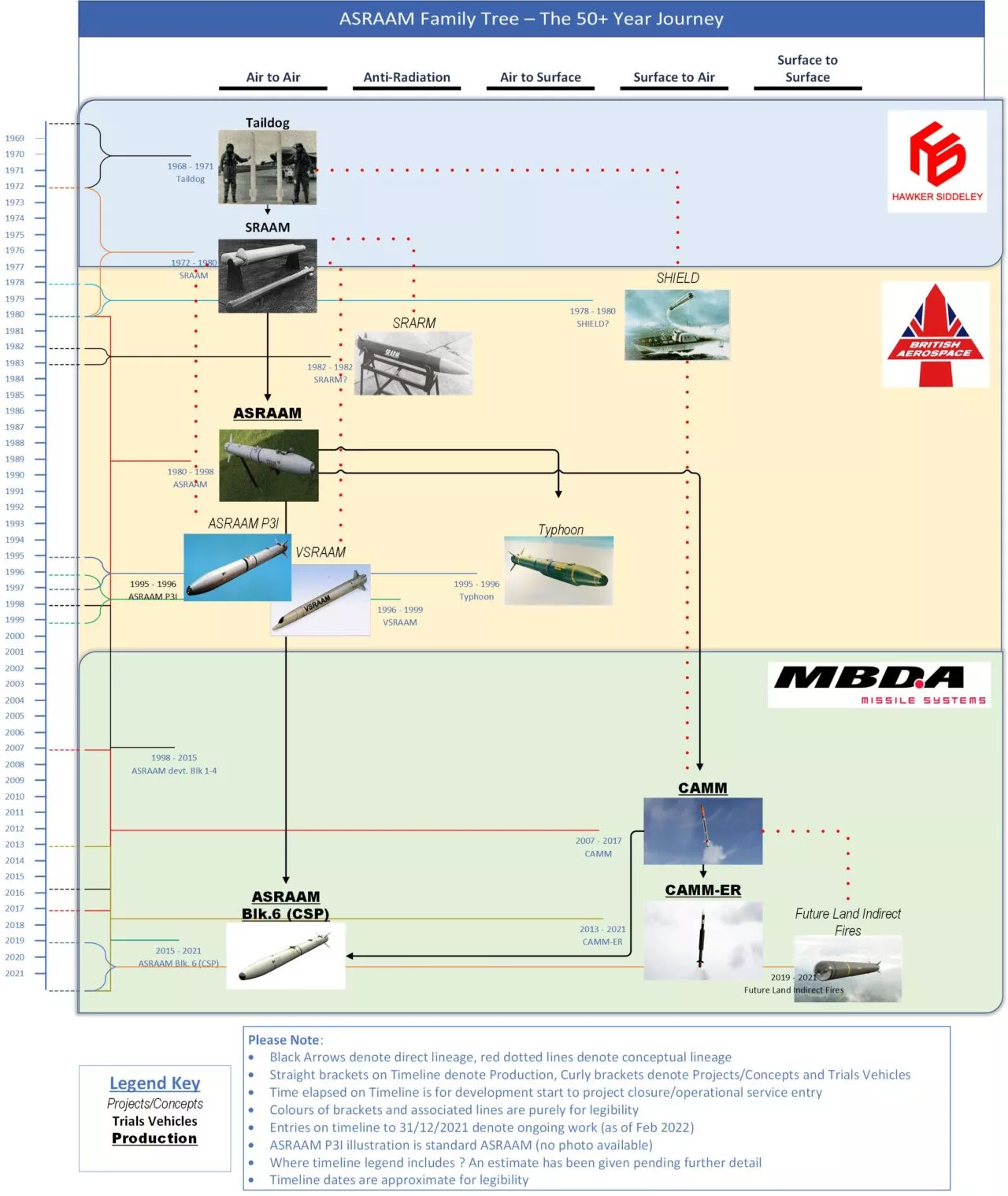
A kind reader sent me this graphic, providing a good summary of the convoluted past of ASRAAM.
In August 2023, it was revealed by The Times that ASRAAM had been integrated with surplus Supacat HMT vehicles (ex-Soothsayer ECM carriers) for use in Ukraine, with what appeared to be a Chess Dynamics Hawkeye mast-mounted EO sensor.

Anecdotal reports from Ukraine indicated that the ground launched ASRAAM was very effective.
It was additionally reported that the missiles were legacy Block IV models.
The UK began to explore options for on shoring the production of complex weapon energetics in 2024.
The Ukrainian Air Force released a video showing Raven/ASRAAM working in Ukraine
At DSEi in 2025, MBDA displayed a number of additional surface launched ASRAAM designs.

Advanced Short Range Air to Air Missile (ASRAAM) Capabilities #
ASRAAM is an all-aspect, infrared-homing missile powered by a solid propellant motor and armed with a fragmentation warhead.
ASRAAM is 2.9m long, 166m in diameter and weighs 88 kg.

The fuse utilises both impact and laser proximity modes with the lock-on after-launch guidance provided by a 128×128 pixel focal plane infrared array seeker.
The blast fragmentation warhead weighs 10 kg, developed by Daimler-Benz Aerospace.

The missile body is wider than Sidewinder or IRIS-T and this gives a clue to the underlying operating concept for ASRAAM in comparison with other similar missiles.
The missile can be fired singly or in salvos., cued by any of the aircraft sensors and the pilot’s helmet.
The range is stated to be ‘in excess of 25km’ and variously reported to be around 50 km.
It is this long range that makes ASRAAM different, instead of focussing on the extremely short-range or within visual range manoeuvrability, the larger rocket motor on ASRAAM enables much longer range shots to be taken.
See first, shoot first, kill first, as the marketing blurb goes.
The focal plane array allows ASRAAM to be highly resistant to countermeasures and detect targets at extended ranges.
ASRAAM can also be cued by the Typhoon’s PIRATE IRST or Helmet Mounted Sight or Display (HMS/D) for a total passive engagement sequence.
ASRAAM can also be fired at very high speeds and G loading, locking on to the target before or after launch.
Although many like to compare it to IRIS-T or Sidewinder, the fact is they are different, with different concepts of employment.
Unlike IRIS-T, MICA or Sidewinder, it is designed to be used at beyond the visual range, using its seeker, mid-course correction and large motor.
ASRAAM Block 6 is ITAR-free, enabling export without US approval.
As part of a wider technology refresh, it incorporates a number of new components and systems, including the UK-designed seeker and a built-in cryogenic cooling system.
Block 6 ASRAAM was due to enter service on Typhoon in 2022, with an in-service date of 1st April declared.
Block 6 ASRAAM is due to enter service on F-35B in 2024.
F-35 Carriage #
The original intent was for four ASRAAM to be carried internally.
This then changed to internal and external, some test fits were made on mock-ups and development aircraft.

Following the 2010 F-35C change and the subsequent reversion to F-35B, this was amended to external only. Brimstone was also dropped from the threshold list.
The current plan is to carry two ASRAAM on the outer wing low observable pylons, positions 1 and 11.

Together with Paveway IV, these are the ‘threshold weapons’. AIM 120-C7 AMRAAM will also be available and likely to be carried out before Meteor is integrated as part of Block IV (together with SPEAR Capability 3).
Paveway IV, SPEAR Cap 3 (100B) and Meteor are all planned to be internally carried.

Not shown above is Paveway IV, a single example could be fitted to the A-G station in each bay, or on external pylons as needed.

MBDA has shown images of an air dominance role fit of 2 ASRAAM on wing pylons and 4 Meteor in the bay.
A multirole fit can be 2 ASRAAM on wing pylons, 2 Meteor and 8 SPEAR Cap 3 in the bay.
ASRAAM Block 6 is currently scheduled for integration with the F-35B as part of the Block IV software release.
If you found value in this article, help me keep Think Defence going

Think Defence is a hobby, a serious hobby, but a hobby nonetheless. Hosting, security and other support software all adds up.
E-books and merch
Downloadable PDFs, and the Redbubble shop.
Amazon links in posts are affiliate. Firearm designs on Redbubble may be marked mature.
Thank you for reading, and for any support. It really is appreciated and helps me keep the show on the road.
Read more


One of the most interesting aspects of ASRAAM is that its design philosophy differs from many other short-range IR missiles. Rather than optimizing exclusively for extreme dogfight agility, ASRAAM prioritizes high kinematic performance, long-range infrared engagements, and passive "first-look, first-shot" capability. That distinction becomes increasingly important as modern air combat relies more on sensor fusion, helmet-mounted cueing, and IRST than traditional visual engagements. The evolution of air-to-air missiles also reflects the broader transformation of unmanned and autonomous warfare.
it is a shame that ITAR problems were not mentioned.