
 Doc Summary

VERDI were significant pieces of research work carried out by the Military Vehicles and Engineering Establishment (MVEE) and British industry in the eighties and nineties.

This document from details the VERDI programme’s two phases, including technology demonstrators built on the Warrior IFV, collaborations with industry leaders, innovative features like elevating sensor masts and automated target detection
It describes real-world trials that influenced future platforms such as TRACER and the foundations of Generic Vehicle Architecture (GVA).
Readers will gain a fascinating insight into a pivotal era of British military innovation, understanding how these programmes shaped modern armoured vehicle systems design and the ongoing quest for standardised, electronics-driven warfare capabilities.
SAVE and MAVIS #
In the late seventies, it was clear that vehicle microelectronics were going to play a major role in armoured combat vehicle development, and so their integration with vehicles would require a new approach. MVEE established the Systematic Approach to Vehicle Electronics (SAVE) initiative that defined standards for electrical and electronic distribution, and physical characteristics.
The Modular Assembled Vehicle Installation System (MAVIS), or to you and me, a shelf, is also defined means by which electronics could be secured and mounted in vehicles.
Vehicle Electronics Research Defence Initiative (VERDI-1) and Wide Area Surveillance Automated Detection (WASAD) #
In 1987, the Vehicle Electronics Research Defence Initiative (VERDI) built on this previous work.
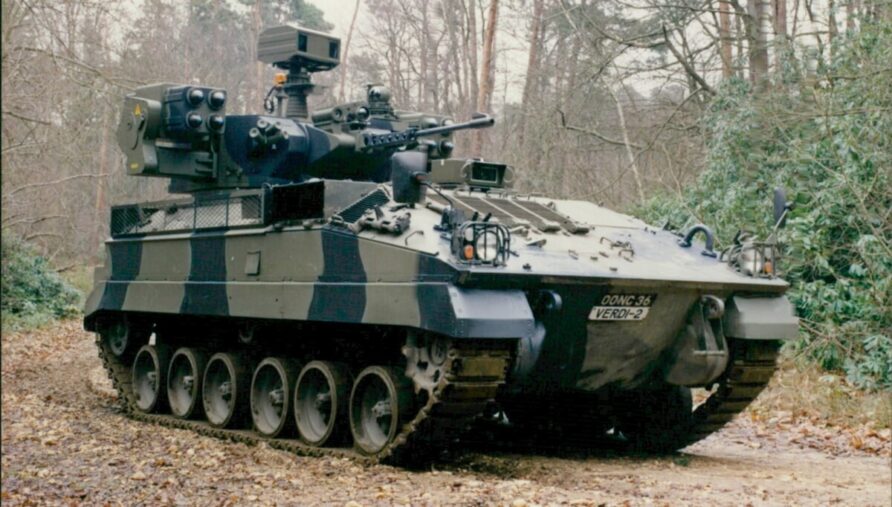
It examined how modern vetronics (a portmanteau of the words vehicle and electronics), sensors and communications equipment could be exploited to improve performance and reduce crew numbers. VERDI was a technology demonstrator using an FV510 Warrior as the base vehicle.
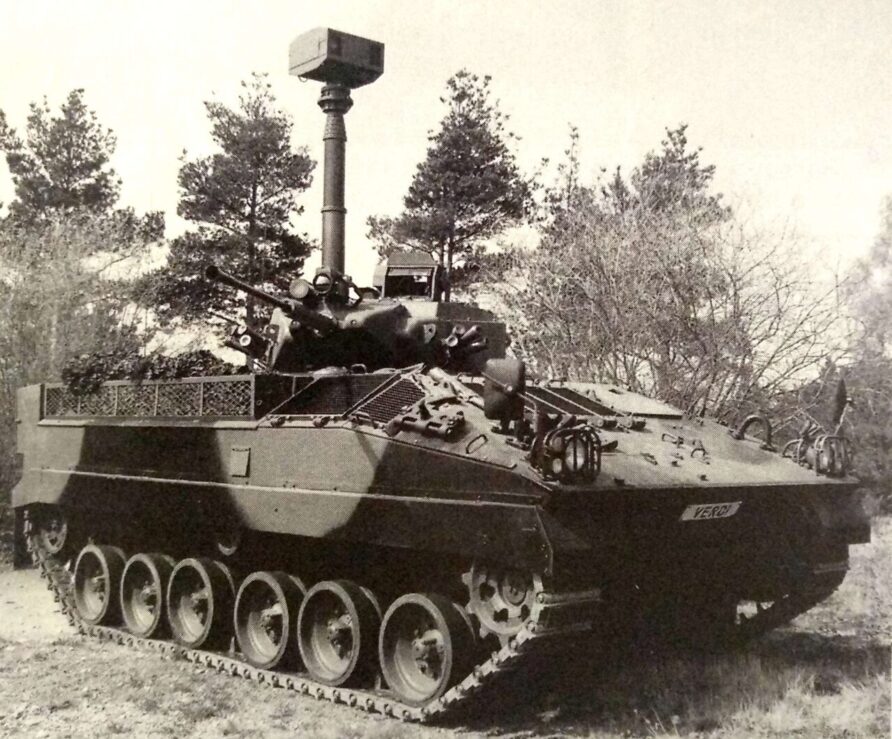
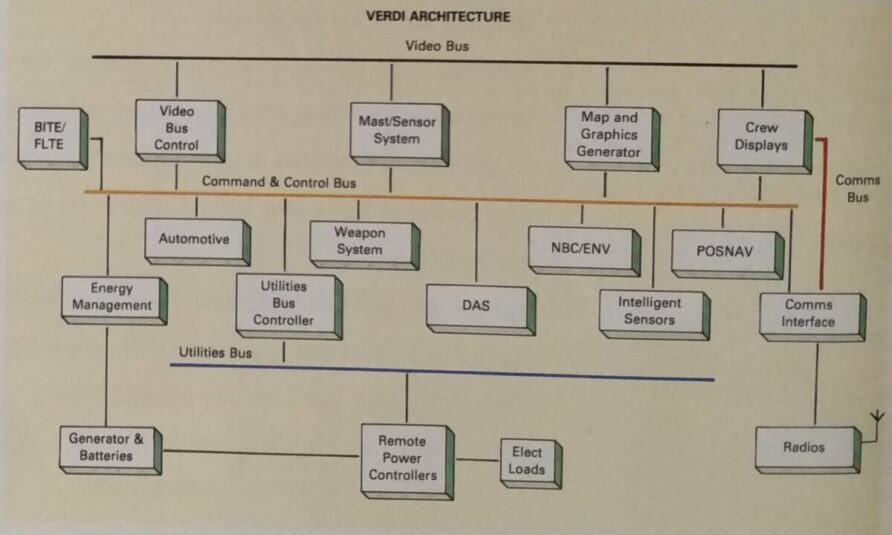
Concluding in 1990, VERDI demonstrated many technologies including data bus multiplexers, navigation, data fusion, positioning, display and engine monitoring.
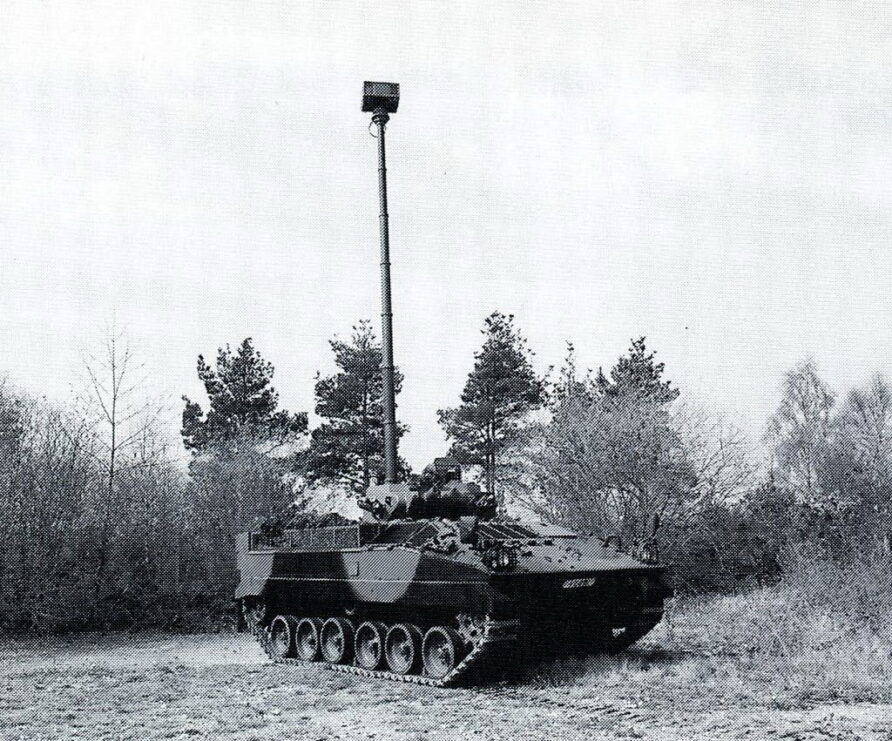
The benefits of mounting sensors on an elevating pneumatic mast from Clark Masts were also assessed. The demonstrator mast was equipped with a thermal imager and image intensifier.
A crew of three was retained for this initial demonstrator, but it was clear there was potential to reduce even this.
The Wide Area Surveillance Automated Detection (WASAD) project was built on earlier work at the Vehicles and Engineering Establishment (MVEE) which examined remote vision, vehicles with external cameras (instead of optical periscopes) and unmanned turrets.
MVEE had concluded that the available technology of the period was not mature enough for adoption into service.
WASAD took another look, at newer technology.
It developed a panoramic day/night vision system that included automatic target detection and recognition whilst on the move, connected via voice recognition to the fire control system on a modified Challenger 2.
WASAD had shown the potential of electronic systems’ integration in combat vehicles, while highlighting the need for greater standardization to ease implementation.
VERDI and WASAD had demonstrated considerable potential and this resulted in a second phase project starting in 1993, VERDI-2.
Vehicle Electronics Research Defence Initiative (VERDI-2) #
VERDI-2 was designed to de-risk some systems thought likely to be included with the new Tactical Reconnaissance Armoured Combat Equipment Requirement (TRACER).
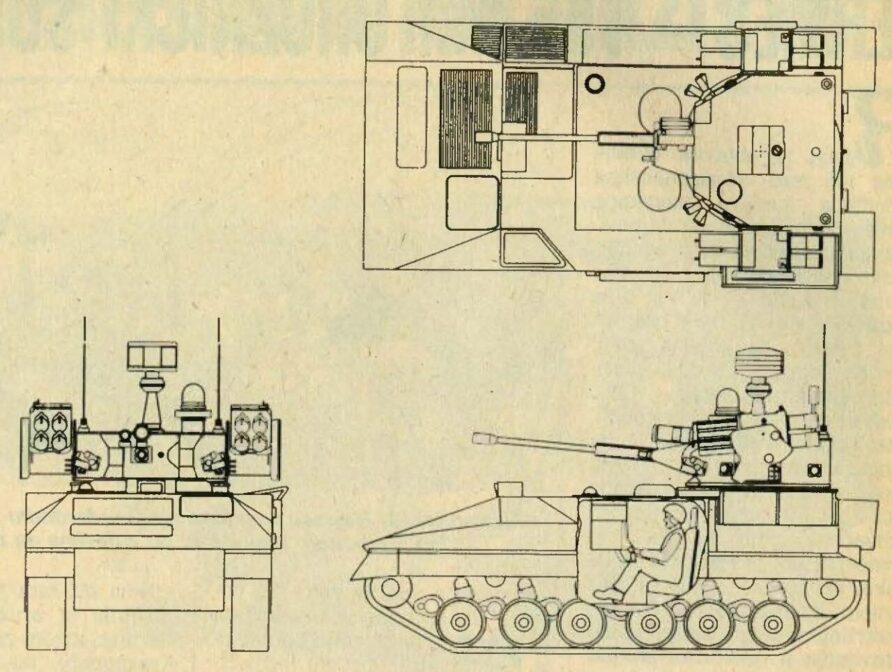
The VERDI-2 Warrior was designed to test 2-man crew concepts and the ability to manoeuvre using only indirect vision.
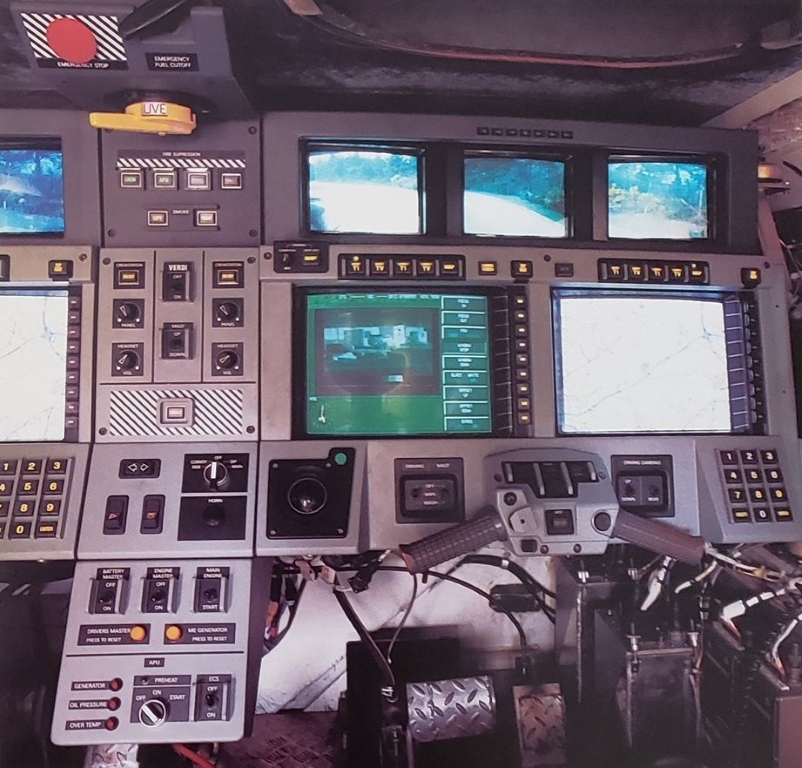
It had a side-by-side crew station, each with two CRT displays that could show mapping information, GPS data, symbology, and other sensor information. VERDI-2 only had a crew of two, both side by side (although during trials, a safety driver was used in the original drivers’ position)
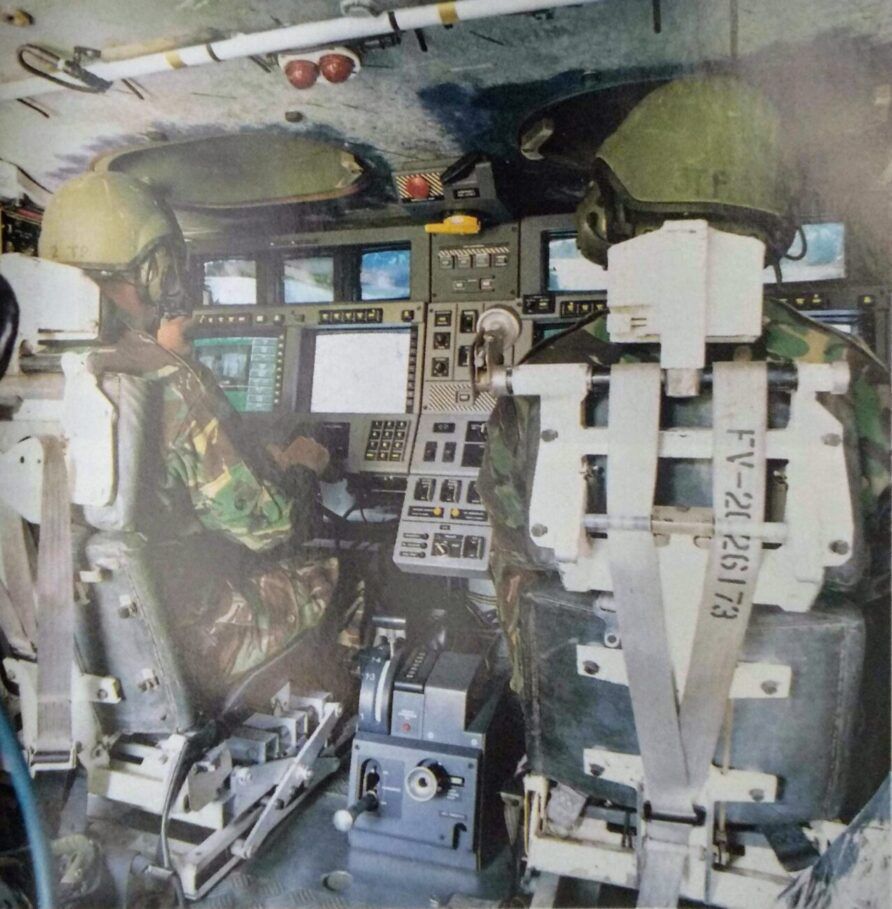
The sensor package was upgraded, using the automatic threat detection and identification systems from WASAD and this included audio warnings to the crew of potential danger.
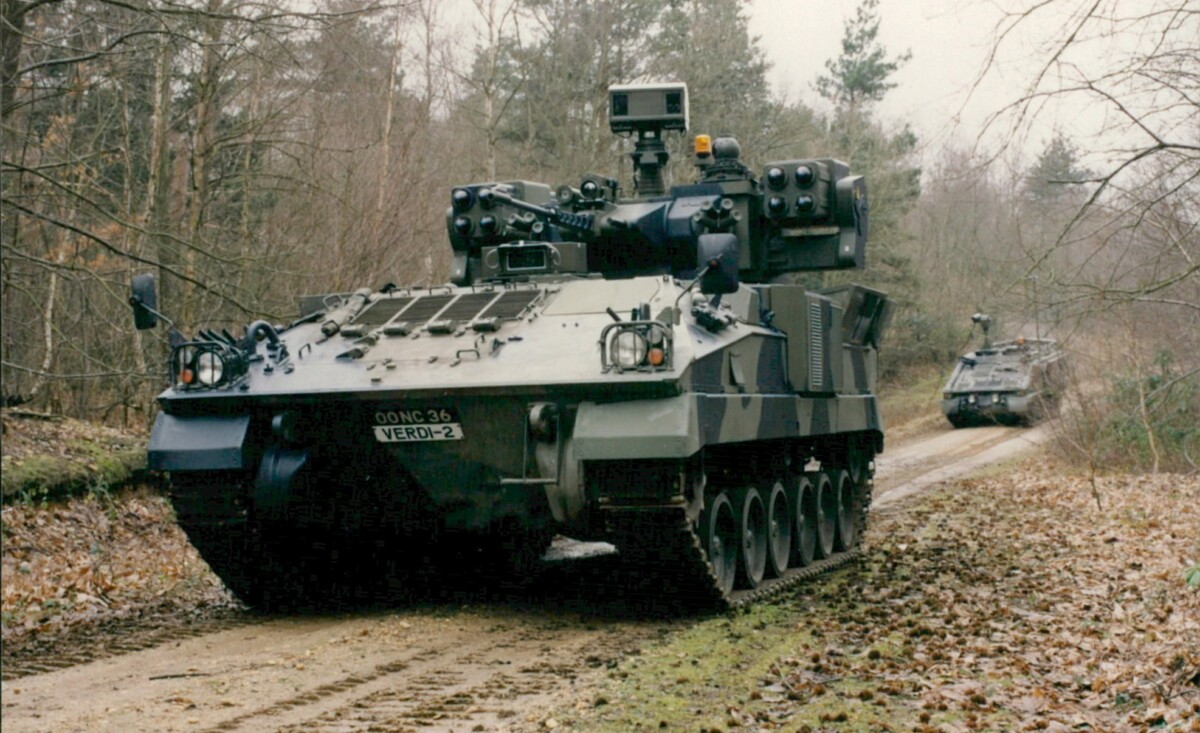
VERDI-2 had a representative turret fitted with a mockup of a medium-calibre weapon system, a 7.62 mm coaxial machine gun and, mounted on either side of the turret, a pod of four Shorts Starstreak High-Velocity Missiles (HVM). Mounted on the turret roof was a Pilkington Optronics passive Air Defence Alerting Device (ADAD).
A new concept for VERDI-2 was to team the 2-man Warrior with a Troop Leader’s Stormer vehicle, communicating in real-time to establish a ‘recce team’. This vehicle acted as a communications and data hub and was equipped with additional data networking and processing equipment.
VERDI also demonstrated a remote surveillance remote-tracked vehicle called HARP that was carried as a demountable payload.
VERDI was a collaborative programme, with the following organisations contributing
- Alvis Vehicles: Stormer APC.
- British Aerospace (Systems and Equipment): automatic target detection and tracking.
- Computing Devices Company: display processing.
- Defence Evaluation and Research Agency: programme management, software, crew station, route
- planning.
- GEC-Marconi Aerospace: intelligent power control system and utilities data bus.
- GEC-Marconi Defence Systems: Global Positioning System.
- Hunting Engineering: zero contention fibre optic command control bus.
- Kidde-Graviner: fire detection and suppression.
- Lucas Aerospace: power generation, control, and distribution.
- Marconi Radar and Control Systems: battlefield data communications, digital map system, weapon control system, thermal imager and daylight imager.
- Pilkington Optronics: surveillance sights and marketing support.
- Royal Ordnance: communications bus.
- Shorts Missile Systems: missile system, launcher, and guidance control.
- Siemens Plessey Systems: combat radio system.
- Smiths Industries: digital map system, inertial navigation system.
- THORN Electronics (parts of which are now Pilkington Optronics): threat warning, thermal imager, crew station ergonomics.
- Vosper Thorneycroft (UK): system software and system integration, graphics software and graphics development tool.
- Amphenol: data bus connectors/couplers and interconnection cables.
- Barry Controls: vibration and shock insulation systems.
- BICC Brand-Rex: cabling systems.
- Bradley Electronics: diesel power auxiliary power unit.
- Chloride Industrial Batteries: maintenance-free batteries.
- Clark Masts: telescopic sensor mast.
- Dowty Electrics: crew station switches and controls.
- EEV: CCD TV cameras.
- Fairchild Associates: marketing communications and PR.
- Graseby Ionics: chemical agent detection.
- Icore International: electric power distribution and conduited systems.
- IDM Electronics: rotary base junction with fibre optic joint.
- Instro Precision: pan and tilt platform.
- NBC system.
- MPE: RFI suppression, EMC consultancy.
- Racal Acoustics: audio warnings and active noise reduction.
- Radstone Technology: modular military computer systems.
- Raychem: cabling systems.
- SIMRAD Optronics: eye-safe laser rangefinder.
- Texas Instruments: semiconductor components.
Trials were completed by Household Cavalry in April 1994, their 1994/5 Journal describing the process
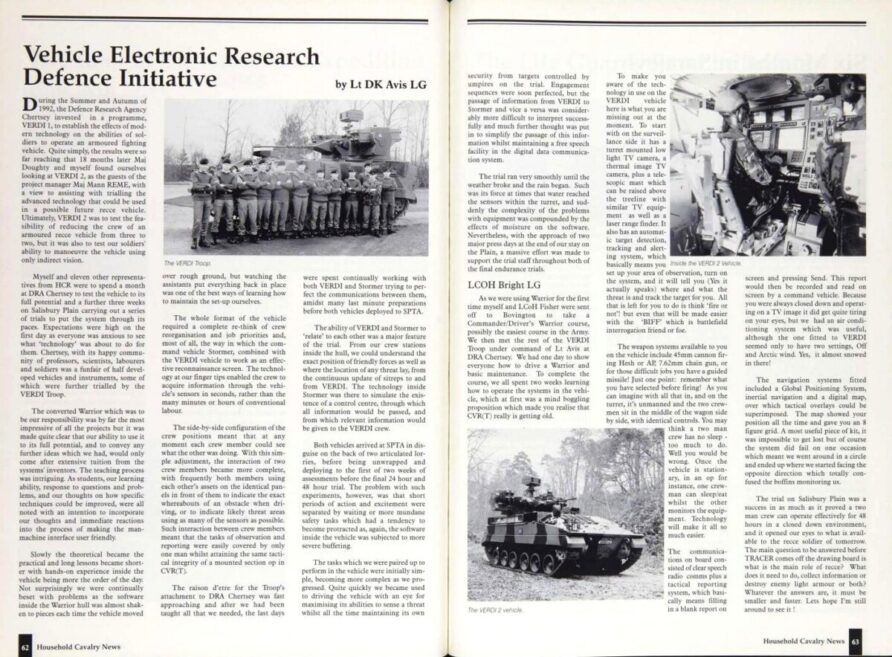
Including this amusing comment on the fragility of early vehicle electronics:
The navigation systems fitted included a Global Positioning System, inertial navigation and a digital map, over which tactical overlays could be superimposed. The map showed your position all the time and gave you an 8-figure grid. A most useful piece of kit, it was impossible to get lost but of course, the system did fail on one occasion which meant we went around in a circle and ended up where we started facing the opposite direction which totally confused the boffins monitoring us.
One of the trial’s participants concluded;
The trial on Salisbury Plain was a success in as much as it proved a two-man crew can operate effectively for 48 hours in a closed-down environment, and it opened our eyes to what is available to the recce soldier of tomorrow. The main question to be answered before TRACER comes off the drawing board is what is the main role of recce? What does it need to do, collect information or destroy enemy light armour or both? Whatever the answers are, it must be smaller and faster.
Let’s hope I’m still around to see it
The Royal Scots Dragoon Guards and Household Cavalry crewed the VERDI Warrior, with the Troop Leader Stormer vehicle being crewed by personnel from the Royal Tank Regiment and Royal Dragoon Guards.

If you found value in this article, you can help me keep the site going.
Think Defence is a hobby, a serious hobby, but a hobby nonetheless. I have removed those annoying adverts, but hosting fees, software subscriptions and other services add up.
To help me keep the show on the road, I ask that you support the site in any way you can. It is hugely appreciated.
You can click on an affiliate link, Buy Me a Coffee at https://ko-fi.com/thinkdefence, download an e-book at https://payhip.com/thinkdefence or even get some TD merch at https://www.redbubble.com/people/source360/
Youtubers, if you are going to lift content from here, the decent thing to do would credit me


