
Continuing the Light Strike concept series, this post focuses on the introduction and strategic context of the Cold War era 24 Air Mobile Brigade.
6 Airmobile Brigade and the Transition to 24 Airmobile Brigade.
The 24 Brigade operating concept came from experiments with 6 Airmobile Infantry Brigade.
In 1983, 6 Infantry Brigade was redesignated as 6 Airmobile Infantry Brigade to serve as the test bed for the British Army’s new airmobile concept.
Its primary mission was to act as a Corps reserve for 1 (BR) Corps in Germany. It tested the ability to fly small, anti-tank-heavy teams forward by helicopter to establish defensive positions and block enemy tank advances.
The trials, most notably during Exercise Lionheart (1984), were considered “distinctly encouraging” and validated the utility of a highly mobile anti-tank force.
Transition to Armour: Once the concept was proven, 6 Brigade surrendered the airmobile role and converted to an Armoured Brigade in 1988, eventually joining 3 Armoured Division.
24 Airmobile Brigade History
As the 1980s drew to a close, the military landscape of Western Europe was defined by the high-intensity stand-off between NATO and the Warsaw Pact along the Inner German Border (IGB).
The Northern Army Group (NORTHAG) was responsible for the defence of the North German Plain, a vast expanse of flat, tank-friendly terrain that was considered the most likely avenue for a massive Soviet armoured thrust.
For decades, NATO’s defensive posture relied on layers of national corps (British, German, Dutch, Belgian, and American) arranged in static defensive belts. However, by the mid-1980s, Soviet military doctrine had evolved significantly, introducing the concept of the Operational Manoeuvre Group (OMG).
These were highly mobile, independent formations designed to punch through NATO’s front lines and wreak havoc in the rear areas, severing supply lines and destroying command centres before NATO could mobilise its heavier reserves.
In response, NATO transitioned toward the AirLand Battle doctrine.
This doctrine emphasised deep strikes, aggressive manoeuvre, and the integration of air and ground assets to defeat the enemy’s first and second echelons.
A critical component of this new strategy was the need for a high-readiness operational reserve, a force that was not tied to a specific geographic sector but could be deployed rapidly to any point where the enemy had achieved a breakthrough.
The Genesis of the Multi-National Airmobile Division (MNAD)
The conceptual seeds for the 24 Air Mobile Brigade were sown in 1988, when the Northern Army Group Commander identified the operational possibility of utilising airmobile forces as a flexible reserve.
This initiative aligned with a concurrent study conducted by Supreme Headquarters Allied Powers Europe (SHAPE), which sought to create multinational formations that would demonstrate the Alliance’s cohesion and shared risk-taking.
Historically, air mobility in the British Army had been the province of the Parachute Regiment or specialised trials like the 6th Airmobile Brigade in the early 1980s.
However, the 1988 decision represented a more permanent shift in British Cold War planning.
24 Infantry Brigade, based at Catterick, was formally designated for conversion to the airmobile role. The strategic goal was to create a force that could bypass the “friction” of the modern battlefield, ground damage, refugees, destroyed bridges, and NBC-contaminated zones, to deliver lethal anti-tank firepower exactly where it was needed.
By 1991, this concept reached fruition with the formation of the Multi-National Airmobile Division (MNAD). This division was a radical experiment in military integration, featuring a headquarters staff composed of 40% British, 30% German, 15% Dutch, and 15% Belgian personnel.
24 Air Mobile Brigade served as the British core of this multinational force, designed to act as the primary anti-tank capability for the division.
Exercise Certain Shield 1991
To test this new formation, NATO launched Exercise Certain Shield from September 10th to 18th, 1991.
Part of the larger REFORGER (Return of Forces to Germany) series, “Certain Shield” was conducted in the West German region between Münster, Paderborn, and Kassel. The exercise was commanded by General Sir Peter Inge, then-Commander of NORTHAG, and was designed to be a rigorous test of the airmobile concept against a sophisticated adversary.
Certain Shield was unique in its methodology, combining a Field Training Exercise (FTX) with a Command Field Exercise (CFX) and utilising the Computer Battlefield Simulation (CBS) system.
Because of the simulation, no actual main battle tanks were deployed in the field; instead, vehicles like the Dutch PRTL Cheetah and simulated “GOLDFOR” (Aggressor) tank regiments were used to create a realistic tactical environment.
This allowed the 24 Air Mobile Brigade to practice its role in a high-intensity war scenario without the logistical constraints of moving hundreds of real tanks across the German countryside.
The scenario for Certain Shield placed the 24 Air Mobile Brigade in a desperate tactical situation that illustrated perfectly its Cold War role.
The attacking GOLDFOR force, simulated by the reinforced Dutch 12th Armoured Brigade, had achieved a significant breakthrough of the BLUEFOR lines and was pressing an attack from East to West toward Paderborn.
Simultaneously, two additional simulated Soviet tank divisions were attacking Belgian brigades further south.
The BLUEFOR commander faced a crisis: the advancing Soviet armour threatened the entire corps’ defensive line.
The decision was made to field the MNAD to slow down the GOLDFOR attack. The mission of 24 Air Mobile Brigade was not to defeat the Soviet tank regiments in a pitched battle of attrition, but to win time.
By rapidly airlifting into the path of the breakthrough, the brigade was intended to stall the enemy’s momentum long enough for the US III Corps to move into position and launch a decisive counter-attack from the north.
Beyond 24 Airmobile Brigade
24 Brigade was eventually merged with 5 Airborne Brigade to form 16 Air Assault Brigade, beyond the scope of this article.
24 Airmobile Brigade Roles, Requirements and Organisation
Primary Role
The design parameters set for the brigade were demanding
- Deploy over distances of up to 120km regardless of ground damage or obstacles, utilising the support of British and German helicopters.
- Evade Detection: As Soviet surveillance had improved significantly, standard reserves were often destroyed before reaching the battle. Therefore, the brigade was kept well behind the front lines, relying on its helicopter-borne speed to move from a safe deep position to the point of contact only when necessary.
- Block, Contain, or Delay: The task was to blunt a Soviet penetration, able to be rapidly inserted at the point of need.
- Self-Sustainability: The brigade had to be capable of sustaining itself in a high-intensity battle for 48 hours.
- Operational Tempo: Once extracted from the battle, the brigade was expected to be capable of returning to combat after a further 48-hour rest and replenishment cycle.
The role of the brigade was fundamentally shaped by the requirement to evade detection.
Because airmobile forces could access helicopter lift, they could be held in assembly areas well behind the front line, often beyond the reach of immediate enemy tactical reconnaissance and long-range weapons.
When the call for deployment came, the brigade would be flown in by helicopters from these protected rear positions directly to the point of contact.
This requirement for 120km of rapid reaction range regardless of ground obstacles or damage was another defining feature of the brigade’s role.
In a scenario where the German road network might be choked with refugees or shattered by tactical nuclear exchanges, the airmobile brigade’s role was to be the only force capable of reaching a breakthrough in time to prevent a total collapse of the defensive line.
The 48-hour sustainability requirement meant Its role was to hold the enemy for 48 hours, after which it was expected to either self extract, or meet up with its road borne component.
Once extracted, the brigade’s role was to enter a 48-hour replenishment phase, preparing to go back into battle.
This cyclical role made the 24 Air Mobile Brigade a reusable asset that could be pivoted across the entire NORTHAG front as the tactical situation dictated.
The brigade possessed the unique combination of speed to outmanoeuvre a potential adversary and the concentrated firepower to hold them until more heavily armoured but slower friendly forces could arrive on the scene.
This relationship between the light airmobile hammer and the heavy armoured anvil was the cornerstone of the MNAD’s operational philosophy.
Secondary Roles
Beyond the immediate anti-tank role, 24 Air Mobile Brigade performed two critical secondary roles that were essential for the success of larger corps-level operations: securing lines of departure and providing flank protection.
In the context of a major counter-attack, such as the one simulated during Exercise Certain Shield ’91, the brigade was tasked with holding key terrain such as bridgeheads, crossroads, or high ground, that would serve as the starting point (the line of departure) for a counter-offensive by heavier formations like the US III Corps.
Without 24 Air Mobile Brigade securing these positions, a heavy armoured division might find its assembly areas under fire or its routes of advance blocked by enemy scouts.
The brigade’s ability to operate in rugged or otherwise ‘tank-unfriendly’ terrain made it an ideal candidate for flank protection.
By occupying the vulnerable sides of a moving corps, the brigade prevented enemy Operational Manoeuvre Groups (OMGs) from striking the logistical tail or command centres of the main NATO force.
The airmobile nature of the unit meant it could leapfrog along the flank, maintaining protection even as the main body of the corps advanced or retreated at high speed.
24 Air Mobile Brigade Organisation and Structure
24 Airmobile Brigade was not conventionally balanced, it was organised to task within the Multi-National Airmobile Division (MNAD)
The brigade consisted of three infantry battalions, each with a carefully defined role.
The emphasis was on anti-tank warfare, with two out of the three battalions designated as specialised antitank units.
- 1st Battalion, The Green Howards: Formally designated as a specialised airmobile anti-tank unit, Its structure was optimised for the deployment of Milan ATGW systems and during Certain Shield, it trialled high-mobility platforms like the Longline Fast Strike Vehicle (FSV) to enhance its ability to reposition anti-tank teams at high speed.
- 1st Battalion, The Duke of Edinburgh Royal Regiment: Like The Green Howards, it was designated as a specialised airmobile anti-tank unit, but Its organisational focus was on the rapid insertion of Milan teams via helicopter, often using the Supacat Mk.2 as its primary ground transportation vehicle.
- 1st Battalion, The Gloucestershire Regiment: This battalion served as the brigade’s primary airmobile infantry unit. While still possessing anti-tank capabilities, its role was more traditional, focusing on securing landing zones (LZs), providing close-range security for the specialised anti-tank posts, and conducting the holding actions required to protect the brigade’s flanks and assembly areas.
Organic aviation support was provided by 9 Regiment Army Air Corps (AAC), comprised of three main squadrons: 657, 672, and 673.
- The Lynx AH.Mk1/Mk7: The brigade’s flying anti-tank capability, equipped with eight TOW missile tubes, organised to engage Soviet armour from a distance, often operating in hunter-killer pairs with Gazelle reconnaissance helicopters.
- The Gazelle AH.Mk1: These served in the reconnaissance role, equipped with Ferranti roof-mounted sights, Gazelle crews identified targets while remaining hidden behind terrain, relaying information to the Lynx and the ground-based Milan teams.
While the AAC provided the firepower and reconnaissance, the Royal Air Force (RAF) provided the mobility.
The brigade was supported by a fleet of Support Helicopters (SH) which provided the heavy and medium lift necessary to move the entire brigade structure in a single lift.
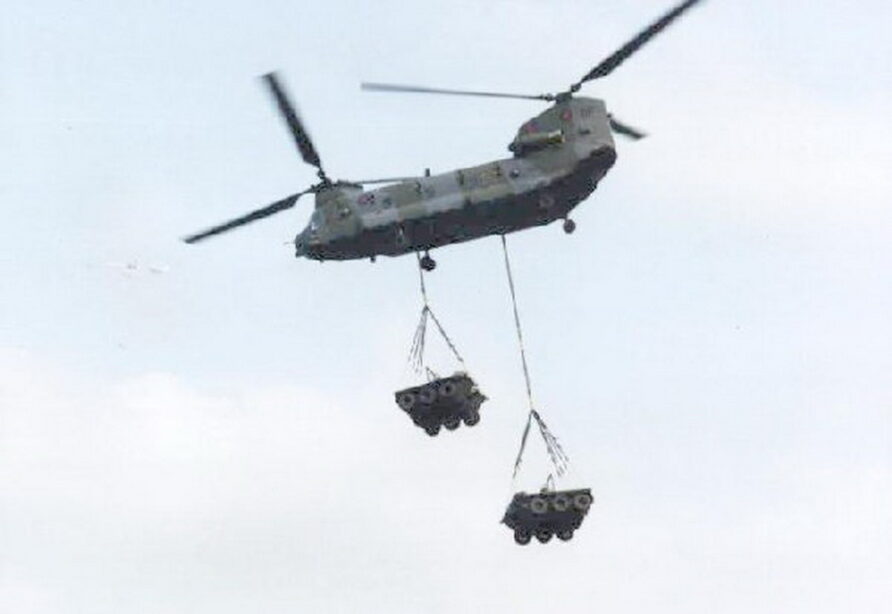
The organisation of this lift capability was divided between two aircraft types:
- Heavy Lift (No. 7 and No. 18 Squadrons): These squadrons operated the Chinook HC.Mk1
- Medium Lift (No. 33 and No. 230 Squadrons): Operating the Puma HC.Mk1, the primary transport for the infantry squads.
To support the combat units, the brigade included specialised combat support and service support elements designed for the airmobile environment.
- 24 Airmobile Field Ambulance: This unit was organised to provide rapid medical evacuation from the Landing Zone (LZ) using Land Rover Ambulances and medical Supacat vehicles
- Headquarters Signal Regiment provided the vital communication links between the MNAD Headquarters and the dispersed national brigades
- 51 Field Squadron (Airmobile) provided combat engineering support to the brigade.
- 19 Regiment Royal Artillery supported the brigade with 105mm Light Guns
24 Airmobile Brigade Equipment and Vehicles
24 Airmobile Brigade equipment was defined by the synergy between lightweight ground mobility platforms, high-capacity rotary-wing lift, reconnaissance helicopters, and a dense concentration of anti-tank guided weaponry, both on the ground and in the air.
But with that said, what was striking about 24 Airmobile Brigade was that its equipment and vehicles were already in service in the wider field army. The only exception was the Longline Fast Strike Vehicles, which were experimental, but everything else was standard.
Vehicles consisted of the following:
The Supacat ATMP Mk.2 served as the standard transportation vehicle for 24 Air Mobile Brigade.
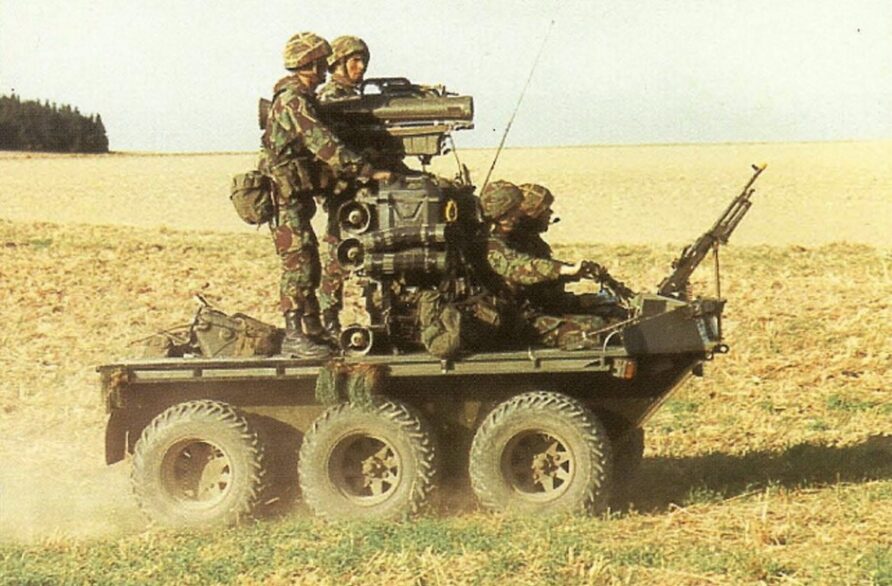
Read more about the ATMP at the link
Supacat All Terrain Mobility Platform (ATMP) – Think Defence
The Longline Fast Strike Vehicle was akin to the classic dune buggy, very low profile and fast, but limited on poor terrain.
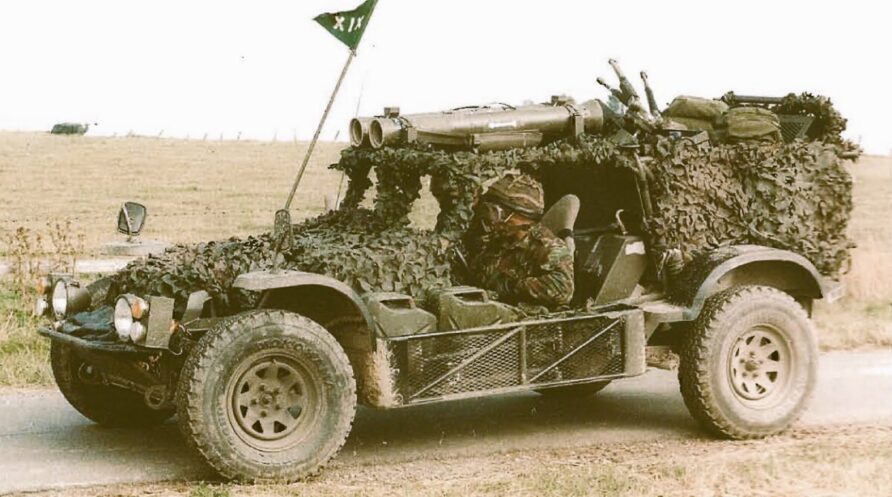
Speeds up to 100 kph were theoretically achievable, although terrain limited this. It had a crew of two and was often fitted with a Milan firing post, with spare rounds carried on the rear stowage area.
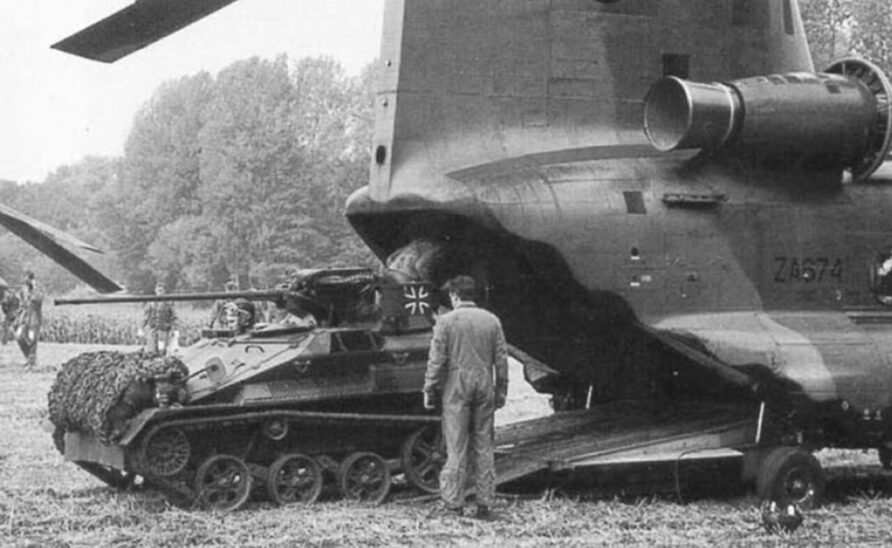
When internally carried, vehicles were reversed in, allowing rapid egress upon landing. The RAF Chinook force supported the whole division, show below is a German Wiesel unloading from an RAF Chinook.
The brigade also relied heavily on Land Rovers, 90 and 110 models, both FFR and GS.
Bombardier motorcycles provided manual communication and coordination between anti-tank posts, which was especially vital when radio silence was required or in an electronically contested environment.
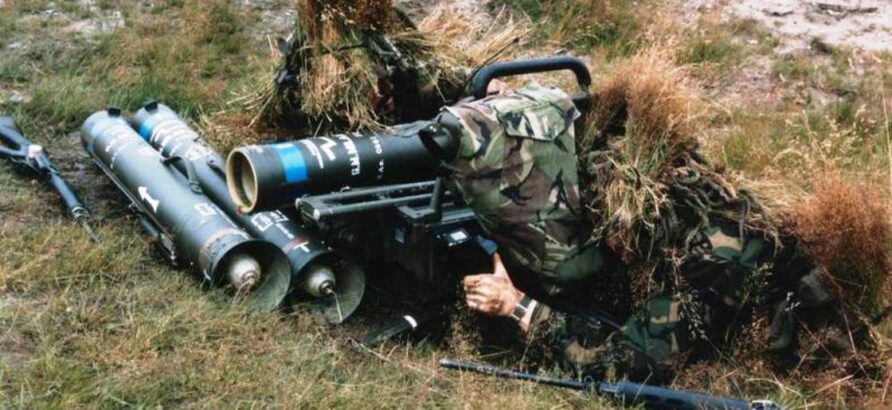
If there was one signature weapon of the brigade, it was the Milan Anti Tank Guided Weapon (ATGW)
The two anti tank battalions (1GH and DERR) were scaled for 42 Milan firing posts each, with 12 per company.
For close-range defence, units carried the LAW 80
Low-level air defence was provided by teams carrying Javelin MANPADS (Man-Portable Air Defence Systems).
Logistics and support were provided by the standard 4 tonne truck and Foden Medium Mobility 6×6 Recovery Vehicle.
Tactics
Orchestration of the brigade was conducted to combine high-speed manoeuvre, aerial infiltration, and concentrated anti-tank ambushes (with ground and air forces).
The primary tactical advantage of an airmobile formation is its ability to bypass ground obstacles, destroyed infrastructure, and the friction of the conventional battlefield. The Cold War Warsaw Pact forces had a fearsome integrated air defence capability, so helicopters had to adapt to this.
To evade radar and visual detection, British and German pilots practiced extreme low altitude flying, often just feet above the ground, using terrain features like hills, valleys, and tree lines as physical shields.
Long-range surveillance was avoided by staging from 120km behind the forward edge of battle. This distance made helicopter transport essential, only using vehicles would reduce time to prepare ambush positions or exploit terrain.
The transition from air to ground was the most critical moment of an airmobile operation. Minutes saved at the Landing Zone (LZ) could mean the difference between successfully establishing a blocking position or being overrun by an advancing tank regiment.
Speed become the watchword, with infantry landed by Pumas securing landing zones to allow rapid deployment of the vehicles by Chinook.
Fly forward was controlled by an Improvised Map Plan (IMP), speed in planning was a feature, just as speed in execution. Whilst the map plan improvised, the load plan was not.
Every single kilogram was accounted for, vehicles were distributed to the most effective helicopter, personnel distributed by function, with the fly forward elements moved in two lifts.
The 9 Regiment AAC Lynx and Gazelle helicopters operated for Forward Operating Bases, providing a screening force for the Chinooks.
The trials of the Fast Strike Vehicle (FSV) with The Green Howards introduced a new level of tactical agility to the brigade’s anti-tank defence, often working in tandem with despatch riders on motorcycles to determine optimal positioning and the ‘next location’
Engineers would use mines and other techniques to channel opposing forces into the ambush zones.
The high density of Milan firing posts created an extremely effective anti-armour ambush capability, with the high number reducing the need for follow-on engagements. Once the engagement sequence had completed, teams would immediately reposition.
Strict emissions control (EMCON) was executed.
Finally, mortars would be used with the Milan missiles in the primary and secondary kill areas.
Planned, executed, slick.
A later experiment saw all the FSV and ATMP’s consolidated into a single grouping, together with motorcycles and mortar teams. It could decoy, track and identify high-value reconnaissance and command vehicles. Once the ambush was engaged, it could withdraw as a small brigade reserve or conduct flank protection.
Analysis and Legacy
The trials conducted in the Münster-Paderborn-Kassel region served as a definitive validation of the airmobile concept.
24 Air Mobile Brigade demonstrated that a light, helicopter-borne formation could effectively blunt an armoured breakthrough.
The concept worked.
But it was not without flaws.
Whilst it could quickly strike with devastating precision, it was plagued by physical sustainability issues, technical limitations of its light platforms, and an inherent vulnerability to even minor tactical miscalculations.
It relied completely on timing, designed to be placed upon the nose of an OMG advance. Deploy it too early and the OMG would divert, too late, and it would land in a rear area to achieve little.
One of the most significant flaws identified during the trials was the discrepancy between the brigade’s 48-hour combat mandate and the physical capacity of the individual soldier, the sheer weight of Milan missiles, carried in the quantities needed, impeded foot borne mobility.
The specialised vehicles trialled during the exercise, while innovative, exhibited technical issues and inherent physical limitations that hindered their battlefield utility
The Fast Strike Vehicles suffered cooling issues, and were not brilliant in soft terrain.
The reliance on helicopters for both strike and reconnaissance created a significant electronic, audible and visual (dust) signature that the enemy could exploit.
The Lynx was also vulnerable to enemy fire because of its optically tracked wire guided missiles required it to stay visible throughout the engagement envelope.
The brigade was entirely dependent on its Support Helicopter (SH) fleet. Airframe availability against the punishing 48 hour deploy, withdraw and deploy again cycle, suffered in reality. The Support Helicopters assigned to the brigade were not dedicated to the brigade.
Only the fly forward elements of the brigade would be helicopter borne, with the road component having to catch up. The road component carried additional personnel and sustainment supplies, potentially suffering from the same friction that the fly forward elements avoided.
The need for underslung loads meant the speed of Support Helicopter deployment was reduced.
Ultimately, 24 Air Mobile Brigade was a formation defined by extreme trade-offs.
To achieve the speed necessary to blunt a Soviet breakthrough, it sacrificed physical sustainability, vehicle versatility, and operational protection.
The single biggest flaw, paradoxically, was lack of mobility.
Once landed, the majority of the battalions had limited mobility. Whilst the FSV’s and ATMP were mobile, they were still limited by numbers, despite the images of FSV’s and ATMP’s moving at speed, the majority of the three battalions were still foot borne.
Soldiers could not carry sleeping bags, or even metal stoves, loads were stripped down to the barest of essentials, and a million Milan missiles!
The lack of Support Helicopters (SH), and the need to carry vehicles as underslung loads contributed to the outcome that once it was deployed, the brigade was limited in its ability to manoeuvre if the Russian force decided to be uncooperative.
Someone called it a ‘glass cannon’, unfair perhaps, but perhaps not.
In the next post in the series, I will look at a concept I called the Light Strike Brigade.
Light Strike
Written in February 2018, the Light Strike Brigade embodied some of the features of 24 Airmobile Brigade, bringing the concept up to date to that point.

Wouldn't modern man pads make it impossible to get to the front line ?
See the next post, coming out later!
Operational Tempo: Once extracted from the battle, the brigade was expected to be capable of returning to combat after a further 48-hour rest and replenishment cycle.
Sounds very much like what the UK & US paratroops were told when they went into Normandy, only to stay on the frontline for weeks.