
 Doc Summary

The San Carlos Forward Operating Base (FOB) represents one of the more overlooked but tactically vital elements of British air operations during the 1982 Falklands War.
Harrier Dispersed Operations Capability #
The design of the Harrier was predicated on operating away from large airbases and in austere operating bases that made use of rapidly laid runways, supermarket car parks and roads.
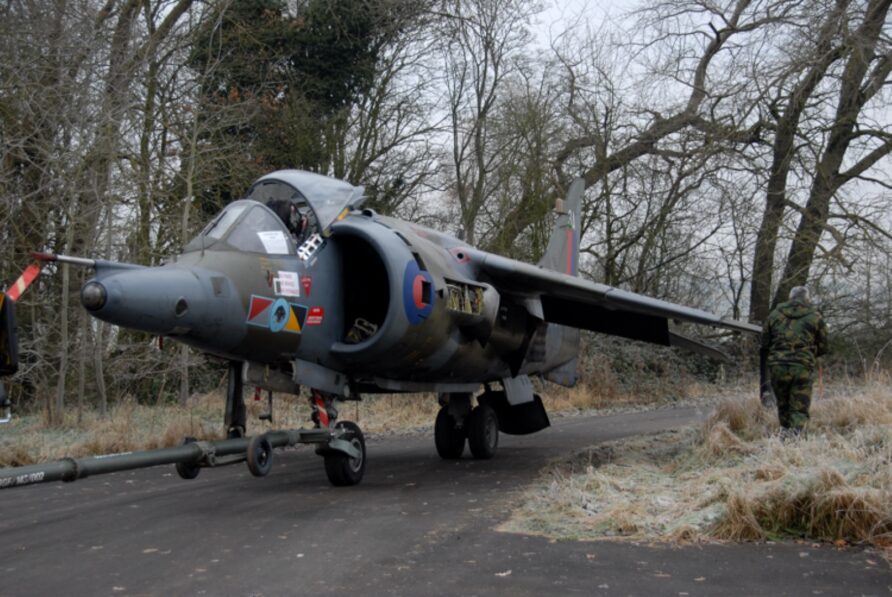
The dispersed operating concept for RAF Harriers was, by 1982, firmly established and well practised.
300m runways and 7 square metre vertical landing pads were the norm for such.
Planning the San Carlos FOB #
During initial planning for the Falklands campaign, several options were considered for developing land-based air power.
The preferred option of Rear Admiral Woodward was to establish a forward operating bases on West Falkland that would allow not only Harriers to operate, but also Hercules and F-4 Phantoms.
Despite the obvious advantages of this approach, it was soon discounted as force protection and resource demands became clearer.
By the 21st of April 1982, the concept of an amphibious landing on East Falkland and an ashore Forward Operating Base for the GR.3 force was maturing, and the early-stage designs called for sustained operations over a 22-day period before needing resupply.
The location was planned to have air-traffic control and maintenance facilities for 12 aircraft, with a 400m runway to sustain 8 sorties per day.
There was also some discussion at the end of April about trying to establish a FOB in South Georgia, although, for obvious reasons, this did not progress.
The San Carlos FOB would also serve as a replacement for a carrier, should, in the medium term, one of them become unavailable due to planned maintenance or enemy activity.
Combat engineering support for the Task Force came in the form of 59 Independent Field Squadron RE supporting 3 Commando and 9 Parachute Squadron RE supporting 5 Infantry Brigade. Detachments and attachments from 2 Port Control Regiment, 36 Engineer Regiment, 38 Engineer Regiment, 33 Engineer Regiment and the Royal Pioneer Corps were also supporting the task force; over 800 personnel in total.
59 Independent Commando Squadron RE selected a location with a natural ski jump, the firm ground near Green Beach and Port San Carlos settlement, the intended location for 3 PARA and 42 CDO to land.
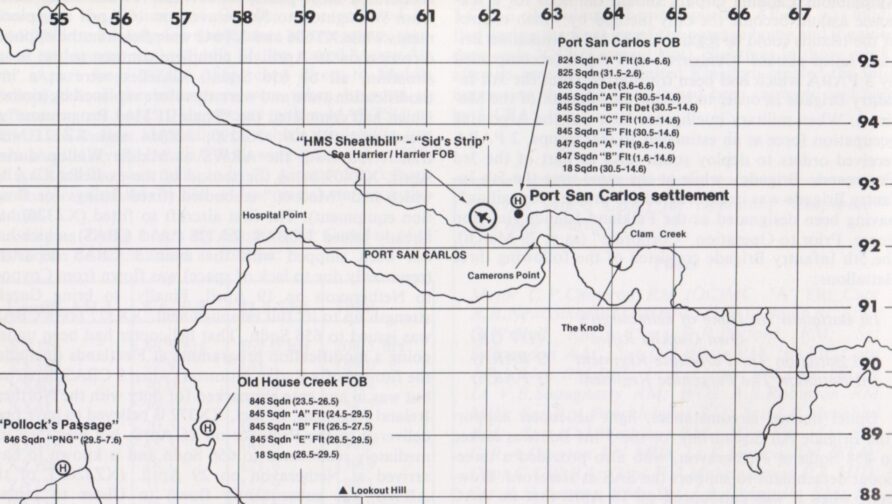
The FOB should perhaps, therefore, be more correctly referred to as the Port San Carlos FOB, not the San Carlos FOB.
On the 8th of May, a signal to the task force pointed out that the establishment of a landing site for Harriers and helicopters should be a top priority.
While ‘Repossession’ remains the ultimate aim, it can only be achieved in stages.
The first stage is to build a secure bridgehead, where sea/air resupply can be conducted in safety.
This must be followed by the establishment of a landing site ashore for helos and Harriers
On the 12th of May, CINCFLEET issued the order 3/82 for Operation SUTTON.
The same day, a signal from Major General Moore to Brigadier Thompson again clarified it.
You are to secure a bridgehead on East Falkland, into which reinforcements can be landed, in which an airstrip can be established, and from which operations to repossess the Falkland Islands can be developed.
Once 2 PARA, 3 PARA, 40 CDO and 45 CDO had landed, the next priority was to establish local ground-based air defence.
Due to the distance from San Carlos to the carriers, the Sea Harriers could only stay over the area in their Combat Air Patrol role for 10 minutes.
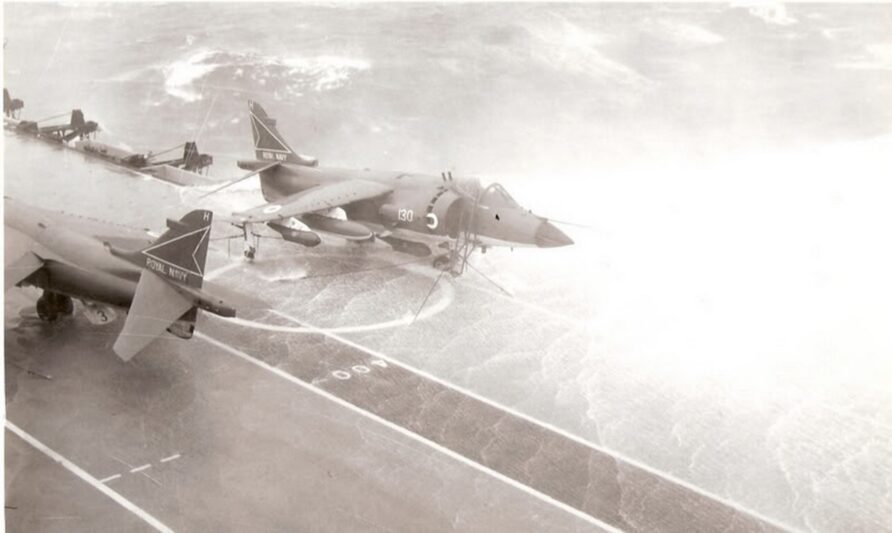
Before British Forces had been firmly established onshore, the centre of gravity was clearly the aircraft carriers and their precious cargo of Sea Harriers. Admiral Woodward had to balance the needs of protecting the carriers against protecting the amphibious assault forces in San Carlos Water.
This desire to protect the carriers resulted in the decision to keep them far out to the east of the Falkland Islands.
This meant two things, no defence in-depth, and what limited air cover could be provided over San Carlos would be extremely limited in duration.
The landings commenced on the 21st of May 1982.
The first engineer tasks were reinforcing the landing points with a trackway and digging in tasks, especially for ashore HQ elements.
Establishing the San Carlos FOB #
On D+1 the planned FOB site was reconnoitred, the old Auster strip at San Carlos settlement was also considered but discounted because of load-bearing concerns.
On the 23rd the fuel handling equipment came ashore and was installed by 1 Troop 59 Independent Field Squadron RE, although pump problems meant transfer rates were extremely slow.
2 Troop 9 Parachute Squadron RE also helped with installing the FOB.
On the 24th of May, the MV Stromness, MV Norland and RFA Sir Percivale had been emptied of their stores
11 Field Squadron, the specialist air support squadron, came ashore from Sir Bedivere, unfortunately without any of their stores and equipment because that was on the Atlantic Conveyor.
By the 25th commanders felt increasing optimism, the beachhead had been secured, stores were being built up and combined forces had started to achieve the upper hand in the air war, despite significant losses.
Argentine commanders correctly assumed that the opportunity to dislodge British forces from San Carlos had passed, and their best course of action was to disrupt the sustainment of a blockade.
The 25th of May also saw a large-scale attack and the Atlantic Conveyor destroyed by Exocet missiles.
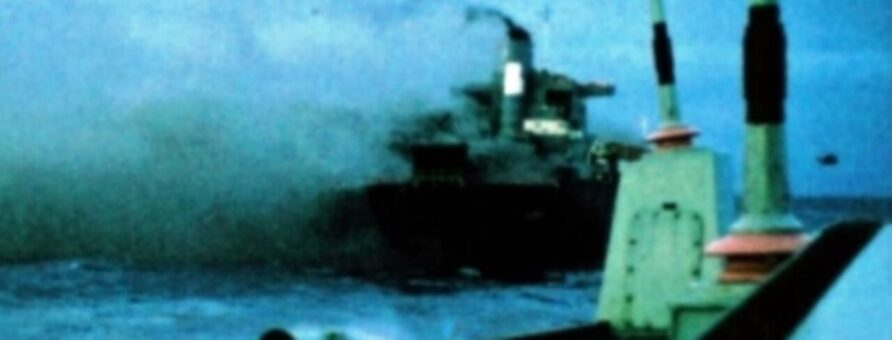
This was a giant blow to the construction of the FOB, compounded by the fact that many of the Sappers vehicles were unable to be offloaded from RFA Sir Lancelot because of unexploded bombs.
On the Atlantic Conveyor were all of 11 Squadron’s stores, i.e. the FOB and the means to create it (engineering plant etc.)
Onboard MV Stromness were a number of PSA (Prefabricated Surfacing Airfield) panels that were allocated to bomb damage repair and vertical take-off and landing pads at a post conflict Stanley Airport.
They were hastily re-allocated to the FOB and moved ashore.
PSA panels are 3m long and relatively narrow and secured into the ground using long panel pins, driven flush.
The panel’s interlock, the correct terminology for PSA is PSAI.
I stands for interlocking.
Panels are also available in 37 ft (ca. 11 m) lengths and still available today.
Additional Expeditionary Bulk Fuel Handling equipment was also secured from the Stromness.
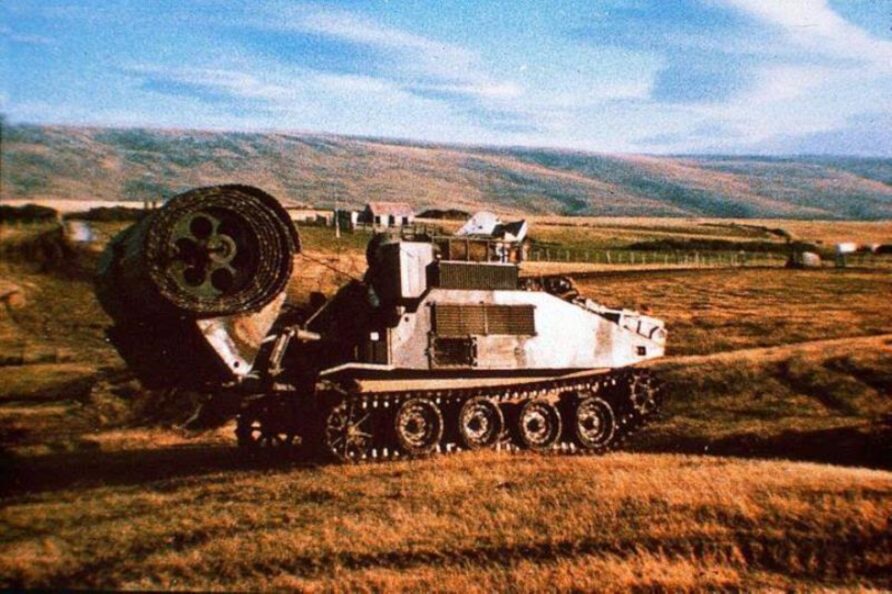
A Combat Engineer Tractor (one of the two embarked) was used to excavate the bunding for the fuel bladders and install some Class 30 Trackway.
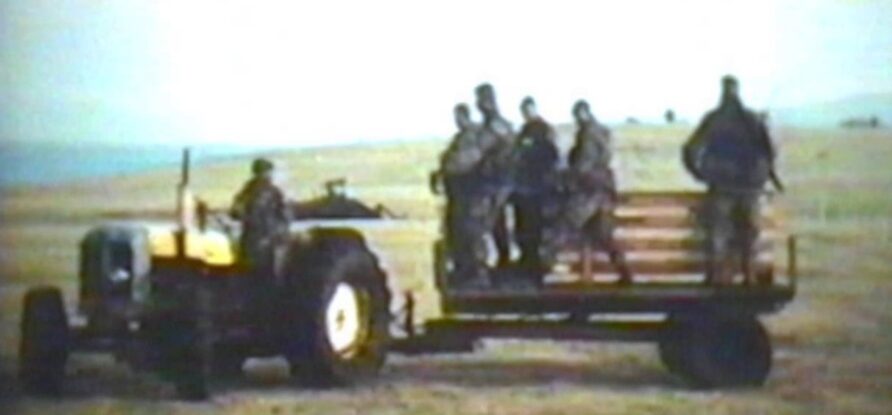
Some PSA panels were also flown ashore to ensure the build was not interrupted, and the rest were brought ashore at Green Beach, then transferred using vehicles loaned from local farmers.
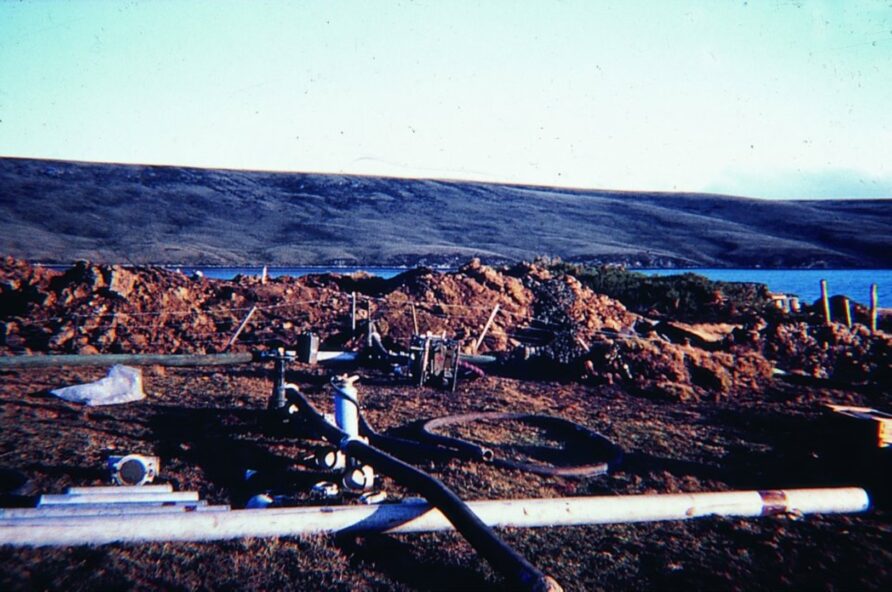
The Emergency Bulk Fuel Installation (EBFI) was established.
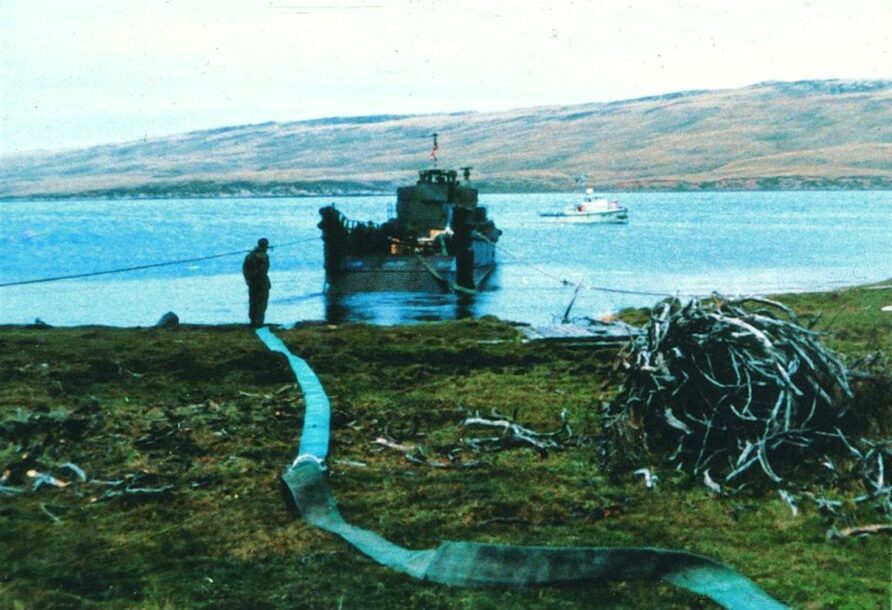
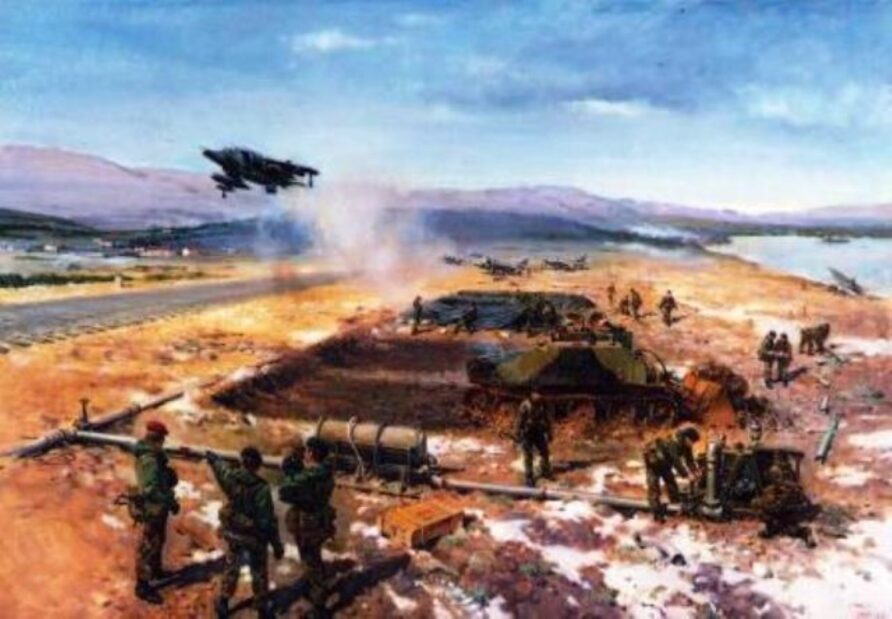
On the 2nd of June, the FOB was ready for helicopter operations.
Operating the San Carlos FOB #
The first Harriers into the FOB were a pair of Sea Harriers, closely followed by two GR.3’s from HMS Hermes, on the 5th of June, D+15.
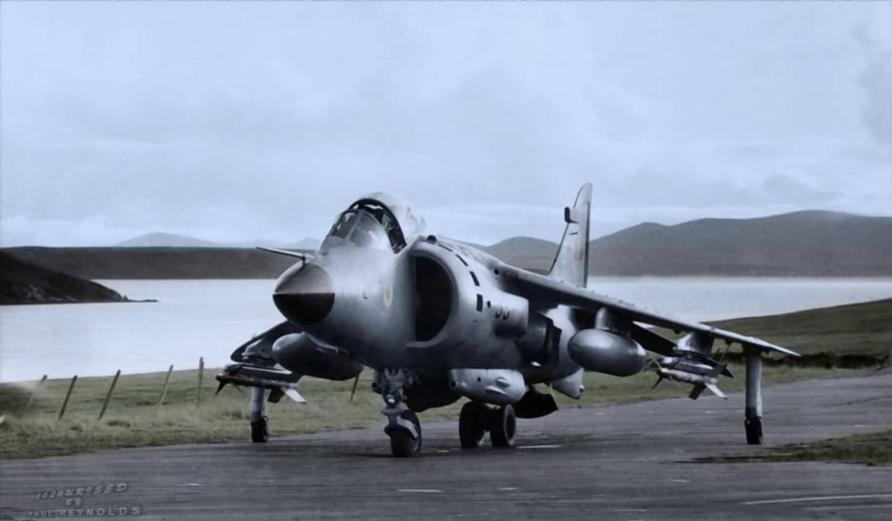
The FOB was variously called West Wittering, HMS Sheathbill and Sid’s Strip (after Squadron Leader Syd Morris) depending on what service you belonged to.
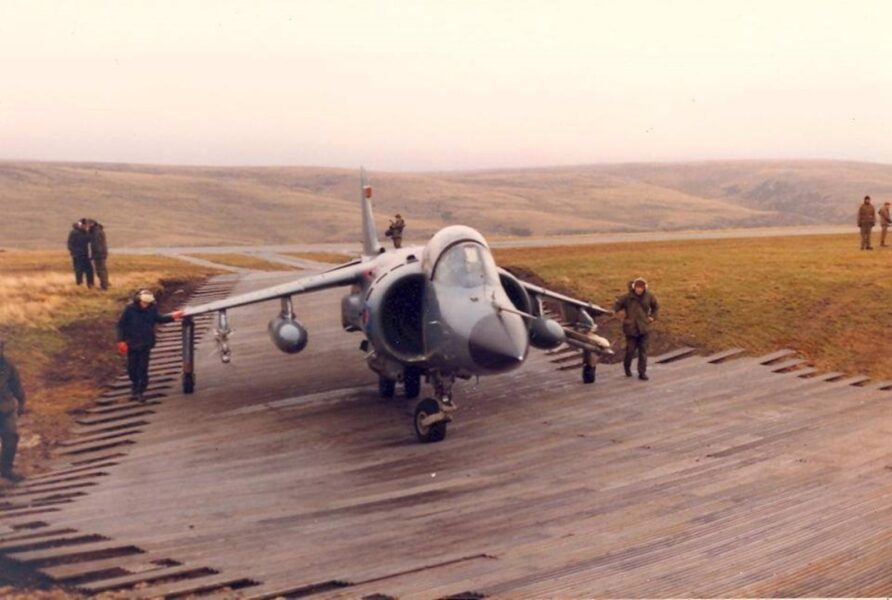
The final FOB, operated by 11 Squadron RE and commanded by the RAF, had a 260m runway, dispersal areas for four aircraft, a separate vertical landing pad and a redesigned and reinstalled bulk fuel installation that could store 18,000 Litres.
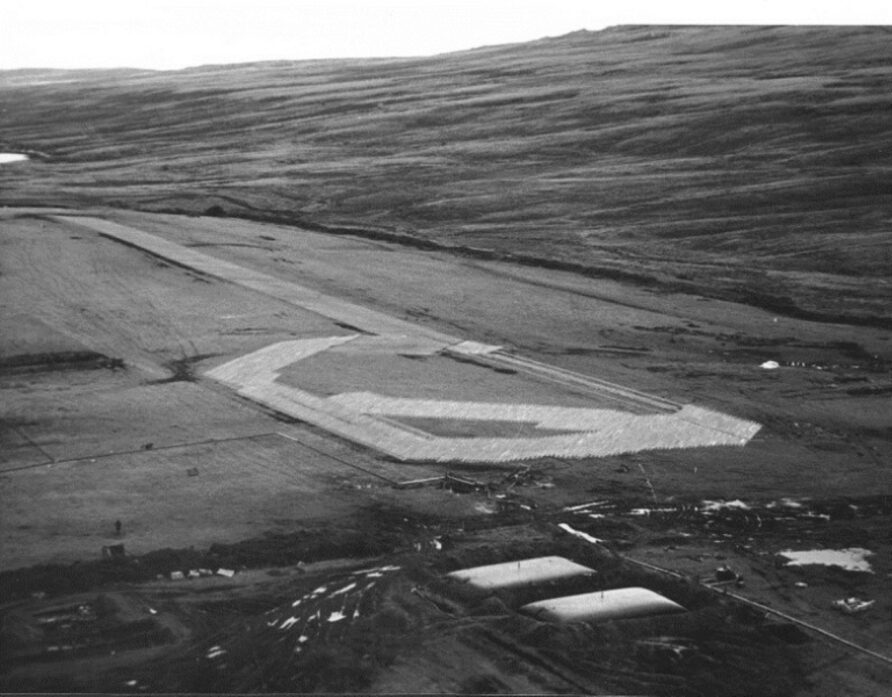
It was a masterpiece of improvisation.
Additional landing and refuelling space for helicopters were also provisioned.
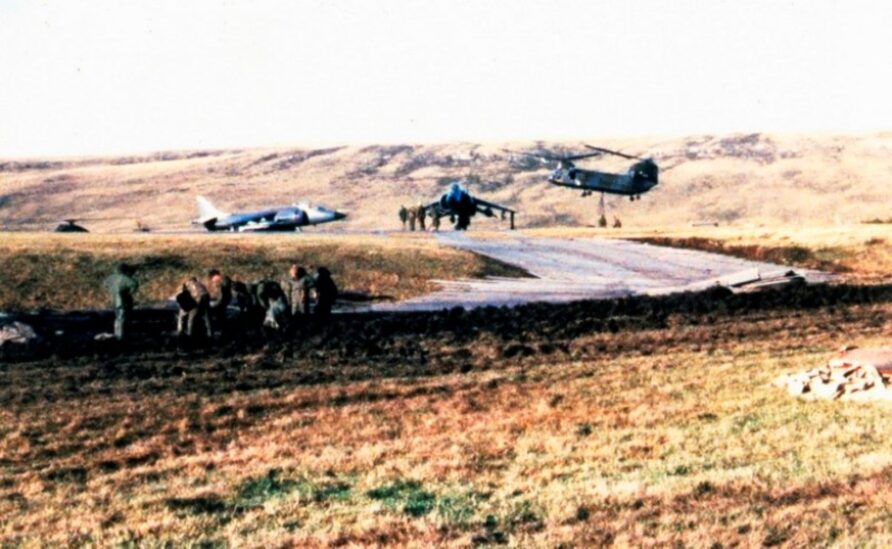
The normal Sea Harrier sortie was 75 minutes long which included a 65-minute journey to and from the carriers, only 10 minutes effective mission time.
The FOB allowed the Sea Harriers to complete their transit and refuel several times before flying back to the aircraft carriers, i.e. much greater time spent on station.
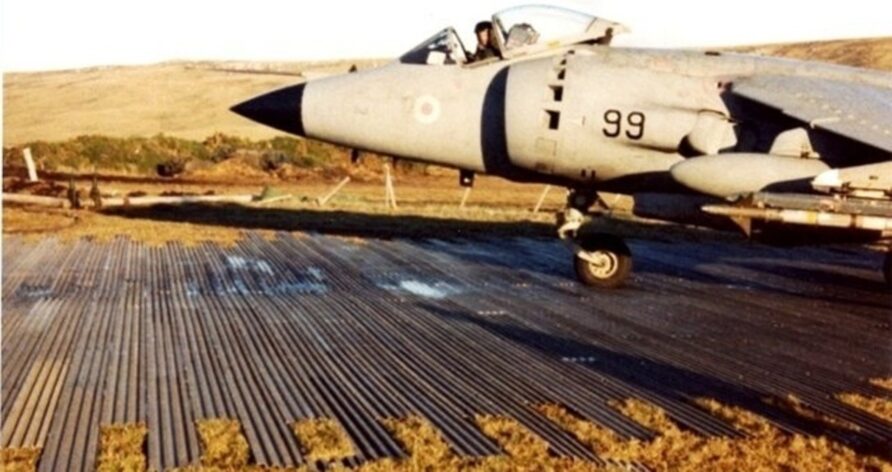
For the GR3’s, the FOB meant they could wait there for tasking from a Forward Air Controller, improving response times.
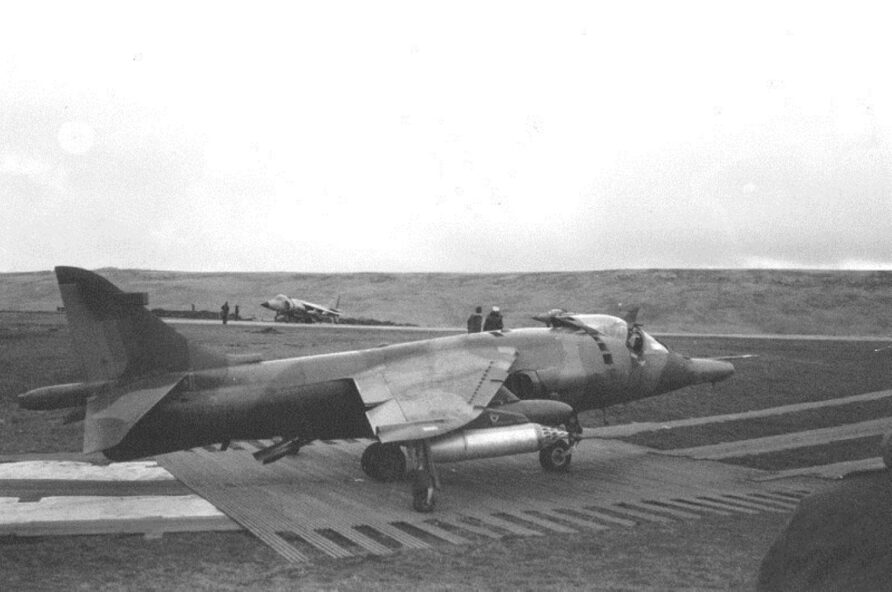
Fuel was always a problem during the Falklands Conflict.
After MOGAS (motor gasoline) for the Rapier units, AVGAS for the FOB was a top priority.
At its peak, the FOB dispensed over 50,000 litres of fuel per day.
Although all Rapier batteries were fully operational by the 8th of June and SOP’s established for the departure and arrival of aircraft via Fanning Head, the lack of IFF equipment on the Task Force helicopters slowed operations.
Due to almost continual lock-on’s, the Rapier Blindfire system had to be shut down. This degraded the usefulness of the system as a whole.
Furthermore, on the 8th of June, there was an incident at the FOB.
The Harrier GR3 in the image below was from 1(F) Squadron RAF; the pilot was Wing Commander Peter Squire, who later went on to become an Air Chief Marshal.
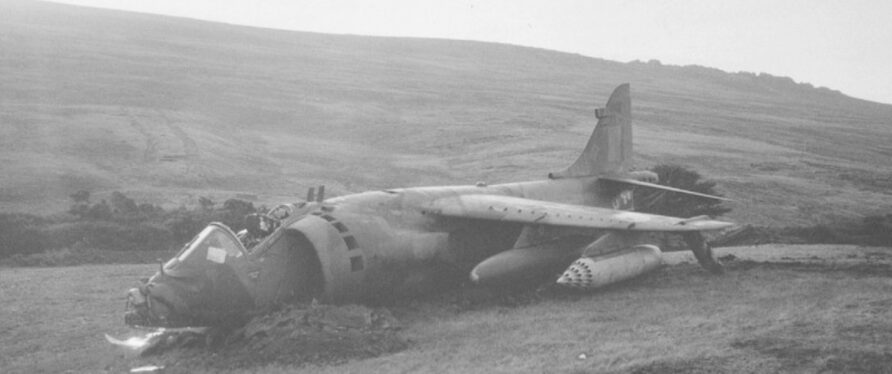
The aircraft was carrying a few defects but was intended to mount Ground Alert at the FOB.
Upon approaching, some foreign object (assumed to be a PSA panel pin) was ingested by the engine.
As the aircraft overshot it became obvious that the damage was significant and because the aircraft was pointing at a Rapier firing unit, the pilot elected to stay with the aircraft instead of ejecting.
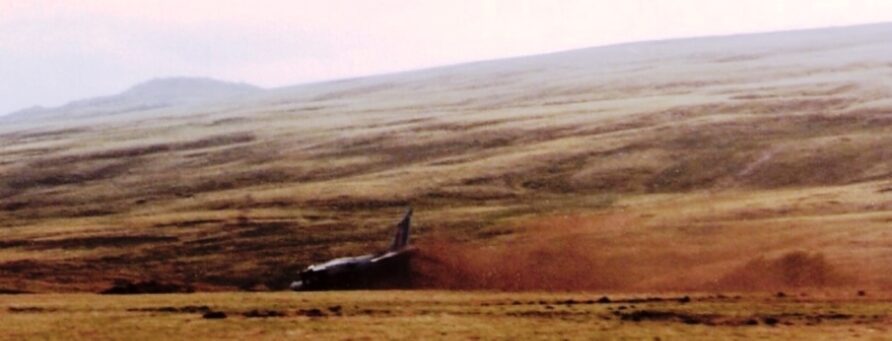
It came to rest at the end of the landing strip close to a trench which was occupied at the time by a member of the RAF Regiment. The person looking somewhat interestingly into the cockpit in the image below, apparently!
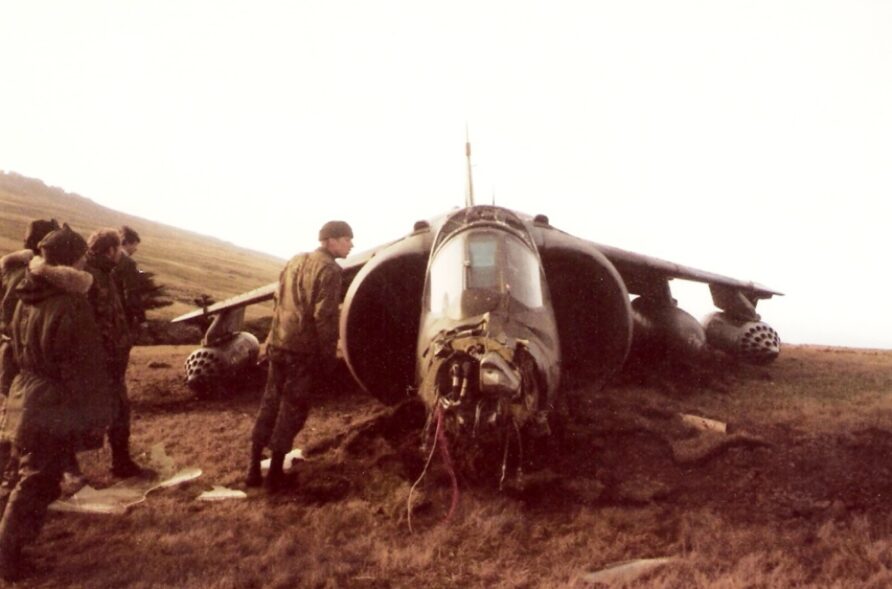
The other GR.3 managed to make a very skilful landing on what remained of the runway.
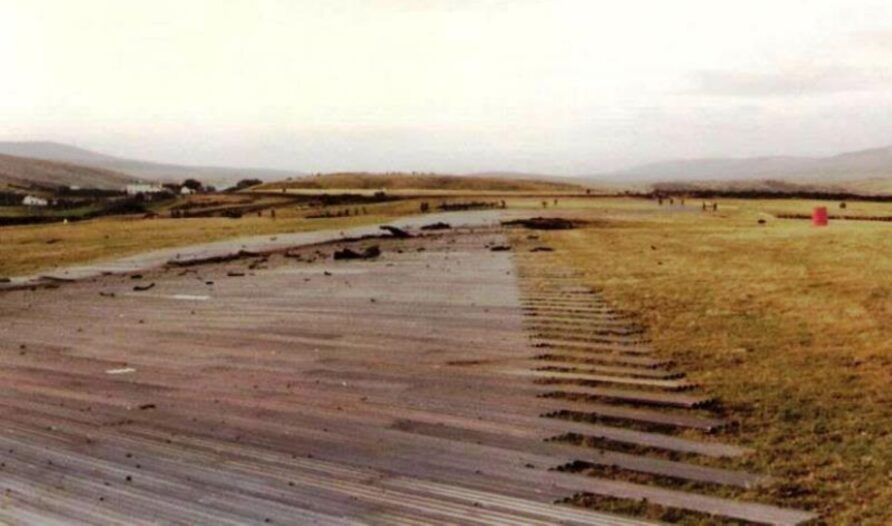
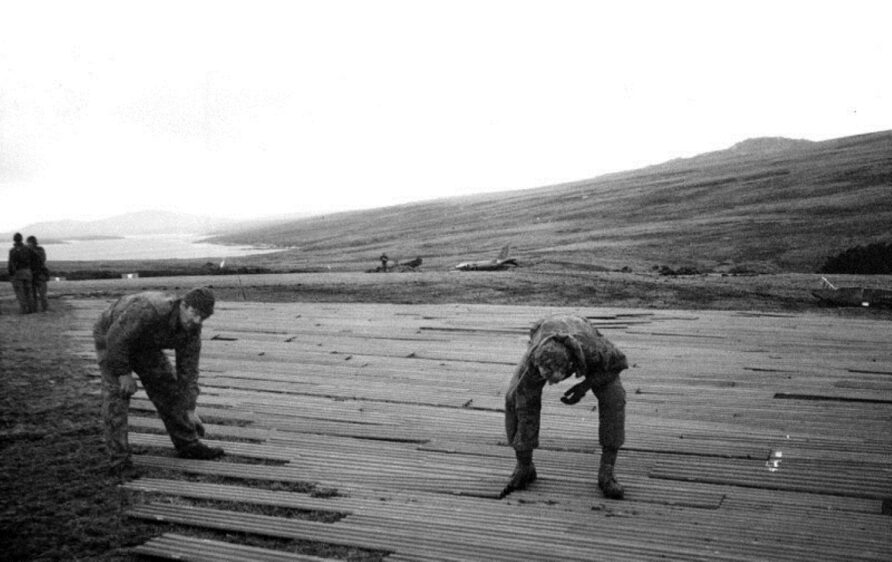
Repairs to the runway were made as quickly as possible
With two GR.3’s on the ground and much of the runway damaged, two inbound Sea Harriers did not have enough fuel to return to the carriers.
Instead, they each carried out a vertical landing on the two assault ships in San Carlos Water, HMS Fearless and HMS Intrepid.
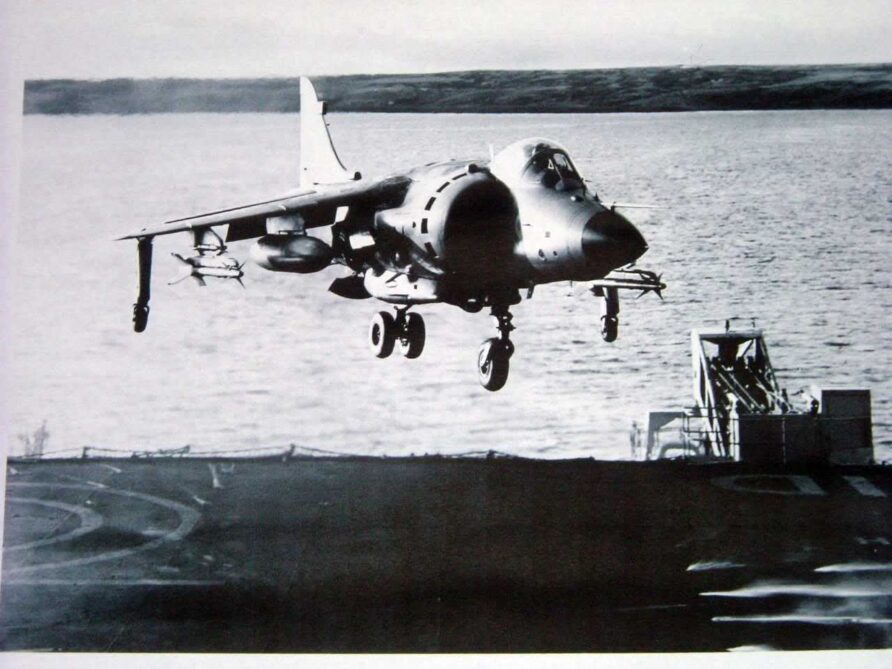
With the FOB out of action, HMS Hermes busy with boiler cleaning and HMS Invincible still far to the east, the available Combat Air Patrol would be constrained.
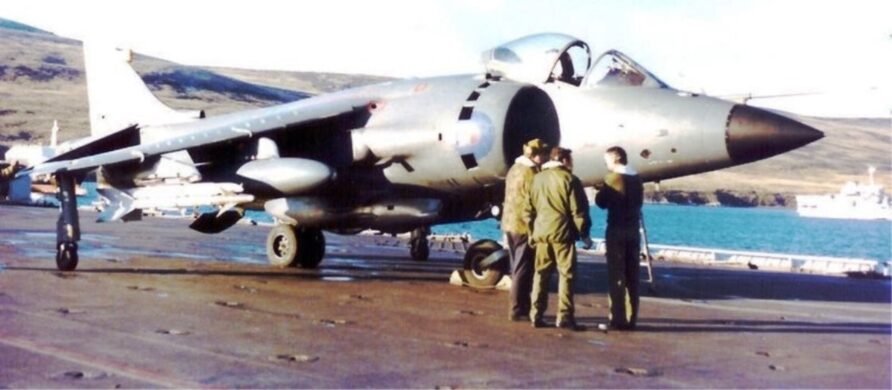
This unfortunate series of events coincided with a large air attack that resulted in the loss of RFA Sir Galahad and damage to RFA Sir Tristram at Bluff Cove.
The damaged GR.3 was stripped for parts and the FOB repaired.
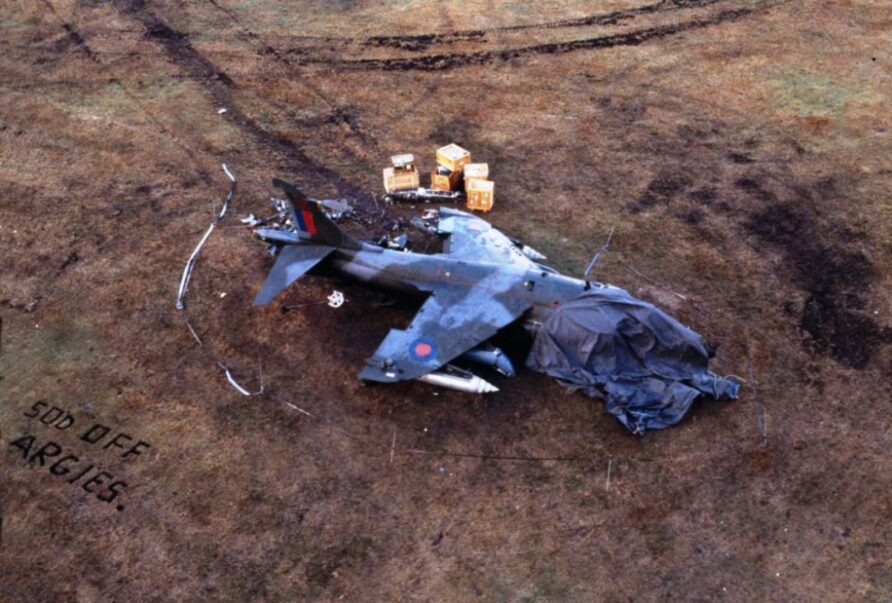
It was later recovered to Port Stanley, and then to the UK for training purposes.

A detachment of 820 NAS Sea Kings was stationed near the FOB from the 9th for reconnaissance and intelligence purposes, and sometimes used the refuelling facilities.
On the 13th another incident at the FOB saw the sole British Chinook, Bravo November, lift some matting planks with its down draft, throwing them to one side and requiring a significant repair effort.
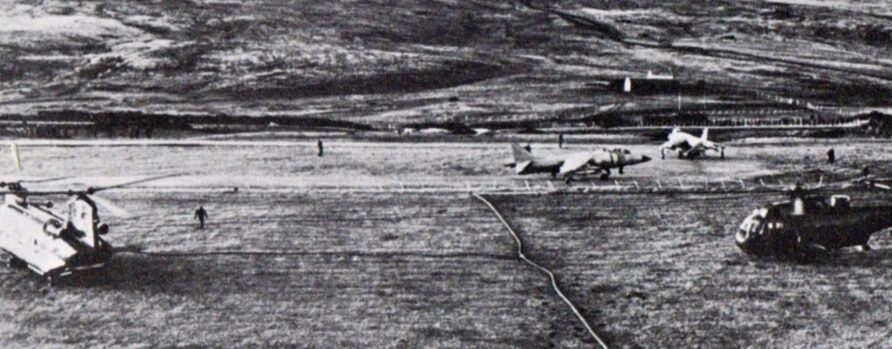
With no spare panels available for replacement and several gaps in the runway, the only option was to relay sections of the runway, another massive task.
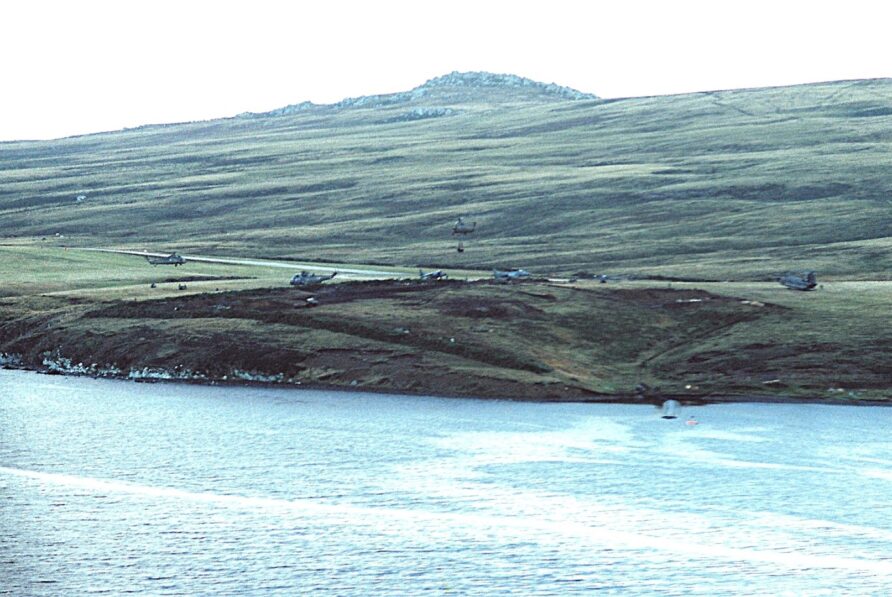
The 14th saw the surrender of the Argentine forces and the FOB out of action in the early morning due to icing.
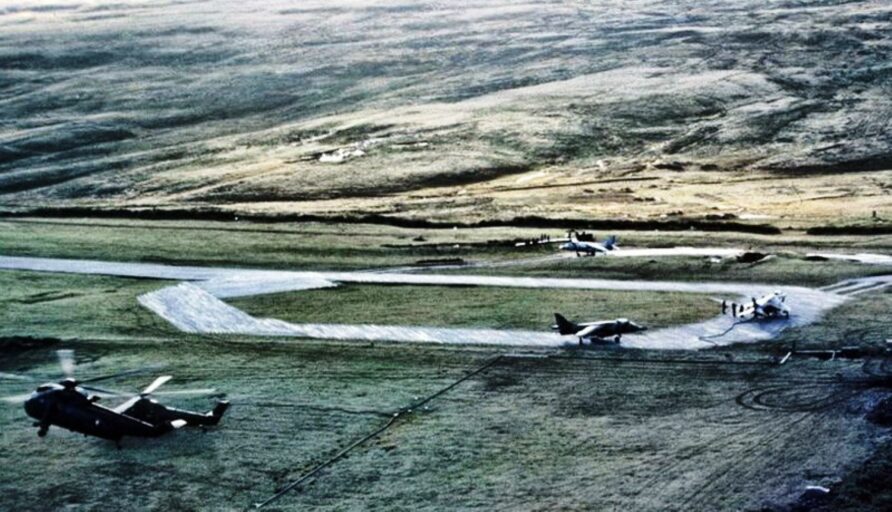
From the 5th of June to the 14th of June, the FOB at San Carlos supported over 150 operational sorties. It was then taken over by the RAF in August.
Summary #
Although the Forward Operating Base at Port San Carlos was a significant aspect of overall planning, the speed of embarkation of the task force meant many risks were accepted.
The vast majority of the planned FOB stores, equipment, and vehicles were on onboard the MV Atlantic Conveyor, a single risk that was sadly realised.
It took ten days to establish because of this.
Despite the magnificent improvisation of the Royal Engineers, the FOB never reached its full potential.
Yet despite this, it still hugely contributed to the air war and, hopefully, is considered a valuable case study and source of lessons for future capabilities.
If you found value in this article, help me keep Think Defence going.
Think Defence is a hobby, a serious hobby, but a hobby nonetheless. I have removed those annoying adverts, but hosting fees, software subscriptions and other services add up.
To help me keep the show on the road, I ask that you support the site in any way you can. It is hugely appreciated.
You can click on an affiliate link, Buy Me a Coffee at https://ko-fi.com/thinkdefence, download an e-book at https://payhip.com/thinkdefence or even get some TD merch at https://www.redbubble.com/people/source360/
Youtubers, if you are going to lift content from here, the decent thing to do would credit me
Read more (Affiliate Link)


