
 Doc Summary

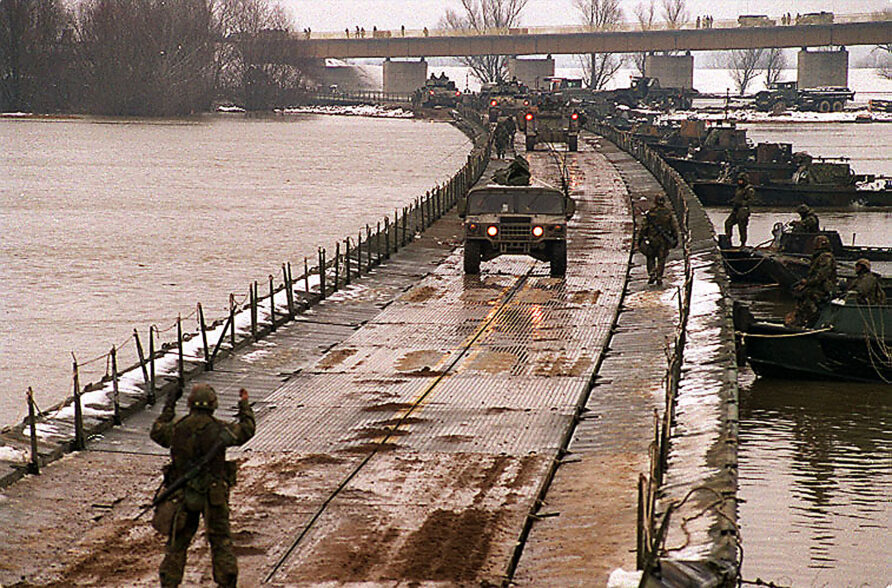
In December 1995, U.S. Army engineers built the largest pontoon bridge since World War II across the flooded Sava River to enable the 1st Armored Division’s entry into Bosnia during Operation Joint Endeavor.
Whilst fascinating in of itself, the crossing would have a profound impact on the development of US and British Army thinking.
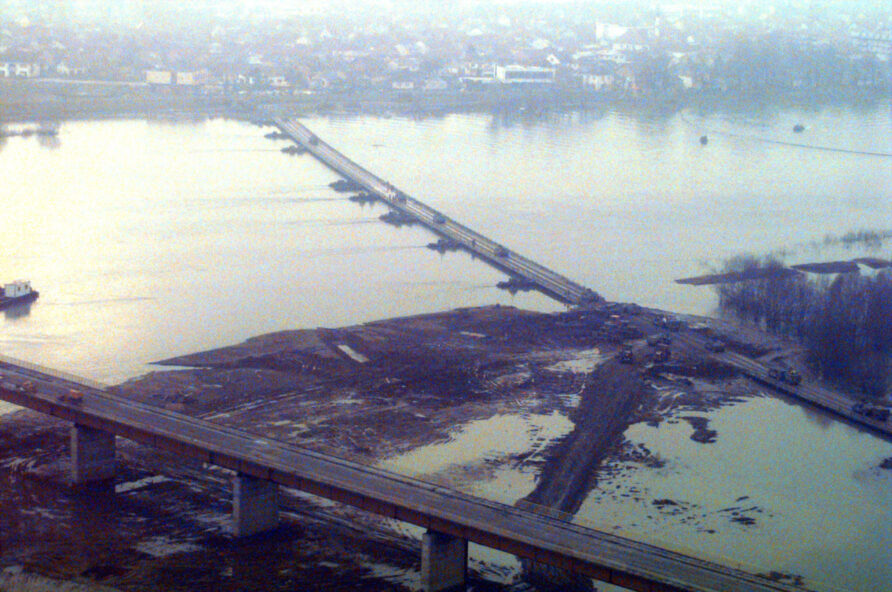
In late December 1995, as part of NATO’s Operation Joint Endeavor to enforce the newly signed Dayton Peace Accords and bring peace to war-torn Bosnia-Herzegovina, the U.S. Army’s 1st Armored Division faced one of its most formidable engineering challenges.
The flood-swollen Sava River, which forms the natural border between Croatia and Bosnia, had surged to near 100-year flood levels due to heavy rains and snowmelt, destroying initial construction efforts and creating treacherous conditions.
Working under intense international pressure to meet deployment timelines, combat engineers from units like the 130th Engineer Brigade and the Division’s own engineer battalions battled icy waters, swift currents, and submerged access roads to assemble a massive ribbon pontoon bridge
The pontoon bridge stretched over 2,000 feet and recognised at the time as the longest such floating bridge constructed by the U.S. Army since World War II.
Crossing the Sava River #
United Nations Protection Force (UNPROFOR) #
Towards the end of UNPROFOR operations the differences between the common public perception of events, and the reality on the ground, was marked. Despite evidence to the contrary, there was a near-universal perception that the Serbs were bad guys and the Bosnian Muslims were victims.
This had predictable political and policymaking consequences.
Meanwhile, the UN peacekeepers themselves were often placed in impossible situations because of the operational restrictions placed upon them, arguably undermining their ability to deliver results.
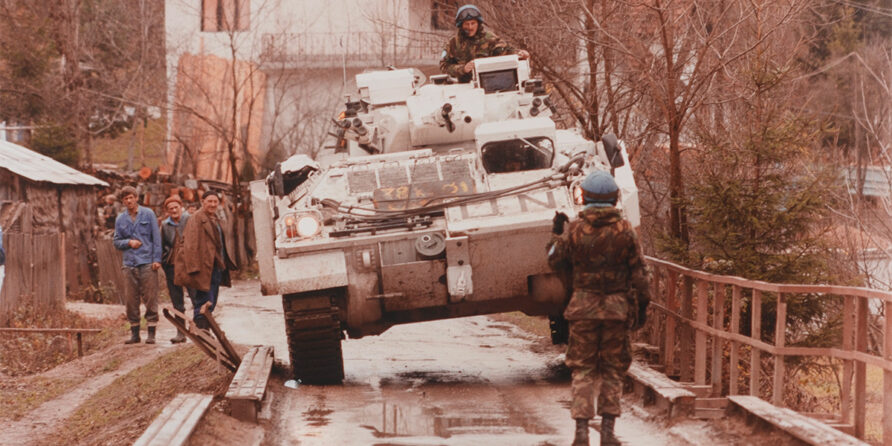
The mortar attacks on the Markale market in Sarajevo, the massacre at Srebrenica, the taking of UNPROFOR hostages, and the general political environment turned out to be decisive factors in the move to the next stage of peacekeeping efforts. IFOR, the ominously named Implementation Force. IFOR.
Implementation Force (IFOR) #
Initial planning for a US deployment to the Balkans had started as early as 1993.
OPLAN 40103 envisaged a deployment to the area of elements of the NATO Allied Command Europe (ACE) Allied Rapid Reaction Corps (ARRC). This plan was never implemented, but it did evolve into another scenario: the plan for ARRC to provide an extraction force for UNPROFOR, should UNPROFOR come under threat.
In summer 1995, another round of planning activity commenced, which would ultimately result in the formation of IFOR.
This plan was put into action when a ceasefire was agreed between the warring factions on the 5th of October, and the Dayton Peace Accords were signed on 14th December 1995.
Following the Dayton Accords it was NATO, not the UN that would be responsible for implementation of the agreement and so IFOR was constituted, the Implementation Force.
Off came the white paint
IFOR had a fixed one-year term, from 20th December 1995 to 20th December 1996.
The land component of IFOR was the ARRC, a standing NATO corps headquarters commanded by the United Kingdom (UK) Lieutenant General Sir Michael Walker. The IFOR subordinate formations were three ad hoc multinational divisions (MNDs). The United States, United Kingdom, and France provided the main forces and divisional headquarters of the MNDs. Units from both NATO and non-NATO nations were assigned to these MNDs for tactical control. A U.S. major general commanded MND (North); a French major general, MND (Southeast); and a British major general, MND (Southwest).
The land command was divided into three regions.
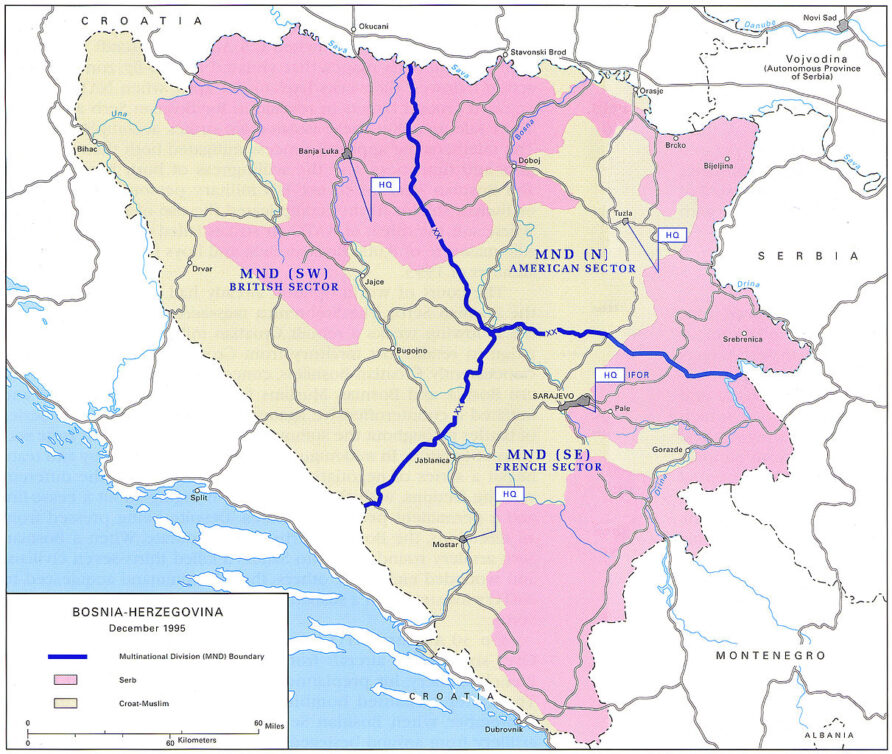
The US-led area, Multi-National Division (North), consisted of two US Brigades and a Brigade each from Russia, Turkey and a joint Polish/Nordic Brigade.
This division was commanded by United States Army, Europe (USAREUR), located forward at Taszar, Hungary.
Given the operating area and the fact that the Adriatic ports were all being heavily used by other IFOR units, it was planned to stage out of Germany, through multiple countries, onto an Intermediate Staging Base (ISB), also at Taszar. Then move out to locations in Bosnia as required.
The line of communication was more than 900 miles (ca. 1,448 km) long, snaking through Germany, Austria, the Czech Republic, Hungary, Croatia, and Bosnia.
A final leg would require crossing the Sava River, and on to Tuzla, another 30 miles (ca. 48 km).
The force package was known as Task Force Eagle.
It was planned that the initial deployment would use 373 trains, 7,187 flat bed rail trucks and 1,408 aircraft sorties. These were to be joined by 441 commercial buses and over 200 trucks in convoys.
In general, it took between four and five days for the bulk of the force to deploy to the Intermediate Staging Base (although not all force elements would transit through the ISB).
Tasked with theatre entry was 16th Engineer Battalion, comprising:
- 502d Engineer Company (Assault Float Bridge)
- 586th Engineer Company (from the continental U.S.)
- 535th Engineer Company (Combat Support Equipment)
- 1/1st Cavalry (the security unit)
- Two medium girder bridge companies
The Sava River Crossing Point #
The crossing point at Zupanja was selected because of its proximity to a railhead and good roads, although the permanent bridge had been destroyed.
The first US forces over (using inflatables) the Sava were elements of the 1st Armoured Cavalry Regiment, These were to provide security. Preparation work commenced on the 17th of December with reconnaissance, the creation of stores parks and general site preparation as bridge components arrived on site.
The battalion planned to use the Ribbon Bridge system, moved into place by small bridging launches, in ideal conditions, a two to three hour task.
At over 300m wide, by any definition, the Sava was a challenging gap, but at the time, the river was at high water.
Three days later, the engineers started to build the bridge using a combination of Ribbon Bridges and some Assault Bridges for access.
There was not enough bridging equipment within the 16th Engineer Battalion, and so war reserve stocks had to be flown in from Italy by C17 and moved forward by Chinook.
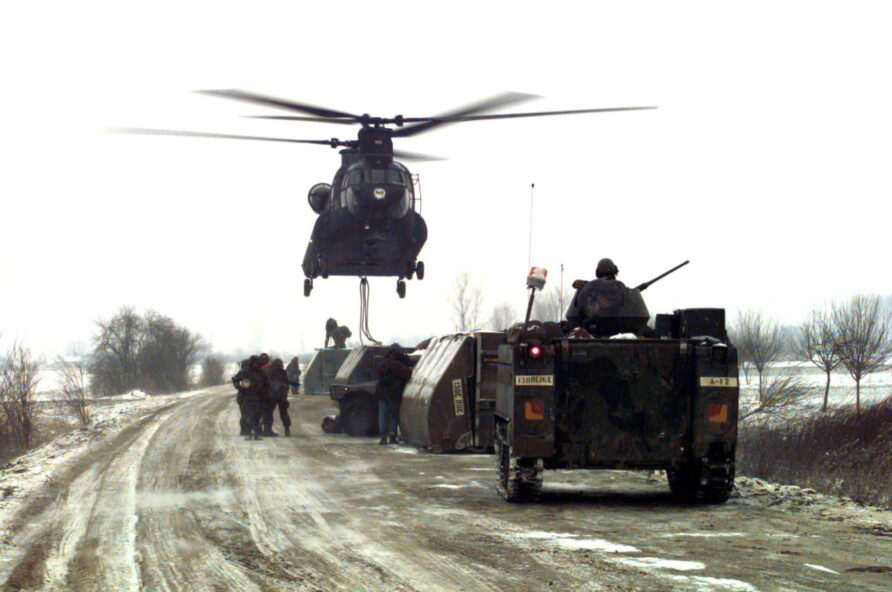
Construction of exit and approach ramps started on the 22nd of December, as did floating mine protection booms.
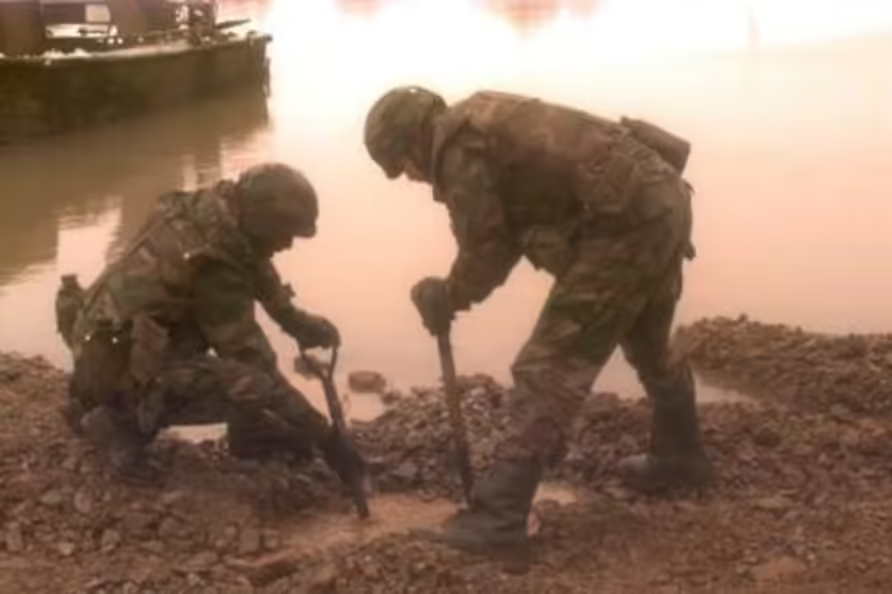
To provide additional security, rafts were used to move a platoon of Bradley Fighting Vehicles to the far bank.
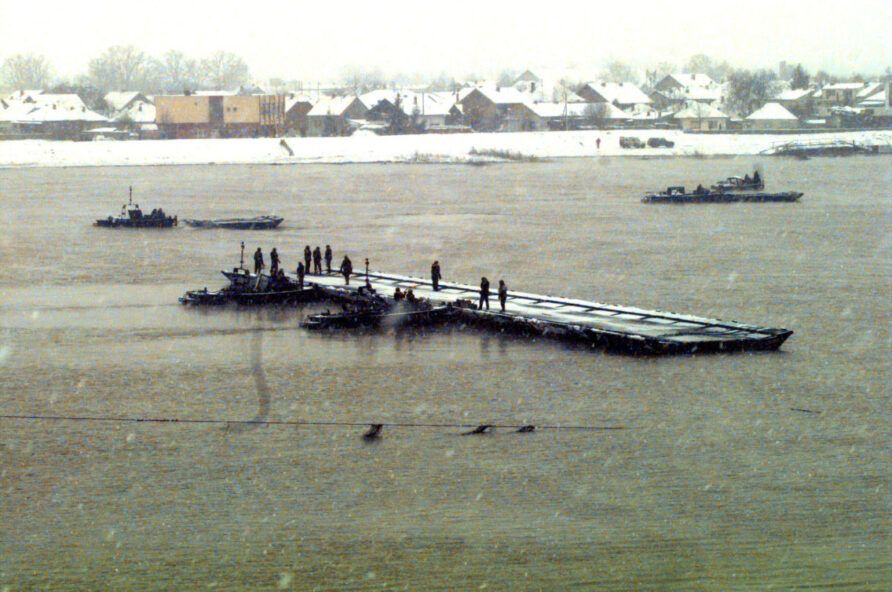
On the 28th December, as the bridge was nearing completion, the river burst its banks for the first time in 70 years. The resulting flood, caused by melting snow, washed away the engineer’s camp and much of the bridge in the early hours of the morning.
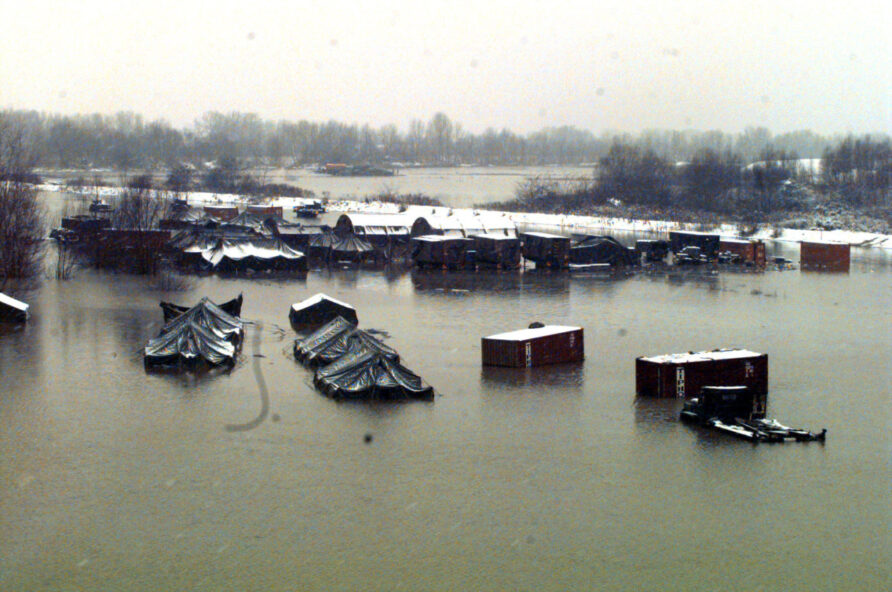
One can imagine it was a somewhat emotional morning!
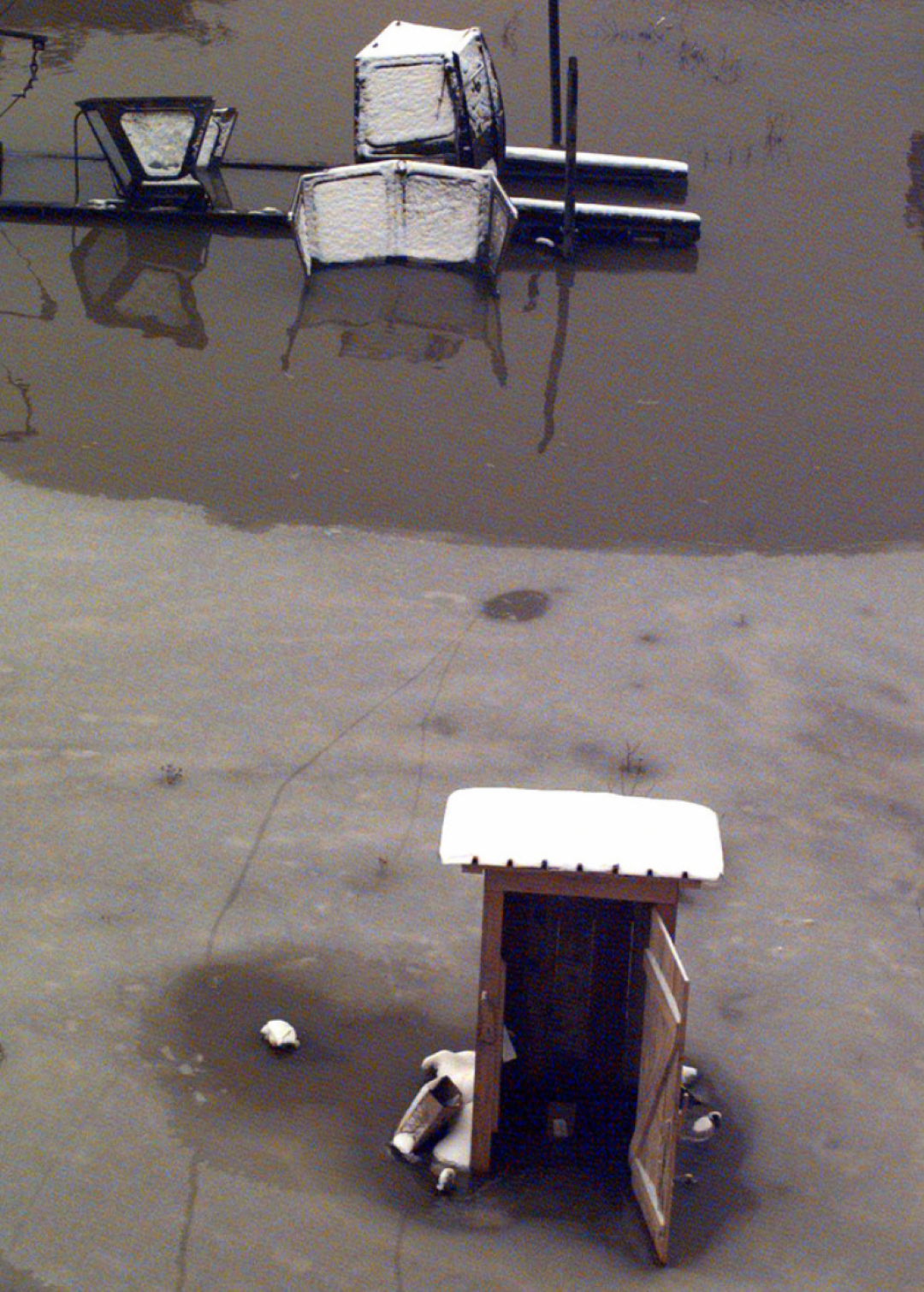
Repairs and lengthening commenced soon after, including direct emplacement of bridging sections by Chinook and more bank support with aggregates.
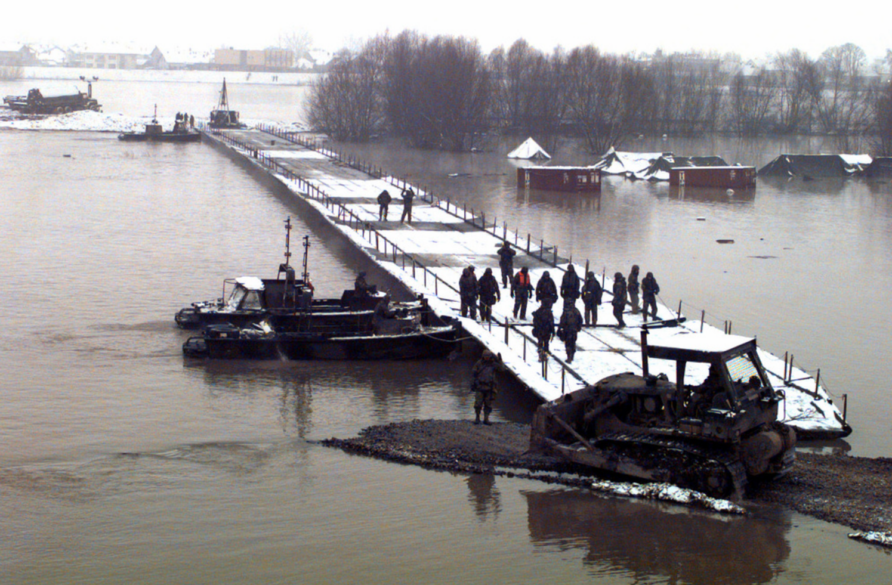
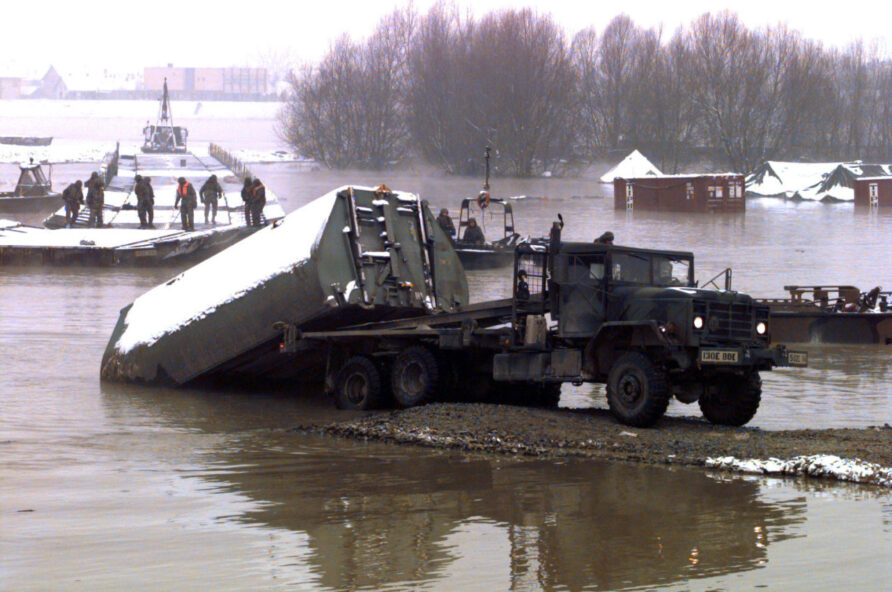
The 300m gap was, by then, 600m.
Completion #
Two hours after completion on the 31st, the bridge was trafficked by lead elements of the 1st Squadron, 1st Cavalry Regiment, 1st Armoured Division.
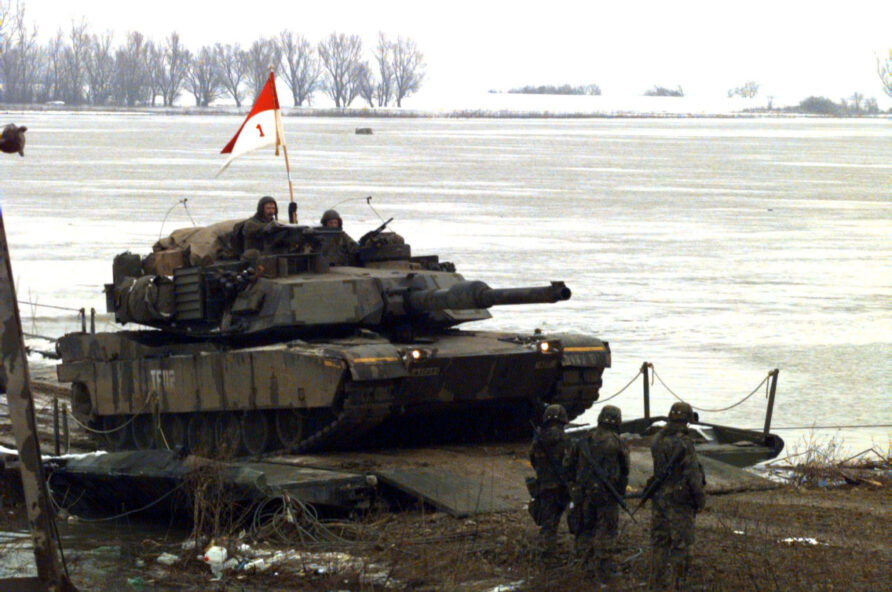
This video shows some initial traffic.
A second bridge was constructed from the 10th of January to the 17th of January 1996.
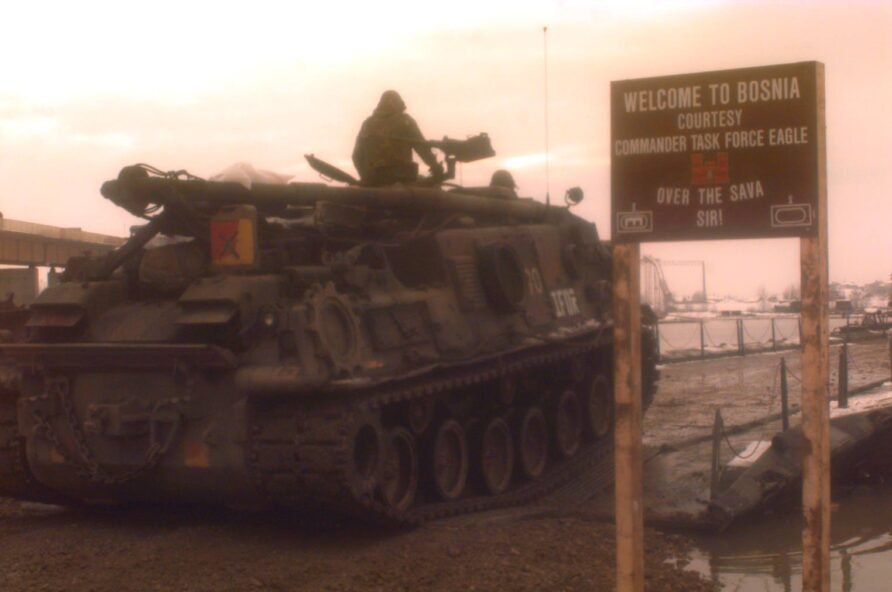
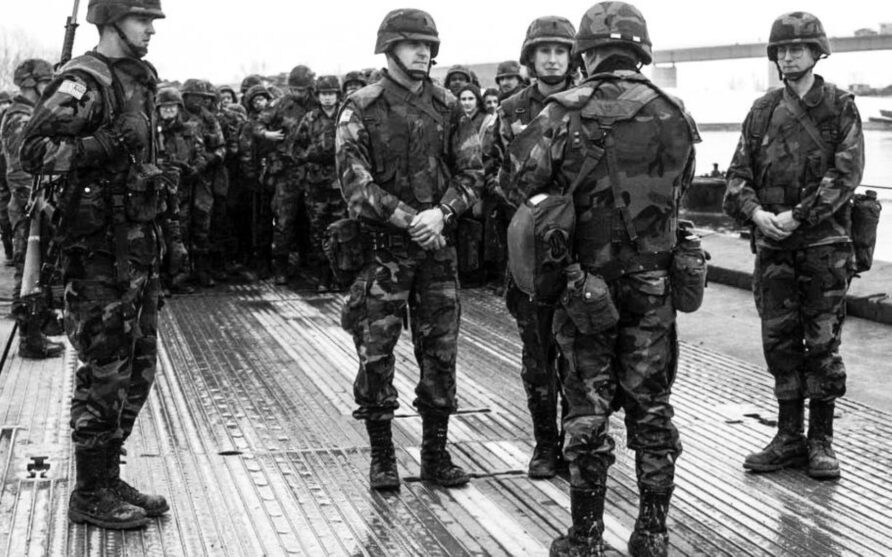
In February 1996, with the second bridge in operation, there was even time for a wedding!
If one looks at a Google Map of the bridging site, the access roads and other construction remnants can still be seen, click here
Influence #
Despite it being a huge achievement, despite flying armoured bridging units (for the first time) by C17, and despite the use of Chinooks for bridge emplacement, much of Task Force Eagle was still held up for nearly two weeks.
The crossing of the Sava River and Task Force Hawk had both exposed critical flaws in US Army capability. It was perceived as slow, lumbering and completely lacking in any kind of strategic agility. Meanwhile, the USAF and USN were getting into their ‘precision effects’ stride, and the US Army knew it had to do better or get left behind in the battle for relevance. And with that relevance, funding.
If you found value in this article, help me keep Think Defence going.
Think Defence is a hobby, a serious hobby, but a hobby nonetheless. I have removed those annoying adverts, but hosting fees, software subscriptions and other services add up.
To help me keep the show on the road, I ask that you support the site in any way you can. It is hugely appreciated.
You can click on an affiliate link, Buy Me a Coffee at https://ko-fi.com/thinkdefence, download an e-book at https://payhip.com/thinkdefence or even get some TD merch at https://www.redbubble.com/people/source360/
Youtubers, if you are going to lift content from here, the decent thing to do would credit me
Read more (Affiliate Link)


