
 Doc Summary

The most enduring military logistics challenge is producing and distributing clean, drinkable water.
It cannot be dehydrated, it cannot be compressed, it cannot be flat packed, and there are no clever tricks to avoid the simple fact that water, when consumed, is the same as water everywhere else.
Water demand will vary depending on the weather, physical exertion rates, and whether it will be used for drinking or cooking, washing, equipment cooling, or medical reasons. Armies have developed various techniques and strategies that combine the usage of boreholes, purification from bulk sources like rivers and lakes, storage, and distribution.
Once purified, water distribution uses a series of increasingly smaller packages, from water tankers to water bottles, and everything in between.
Advances in materials technology have resulted in more sophisticated filtration media, allowing much-improved systems to emerge with a high degree of predictability, safety, and efficiency.
But as good as these modern systems are, they still need a source of bulk water.
Atmospheric water generation provides an alternative option.
Atmospheric Water Generation #
Atmospheric Water Extraction (AWE) / Atmospheric Water Generation (AWG) harvests liquid water from the water vapour (typically 1–30 g/m³, depending on temperature and relative humidity) that is always present in ambient air. The process is fundamentally driven by the need to overcome the chemical potential difference between dilute atmospheric vapour and liquid water, with the theoretical minimum energy requirement determined by Gibbs free energy of separation (increasing sharply as relative humidity falls). In practice, all active systems require energy input for air movement, cooling, heating, or regeneration.
There are two dominant technical approaches: cooling/condensation (refrigeration-based) and sorption/desiccant-based (adsorption or absorption). Hybrids and passive variants exist but are less common for scalable extraction.
1. Cooling/Condensation Method (Vapour-Compression Refrigeration) #
This is the most common commercial technology (e.g., Watergen GEN series, many portable units).
Step-by-step process:
- A fan draws ambient air through pre-filters (removing dust, pollen, and particulates).
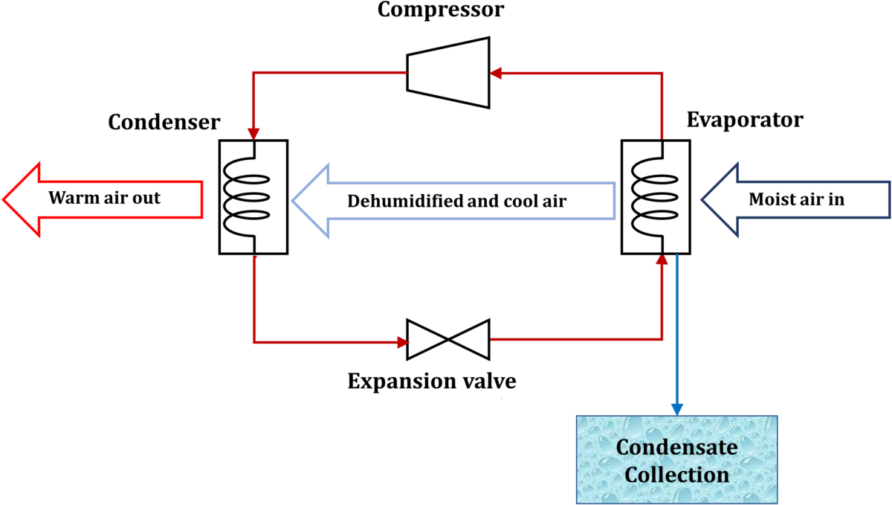
- Air passes over a cold evaporator coil where a refrigerant (e.g., R134a or R410A) circulates in a closed vapour-compression cycle:
- Compressor raises refrigerant pressure and temperature.
- Hot refrigerant rejects heat to ambient air via the condenser coil.
- Expansion valve throttles the refrigerant, dropping its temperature and pressure.
- Cold refrigerant in the evaporator absorbs heat from the incoming air.
- When air temperature drops below its dew point (the temperature at which relative humidity reaches 100%), water vapour condenses as liquid droplets on the coil surface.
- Condensate drains into a collection pan, then passes through post-treatment: activated carbon, UV-C sterilization or ozonation, antimicrobial filters, and optional remineralization to achieve potable quality (meeting WHO or ISO 10500 standards).
- Dehumidified air is exhausted; the cycle repeats continuously.
Key thermodynamics and parameters:
- Latent heat of condensation: ~2,260 kJ/kg water released.
- Coefficient of Performance (COP): typically 2–4 (2–4 units of cooling per unit of electrical input).
- Effective only above ~18 °C and >30–40% RH; below this the dew point becomes too low, and energy demand rises exponentially.
- Typical energy consumption: 0.3–1.0 kWh per litre in humid conditions; significantly higher in arid air.
- Yield depends on airflow rate, coil surface area, and cooling capacity (e.g., 20–100+ L/day for commercial units).
Here is a schematic of the standard refrigeration-cycle AWG:
2. Sorption-Based Method (Desiccant / Adsorption) #
Preferred for arid or low-humidity environments (effective down to 10–20% RH).
Step-by-step process (usually cyclic or continuous-flow):
- Ambient air flows over a sorbent bed or fin-array coated with a hygroscopic material. Water vapour is captured via:
- Adsorption (surface binding): silica gel, zeolites, metal-organic frameworks (MOFs).
- Absorption (bulk uptake): liquid brines (LiCl, CaCl₂).
- The sorbent concentrates water (uptake capacity 0.2–1.5 g water per g sorbent).
- Once saturated, the sorbent undergoes regeneration/desorption by heating (solar thermal, electric, waste heat, or vacuum-assisted, typically 60–150 °C). This shifts the equilibrium vapour pressure and releases water vapour.
- Released vapour is directed to a condenser (often passive or actively cooled) where it liquefies and is collected.
- The regenerated sorbent cools and the cycle repeats. Many systems operate diurnally: sorption at night (higher RH, cooler temperatures), desorption during daylight (solar heat).
Advanced materials:
- MOF-801 (zirconium-based): high uptake at low RH, solar-driven release at ~60 °C.
- Hydrogels, cellulose-konjac composites, or zeolite-coated copper foams: reported yields of 5.8–13 L water per kg sorbent per day at 15–30% RH.
- Energy consumption can be as low as 310 Wh/L with optimized solar-thermal designs.
Key thermodynamics:
- Sorption is spontaneous and exothermic; desorption is endothermic.
- Operates via difference in partial vapour pressure between air and sorbent.
- Far more tolerant of low humidity than condensation methods.
Additional Variants #
- Passive radiative cooling: Surfaces emit infrared radiation (8–13 µm window) to cold outer space (~3 K), cooling below ambient dew point at night. No active energy input, but low yield and weather-dependent. (A related schematic illustrates the dew-harvesting panel concept.)
- Fog collection: Passive meshes capture liquid droplets in foggy air (not true vapour extraction).
Common Post-Processing and Metrics #
- All systems require final filtration/sterilization because condensate or desorbed water can contain airborne contaminants or sorbent residues.
- Performance metrics: water yield (L/day or L/kg sorbent), specific energy consumption (kWh/L or Wh/L), and size/weight/power (SWaP) for portable/military use.
- Overall limitations: energy intensity in dry air, sorbent lifetime (cycling degradation), and initial capital cost.
- Strengths: completely independent of surface/groundwater sources; relevant for remote, defence, or disaster-relief applications.
In summary, condensation systems dominate humid environments with mature, reliable hardware, while sorption systems (especially MOF- and hydrogel-based) are the focus of current research for expanding viability into arid zones using low-grade or renewable heat. Selection depends on local climate, available energy source, and required output volume.
Examples #
The technology is not new, Watergen has had deployable and vehicle-based systems available many years, others more recently. An older model, the 70 kg Watergen GEN-35V military unit could produce up to 35 litres daily, at 25 °C and 55% RH. It was a self-contained unit, only requiring a power source. An (also) older video below provides additional information.
Watergen may be focusing on civilian applications now, but other providers are available, with some taking OEM units from Watergen.
The French Army equipped some of their VBCI vehicles with Watergen units in 2014, with Cofely-INEO as the integrator.
Other providers include Genaq, Uravu, Akvo, and Drupps, all with alternatives and differing scales, including this containerised solution from Rayagua.
Powering a device like those above requires fuel or renewables, renewables are not always that practical for deployed and mobile military forces, and fuel, like water, has to be stored and distributed.
Reading through the various marketing claims, they all seem to focus on a best-case of 1 litre of fuel for 5 litres of water.
Alternatives #
One interesting approach is for vehicle technical water, cooling, windscreen and sensor washing. This approach dispenses with the need to purify and maintain drinking quality.
The US Defense Advanced Research Projects Agency (DARPA) launched a research programme in 2020 called Atmospheric Water Extraction (AWE) to develop technology that can extract water from arid air.
DARPA recently awarded five contracts and selected one Government partner to develop technology to capture potable water from the air in quantities sufficient to meet critical DoD needs, even in extremely dry climates. GE Research, Physical Sciences Inc., Honeywell International Inc., Massachusetts Institute of Technology, University of Texas at Austin, and U.S. Naval Research Laboratory were chosen to develop next-generation, scalable sorbent materials and prototypes under DARPA’s Atmospheric Water Extraction (AWE) program.
The goal of the AWE program is to provide fresh water for a range of military, stabilization, and humanitarian needs through the development of small, lightweight, low-powered, distributable systems that extract moisture from the atmosphere. DARPA is open to various approaches, with an emphasis on advanced sorbents that can rapidly extract water from ambient air and release it quickly with minimal energy inputs. These sorbent materials offer potential solutions to the AWE challenge, provided they can be produced at the necessary scale and remain stable over thousands of extraction cycles. In addition to developing new sorbents, AWE researchers will need to engineer systems to optimize their suitability for highly mobile forces by substantially reducing the size, weight, and power requirements compared to existing technologies.
“Access to clean water is of critical importance to the warfighter, and current water distribution operations incur numerous financial, maintenance, and logistical challenges,” noted Dr. Seth Cohen, AWE program manager. “The selected AWE program performers are being asked to leverage advanced modeling, innovative engineering, and additive manufacturing methods to support the program, which in turn will help maintain combat readiness, reduce casualties and cost due to water transportation, and enhance humanitarian and disaster relief efforts.”
AWE will address water needs in two tracks: expeditionary and stabilization. The expeditionary unit will seek to provide sufficient drinking water for an individual warfighter, with size, weight, and power (SWaP) parameters restricted by the need for portability and operation in austere environments. The stabilization device should provide the daily drinking needs for up to ~150 people (i.e., a company or humanitarian mission), with SWaP requirements tailored to resources available to missions of that scale.
AWE focused on additive manufacturing and material technology to create a usable system in two forms; a single person (called the expeditionary track) and for a group of approximately 150 people (called the stabilization track).
The key difference between the DARPA programme and those described above is the target to extract water from arid air using advanced ‘sorbents materials’.
To demonstrate the challenge, this article in the Science magazine in 2017 described a technique using a Metal-Organic Framework (MOF)-801 that was tested in Arizona.
It produced 100g of water using 1.2 kg of the material in a full day/night cycle using sunlight and ambient cooling.
More from DARPA is below.
General Electric was subsequently awarded a $14.3m contract to contribute to the AWE programme, joining Physical Sciences, Honeywell, the Massachusetts Institute of Technology, and the University of Texas.
The material is formed into a 3D-printed heat exchanger.
If you found value in this article, help me keep Think Defence going.
Think Defence is a hobby, a serious hobby, but a hobby nonetheless. I have removed those annoying adverts, but hosting fees, software subscriptions and other services add up.
To help me keep the show on the road, I ask that you support the site in any way you can. It is hugely appreciated.
You can click on an affiliate link, Buy Me a Coffee at https://ko-fi.com/thinkdefence, download an e-book at https://payhip.com/thinkdefence or even get some TD merch at https://www.redbubble.com/people/source360/
Youtubers, if you are going to lift content from here, the decent thing to do would credit me


