
A proposal from Anglo Engineering Concepts to meet British Army vehicle capability gaps and drive down support costs by adopting system engineering thinking and a design language that places the designer closer to the user.
Anglo Engineering Concepts is run by an experienced design engineer that formerly worked as one of the three design engineers in the Drawing Office of Alvis. The design engineers’ remit was to bring forward realistic innovation – this approach of creating designs stretching beyond current capability that could be manufactured in the near future from available technology has since remained a core design principle.
In more recent times, this same design engineer was part of the team that created Lockheed Martin’s AVA wheeled vehicles that were exhibited at the DE&S DVD events.
The designs described below have been reviewed by serving Army personnel, by MOD and DSTL personnel, and by various experts in the industry, including the former Manager of the Alvis Drawing Office. Generally (and it is to be hoped not just out of politeness) the designs have been well received.
Some design choices caused concerns, but wherever possible these concerns have been addressed in subsequent revisions. This highlights another core principle behind the design work – that solid direct communication between designer and user is essential to effective vehicle development.
A Short History
When the MOD embarked upon a replacement programme for CVR(T) it at first seemed, under FFLAV, that modern, more capable and better-protected versions of the Scorpion family were sought. This seemed rational; there are tasks ideally suited to small-light-fast armour which MBT-sized vehicles or up-armoured Land Rovers cannot perform as efficiently, if at all.
FFLAV though did not progress to a procurement programme.
The TRACER study that succeeded FFLAV was far more ambitious. As the TRACER programme progressed, the vehicles grew larger and heavier, although still nowhere near MBT size. There seemed to be a capability gap opening up between Land Rover-sized CVR(T) and this new breed of digitised high-tech reconnaissance vehicles.
Many in the industry saw a need for light armour and moved to offer solutions – Stormer 30 being an obvious example.
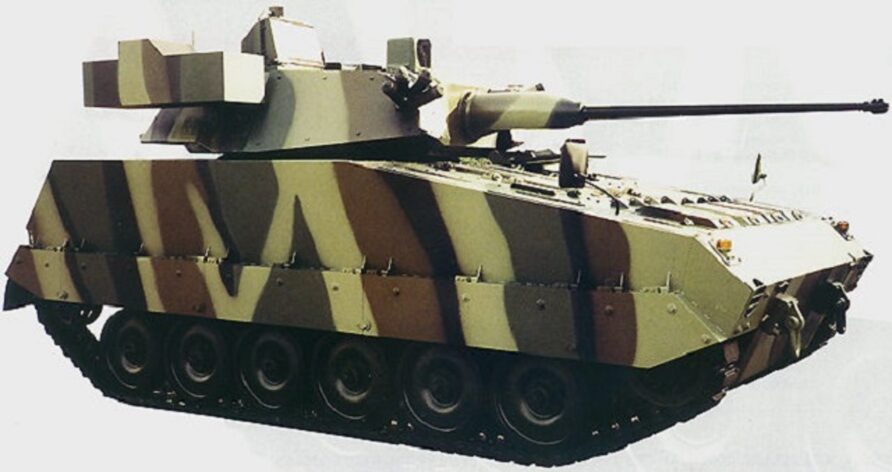
When FRES described a need for C-130 transportability, simple, light and upgradable armoured vehicles like Stormer 30 were brushed aside as the new programme would deliver exactly that class of vehicle, only better.
Skip forward many years; as we all know, FRES eventually delivered something that is the width and height of an MBT, at half an MBT’s weight and with half an MBT’s engine power.
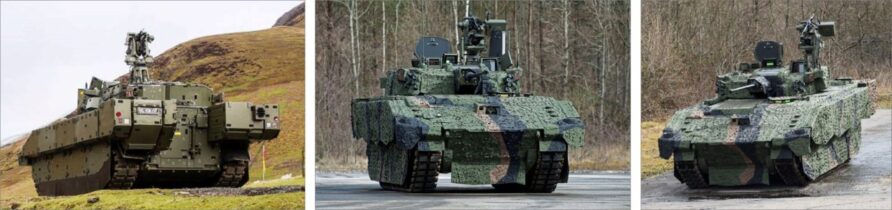
When FRES turned heavyweight, BAE toyed with what seemed to be a relaunch of Stormer 30, the hull updated and apparently carrying a version of their FRES CV90 prototype turret possibly armed with the Mk44 Bushmaster cannon, but it appeared only as a low fidelity graphic:
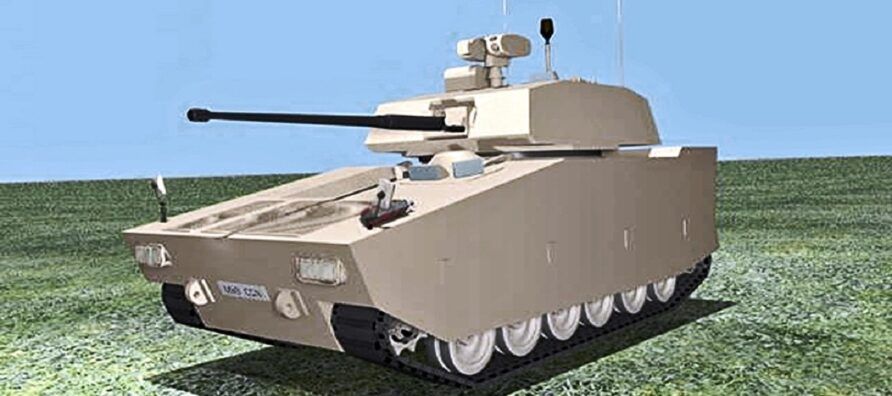
This vehicle, it seemed, never reached the prototype stage, but CVR(T) derived designs continue to emerge – there are rumours another Stormer 30 rebirth is imminent but yet to break cover – which only shows how good the CVR(T) concept was way back in the 1970s.
Anglo Engineering Concepts sprang from a conviction that Ajax could not perform the same tasks that CVR(T) suited, and where size and weight were defining requirements. Several vehicle concepts were created, assessed, and either set aside or carried forward for further development.
This coherent design and development process has been ongoing for over seven years. Seven years of design effort aimed at a single family of armour — this is a duration of design effort not seen since the days of the Establishments.
The effect the closures of the Establishment had on UK defence equipment design was fundamental. The MOD assumed the industry would perform all the work previously done by the Establishments, but cheaper!
Of course, it didn’t.
The industry is not a charity; unless there’s a high probability of a good return on its investment, it does nothing. Without a cast-iron contract, or a winnable competition for one, or at least a clear indication from MOD that they have a clearly defined requirement for a specific capability, there will be no design effort in the industry.
And as soon as the opportunity expires, all design effort stops. Dead. There should be no surprise that since the 1990s, nearly every armour bid has been based upon previously fielded products minimally modified to tick the latest requirement boxes, or on products imported from afar, developed on their nation’s taxpayers’ money.
This is perfectly summarised in one simple quote from William Suttie’s book ‘The Tank Factory’, where he is looking back at the 1920s.
“The decision to focus tank design in industry and run down the experienced and innovative Department of Tank Design (DTD) was a significant factor that resulted in Britain becoming a backwater in tank design until the Chertsey Establishment was established.”
Clearly, that was a lesson not learned.
In this modern environment, the sustained focus of design effort is a rarity and has delivered not so much a set of vehicles, as a design system comprising a set of subsystems and components that by use in different configurations permit rapid development of role-specific vehicle types.
The designs resulting from this methodology have been created and developed despite there being no MOD procurement project, formal requirement or funded study.
These are simple honest vehicles designed from the inside out to be effective, maintainable, and achievable, but just as important is the design process that produced them.
Anglo Engineering Concepts — Family of Light Armour
While it has been the norm for the Armed Forces to do the best with the kit which is available, this has at times made tasks more difficult, less effective or in some cases much more dangerous. Gaps in capability place additional strain on the serving soldiers as they wrestle with equipment that is not really the right tool for the job.
What is needed is a wider range of useful tools in the Army’s toolbox, so that the difficult task of the soldier can be made as easy as possible.
The most obvious gap in UK equipment is precisely the space that has been occupied by CVR(T), and FV600 before that, and the likes of the Daimler, Coventry, and Staghound armoured cars before that. Considering the age of FV432 Bulldog and M270 MLRS, ongoing concerns over Panther protection, and the mobility of the Mastiff family, there is a broad spectrum of light to medium armour that might be considered also in need of replacement.
It appears the US Army has determined it too has a similar need for such armour (as reported here:
https://www.army.mil/article/184597/
The vehicles broadly align within the earliest FRES framework; C-130 transportable combat armour fulfilling many of the defined FRES roles. But before embarking on a design, their purpose had to be adequately defined. As one of the VERDI-2 trials operators (LCoH Bright) stated at the end of its trial:
“The main question to be answered before TRACER comes off the drawing board is what is the main role of recce? What does it need to do, collect information or destroy enemy light armour or both?”
The first task faced by any armoured vehicle designer and the user is to understand the role; to scope out something like a Cardinal Points Specification of perhaps half a dozen defining characteristics the design needs to have. Without such a CPS the created armoured vehicle may not fit comfortably into any role – a square peg looking for any vaguely square-shaped round hole into which it can be forced.
Once each role had its defined purpose, a brief study was carried out to investigate the problem space, including reviews of the strengths and weaknesses of earlier vehicles to pick out valuable features to carry forward to new designs. Ever since the invention of the tank, armoured vehicle designers have come up with very clever solutions to problems that are as relevant now as they ever were.
Incorporating these, together with modern systems and approaches is in no way outdated thinking; the external shape of the new designs merely reflects the packaging of the necessary subsystems and human factors, taking those earlier smart solutions which have been brought up to date into account.
There may be raised eyebrows at the imposed C-130 transportability constraint given that the UK now has A400M, but there are sound reasons to work with this constraint. Firstly, the 9ft (2.74 m) by 9ft (2.74 m) gauge and 18t weight limit are entirely appropriate for a family of vehicles to replace CVR(T) and other similar light armoured vehicles.
Secondly, while the UK has A400M many of our allies do not, and the flexibility of deploying as part of an ally’s force seemed worth retaining. Thirdly, complying with the C-130 gauge also makes rail and road transport much easier, ensures slick RO-RO operations, and keeps the vehicles down to road vehicle bulk such that few routes would be impassable using the extant infrastructure.
Finally, holding to C-130 constraints maximises export potential which would be of value to UK PLC.
The counter-argument most often pitched at this is that in the contemporary operating environment, the light armour of such compact form cannot meet the protection levels necessary to survive the most likely threats. This would be a valid argument if the entire fleet of armour was to be changed to sub-20t vehicles. but the Army will still have its 70t MBTs, 38t Ajax, 30t+ upgraded Warrior and MIV, which is likely to be a 35t vehicle.
If threats are so severe, then field the kit appropriately but accept the limitations they bring; the restrictions on routes, the greater logistic tail, and the reduction in stealth (visual and IR but particularly noise). On the other hand, where rapid reaction and get-to-anywhere mobility are key, using a light small mobility-focused armour capability has its advantages.
Different tools for different jobs.
Low weight does not necessarily mean paper-thin protection. These smaller vehicles have been designed with a thick and heavy hide but due to smaller surface areas, the weight of equivalent protection armour is less than would be seen on larger armoured vehicles. There are also some very intriguing new developments in passive and reactive forms of protection, and many active forms of protection are now being marketed.
Clearly, the cost is key as in all projects, but this points towards better-than-expected protection in smaller and lighter platforms.
Those who follow TD’s daily feed of defence-related snippets will recall this comment: “Start with a common engine, wheels, tyres, transmission & other bits, then, AND ONLY THEN, build vehicles around them.
Systems thinking.” Those who cut their teeth in the UK defence industry of the last century have always sought to use common components and subsystems, a discipline that the Government Defence Establishments promoted, encouraged and sometimes enforced. No surprise then that exactly this approach has been followed with the vehicle concepts described here.
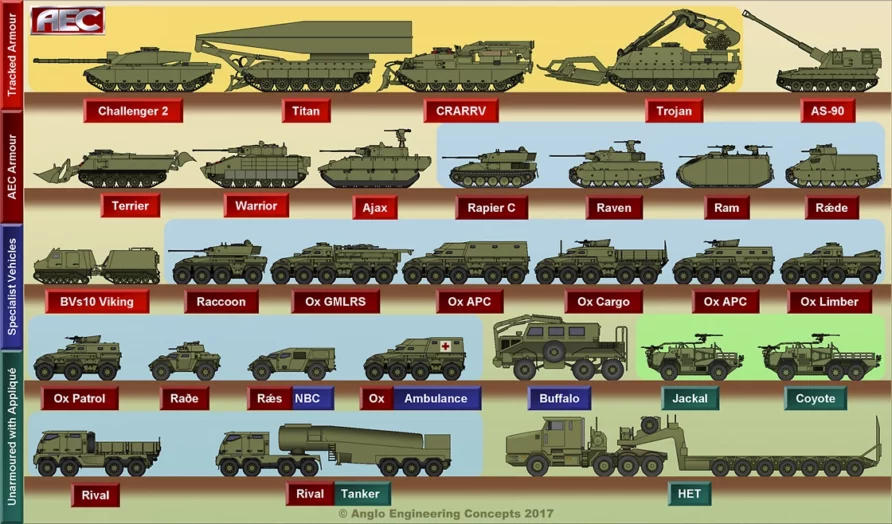
This graphic shows each current vehicle type drawn to the same scale; it is not exhaustive or definitive, for example, no armoured JCBs nor Command or Engineer or Repair/Recovery Variants of all the types depicted, but it does indicate the broad and varied nature of UK armoured vehicles.
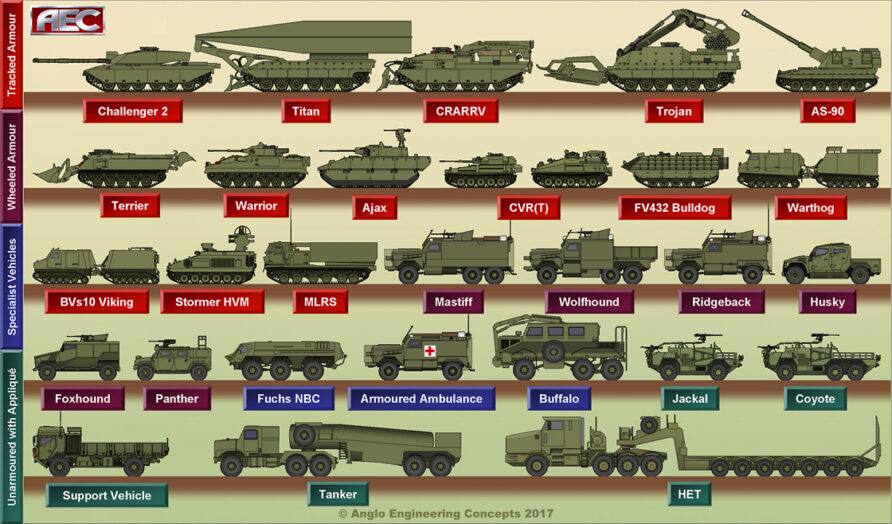
Some armour is very new, some are ages old, some have aged well and others badly. Many have been purchased as Urgent Operational Requirements when existing fleet shortfalls were identified, and some of these may not be retained in service in the medium term.
What is quite plain to see is that there are many types, each filling a niche role, all needing their unique equipment care and REME support to keep working. That is a lot of different vehicles with different spare requirements and different maintenance procedures.
Anglo Engineering Concepts — Vehicles
Shown below is a brief outline of the vehicles, their purpose, and some development rationale as the process evolved. They are each valid Light Armour solutions as they stand, but it should be understood that they also serve as examples of the wide variety of armour that the design approach can deliver.
They may be viewed as vehicle proposals or equally a basis for further development. They did not come about all at once but progressed over the development period in response to user feedback and other inputs.
The 3D images are taken from CAD where the vehicles have been modelled. The CAD models are not complete production-ready designs but do serve as packaging exercises and allow some degree of human factor and maintenance assessment.
Anglo Engineering Raven
Role: Fast Light Armoured Fire Support; Reconnaissance Vehicle
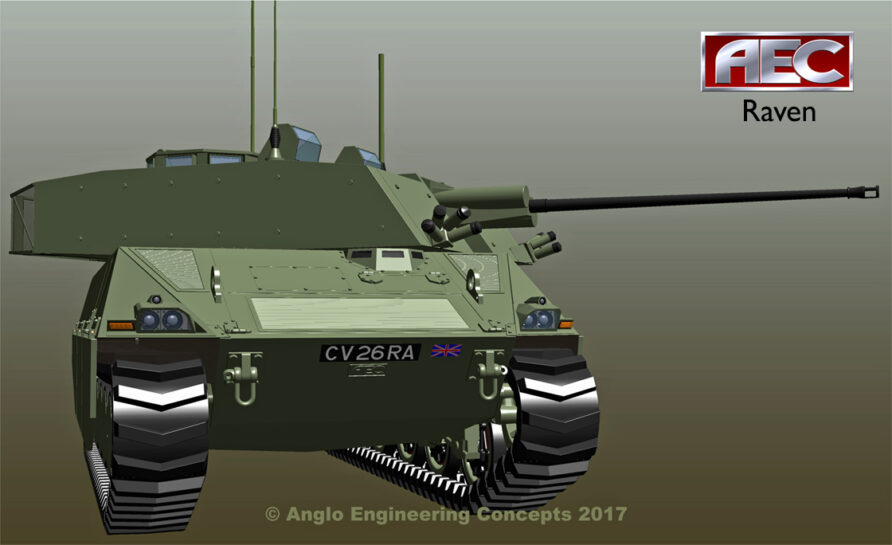
Design: The initial concept was nothing more ambitious than a low-profile hull on which either Ajax or Warrior CSP turrets could be mounted to provide obvious commonality and support advantages whilst also providing a lighter lower-profile fighting vehicle than an IFV.
Not as easy a task as imagined, modern turrets are huge compared to those of years ago; a function of larger guns, elaborate feed systems, a lot of electronics to house, the requirement to accommodate physically larger soldiers and the space demands of body armour and wearable personal technology.
There has apparently been a loss of focus on designing armour to the minimal possible dimensions over the years. This may be a simple consequence of moving to CAD – if the design only exists in the virtual world, it’s difficult to grasp the reality of internal space. There is also a significant reduction in the rate of new projects compared to previous decades, meaning engineers are just not using their skills often enough to gain the all-important knowledge that translates to experience and technical intuition.
There is a school of thought that the use of automated design tools in place of experienced designers will make better products, but this is far from proven.
For a combination of some or all of the above, Ajax and Warrior CSP turrets are large. During the evolution of the design process, it became clear they could not form the basis for a CVR(T) sized vehicle and in addition, their asymmetric width creates issues on small vehicles.
After a good deal of concentrated options assessment, a configuration was found that created a balanced vehicle that worked using either of these British Army turrets or either of the two BAE Systems proposed Warrior CSP and CV90 FRES turrets.
This vehicle was named Raven, and for the purposes of illustration, the third-party turret with which it has been fitted is the BAE Warrior CSP turret, selected before the MOD decision was made to buy Lockheed Martin turrets for Ajax and Warrior CSP.
There are some unusual design decisions embedded in the hull design which significantly improve personnel protection without adding weight. This vehicle tips the scales at approximately 14t. As might be expected, it has a crew of three, but perhaps not as expected it also has a high power-to-weight ratio giving a very lively performance.
In subsequent reviews, serving British Army representatives voiced concerns and reservations over some of the more radical technical choices involved in the hull design.
Anglo Engineering Rǽde
Role: Armoured Personnel Carrier
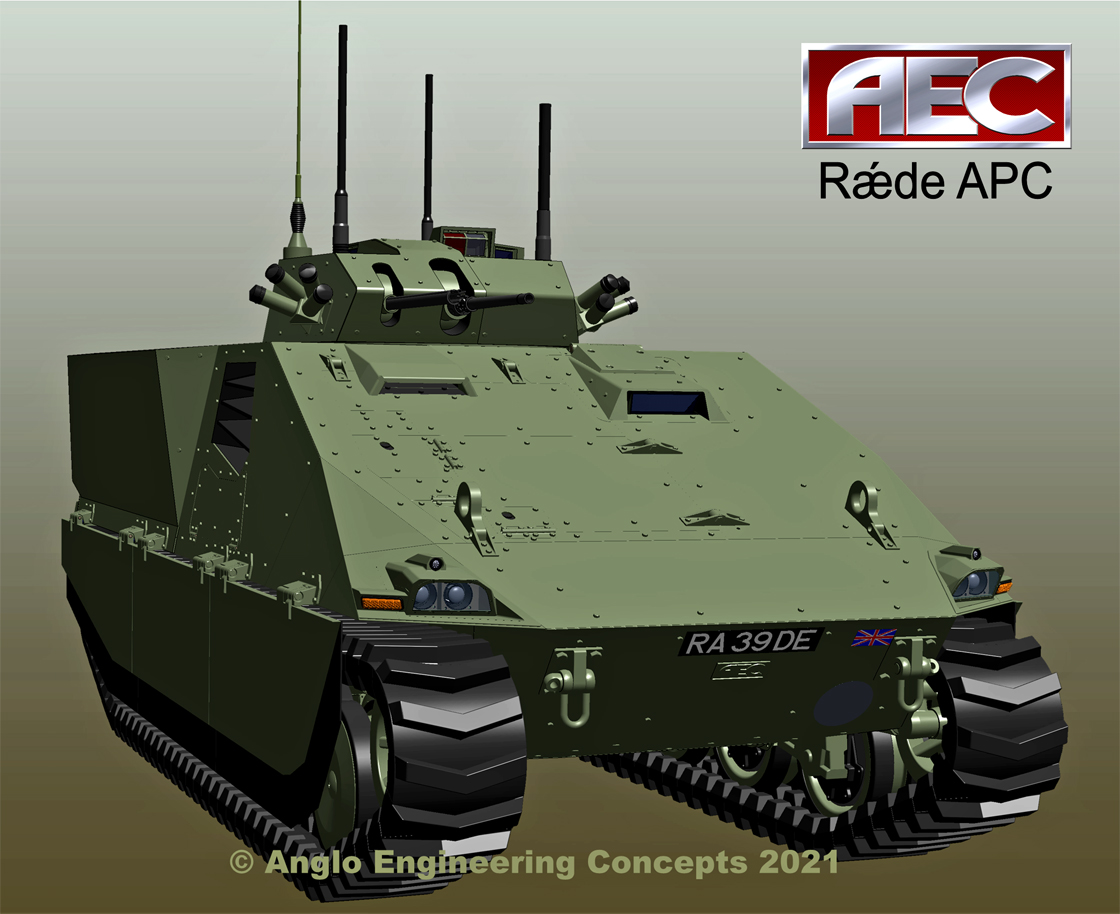
Design: The low-profile Raven hull had its roof plate raised to create a personnel carrier. The resulting vehicle, called Rǽde, has a similar internal volume to the Alvis Stormer APC. But where that vehicle was defined as 2 crew plus 10 dismounts, using the 97th percentile male soldier anthropometric model that is now demanded, reduces the capacity to 5 dismounts.
The current Def Stan requirement is that vehicle seating must be separate and well-defined with restraints and supports, and where possible arranged facing fore/aft. If all the non-mandatory guidance is followed, when there is a seating capacity of five, five is all that can be carried. Older military personnel carriers would be fitted with benches or close-coupled flat-squabbled seating facing side-on.
While there would be a nominal seating capacity, the seating arrangement could take more at a crush in emergencies. Following all Human Factors guidance has implications that must be understood.
In the AEC designs for Armoured Personnel Carriers, the seating for dismounts is blast-attenuating but side-facing, and while the seats are individual and shaped, they are close enough to their neighbours to act as a bench when necessary.
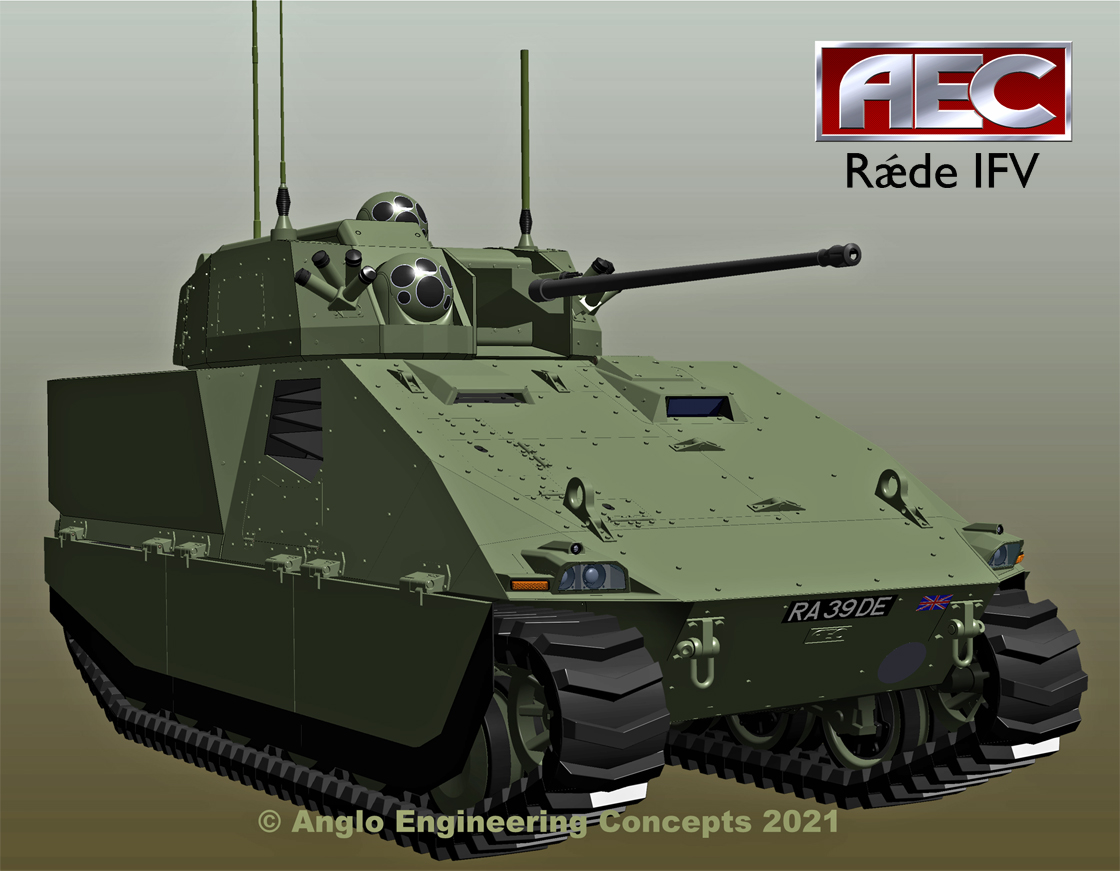
With the cancelling of Warrior CSP, a trial fit of the Rapier remote turret on the Rǽde hull has been given an initial assessment. The turret requires a well in the outer armour of the hull for the ring and RBJ (the slip-ring unit for electrical connection) which constrains dismount compartment headroom, added to which the significant weight of such a turret on a light armoured vehicle would lead to lateral instability.
This IFV version would also exceed the C-130 transport gauge due to excess height. While it might seem an attractive fightable concept, the penalties are not insignificant, and operating APCs in concert with fire support such as Rapier or Raven would probably deliver a more robust combat effect.
Anglo Engineering Ram
Role: Close Combat Support; Assault Gun
Design: With a fixed forward-firing 25 mm Oerlikon KBA or CTA40 and two Selex Enforcer RWS, the Ram is designed for close assault in urban and semi-urban terrain. With one RWS, the opposition may approach if it is focused elsewhere, with two RWS the probability that neither is about to sweep for threats is small.
To aim the hull gun, the vehicle must be aimed much like the S-tank, and like the S-tank the hull attitude can be adjusted in this case by air-suspension units. The flanks are designed to support heavy anti-IED/RPG slab armour, making this vehicle both heavy and wide.
Ram has not yet been transferred into CAD.
Anglo Engineering Rival
Role: Protected Cargo Vehicle
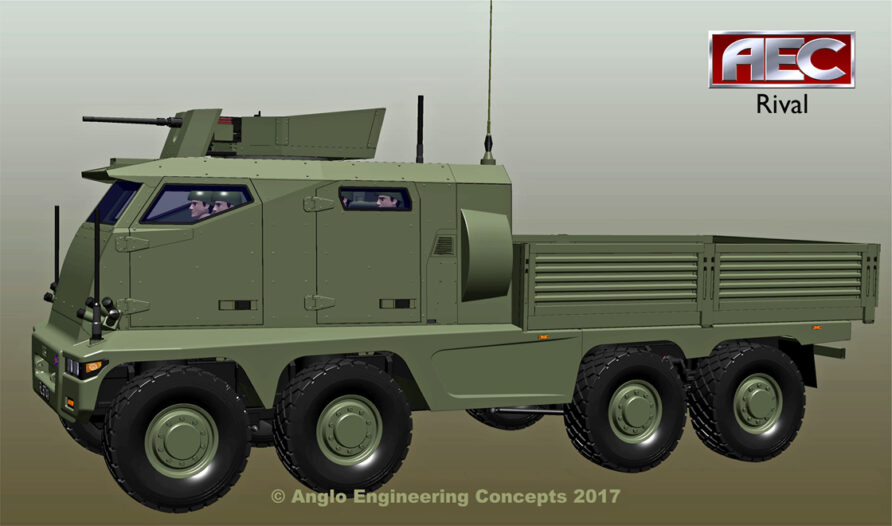
Design: In a complete change of direction, there was a request to investigate if the technology of the tracked vehicles above could be re-engineered into a wheeled chassis, specifically, in this case, a chassis for an existing armoured cab, to be configured as a drop-side cargo truck.
The exercise proved successful and resulted in a cargo carrier of modest size and payload capacities between 8t and 11t and room for six NATO standard pallets on its conventional drop-side load deck.
At a late stage, the Design Authority for the cab decided it was not to be used. An alternative AEC cab was created on the same footprint and with the same mounting interface to suit the chassis. The cargo deck and dropsides were modelled on the excellent Marshall’s products used on current British Army MAN/Rheinmetall cargo vehicles.
This could also be adapted to the protected tanker role.
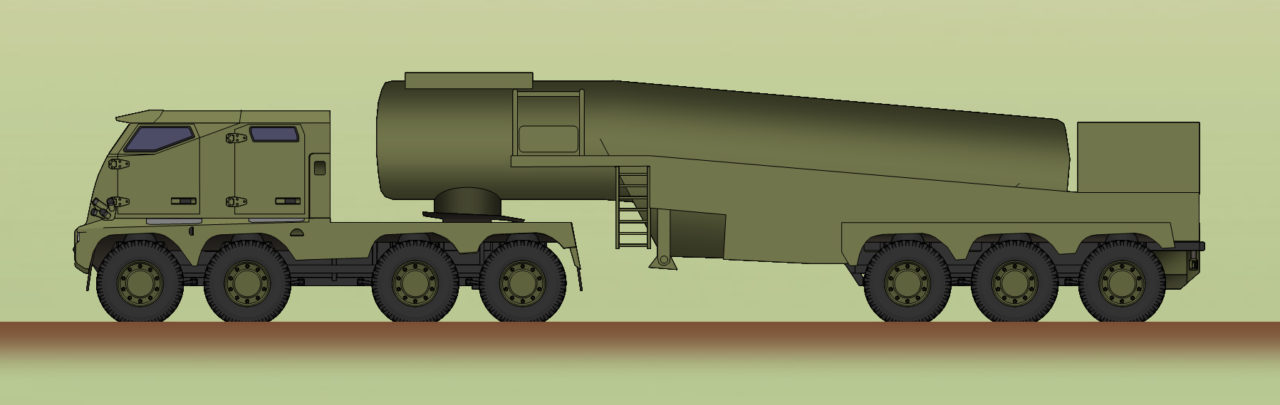
Whilst the suspension and general layout meet the requirement, at between 6.5t and 8t per axle it was too demanding on available technology. The axle rating was reduced to 3.5t per axle for all other wheeled vehicles, making these lighter vehicles feasible within current technology, but the geometry and configuration of the suspension remain the same.
A note about this geometry; a request was made to the designer of Jackal, and he kindly defined the trigonometry of the suspension. The suppleness of wheel movement will be equal of Jackal but at 3.5t the axle loading is less and the tyre width greater, which allied to the high power-weight ratio makes the fully armoured vehicles’ theoretical mobility considerably better than the impressive Jackal
Anglo Engineering Ræcc
Role: Autonomous Engagement Capability; Armoured Car
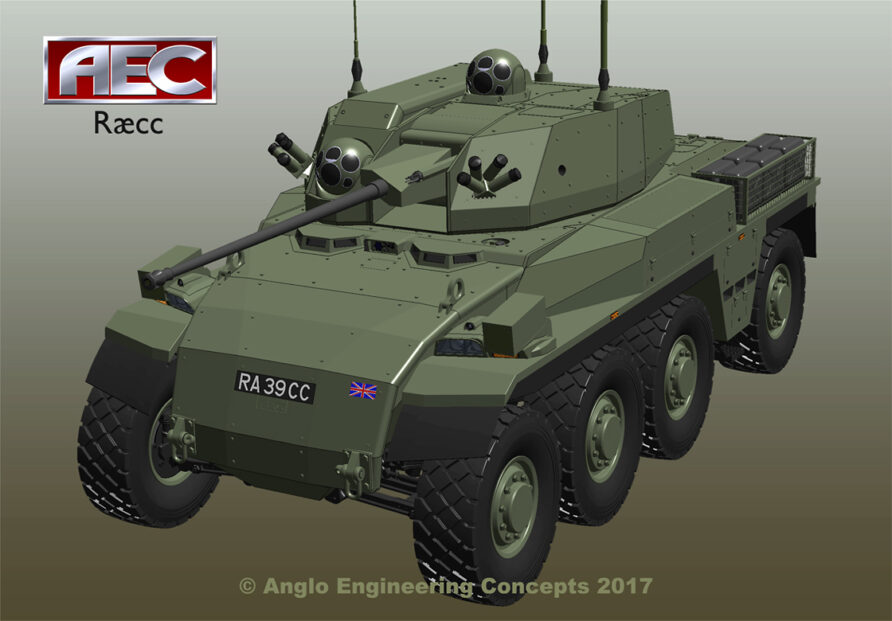
Design: The first of the wheeled vehicles using this 3.5t axle loading was perhaps an odd choice. The lack in the UK Order of Battle of high-speed high mobility firepower capable of long-distance transits and being able to counter a broad spectrum of threats seemed to be a capability gap worth filling.
The four possible UK turrets (one each for FRES and Warrior CSP from BAE Systems and Lockheed Martin UK) did not fit well on a vehicle designed to be small and mobile, not only because of their size and weight but also because the turret basket size did not suit this vehicle’s narrow V-hull. A more comprehensive selection of firepower was also required.
A new remote turret was designed, armed with the CTA40 and with Anti-Aircraft and Anti-Tank Guided Weapons installed conformally. The turret also has an elevating sight – it only rises a few feet, but as one RAC Major commented, he had found standing on the turret top with a pair of binos a very effective way of seeing without being seen; he didn’t see the limited elevation as a handicap.
The hull has room for just two crew, but then the gun has its autoloader and the missiles are in essence ready-rounds, and the 7.62 mm coax was given large ammo can use, so much of the gunnery effort was taken care of by machinery and advance vehicle preparation.
The turret was set on an 8×8 hull of low profile and of a deep V profile in which the crew operated, and sat in a well-protected citadel using the array of electronic vision options for driving targeting and situational awareness.
A point to consider here is that LCoH Bright after the VERDI-2 trial stated the following:
“The trial on Salisbury Plain was a success in as much as it proved a two-man crew can operate effectively for 48 hours in a closed-down environment, and it opened our eyes to what is available to the recce soldier of tomorrow […but…] it must be smaller and faster.”
The Ræcc vehicle concept, like VERDI, is a two-man vehicle, with electronic vision and a remote turret, but packaged small enough to fit C-130 and just possibly light enough for CH-47 lift and has mobility and speed in Jackal’s class. That’s all LCoH Bright’s wishes fulfilled.
It was presented to a group of the Army that has the remit to embrace and assess new developments. But where Raven raised some concerns under review by the User group, Ræcc raised considerable objections. The reliance upon electronic vision, no ability to get the commander’s head out with a clear sight of all sides of the vehicle, difficulties with misfires and ammunition feed stoppages and on and on.
So despite the outcome of the VERDI-2 trial, when offered just what that trial’s team recommended, it was the User who rejected unmanned turrets and solely electronic vision.
Quite disappointing, but the point of the AEC design approach is that the same building blocks may be moved and recombined with a high degree of configuration flexibility, so the rejection of one particular vehicle configuration does not mean a start from scratch.
A redesign then…
Anglo Engineering Raccoon
Role: Autonomous Engagement Capability; Armoured Car
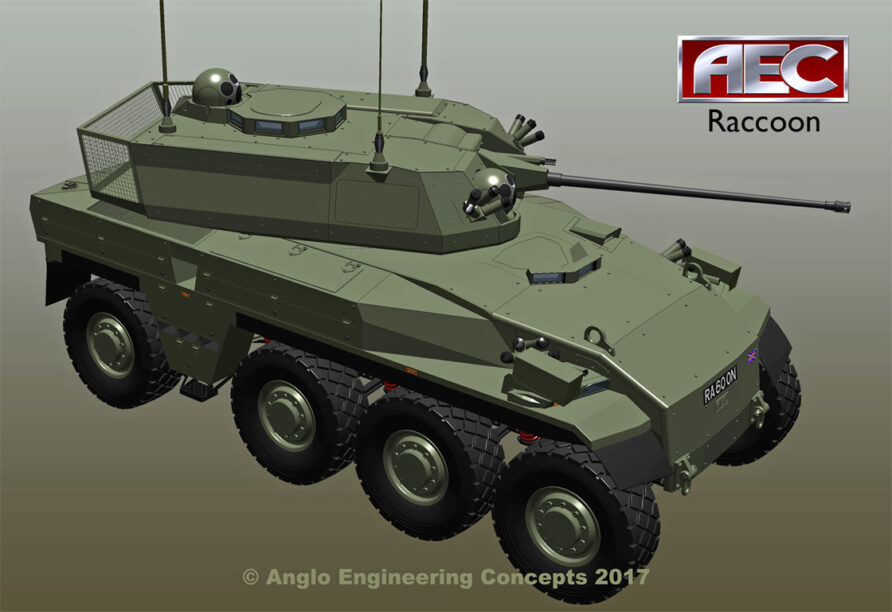
Design: Raccoon is still an 8×8, but now with a one-man turret.
To accommodate one man, the turret is physically larger and has a reduced number of missiles. And of course, it now has a basket that occupies much of the hull. The hull too needed redesign, with effort upon retaining some crew protection mechanisms employed in the earlier Ræcc hull. It grew a little taller, the turret moved further back.
It is not as compact as Ræcc, but one of the opportunities the redesign brought was the provision of protected missile stowage for two of each GW type, armoured both from the outside world and from the crew citadel within.
Anglo Engineering Rapier-C
Role: Reconnaissance Vehicle
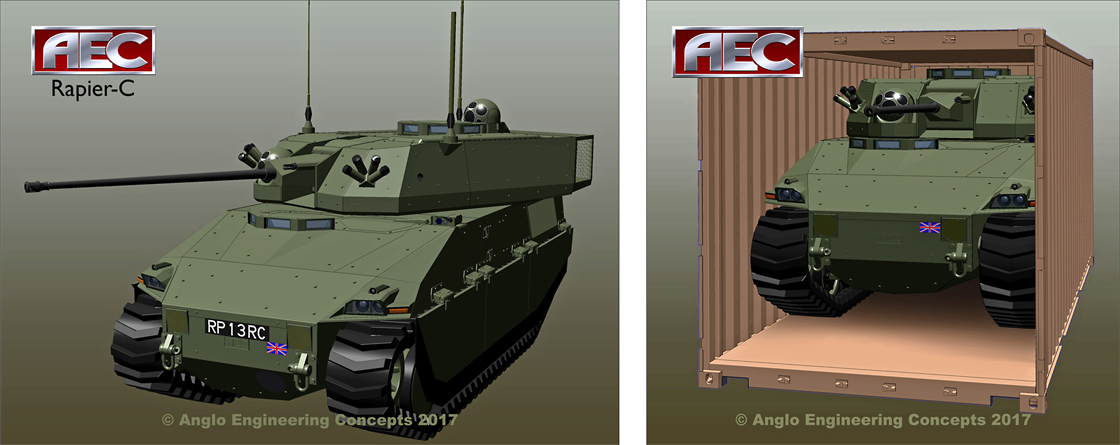
Design: The turret of Raccoon, complete with both natures of guided weapons, is still more compact than the Ajax and Warrior CSP turrets. The next task was to see how much smaller the tracked hull could get if this one-man turret was to be used.
The hull width was reduced as the basket is a smaller diameter; the L/C ratio that defines tracked vehicle steering behaviour allowed a shorter run of track on the ground as the vehicle was narrower, there was (just) enough room to get two crew, driver and gunner, side by side in the hull and room for the engine bay behind the turret basket.
This compact vehicle called Rapier-C ended up very nearly CVR(T) scale.
Rapier-C is a tracked vehicle as narrow as a Scimitar (if track guards are omitted) and a few per cent longer and taller, with a crew of three, and with CTA40, 7.62 coax, ATGW, Anti-Aircraft GW and an elevating sensor.
It has low ground pressure within 10% of that of a Scimitar and a very high power-to-weight ratio that provides astonishing performance. With the removal of track guards, antennas and the upper EO/IR sensor, it fits into an ISO container.
It is perhaps worth pausing here to compare and contrast with Ajax. Many will not have seen Ajax in the metal and will base an idea of scale upon photographs. Face to face, it really is imposingly large as are most new armoured vehicles, but for those who remember the compact dimensions of Scorpion/Scimitar/Sabre, this is a real step-change.
To help appreciate the size difference in absolute terms, the image below provides a comparison, Scimitar the blue-coloured vehicle is Rapier-C, and the pink outline is Ajax. Each to scale
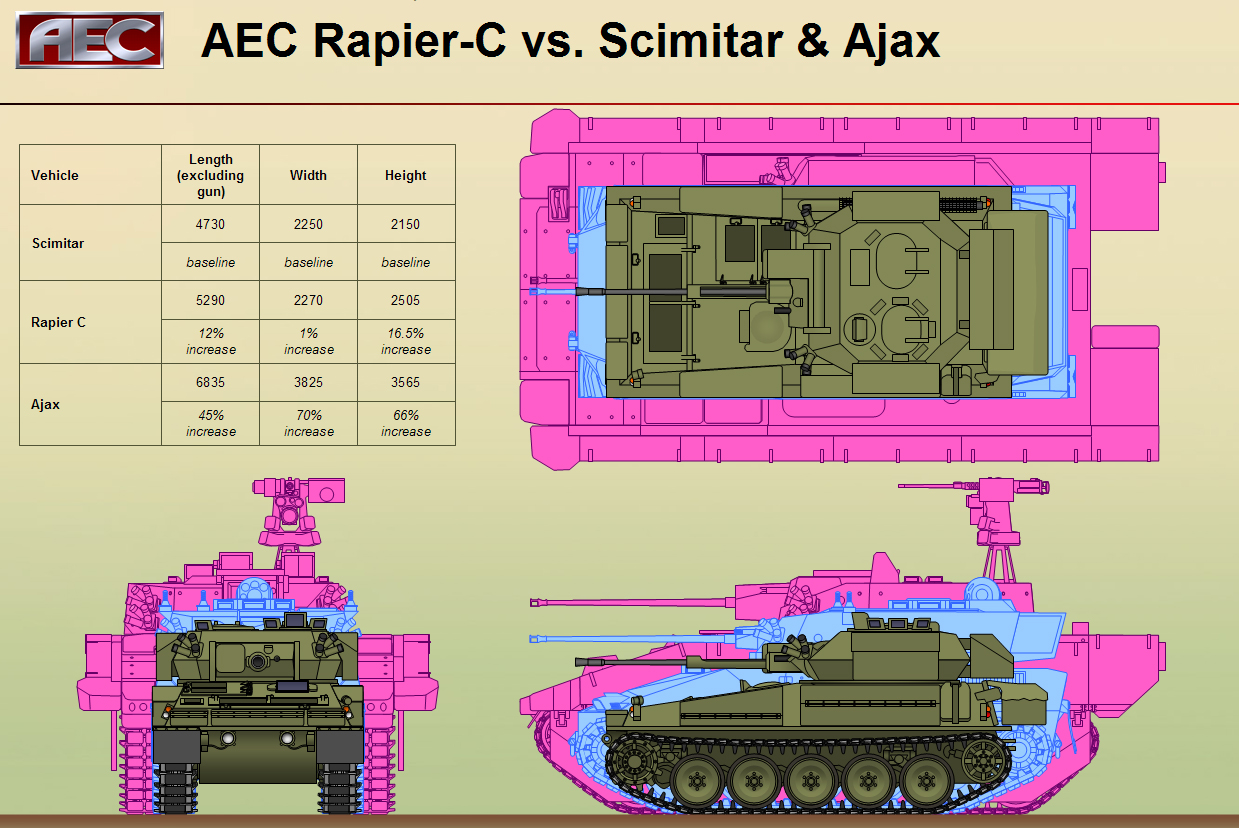
There is no doubt that once in service, Ajax will be a competent vehicle and there will be situations in which it will be the ideal fighting vehicle to use. Would these be situations where similarly armed, similar weight Warrior CSP couldn’t be used with similar success?
Or similarly, armed similar size and weight MIV? Or even Challenger 2 which is similar in width and height and has only 25% greater ground pressure under its tracks?
Possibly, possibly not, but it is a fair bet these other vehicles could be more readily substituted for a missing Ajax far better than an Ajax could be substituted for a missing Scimitar in situations ideally suited to the CVR(T) capability
Anglo Engineering Rapier-A
Role: Reconnaissance Vehicle
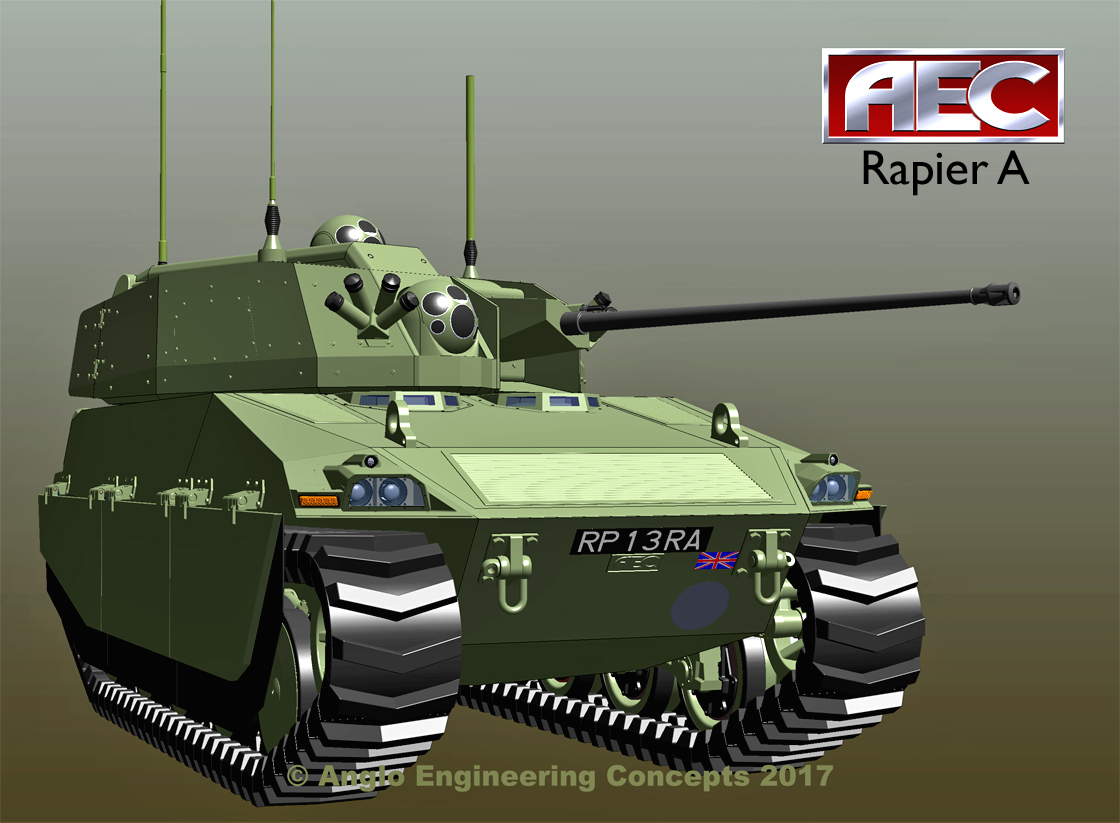
Design: A predecessor to Rapier-C, Rapier-A was a concept using the remote turret of Ræcc complete with CTA40, coax, SHORAD and ATGW and its elevating surveillance sensor, offering better personnel protection than Rapier-C in a smaller package yet, but at the expense of Mk1 eyeball direct vision – a proper VERDI-2 capability in a Scorpion sized vehicle – but currently shelved due to the User rejection of reliance upon remote electronic interaction with the outside world.
Anglo Engineering Raðe
Role: Fast Scout and Liaison
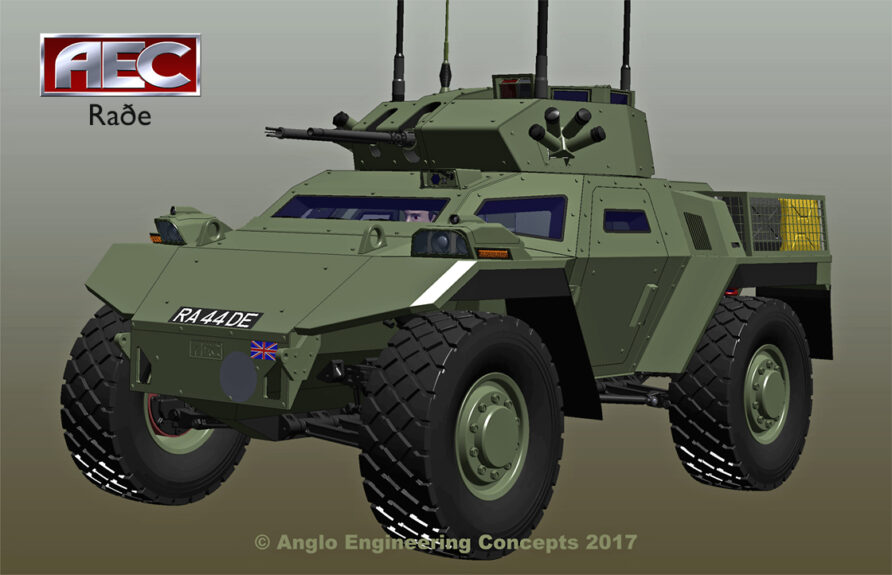
Design: Following the FCLV debacle and the continuing run of rumour and disquiet that Panther may not suit the role for which it was procured, and to see how compact a vehicle the standard wheeled driveline and suspension set-up would support, a vehicle similar to Ferret was constructed.
This was Raðe – a two or three-man vehicle, rear-engined. Originally penned to take the Thales (ex-Helio) FVT800 turret, it seems Thales has withdrawn this. So a similar turret fitted with .50 cal and a 7.62 mm chain gun was created. With the one-man turret, there is only room for the driver to sit ahead of the basket front & centre; with a remote weapon station, two personnel would easily be accommodated behind the driver.
Two axles hence 7t all-up mass, overall dimensions not dissimilar to CVR(T) but obviously with greater ground clearance.
For comparison, this is not of the Ferret scale. The reason is simple – there is no way a vehicle of Ferret size could accommodate two 97th percentile soldiers, let alone the three that this vehicle could accommodate. Raðe is similar in dimensions to the Coventry Armoured Car, and both wider and taller than CVR(W) Fox
Anglo Engineering Rǽs
Role: Civil Order Policing; Military Utility
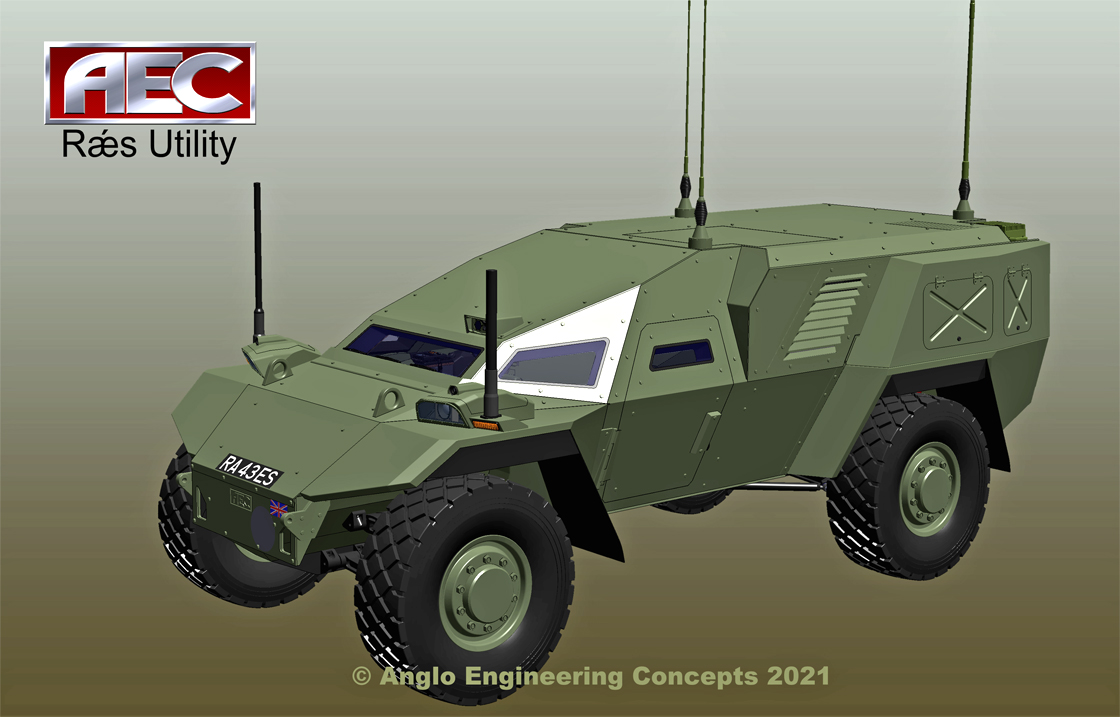
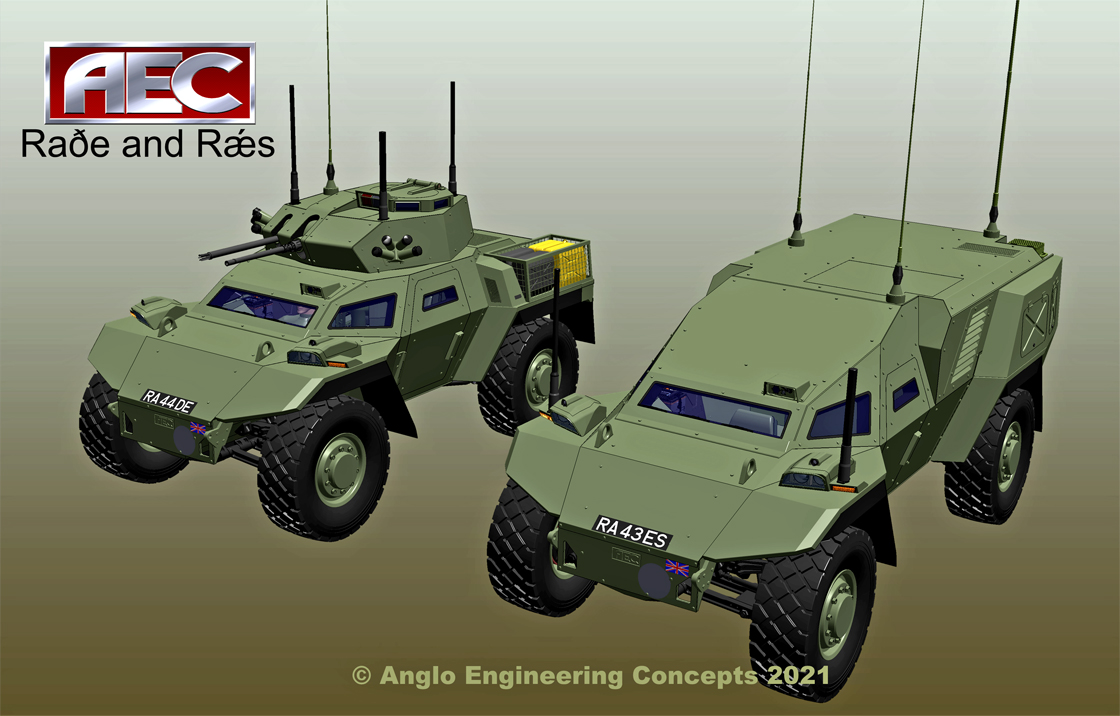
Design: Using Raðe as a starting point, a Utility Variant was drawn up called Rǽs. To create a usable rear access cargo compartment, the engine bay was moved to the side just in front of the rear wheel. The wheelbase had to extend to make the space, meaning this is the only wheeled vehicle that fails to meet defined HMLC criteria, due to break-over angle.
While the cargo space is limited, the vehicle retains the same armour protection as all other vehicles. The siting of the engine bay means there is no room for a turret basket, so RWS or a simple head-out machine gun would be the self-protection measures.
The vehicle was designed to adopt roles that FV1611 (Humber Pig) would have undertaken; riot control and civil order policing.
Anglo Engineering Ræcc-R
Role: Autonomous Engagement Capability; Armoured Car
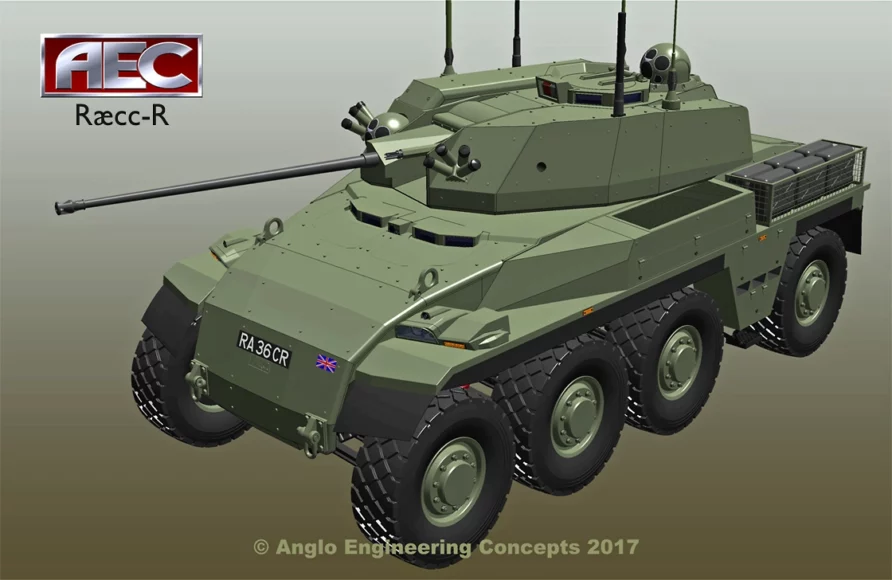
Design: At a briefing to British Army personnel new to the AEC concepts, it was suggested the mix of ATGW and anti-aircraft guided missiles on Raccoon was flawed, not because they were technically incompatible but because the level of training to get one crew competent on both missile types was unlikely to be provided.
Better to fit just ATGW and a gun, they said. Another redesign then.
Removing one of the missile systems allowed the turret profile to reduce back to that of the unmanned turret whilst still having room for the one crew member within. There followed an effort to redesign the first Ræcc hull to suit this smaller one-man turret, which has worked, although some benefits of the earlier design are lost, notably in relation to hull crew protection.
The result was a vehicle looking remarkably similar to Ræcc and using the same subsystems driveline etc, but having an entirely different internal configuration and hull structure.
This is called Ræcc-R, it represents a moderately compact armoured car the likes of which were common Army equipment until the 1970s, armed with the Army’s favourite medium calibre gun, CTA40, and ATGW.
Vehicle performance is on par with the typical Golf TDI.
Anglo Engineering Rapier-AC
Role: Reconnaissance Vehicle
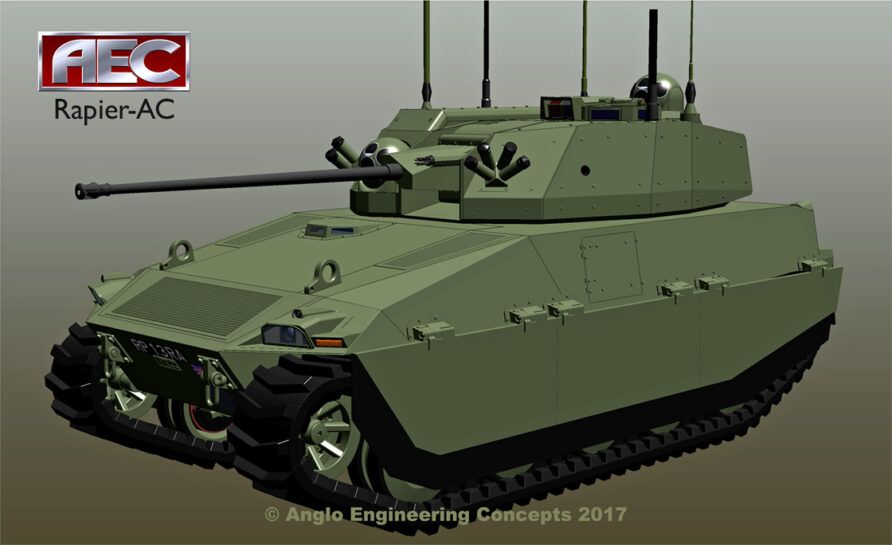
Design: The Ræcc-R turret (or a close derivative of it) offered itself as a way to revive the remote turret Rapier-A recce vehicle. Keeping to a vehicle crew of two, driver in the hull and vehicle commander either in the optionally manned turret or beside the driver, the vehicle remains as compact as the Rapier-A and maintains that vehicle’s crew protection advantages, but now, of course, allows the commander to operate head-out in the turret.
Use of this turret does, of course, mean the absence of anti-aircraft GW, but there remains the 40 mm CTA gun, the coax 7.62 mm chain gun and two ATGW in a conformal silo, as well as an elevating sensor.
A note about sensors here; the preference is to use spherical units as they maintain a constant silhouette as they pan and tilt, which helps reduce their detection.
But fully gyro-stabilised sensor balls are eye-wateringly expensive – each one way more than the cost of the base vehicle – so a more cost-effective adequate surveillance and targeting sensor solution has to be found.
Assuming an affordable optics solution is found, the vehicle design is sound. Still a work in progress, this is Rapier-AC
Anglo Engineering Ox
Role: Multi-Role Rapid Reaction
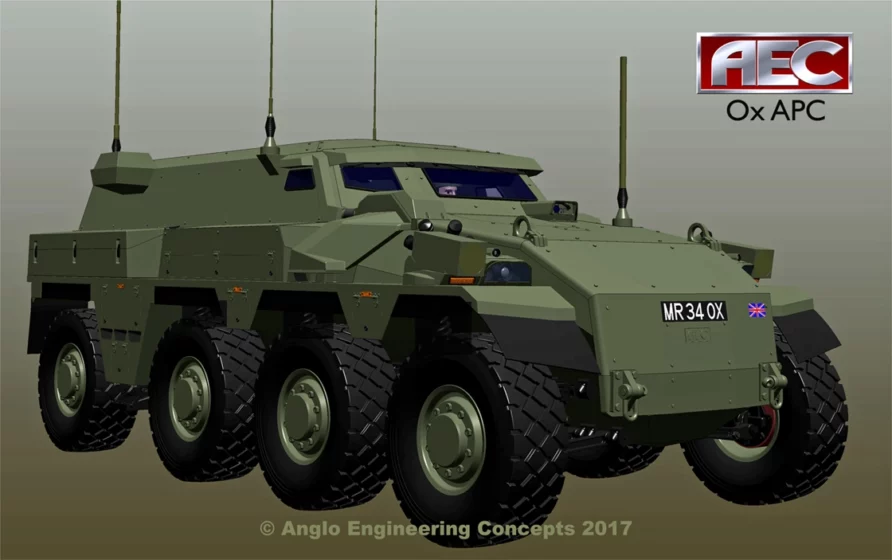
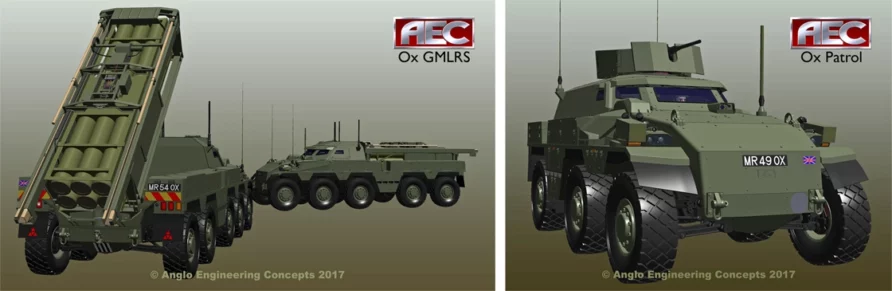
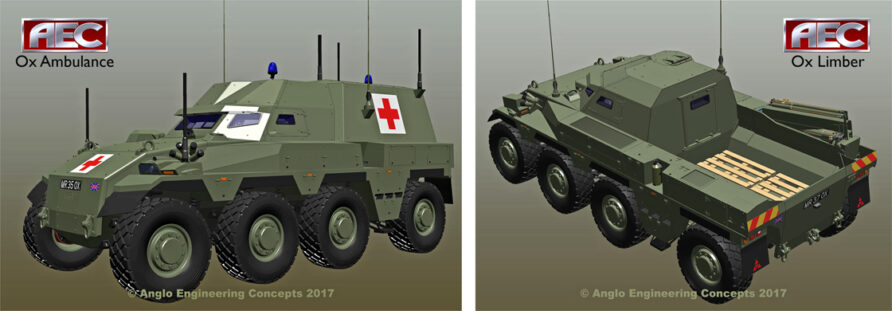
Design: This was the only vehicle in the set that was designed from the outset as a multirole concept based upon an automotive V-hull and a clearly defined and separate ‘mission module’ for the crew and the mission equipment.
However, this is not one vehicle structural design to which role equipment is bolted. Each role requires a separate design of mission module and to support the diverse needs of the role the V-hull may differ in length and number of axles.
The intent is that each vehicle would leave the factory already configured to the role, and that any reconfiguration to a different role would require a return to the factory or at least to third-line workshops.
The design of Ox owes much to FV603 Saracen, a fine design in concept if a little flawed in execution. Not surprisingly, when creating a wheeled V-hulled APC with an engine bay in the nose and crew compartment behind, the result looks like Saracen.
No bad thing; the design was well-considered. The V-hull holds a constant profile for the full length of the vehicle and is the structure upon which all the driveline is mounted.
The mission module sockets into this V-hull behind the engine bay and may take various forms, although each so far considered has a similar driver station.
The following graphic shows some options:
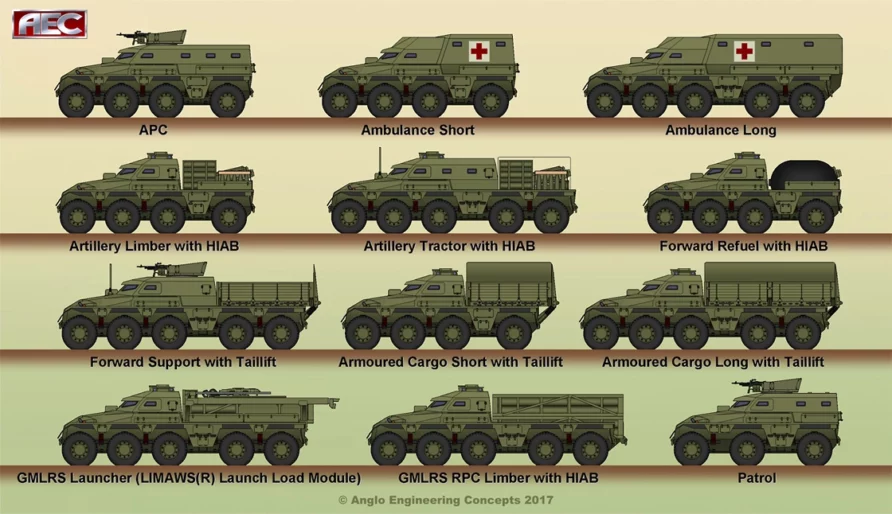
Several variants of the Ox family have been constructed within CAD, showing the variations in V-hull length, number of axles and variations in the mission module.
Anglo Engineering Raven-R
Role: Fast Light Armoured Fire Support
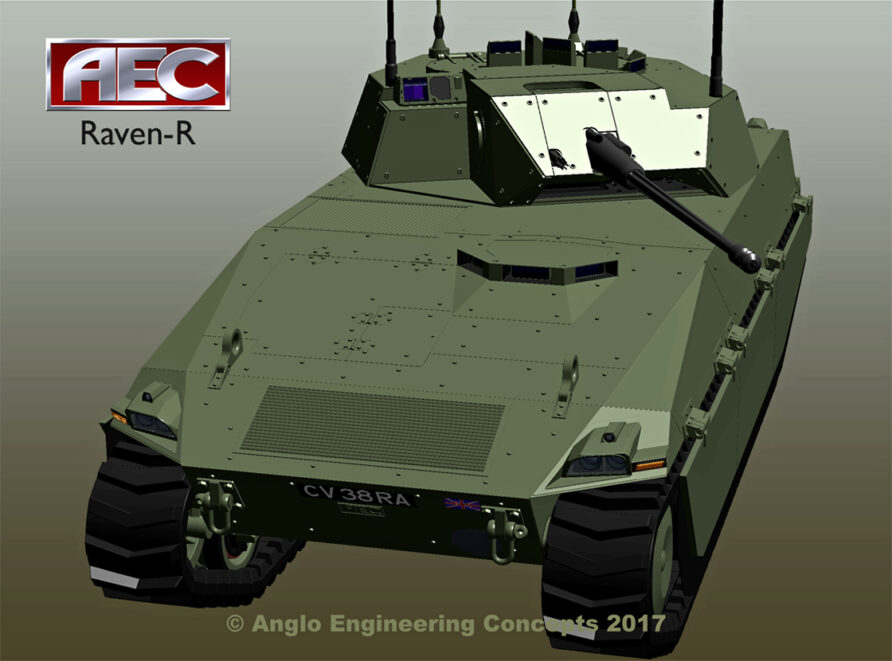
Design: Earlier this year, the Raven hull design was reviewed with the Rheinmetall Lance and Leonardo Hitfist 30P turrets; with these more compact units, the hull could be reconfigured, and some radical elements engineered out. This much more conventional, reworked design has been named Raven-R.
Apart from the obviously different turret, it has a forward engine bay besides the driver and a rear escape/resupply hatch, but otherwise shares the original Raven hull’s components, performance, and vehicle role.
What it loses is the unconventional crew protection advantage of the original Raven hull, but its entirely conventional layout would not raise any of the concerns voiced against the original design.
While the vehicle could be constructed at the same weight as Raven, it would be expected that extra blast protection measures would be demanded to offset the higher risk configuration. This would, of course, impact vehicle weight.
While the use of a turret not fitted with CTA40 may prevent UK MOD from considering the vehicle, the use of this hull with either Lockheed Martin UK turrets, Ajax or Warrior CSP, by current assessments is inappropriate due to the long forward overhang in front of the ring which pushes the turret axis far back down the hull.
There would also seem to be significant width of the turret to the right of the centreline in each of the Lockheed Martin designs, which makes fitment to these narrow vehicles far from ideal. It is possible the information available in the public domain is misleading, or indeed has been misunderstood, but until further information is published it seems wise to look at narrower turrets such as Lance or Hitfist.
Anglo Engineering Concepts — Large Calibre Turret Assessment
An obvious task is to look at the options for fitting turrets with larger calibre guns. Both Leonardo (ex-Oto Melara) and CMI/Cockerill have 105 mm or 120 mm turrets that are offered for OEM fitment.
A high-pressure gun option would be best, such that MBT armour might be challenged. Initial assessments suggest these off-the-shelf turret options have baskets that are too broad for either wheeled or tracked vehicles of this size; the rings are similarly broad but could be accommodated. It is a shame there are apparently no decent guns being made or marketed in the 60 mm to 75 mm range – such a calibre would suit vehicles of this size well.
But for this task, the turret from the BAE M8 Buford (designed by United Defense) has been assessed for its compatibility with AEC vehicle hulls. This is a 105 mm armed turret with an autoloader, but unlike most of the similarly armed turrets available from the likes of Leonardo or CMI/Cockerill, the autoloader is not mounted in a turret bustle.
In the case of M8, it is a very compact unit nestled below the breech. What this means is that the turret armour is compact and ideally suited to small vehicles with limited hull roof plate real estate. This should be no surprise, as the M8 Buford is itself a small vehicle.
In the large calibre turret marketplace, most turrets are designed for hulls larger than the AEC vehicles. Unusually, the M8 turret was designed to suit a vehicle specifically designed for C-130 transportability; a next-generation Sheridan. It was this design constraint that made the M8 turret the ideal candidate for assessment for its compatibility with the AEC hulls.
The Buford hull and that of Raven-R have a similar width between the tracks. The basket would fit neatly. The depth of the internal volume in Raven-R is greater than that of the very compact M8, but for reasons of internal configuration, the Raven-R roof plate cannot be lowered. However, the same limitations do not apply to the original Raven hull; more of that later.
Looking at the autoloader operation, it would seem most likely to be operated hydraulically. The current Raven hulls are not equipped with hydraulic packs, so this would be a further design update.
But for the basic question “does the turret fit?” the answer is a clear yes.
The size of the turret is illustrated by comparison with the Hitfist 30 mm turret that Raven-R was designed to carry. Big, but not outlandish.
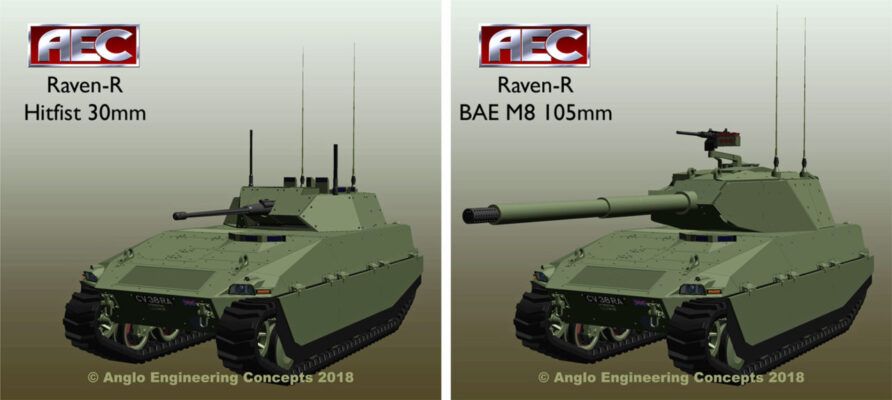
The same turret has been assessed against Raccoon and Ræcc, with the expectation that their steeply sloping hull sides would not allow the M8 turret’s basket to fit. Given the autoloader configuration, it would seem highly unlikely the turret basket, could be reworked to a smaller diameter.
However, the interference in each case is minimal – maybe a 20 mm radius reduction at the basket floor for Raccoon and a 50 mm reduction of floor radius for Ræcc due to its lower hull roof plate – suggesting that it would be possible to engineer a fit.
The hull roof plates of the wheeled vehicles are narrower than on the Raven hulls, which may cause rework if the M8 turret ring is as broad as the armour structure suggests. But again, such changes are possible.
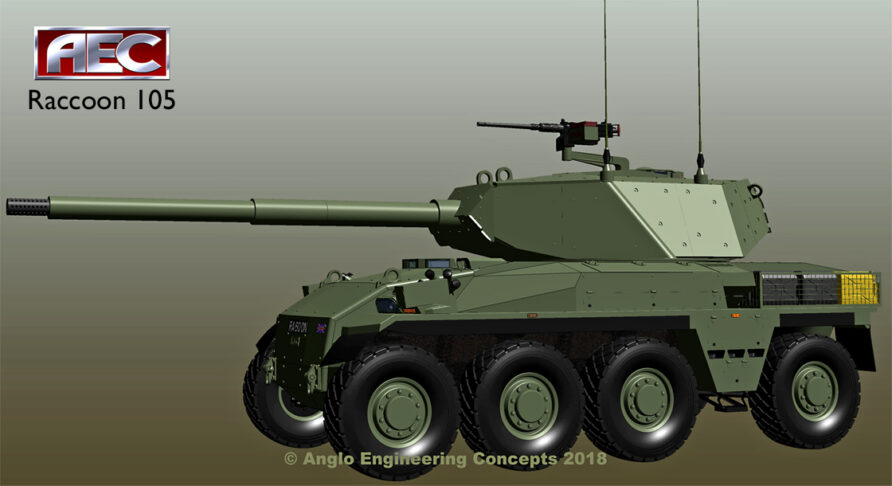
It can be seen that the turret looks larger than the hulls would be expected to carry, despite its compact arrangement. However, even on the taller Raccoon hull, the height of the cupola hatch is within the 9ft (2.74 m) C-130 gauge (just).
Turret weight may be more than desired too, although the complete M8 Buford vehicle was designed for C-130 transport, which suggests the weight of the turret may not be seriously greater than the one-man 40CTA turret that Raccoon was designed to have.
Using the Ræcc hull reduces overall height marginally and moves the turret axis forward nearer to the vehicle midpoint.
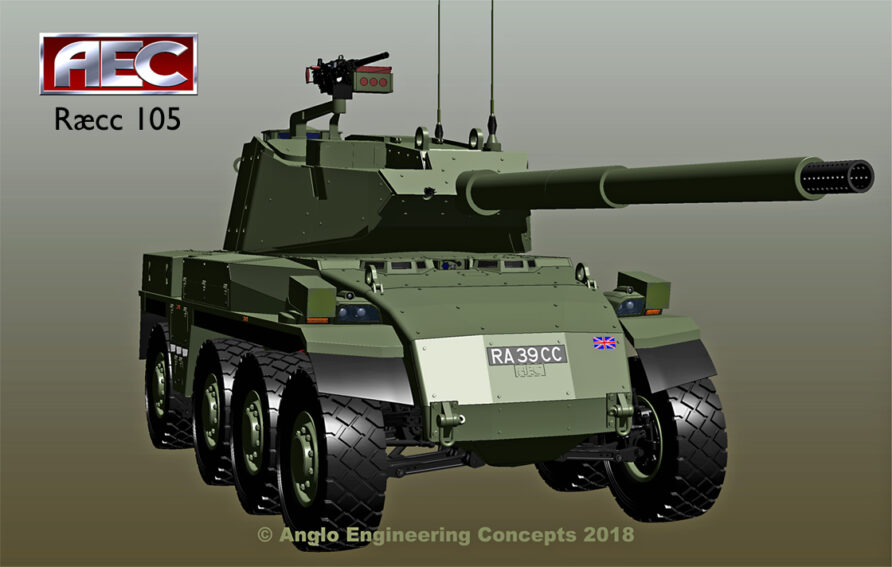
The barrel overhang may be an operational irritation, particularly as there would appear to be fairly limited elevation, so running fast over rugged terrain may prove a risky business. But this would be no different to many large calibre AFVs. Indeed, the issue may be more pronounced on the M8 Buford itself, where the turret is mounted on a lower hull but with just as much forward overhang.
This would also apply to the lower profile Raven hull.
So. Back to the original Raven hull reworked for a lower roof plate, named Raven-F. This is to reduce the hull height under the turret ring, which would make for a more stable platform. On the downside, the turret ring is further forward than in Raven-R, extending the barrel’s overhang. But this option does make a better-balanced solution, in proportions that have since the arrival of Centurion been considered the norm for main battle tanks.
Except in this case the vehicle is smaller and because of that, lighter – rough estimate only, but of the order of 16 or 17t. From muzzle to rump it is 8.7m, from ground to cupola it is 2.45m and to turret ring is just 1.435m.
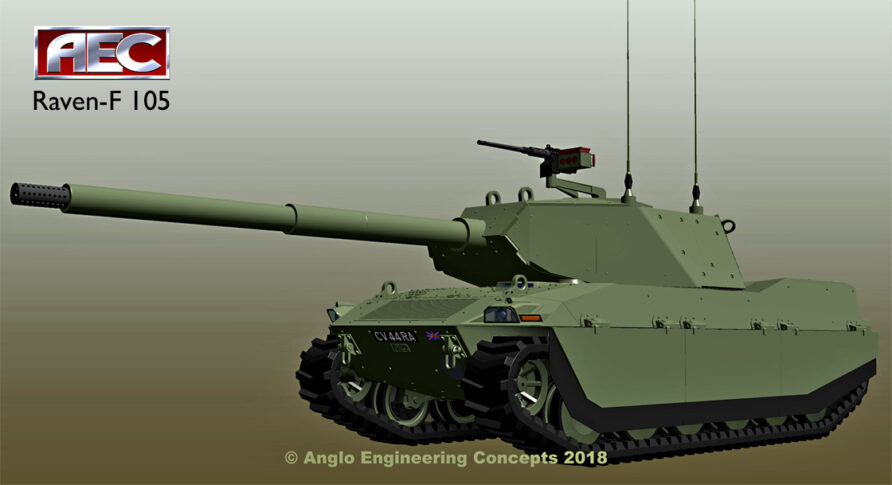
It is little more than the length of Challenger 2’s hull alone; it is just 200 mm longer and 100 mm taller than the unarmed Boxer, and 200 mm narrower. It is also 200 mm shorter and 100 mm lower than the M8 Buford AGS that the turret was designed for, and with a better power-to-weight ratio too.
The obvious question that would be asked is, “Why not just buy the M8 Buford vehicle as it is?” Indeed, if the need was just to buy a tracked 105 mm easily deployable AFV, it would make sense to buy COTS.
But if a 105 mm direct fire capability was desired as just one part of a wider fleet of diverse capabilities, especially if tracked and wheeled were both required, then these AEC hull options make sense.
The commonality is a great advantage.
The OEM option turrets have not been discounted as possibilities and given time and more information than the public domain has to offer, their suitability could be determined. But the apparently comfortable fit of the M8 105 mm turret illustrates such firepower is entirely possible on these compact, high-mobility vehicles.
Anglo Engineering Family Values
Every one of the above vehicles remains within the C-130 gauge for air transport; everyone fits within the UK’s most restrictive W6 rail gauge (for some of the taller vehicles that require the use of Warwell wagons but many could sit on typical flat container wagons).
The 4×4 scout Raðe, the utility Rǽs and each of the Rapier recce vehicles could be moved inside 20ft ISO containers with minimal preparation. These are designed to be easy to deploy in numbers wherever they are needed. Tracked vehicle ground pressure is just 10% higher than CVR(T) at its initial 9t Gross Vehicle Weight, 60% of that of Warrior and 40% of Challenger 2.
Tracked vehicle acceleration would leave most GTIs behind and wheeled vehicle acceleration matches typical family cars, this performance is a result of ensuring enough torque to sustain speed on a 40⁰ climb gradient if ever wheels or track could keep traction. High levels of redundancy within the driveline would offer resilience against damage or component failure.
They are not the world’s most protected armour; they would undoubtedly need to be fitted with RPG protection (Tarian nets would be favourite) and would benefit from being fitted with ABBS VGAM blast protection system; they are not spacious; the turreted vehicles are not armed with 120 mm MBT guns.
Being armoured they are not as light as soft-skinned vehicles and transport under CH-47 would be a challenge for most and impossible for the larger types, but then compromises must be made.
These are simply nimble, small, highly mobile, and reasonably well-protected useful vehicles.
Underlying all the designs is a firm principle to engineering the different vehicle types from common components – common engines and drive systems, common air filtration systems, common instrumentation and controls, for the wheeled vehicles, common suspension, steering, wheels and tyres, for the tracked vehicles common suspension, idlers, road wheels and track-type – with a sharp focus on simple affordability.
Rather than designing a single complex all-encompassing multirole vehicle, individual simpler designs focused on their prime role have been created, but each is based upon the same subsystems and components resulting in very high commonality to ease support burden.
As each vehicle type is freed from the burden of meeting the needs of many roles, they become more compact, lighter, and affordable.
Affordability improves if more types are brought into service as the common support brings benefits in maintenance training, spare inventory, diagnostic aids, and even maintainer currency.
This can perhaps best be illustrated by repeating the earlier graphic of the breadth of UK armour, this time with the above-described AEC vehicles replacing current incumbents:
The shading behind the vehicles shows common support. Consider what such broad common support means; much more accurate spare scaling, streamlined maintainer training, and much-improved maintainer currency, leading to greater maintenance efficiency, lower maintenance cost, and greater vehicle availability. Common support makes sense.
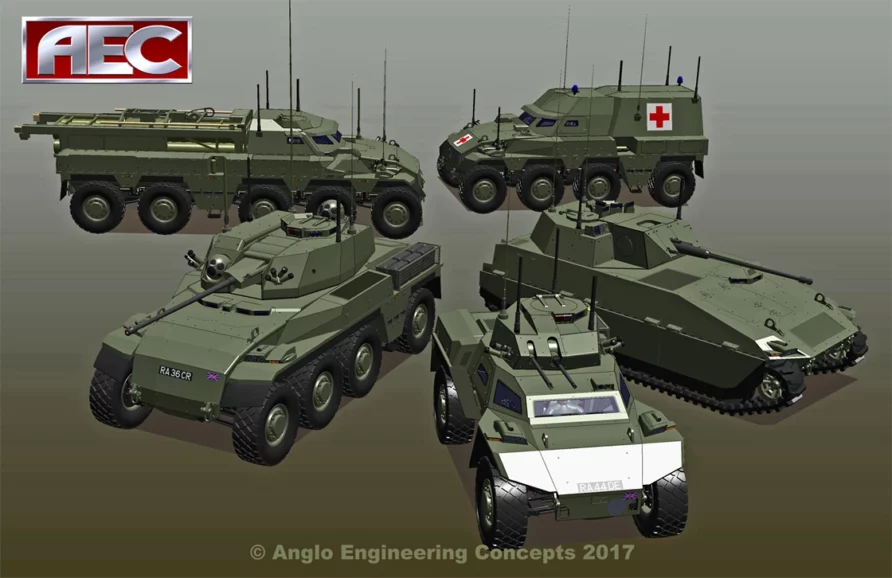
One family of many forms, large and small, tracked and wheeled, this is the sort of joined-up thinking the Army and the MOD needs.
These designs are by no means the limit of possibilities. Given current technology, assume a wheeled vehicle maximum weight of 17t or so, for tracked vehicles that may be increased to somewhere near 28t. This is due to driveline capability, the lower maximum weight for wheeled vehicles down to the larger diameter of wheel/tyre which demands greater torque to achieve acceptable performance.
Note though that the designs undertaken for tracked vehicles have been substantially less than 20t, mostly because this is where the projected UK capability is weak but also because of the self-imposed C-130 transportability constraint. There is no reason why lighter heliportable vehicles could not be designed, as long as lower protection was accepted.
There are challenges not yet met for an amphibious operation, articulation, integration of major hydraulic powered systems (cranes, diggers, winches, lifts) and high recoil force systems (large bore mortar, SP gun), but there are no fundamental reasons why these should be more difficult than in any other armoured vehicle design.
An Echo from the Past
Before Ajax, FRES. MRAV and TRACER, there was the Future Family of Light Armoured Vehicles, FFLAV. Here is what the Alvis team offered for FFLAV:
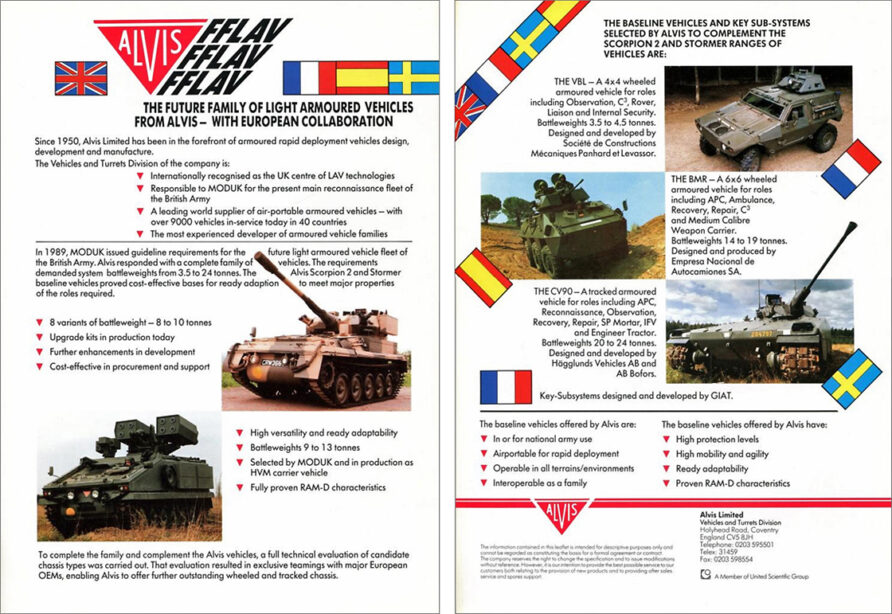
One view of this offering is to see it in the light of where the British Army is now. In place of VBL, the UK has Panther FCLV. In place of CV90, we have Ajax, remembering, of course, CV90 was the other FRES-SV contender. In place of BMR, we will have MIV.
Was FFLAV visionary? Well, probably not, but it was blindingly obvious good honest robust common sense. So blindingly obvious that thirty years down the line, the original FFLAV solution is roughly what the Army has selected.
There are differences, though. Ajax, as delivered, is far heavier than the 1990 FFLAV version of CV90. MIV is likely to be far heavier and bigger than BMR. And of course, where the FFLAV proposal focused on upgraded and developed CVR(T) and Stormer vehicles, these are now due to retire from UK service.
Taking an alternative view, compare the FFLAV offerings to the AEC family described in the text above. VBL roles are covered by Raðe scout and Rǽs utility. BMR is covered in the same weight range by the various versions of Ox.
Stormer and Rǽde APCs are direct equivalents. Scorpion is matched by Rapier. And while CV90 is heavier than the Raven concepts, there is no technical reason why the Raven driveline couldn’t be used on tracked vehicles up to 28t. And in addition to covering the FFLAV bases there are also the Ræcc and Raccoon armoured cars, and Ram assault gun, and providing driveline technology develops there is the Rival armoured logistics truck too.
And there is VERDI-2 envisioned capability in Ræcc Raccoon and Rapier. And the design approach could deliver many more types of light armour for additional roles too.
The AEC family of armoured vehicles aligns exceptionally well with the FFLAV vision. Except for the one attribute that FFLAV couldn’t deliver – common support throughout the entire range.
Options for Advancing the Anglo Engineering Project
The original design, Raven, was first briefed to the appropriate MOD desk officer late in 2010. Several other briefings have been made since as the text above notes, and the designs have been changed where advice from Users was offered.
The most challenging aspect has been the MoD’s procurement process. Although the MoD has several initiatives in certain product sectors for SME engagement, major vehicle projects tend to be placed only with larger and established companies.
It was suggested at one briefing by a DSTL engineer that would be a good idea to generate a prototype of one of the AEC vehicles to test the concepts, with a view to jointly creating a DSL-owned design for the industry to bid to build (very much as Establishments worked) but he failed to convince his colleagues.
The UK still has a broad spectrum of excellent companies, each expert in their domains, despite the low-volume market for military equipment.
And at all levels too, from stock materials through welding, casting, forging, moulding and fabrication, on through component manufacturers and integrators of specific military systems, to platform level assembly and integration plans to vehicle designers and manufacturers, to complete military product suppliers such as the various divisions of BAE.
The UK has all of this onshore, and it would be perfectly feasible to complete the process through to manufacturing within the UK.
What this means is that there is a broad range of opportunities in how to turn the AEC designs into fielded combat equipment. The following options are, of course, predicated on the Authority and the Army deciding they want this sort of capability.
- Government buys the designs outright and either completes the development of the designs in-house and raises a competitive procurement for primes or manufacturers to bid for the production contract, or raises a competitive procurement for a development and production contract. This would be similar to the process used on Establishment-designed products. The Government has purchased the designs, owns the IP and may change production suppliers as needed. The support contract need not rest with the manufacturer and might be competed separately. This gives the Authority the greatest contractual freedom over the course of the equipment service life.
- Government sets up a collaborative design team, containing Authority, Government scientists, and Army and Industry personnel, all performing tasks necessary for the designs to reach maturity. Somewhat similar to recreating the Establishment’s function, except with the use of Industry players in completing the designs, the IP would need to be shared or purchased. If the latter, this would need declaring at the start of the project so that contributing businesses knew from the outset that whatever they embody in the design would cease to be their IP at the end.
- Industry adopts the designs either by collaborative development or simply by the purchase of the designs by a company of the stature the Authority is prepared to contract, thereafter developing the designs under its R&D budget. The resulting vehicles would be COTS for future competitive procurements; should the Authority choose to buy them, the IP would remain firmly within the company’s ownership.
Each of these options has advantages and disadvantages, but it is probably fair to say the preferred MoD method of standard Competitive Procurement adds significant bid and compliance costs, takes the longest and puts the greatest distance between User and Designer, often allowing User input into the design only at formal infrequent reviews and measuring every User suggested improvement against the contracted Requirement.
It also almost guarantees no commonality either to in-service material or to other projects in the procurement cycle.
It is hoped that reforms at DE&S may provide some future flexibility that reduces bid costs and allows a more integrated and collaborative approach.
A shorter concept to ‘out of service’ cycles would also have significant competitive and industrial advantages
Summary
The AEC concept vehicles described above have all been designed using current technology and were deliberately designed to be as affordable as the technology allows. The Army could benefit from an increase in inventory – more tools in the toolbox – so designing the most affordable solution is in the MoD’s interest.
As such, they would be ideal candidates for streamlined low-cost procurement, where the simple adequacy of the vehicles would be matched by a simple and adequate acquisition process based on free open communication and common teamwork.
It could be revolutionary.
Change Status
| Change Date | Change Record |
| 01/10/2017 | Initial issue |
| 22/07/2021 | Format refresh |
| 20/11/2022 | Minor corrections and updates |

I agree Mike its a poor situation. We used to have a positive relationship between designers industry and the MOD/War Dept/Admiralty etc. MOD has chosen only to deal with big companies, the corporations that do very well out of this arrangement push small independents aside (or take their ideas) to protect their domain dominance. Even the organisation MOD set up to capitalise on SME innovation (was called the Centre for Design Excellence – CDE – but I think is now branded Innovate UK) was hugely dismissive of SME effort, and massively patronising towards those who had put their own cash on the line to create new ideas for the military. I think it shows – the MOD has precisely the projects it deserves, and has only itself to blame for that.
So these have been in design since 2009, are positively received, but nothing has come out of it and there are no plans to build even a prototype? What is the point then, I will never understand the MoD.
Although a great idea on paper I do wonder how willing companies would be to give up their Intellectual Property.
When the design for Ox started, it being the only specifically multi role platform in the set, such separate mission module/chassis configuration was considered. It took up a lot of space, made protection and structural integrity more difficult, and added both bulk and weight. The penalties imposed just to have a vehicle that could be separated into two parts were significant. As an example, an integrated design of vehicle might fit in C-130 where the same capability but as separate chassis & mission module with the same internal volume may be too large to fit C-130 when bolted together, so needing to be split for transport. The choice was made to keep the design completely modular but to create optimised integrated vehicles from them, as small size and light weight were the main drivers behind the family.
Umm I have had this thought for "sometime" & that would be for a ten-ton platform & an eight-ton module like a very small boxer. keep the Alvis dimensions but break your designs down to the above. That way you create a common design, but you can then be creative on what that design can do eg height & weight can be split for Air transportation. At 18-ton much lighter than most Military vehicles & therefore can go places that our future 36/40 tonners can now. Think forests in the high north though snow & ice, because I think that that's where we are potentially playing next. Kind regards Peter
Anglo Engineering has the best website ever 😍
Nothing to prevent such trailers being hauled by the AEC vehicles,but there are no trailer concepts as yet within the vehicle family, and to be truthful simple towed trailers would not be high priorities for design.
wanted to see if there is an concept of trailer for watertank and kitchen
Many companies have been briefed and invited to engage. Defence players small and large, automotive businesses, plant manufacturers. The story is the same in each case; the concept is sound, the design looks robust, the need for such a class of platforms exists, but…
In most cases the ‘but’ relates to a lack of formal requirement, without which all these businesses know investment will never turn into sales. Some of the businesses though are just scarred by previous attempts to work with MOD; one major player offered a smart idea based on an existing product, gained MOD interest, triggered an MOD project for the idea, was given a long list of capability enhancements and detail requirements to meet, put in a lot of engineering prototyping testing and productionising effort to create exactly the machine MOD demanded, only to see the MOD cancel the project because it now cost too much.
Take a look at a successful defence company – Rheinmetall for example – and what you notice is a ridiculously slow development cycle. Decades to create a new design. Some of this time is down to complexity of the product, but far more is a result of procurement process. Imagine if the defence business produced new designs every three years, which it could if it had the cash and the workforce, and imagine what this would do to procuring organisations – they’d never buy anything because before they’d even assessed the response to the first ITT there would be a newer improved product making the proposed solution obsolete. So the defence business would sell precisely nothing, and would have massive development costs to cover for no benefit whatsoever. The only chance of making a sale is to make sure the product remains the ‘newest and best’ for the duration of the procurement cycle. Once there has been one sale, the same product has a higher reputation so is marketed hard into other militaries, holding off new product launches while there’s a chance to make a bit more profit from the current product’s development. The whole industry has been ground to a halt by disastrous procurement process. Meanwhile our potential adversaries are busy buying latest kit and investing in defence R&D to make sure their latest kit is modern and as effective as technology can make it.
The defence industry here is slow and lack-lustre because it is required to be so. Businesses outside the defence bubble know this, and engage in defence work only when there’s a good chance of selling (rare) or if they believe there’s export potential -subject to ECO rules which bring their own set of restrictions into play. JCB is a brilliant company with strong commercial sales, and has modified some of its products for military purposes, but it well knows designing platforms specifically for defence use would cause it years or even decades of product development and proving that would most likely end up not being bought, or if bought then in far smaller quantities than the MOD promised up front. Its just not worth their effort.
Heres a suggestion – forget trying to convince the MOD – convince an OEM and let them pitch it to the MOD.
I’d suggest JCB. Already an MOD supplier, huge industrial footprint, strong political influence. Don’t mess around with DES middle management – send this straight to Lord Bamford, it’s too good to waste.
Michael – its not just the AEC offering that can’t make headway. To a degree the difficulty faced by UK manufacturers is one of market capacity; since the 60s the UK’s Armed Forces have shrunk back enormously and so has the budget that supports them. But a significant part is that the investment in defence engineering for which the UK was once proudly at the forefront was brutally switched off in the 80s. The Establishments were sold off, on principle ostensibly but in reality more likely just as a cash saving measure. Industry would just have to invest if it wanted a slice of the lucrative defence market, the government said.
But as I’ve noted many times over, industry is not a charity and unless there is realistic and probable return on investment, it will not invest. Most of the UK defence sector decided there was insufficient market to make a profit and there followed masses of take-overs and sell-offs that reduced that sector’s capacity at a rapid rate. At the same time, the government discovered that their bright plan to get UK businesses to pay for all the expected defence materiel R&D had backfired and that far from getting a wide choice of developed products to choose from, the defence companies started to offer old designs with minimal upgrades that just met requirements.
The move to buying from abroad (almost unthinkable from the end of the war until the 70s) was pretty well forced on MOD as there was so little that was up to date being offered domestically. And the foreign stuff was generally seen to be more advanced and effective – nothing to do with their nation’s government funded development of course. So we buy now from abroad because of UK government short-sightedness. And despite the unpopular nature of arms sales, until HMG stopped investing in defence R&D, the UK defence exports made a significant contribution to the Balance of Payments. That R&D cash that was saved has been hugely expensive for the national prosperity. No doubt those involved in the Whitehall bubble would have a raft of explanations excuses and dismissive statements justifying their astonishing good sense and far-sightedness, but then they would wouldn’t they.
A few stalwart companies try hard to buck the system. For the longest time Westlands tried to survive on defence contracts, even then they needed to share development with other companies or lightly modify Sikorsky and Hughes/McDAC/Boeing designs, but they too have quietly gone, now the British arm of Leonardo’s helicopter division. Supacat is still fighting manfully, but its sales are stronger abroad than in the UK and I would not be surprised if they too move the company to more profitable shores. BAE is stronger in the US than the UK. I am struggling to think of any UK defence business making most of its profit from UK defence contracts.
Last year it was reported that the UK spent more on festive food purchases in the four weeks leading up to Christmas than MOD’s total annual spend. Tescos buying power dwarfs that of the MOD procurement branch. In the big scheme of things, MOD is no longer the huge and mighty buying organisation it once was, although their attitude shows they believe they still are. There’s just no surprise there is so little life left in the defence industrial sector.
Chris I am sorry to here that. I have just read TD’s article on the MRV-P. I had not realised that there could potentially be another 3 separate vehicle types added to the fleet. Insanity. People can argue forever about vehicle weight class and protection levels but with commonality there is no argument. The advantages are obvious. I was hoping the MDP would be inspired and influenced by some of the ideas put forward by people such as yourself and TD (probably foolish of me). For a while there did seem like a genuine effort from the government to boost British manufacturing too but it looks like foreign designed vehicles and British assembly lines for now. I hope things change in future and funding for smaller companies is made available to at least prove the credibility of there concepts. I wish you luck.
Michael – thanks for the vote of support. Sadly there’s nothing to report. Many see the sense in both the size & weight of the concepts and in the common support approach but the customer set refuse to engage at any level. No doubt the same situation has played out with dozens of businesses in the past each spending their own cash on really useful ideas and ultimately giving up for being ignored – you have to wonder if this is why the UK defence sector has withered to such a degree.
Hello Chris, I am not sure if comments are still being read but I thought I should leave a comment of support. I often refer back to this article while thinking over various vehicle issues. Like most people here I have my own ideas for what the future should hold regarding military vehicles. Your article aligned with and inspired my own ideas. Unfortunately as the lay man I do not have the skills, experience or general ability to do anything about it. Do you have any updates about this project moving forward?
JH – sorry that’s a no from me. Although when you look at the likes of silver-steel, chrome-moly or chrome-vanadium steels (typically used for modern hand tools) you note the corrosion is far less than a simple hardened steel would suffer. There must be hundreds of metal combinations and an infinite spread of mixing proportions, any one of which might be uniquely brilliant in specific properties.
However, a note of caution is perhaps wise. The old CVR(T) original build used a high current cable called Unipren. This was a very flexible battery cable that would easily wrap in loops around your finger. Inside were a very large number of small gauge copper conductors, outside was a robust thick sheath of neoprene. When it was new it was brilliant. But within a few short years, of the order of seven, the neoprene went from astonishingly robust and flexible to something more like dried-out putty. Any attempt to bend the cable’s set shape caused the sheath to split and crumble. The one saving grace was that the set sheath was quite rigid and took some effort to bend, meaning the cable remained safe in most situations. Aged neoprene extrusions or moulded parts are a nightmare. However for those specifying the material who only saw it fresh and new it must have looked like a wonder-material.
Sometimes its worth seeing what a few years does to material before rushing to use it everywhere. Just to be sure its not going to be a litigation issue in a decade or two.
Five/ten? years ago, I read about someone who was trying to bring back a “mistake”. A century ago, when they were trying to develop stainless steel, there were many attempts before success. Then in the last decade, someone spotted that one of these failures, would give you most of the benefits of stainless steel, but for a fraction of the cost & much easier to scale up. Talk of cars being made with it. I never heard anything since. Anyone know more?
Think it was also called galvanic corrosion or bi-metal corrosion.
The ‘layered armour’ concept was common in the past was it not? It was IIRC called ‘laminated armour’ and there were rumors going around that it was particularly vulnerable to your HESH rounds since it caused the inner-most layer to spall off into the crew cabins. It kind of died off with modern composite armour though it was less ‘died off’ but rather ‘incorporated into’, especially with the addition of spall liners.
mr.fred – like the butt weld pun… Aluminium welding is not all that difficult these days with ‘new’ gas shielded welding techniques developed in the 70s & 80s, allied to an understanding of the effects of welding upon materials structure and the stresses welding introduces. By the time I left Alvis they had processes in place that pretty much guaranteed reliable strong and durable welded aluminium structures, having had some bad experiences in their early attempts of such construction. CVR(T) for example is quite old now and as far as I know they are not all under the welder constantly to stop the joints unzipping.
But (no pun intended there) it does raise an allied question. Those of us who bought cars in the 70s and 80s before corrosion proofing was a thing will recall how putting steel and other metals together created corrosion nightmares in months due to what was described as electrolytic reaction. The technical term may have changed since. So how long would a steel/aluminium sandwich with what looks like a rigid metal-to-metal dovetail junction last in the real world of vehicles? How long before salty water seeps into the sandwich under capillary action? How many years before the joint is blown apart by swelling corrosion? Its not perhaps a question that can be answered now, but until defence materiel is bought and replaced as regularly as is civilian commercial kit, we need to worry about the state of robustness of structures when they are half a century old.
More likely, they are looking at using formed steel in the joints to reinforce them, since aluminium is a pain in the butt to weld.
JH yes I saw the dovetailing article although I missed the point that it was intended to make armour. Not sure how effective that would be. As a structural material encasing a steel armature in aluminium has merit – the aluminium used as a stiffener to keep the steel from buckling so that it keeps its optimum strength shape – but for armour I expect the outer layer to be hard and brittle to disrupt projectiles and the core matrix behind to be malleable ductile stuff to absorb energy without penetration. Maybe that’s simplistic.
Good job there are experts in this world who really know about this sort of stuff.
theengineer website has another item on armour. This time it is a new method of dovetailing a layer of steel in the middle of aluminium. The idea is to have a lightweight aluminium armoured vehicle, that is given extra protection by having a layer of steel.
On the topic of commonality, which seems eminently sensible, I see KMW are offering both MLRS and their automated 155mm gun based upon a modified ASCOD chassis. With the army’s systems in need of replacement soon, they would seem like a very good option – ASCOD of course, being the base vehicle for AJax etc. Just a thought.
https://www.theengineer.co.uk/composite-metal-foam-cmf-armour/
Stopping 23mm shell fragments from half a metre away isn’t particularly impressive, and 5083 alloy is old.
JH – one to watch; always good to have lighter weight armour especially if its not horrendously expensive exotic materials. Considering who funded the research there will be ITAR limitations on its use. UK may have gifted Chobham (Dorchester) to the US but I’m none too sure the US would be so open in return.
Alf – a fact I didn’t know, and a quote to store away for further use, thanks. Every day a learning day.
Interesting article on the engineer website. “Stainless steel composite metal foam offers more protection than other forms of armour”. About a third of the weight of normal steel armour.
Chris
I acknowledge and concur with the point you make.
Just to be a pedant (a character trait i accept and rue in equal measure) I would point out it was Benjamin Franklin who wrote “The bitterness of poor quality remains long after the sweetness of low price is forgotten”.
Alf – That’s why I (reluctantly) accept programme management has a role to play. Obviously the pendulum has swung far too far towards the ‘cost/timescale is all that is important’ position.
But to volley a quote back, one I heard 20-odd years back was “The bitter taste of an equipment’s bad design will be remembered long after the customer has forgotten it was delivered within budget and on time.”
Chris:
“That’s User domain. Also (me included) the engineer has a low priority view of the importance of cost and timescales – getting the design right is far more important, obviously –”
I believe Robert Watson-Watts (the grandfather of RADAR) had a favourite saying of “always accept third best. First best never happens & second best takes too long”
Then again he was living in a time of increased tension across Europe with escalating aggression and trying to head off fascism.
Hang on a minute…..
mr.fred – almost in agreement there, but not quite. In my view the problem space is all about domains of knowledge. I very definitely would not want engineers to control solutions because they will never be the end user nor have they the experience of the environment of the task for which the equipment is needed. That’s User domain. Also (me included) the engineer has a low priority view of the importance of cost and timescales – getting the design right is far more important, obviously – so there need to be managers and accountants, sadly… Where I think we get to common ground is when the User has a good idea of what they need as a solution and engage with engineers (oh all right and budget holders and managers) to discuss all those unintended consequences interactively, so that when the ultimate design path is selected all involved know why the decision was made, what aspects cannot be compromised, where there is flexibility, and where the major risks lie. Its all part of getting the design right first time.
Land Rover was a flyer taken by car maker Rover without User input, but based on the eminently highly valued Willys Jeep, so they knew what the User wanted. The other examples I listed were designed as I described above within the Establishments. Not engineers solutionising all by themselves but a fully integrated environment with scientists engineers Users and MOD managers. All contributing to the design (as they should) rather than to a set of dry capability requirements.
As for the concept of competition, in my view it is a very poor option if the need is for new focused and nation-unique product. It works fine if there are suppliers each with products ideal for the requirement to sell, but for design-to-requirement materiel it just doesn’t work. Bidders have limited time to respond to ITTs and will apply minimum design effort to existing company products to reduce risk and to get the bid prepared in time (the majority of bid prep is taken in team structures, work breakdown structures, whole-life detailed master schedules, compliance matrices, and costs; little is applied to design). The bids are then assessed without discussion with the bidders, and the process repeated with a revised set of requirements and a reduced set of invited bidders. If no obvious winner is determined at this second bid stage there may be a third. There then follows a set of invited ‘best and final offer’ bids where the customer hopes to scare the bidders into under-bidding. or at least to bid at minimum profit. Once a winner is decided and becomes ‘preferred bidder’ then the discussions start but mostly about contract conditions, price, timescales. Little weight is put to the adequacy (or unrecognised consequences) of the solution’s design. All this bid effort takes years – literally – and costs all bidders a huge amount. All to end up with a product that at best is what the User knew he needed years before, at worst just the best of a bad lot. And after all that supposed competition, once the contract is signed then there is absolutely no escape if all goes wrong except for contract default proceedings and lengthy legal fights over financial settlement.
If on the other hand the establishment model is used, then development and trials and production and support contracts can all be competed separately, and if any contract starts to go off the rails, the work can be moved to another supplier without any IPR issue. And the design will be what the User really wanted from day one, and the process is years shorter. And the customer, also being the design owner, can mandate and enforce component and subsystem commonality between projects, which just makes stonking good sense.
So the agreement is that the ideal is to allow solutionising but to do so as a multi-disciplinary team of Users engineers scientists and budget-holders where all those unintended consequences can be explored up front as the concepts gel into designs. This could be as a mixed government/industry formal team structure with shared access IP, or as a government owned design establishment (which in my view has advantages) where the IP rests with the MOD. This gets the User what they need by the fastest route, with the greatest contractual freedom, and almost certainly the lowest total cost. But the MOD must hold the risk.
If you own the design, you can solutionise all you like. If you’re putting it out for competition and letting someone else come up with the solution, you’re probably best to let them do it. If you don’t keep track of how everything interacts you’ll end up with a bunch of unexpected consequences.
At the very least, the people doing the solutionising should be engineers.
Obs – your very own CET was designed by our UK Establishments… While I accept there are examples of government work that is/was dreadful, I think it fair to note when one of the government organisations worked well and did good work. You will have noted over the years I have been consistent in praising the work of the armour design establishments (at various times labelled DTD, FVRDE, MVEE, RARDE) and TD never stops praising MEXE if only for their invention of a floating box, MEXEFLOTE.
A case I think of credit where its due.
As for R101, not the best solution for an airship, especially when there’s an alternative penned by Barnes Wallis that was based on conservative and proven engineering, not bright ideas and a handful of hope. But I for one would have liked to have seen one of the properly vast airships in flight; its impossible to imagine just how big they would be in real life.
https://i.pinimg.com/originals/fd/2c/a0/fd2ca0d40273652dd37d137e1c99c102.jpg
…can’t help but think of the R101 when Chris started praising government solution.
:P
Sorry, it’s the cynic in me.
Been thinking long and hard about the “don’t solutionise” rule. I’m pretty sure when Rover knocked out their Jeep equivalent in the late 40s the Army just pointed and said “we’ll have a few thousand of those”. Similarly the designs for Centurion Chieftain Challenger MBTs, FV510 Warrior, FV600 series, FV100 CVR(T), FV710 Ferret, FV430 series and many others were all non-competitive, with the Army and the government scientists engaged directly in design. Solutionising by my reckoning delivered some cracking kit. Looking at the more recent competed vehicle procurements, where the Army were under strict instructions to keep their mitts out of the bidders’ vehicle design, I would say competition has served the Armed Forces poorly.
I’m always up for boring people with too much detail :p
“User story” seems like short hand for “don’t solutionise”, so a good requirement set gives explicit detail on what end effect is required, without specifying how to do it.
That and there needs to be clear priorities between requirements and clear and measurable “threshold” and “objective” performance levels. On top of that, the threshold and objective levels need to be meaningful, and benefits for exceeding one or the other need to be identified
Trouble is, that’s really hard to do, especially with complex products.
Mr Fred,
I didn’t want to bore everyone with too much detail.
Of course you’d define the type of mud and how accurate you want to fire.
My point is more along the lines of *what I didn’t state* e.g. that it needed to be wheeled or tracked, how many wheels, how heavy, RARDEN or M230, etc.
Another example is Typhoon. Single or twin engined. The requirement was for performance and redundancy. That can be achieved without having two EJ200s. The RAF would have had to define the performance and redundancy levels but HOW it is delivered should not be defined by the customer, otherwise you end up with T26 instead of Bay with a VLS and UUVs.
mr.fred – in my opinion all nails hit squarely on the head, but I suspect not in the way you intended; what you describe is exactly the sort of stuff that the downstream discussions clarify, if the start point is a deliberately brief specification. Is it Cost-Plus? Similar but not identical. Does MOD take ownership of risk? Yes, and in my view it should – for a start it would stop the game of deliberately writing specs with requirements far more onerous that actually necessary (call it ‘stretch’, or Gold-Plate, or even ‘trying it on’) or specs containing requirements that could not be met in combination – this, the requirement writers proudly state, is to tease out the bidders who are not analysing the requirement adequately. Imagine how much engineering effort is wasted trying to meet conflicting requirements; worse still imagine if by technical smarts your team did meet all requirements and were then loftily dismissed for ‘not knowing what you were talking about’.
And whether MOD like it or not, they hold the risk anyway. The suppliers all have risk contingency in the bid; if all goes well that’s cash MOD didn’t need to spend, if things get bumpy then that risk budget covers the costs, if things go disastrously then the supplier may chose contract default over the cost of project recovery, and if its a big enough organisation its legal team will have ample grounds to hang blame on the customer (partial or total). If this was not the case, and businesses were only awarded contracts if they covered all risk cost from their own capital, most businesses would probably not bid, and those that did but came a cropper might well end up losing the company. Its absolutely fine expecting the supplier to hold all risk, if and only if the purchase is precisely COTS. Once the customer starts demanding changes or even bespoke products then they are part of the creation process and have to take responsibility for their decisions.
In my opinion.
I noted the process I favour is like Cost-Plus but different. The difference is that I would expect the customer and the user to embed with the suppliers such that they are part of the suppliers’ workforce, doing useful tasks, engaging interactively on decision making, being a true part of the team. Cost-Plus in my view failed not because the process was wrong nor even that it was unworkable, but because the customer remained remote (its that authority thing again) and managed – or failed to – by reports audits and infrequent formal meetings. Industry wasn’t squeaky clean; some organisations (you would hope not all) chose to misrepresent work undertaken and project costs because it was too easy to overclaim from such an uninvolved customer. Also evidenced was the acceptance by suppliers of new requirements that were clearly not going to work, on the grounds that working through designs and prototypes and qualification trials was all still good income and profit even though all knew the end result would be unusable.
Apparently the early versions of Nimrod AEW3 worked well, out performing the AWACS of the day, but GEC accepted a series of upgrade requirements that the engineers determined would make the aircraft unusable. Several years down the line the aircraft was incredibly overloaded, and needed to keep excessive fuel reserves in the tanks because the fuel was also the cooling heatsink for high value high power electronics, and as a result it could barely get off the ground on the longest of runways and its endurance was hopelessly limited. The once useful capability had been upgraded to inadequacy. I may be doing GEC a disservice; maybe they did tell their customer the changes would break the capability and maybe the customer told them to JFDI anyway.
But the point is still clear – if there is a desire for MOD and industry to work together towards a common goal, with MOD paying legitimate costs as the project moves along, then their personnel must be truly embedded and part of the day-to-day decision process that all businesses perform.
All of this still my opinion. Others no doubt would disagree.
The trouble with a “user story” is how do you translate it into specific technical language that you can use to define a contract? If you can’t define a contract, then you’re back to cost plus and the MoD taking the risk.
I mean; what sort of mud and grass? Lords cricket ground or Salisbury Plain? What sort of 30mm? Do you even need 30mm or are you already solutionising? Do you want to hit anything at 2000m or just for the rounds to get that far? How important is drinking tea compared to the other things? What is “pitch black” in terms of lux levels, and how thick is the fog, and how is it relevant? Did you want to see anything at that distance?
I wouldn’t be surprised if the MoD did elicit “user stories” from the users, but then fed that through operational analysis (or someone’s prejudices) to create specific contracts.
Perhaps the specifications provided for development should be more along the lines of a software “User Story” (see wiki) so something like:
“As an IFV operator I wish to fire 200 x 30mm rounds per minute out to 2000m in pitch black and fog, while travelling at 40kph over mud and grass and sipping a cup of tea”.
“As an IFV passenger I wish to make a cup of tea while being protected from all forms of small-arms fire and artillery fragments. I wish to be able to exit the vehicle with my pack on and assault rifle ready to fire”.
Obs – hadn’t heard of procurement issues; the programme started in the mid 80s and certainly by 1992 the vehicle was in the public domain – I recall details and photographs crossing my desk while at Alvis. I guess its possible the qual trials and acceptance into service might have dragged on, but with ISD in 1995 the programme seems no longer than many – Ajax will be of that order, MICV-80 took 8 years to turn into Warrior, and that’s seen as pretty slick these days.
The point is though that a genuine and concise ‘must-have’ list of requirements allied to discussions throughout the design ends up with a product the User wants. Right first time, as the phrase puts it. I doubt it will ever happen because it would take the customer right out of their comfort zone (and bring them to the same level as their industry counterparts) – just too big a step for such an organisation.
If I recall correctly, wasn’t the AS90 once jokingly called ‘Choirboy’ due to delays and overruns?
The rational being it was ‘buggered by Vickers’.
:)
British SPGs had the tradition of being named after religious positions/figures then. Abbot, Priest, Sexton etc.
Thanks for that Trevor. With reference to procurement, my own view is that two factors are to blame – one a result of the other.
The first that the MOD has positioned itself as ‘the Authority’ (a term it uses for itself) and as such it does not wish to be seen to involve itself with the grubby goings-on of design or production. It is the Customer; it has suppliers that do all that graft on its behalf. Think nouvelle-riche gentry and their interaction with the house staff. To a degree this lofty positioning has been reinforced by the latest reforms, but mostly it stems from the decade after WW2 through which the various military procurement arms (later to be drawn together under the new MOD) saw their absolute control and their budgets draining down at speed; the natural response when real-world status is falling is for the one-time top-dog to talk up its own importance ever more loudly in the hopes others believe it. An example of how this heightened elevated authority has manifested itself is the move away from dealing with small or medium sized businesses and only placing contracts with corporations of the size wealth and importance the MOD deems adequate to engage with. Again this has been underwritten by defence reforms that demand the supplier holds all risk (therefore must have adequate resources to be sued for full contract value if all goes pear-shaped). This is why the once vibrant (and I might suggest much more efficient) defence sector in Britain has been trashed, leaving just BAE, a small number of small independent British specialists, and a lot of foreign owned subsidiary businesses.
Who would have predicted in the late 40s that a single high street groceries chain would have an annual purchasing budget 50% greater than the national defence budget? (2017 MOD budget around £35bn, Tesco around £53bn) In real terms, the MOD does not have the vast buying supremacy it once had.
The second factor is that the position of absolute authority results in an unbridalled flow of commands requirements changes and whims with which the mere supplier must comply. This is the only way such an elevated purchasing body can exert control. And under such a system if anything looks like its moving away from the desired outcome the authority adds more commands requirements changes and good ideas to the existing vast pile to contain the deviation. Colossal micromanagement which results in colossal demands for proof of compliance and for audit trails and progress reports and a myriad of other hands-off micromanagement tools.
This is not an issue afflicting defence alone; all sectors of public spending show the same characteristics of lofty authorities, micromanagement and over regulation. I hate to think just how much of the NHS budget is burned in Powerpoint departmental finance reports and audit data preparation through the dozen or so layers of budgetary management between patient and Westminster.
What then would in my view be a better solution? Simplicity. Back in the 80s the MOD (or more accurately the services) generated very simple high-level specifications that were sent to industry for proposed solutions. These were the likes of Cardinal Points Specifications and Target Requirement Specifications. Rarely more than a page of core needs simply listed. With such clarity no-one was in any doubt about the User’s need. This level of clarity, allied to the freedom to meet that need without proving (at paper concept phase) that the delivered system would exhibit availability in excess of 97.65% and be fully disposable to the last component under latest recycling standards, meant that the User could select the best solution for their need without resorting to years of requirement generation, without expensive complex bid preparation and without equally complex bid assessment, and without the involvement of thousands. Once a solution was selected, the User, the MOD bean counters and the industry experts worked together to develop exactly the system needed, while at the same time a specification for design qualification and for production acceptance was jointly developed. The result was the User got the right kit, the MOD saw and helped control costs, and industry did not end up with thousands of imposed requirements often impossible to meet in combination and mostly applied to cover backsides from future blame.
For examples of the simple approach, take AS90 (requirement reputed to have been a single sheet of A4) which turned out just fine, or perhaps the ultimate in concise spec writing, the memo from Winston Churchill scoping the requirement for the Mulberry Harbour in a single concise paragraph.
https://nhlife.files.wordpress.com/2014/06/churchill-mulberry-memoag.jpg
Of course what such brevity demands in support is discussion between all parties – who would credit it; the best way to get something done is to discuss all issues and work together.
I realise this is now a comparatively ‘old’ article but I just wanted to say it was a fascinating and eye opening read. It’s an advancement of something I’ve been thinking of myself ( a project in my own time on solving and advancing UK military capability) as regards the military and their awful procurement and commonality amongst equipment. They definitely made a huge mistake in getting rid of the defence research establishments if that’s the correct term for them (interested amateur so my terminology may be off). Much food for thought. Thanks!
Chris – I’m glad you found the info useful. Hopefully all goes well for you with them if you decide to go that route.
Ogden – I have read through the information on that link now. Its a sensible tool for the Op Analysis staff, allowing some insight into the effects new and untried technology might deliver. I might see if they want these vehicles in their sandbox. Thanks for the heads-up.
Ogden – thanks! That looks interesting – I’m off tether at the moment but will check it out as soon as I get back in office.
Hi Chris,
Are you aware of the US Army virtual prototyping effort Operation Overmatch?
https://www.defensenews.com/digital-show-dailies/itsec/2017/11/27/operation-overmatch-us-army-launches-prototyping-in-virtual-reality/
It might be a good way to get exposure here in the US. I have no idea of what is involved in becoming a part of it as I’ve only read articles about it and found it to be very intriguing. Of course it all depends on thing being realistically modeled/simmed otherwise it’s no better than pen and paper what-if war games and white papers. Anyways just thought it might interest you.
DN – ref carrying capacity – not quite what I wrote. What I said was that the internal volume of Rǽde would be on a par with Stormer (and FV432) but that the definition of personnel had changed such that making room for 97th percentile soldiers in body armour reduces the capacity right down. If the modern soldier definition were applied to Bulldog it too would have a dramatic reduction in official dismount capacity.
Ref only light and heavy – again I have noted that Ajax will enter service and more than likely a MIV of 30t or more. If you want medium its there. However, I also pointed out that by constraining size the vehicle gets lighter despite having good protection. Going light does not mean dropping protection levels (although that is a choice that can be made). I’m not going to declare or argue protection levels on the open web, but will say there’s a proper step up from CVR(T) levels of protection. One of the reasons why the Rapier at pretty much Scimitar size is a good 50% heavier.
As for fitting into UK ORBAT, if you constrain yourself to extant formal Requirements then there may not be a ‘fit’. The price cap on MRV(P) would be a hard target without the economies of scale JLTV will have. I have said that I could see MIV usefully fulfilled by these vehicles, bearing in mind the similarity of protection that small size permits, and that an AEC staffed MIV in the Strike Brigades would make a very different beast, better suited to rapid reaction. Big heavy 8×8 MIV in Strike Brigade to my mind results in Strike and Armoured Infantry Brigades being far too similar, the only difference being less firepower and longer road transit capability in the case of Strike.
Chris
I’m still failing to see where these vehicles fit into the UK armed forces apart from as a MRVP contender.
You have stated that you wish to give the forces a vehicle that will give commanders a range of choices and then go on to suggest that they could be a 432/Bulldog replacement (but with less carrying capacity). In essence this would revert the armed forces to the same position it was in the early 90’s in which we had the choice of heavy or light, with pretty much zero in between and in which we discovered was inadequate for the type of operations that were becoming and were considered to become the norm and has been proven to be the case.
Michael – MPs, national media, serving British Army officers of all ranks, retired officers, MOD officers – a wide variety of recipients have been contacted and some have been polite enough to respond. I think the problem as far as the media sees it is that the offerings here are not all about maximum absolute protection, and the media feels windy about advocating anything that might be seen as putting forces personnel at greater risk. The military types however have suggested (quietly) that they don’t see the lighter weight necessarily offering less survivability – the smaller size, stealth, mobility and enhanced route access being enhancements in that regard – and that if such smaller vehicles help to achieve the military objective quicker then they may prove lifesavers over the alternative approach of a protracted heavyweight slog. But the concept that, in order to minimise casualties in battle, some soldiers might need to put themselves in harms way doesn’t fly in the tabloid press, hence it seems only the march towards maximum protection makes good headlines.
All axles steer. This contributes to tighter turning circle at low speed and enhanced vehicle stability at high speed. The axle spacing on the wheeled vehicles is partly a need of the suspension construction – for fore-aft robustness at each axle there is a relatively long reaction rod from the lower suspension arm back to the hull (which can be seen under the Ox GMLRS in the family group) but to prevent a long rear overhang at some point along the vehicle the reaction rod needs to be repositioned to go forward not rearward. These can’t simply overlap as there would be interference. So there’s a longer gap to allow the reaction rods space. Why not put the larger gap in the centre? Firstly considering mine blast there seemed to be advantage in biasing axles forward to help keep the vehicle chin off the ground if a front wheel is lost. Secondly the dynamic loading is far greater on forward axles – these have to impart momentum to the vehicle mass particularly when stepping upward whereas for rear axles the hull will already be moving in the right direction before it encounters the terrain height change – so as the front axles have to work harder biasing the others forward helps share that load a little better. Lastly the reaction rods are likely to be more robust in compression than in tension, so having more axles with the reaction rod towards the rear is a help. Any of these factors may be argued – and have been in the past – but that’s why the vehicles have the arrangement they have. If you look back at Fiat’s Puma 6×6 you will see a similar forward bias of axle location so its not a unique feature.
Hi Chris,
I really admire what you are trying to achieve with this concept and I wish you the best of luck taking it forward. Have you thought of other ways to get this concept noticed? I’m sure there must be a few MPs and journalists for whom TDs Medium Weight Capability article followed by your concept would make very interesting reading. Or perhaps that is not the done thing from a business point of view. I don’t know, but the more people who are reading and talking about it the better.
Reference the Ox. Are all three of the front axles for steering? Also what are the benefits of the gap between the front three and rear axles over just evenly spacing them along the V hull?