
A proposal from Anglo Engineering Concepts to meet British Army vehicle capability gaps and drive down support costs by adopting system engineering thinking and a design language that places the designer closer to the user.
Anglo Engineering Concepts is run by an experienced design engineer that formerly worked as one of the three design engineers in the Drawing Office of Alvis. The design engineers’ remit was to bring forward realistic innovation – this approach of creating designs stretching beyond current capability that could be manufactured in the near future from available technology has since remained a core design principle.
In more recent times, this same design engineer was part of the team that created Lockheed Martin’s AVA wheeled vehicles that were exhibited at the DE&S DVD events.
The designs described below have been reviewed by serving Army personnel, by MOD and DSTL personnel, and by various experts in the industry, including the former Manager of the Alvis Drawing Office. Generally (and it is to be hoped not just out of politeness) the designs have been well received.
Some design choices caused concerns, but wherever possible these concerns have been addressed in subsequent revisions. This highlights another core principle behind the design work – that solid direct communication between designer and user is essential to effective vehicle development.
A Short History
When the MOD embarked upon a replacement programme for CVR(T) it at first seemed, under FFLAV, that modern, more capable and better-protected versions of the Scorpion family were sought. This seemed rational; there are tasks ideally suited to small-light-fast armour which MBT-sized vehicles or up-armoured Land Rovers cannot perform as efficiently, if at all.
FFLAV though did not progress to a procurement programme.
The TRACER study that succeeded FFLAV was far more ambitious. As the TRACER programme progressed, the vehicles grew larger and heavier, although still nowhere near MBT size. There seemed to be a capability gap opening up between Land Rover-sized CVR(T) and this new breed of digitised high-tech reconnaissance vehicles.
Many in the industry saw a need for light armour and moved to offer solutions – Stormer 30 being an obvious example.
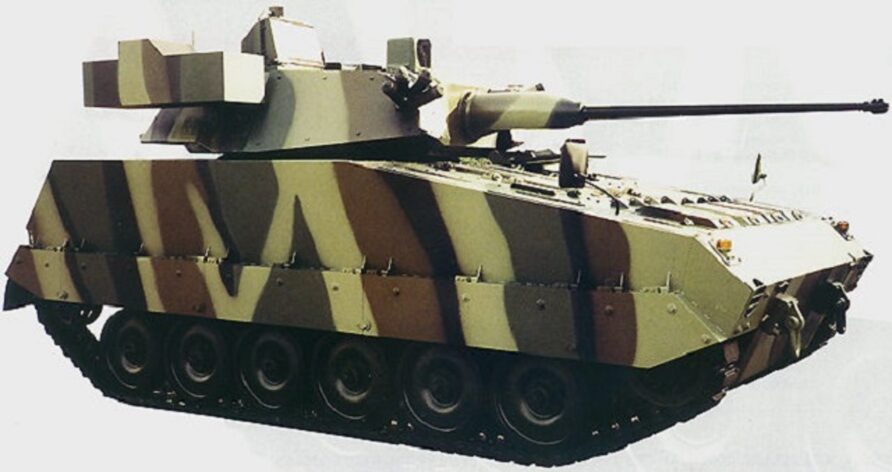
When FRES described a need for C-130 transportability, simple, light and upgradable armoured vehicles like Stormer 30 were brushed aside as the new programme would deliver exactly that class of vehicle, only better.
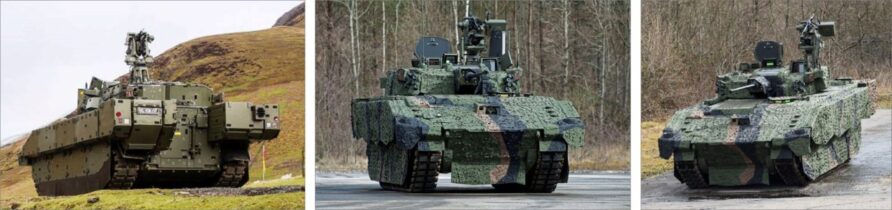
Skip forward many years; as we all know, FRES eventually delivered something that is the width and height of an MBT, at half an MBT’s weight and with half an MBT’s engine power.
When FRES turned heavyweight, BAE toyed with what seemed to be a relaunch of Stormer 30, the hull updated and apparently carrying a version of their FRES CV90 prototype turret possibly armed with the Mk44 Bushmaster cannon, but it appeared only as a low fidelity graphic:
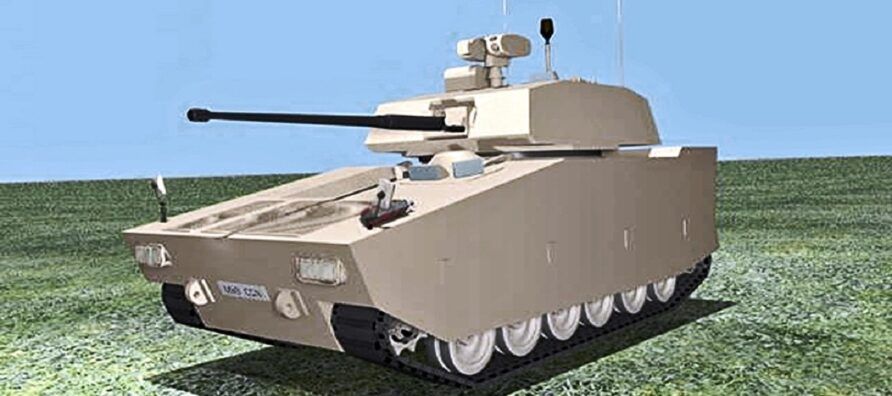
This vehicle, it seemed, never reached the prototype stage, but CVR(T) derived designs continue to emerge – there are rumours another Stormer 30 rebirth is imminent but yet to break cover – which only shows how good the CVR(T) concept was way back in the 1970s.
Anglo Engineering Concepts sprang from a conviction that Ajax could not perform the same tasks that CVR(T) suited, and where size and weight were defining requirements. Several vehicle concepts were created, assessed, and either set aside or carried forward for further development.
This coherent design and development process has been ongoing for over seven years. Seven years of design effort aimed at a single family of armour — this is a duration of design effort not seen since the days of the Establishments.
The effect the closures of the Establishment had on UK defence equipment design was fundamental. The MOD assumed the industry would perform all the work previously done by the Establishments, but cheaper!
Of course, it didn’t.
The industry is not a charity; unless there’s a high probability of a good return on its investment, it does nothing. Without a cast-iron contract, or a winnable competition for one, or at least a clear indication from MOD that they have a clearly defined requirement for a specific capability, there will be no design effort in the industry.
And as soon as the opportunity expires, all design effort stops. Dead. There should be no surprise that since the 1990s, nearly every armour bid has been based upon previously fielded products minimally modified to tick the latest requirement boxes, or on products imported from afar, developed on their nation’s taxpayers’ money.
This is perfectly summarised in one simple quote from William Suttie’s book ‘The Tank Factory’, where he is looking back at the 1920s.
“The decision to focus tank design in industry and run down the experienced and innovative Department of Tank Design (DTD) was a significant factor that resulted in Britain becoming a backwater in tank design until the Chertsey Establishment was established.”
Clearly, that was a lesson not learned.
In this modern environment, the sustained focus of design effort is a rarity and has delivered not so much a set of vehicles, as a design system comprising a set of subsystems and components that by use in different configurations permit rapid development of role-specific vehicle types.
The designs resulting from this methodology have been created and developed despite there being no MOD procurement project, formal requirement or funded study.
These are simple honest vehicles designed from the inside out to be effective, maintainable, and achievable, but just as important is the design process that produced them.
Anglo Engineering Concepts — Family of Light Armour
While it has been the norm for the Armed Forces to do the best with the kit which is available, this has at times made tasks more difficult, less effective or in some cases much more dangerous. Gaps in capability place additional strain on the serving soldiers as they wrestle with equipment that is not really the right tool for the job.
What is needed is a wider range of useful tools in the Army’s toolbox, so that the difficult task of the soldier can be made as easy as possible.
The most obvious gap in UK equipment is precisely the space that has been occupied by CVR(T), and FV600 before that, and the likes of the Daimler, Coventry, and Staghound armoured cars before that. Considering the age of FV432 Bulldog and M270 MLRS, ongoing concerns over Panther protection, and the mobility of the Mastiff family, there is a broad spectrum of light to medium armour that might be considered also in need of replacement.
It appears the US Army has determined it too has a similar need for such armour (as reported here:
https://www.army.mil/article/184597/
The vehicles broadly align within the earliest FRES framework; C-130 transportable combat armour fulfilling many of the defined FRES roles. But before embarking on a design, their purpose had to be adequately defined. As one of the VERDI-2 trials operators (LCoH Bright) stated at the end of its trial:
“The main question to be answered before TRACER comes off the drawing board is what is the main role of recce? What does it need to do, collect information or destroy enemy light armour or both?”
The first task faced by any armoured vehicle designer and the user is to understand the role; to scope out something like a Cardinal Points Specification of perhaps half a dozen defining characteristics the design needs to have. Without such a CPS the created armoured vehicle may not fit comfortably into any role – a square peg looking for any vaguely square-shaped round hole into which it can be forced.
Once each role had its defined purpose, a brief study was carried out to investigate the problem space, including reviews of the strengths and weaknesses of earlier vehicles to pick out valuable features to carry forward to new designs. Ever since the invention of the tank, armoured vehicle designers have come up with very clever solutions to problems that are as relevant now as they ever were.
Incorporating these, together with modern systems and approaches is in no way outdated thinking; the external shape of the new designs merely reflects the packaging of the necessary subsystems and human factors, taking those earlier smart solutions which have been brought up to date into account.
There may be raised eyebrows at the imposed C-130 transportability constraint given that the UK now has A400M, but there are sound reasons to work with this constraint. Firstly, the 9ft (2.74 m) by 9ft (2.74 m) gauge and 18t weight limit are entirely appropriate for a family of vehicles to replace CVR(T) and other similar light armoured vehicles.
Secondly, while the UK has A400M many of our allies do not, and the flexibility of deploying as part of an ally’s force seemed worth retaining. Thirdly, complying with the C-130 gauge also makes rail and road transport much easier, ensures slick RO-RO operations, and keeps the vehicles down to road vehicle bulk such that few routes would be impassable using the extant infrastructure.
Finally, holding to C-130 constraints maximises export potential which would be of value to UK PLC.
The counter-argument most often pitched at this is that in the contemporary operating environment, the light armour of such compact form cannot meet the protection levels necessary to survive the most likely threats. This would be a valid argument if the entire fleet of armour was to be changed to sub-20t vehicles. but the Army will still have its 70t MBTs, 38t Ajax, 30t+ upgraded Warrior and MIV, which is likely to be a 35t vehicle.
If threats are so severe, then field the kit appropriately but accept the limitations they bring; the restrictions on routes, the greater logistic tail, and the reduction in stealth (visual and IR but particularly noise). On the other hand, where rapid reaction and get-to-anywhere mobility are key, using a light small mobility-focused armour capability has its advantages.
Different tools for different jobs.
Low weight does not necessarily mean paper-thin protection. These smaller vehicles have been designed with a thick and heavy hide but due to smaller surface areas, the weight of equivalent protection armour is less than would be seen on larger armoured vehicles. There are also some very intriguing new developments in passive and reactive forms of protection, and many active forms of protection are now being marketed.
Clearly, the cost is key as in all projects, but this points towards better-than-expected protection in smaller and lighter platforms.
Those who follow TD’s daily feed of defence-related snippets will recall this comment: “Start with a common engine, wheels, tyres, transmission & other bits, then, AND ONLY THEN, build vehicles around them.
Systems thinking.” Those who cut their teeth in the UK defence industry of the last century have always sought to use common components and subsystems, a discipline that the Government Defence Establishments promoted, encouraged and sometimes enforced. No surprise then that exactly this approach has been followed with the vehicle concepts described here.
This graphic shows each current vehicle type drawn to the same scale; it is not exhaustive or definitive, for example, no armoured JCBs nor Command or Engineer or Repair/Recovery Variants of all the types depicted, but it does indicate the broad and varied nature of UK armoured vehicles.
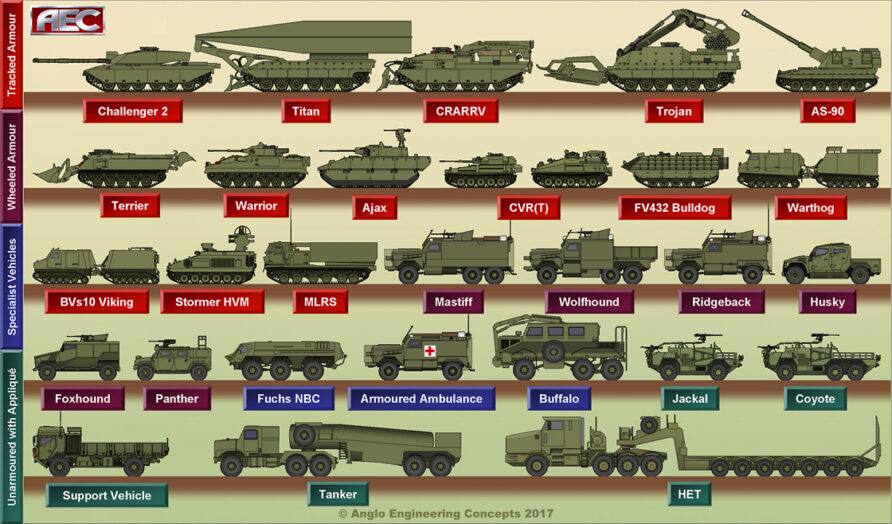
Some armour is very new, some are ages old, some have aged well and others badly. Many have been purchased as Urgent Operational Requirements when existing fleet shortfalls were identified, and some of these may not be retained in service in the medium term.
What is quite plain to see is that there are many types, each filling a niche role, all needing their unique equipment care and REME support to keep working. That is a lot of different vehicles with different spare requirements and different maintenance procedures.
Anglo Engineering Concepts — Vehicles
Shown below is a brief outline of the vehicles, their purpose, and some development rationale as the process evolved. They are each valid Light Armour solutions as they stand, but it should be understood that they also serve as examples of the wide variety of armour that the design approach can deliver.
They may be viewed as vehicle proposals or equally a basis for further development. They did not come about all at once but progressed over the development period in response to user feedback and other inputs.
The 3D images are taken from CAD where the vehicles have been modelled. The CAD models are not complete production-ready designs but do serve as packaging exercises and allow some degree of human factor and maintenance assessment.
Anglo Engineering Raven
Role: Fast Light Armoured Fire Support; Reconnaissance Vehicle
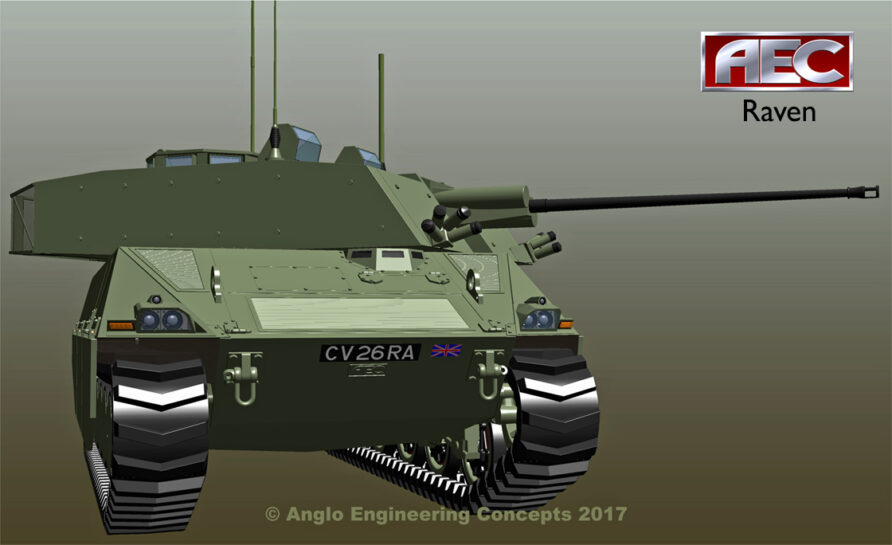
Design: The initial concept was nothing more ambitious than a low-profile hull on which either Ajax or Warrior CSP turrets could be mounted to provide obvious commonality and support advantages whilst also providing a lighter lower-profile fighting vehicle than an IFV.
Not as easy a task as imagined, modern turrets are huge compared to those of years ago; a function of larger guns, elaborate feed systems, a lot of electronics to house, the requirement to accommodate physically larger soldiers and the space demands of body armour and wearable personal technology.
There has apparently been a loss of focus on designing armour to the minimal possible dimensions over the years. This may be a simple consequence of moving to CAD – if the design only exists in the virtual world, it’s difficult to grasp the reality of internal space. There is also a significant reduction in the rate of new projects compared to previous decades, meaning engineers are just not using their skills often enough to gain the all-important knowledge that translates to experience and technical intuition.
There is a school of thought that the use of automated design tools in place of experienced designers will make better products, but this is far from proven.
For a combination of some or all of the above, Ajax and Warrior CSP turrets are large. During the evolution of the design process, it became clear they could not form the basis for a CVR(T) sized vehicle and in addition, their asymmetric width creates issues on small vehicles.
After a good deal of concentrated options assessment, a configuration was found that created a balanced vehicle that worked using either of these British Army turrets or either of the two BAE Systems proposed Warrior CSP and CV90 FRES turrets.
This vehicle was named Raven, and for the purposes of illustration, the third-party turret with which it has been fitted is the BAE Warrior CSP turret, selected before the MOD decision was made to buy Lockheed Martin turrets for Ajax and Warrior CSP.
There are some unusual design decisions embedded in the hull design which significantly improve personnel protection without adding weight. This vehicle tips the scales at approximately 14t. As might be expected, it has a crew of three, but perhaps not as expected it also has a high power-to-weight ratio giving a very lively performance.
In subsequent reviews, serving British Army representatives voiced concerns and reservations over some of the more radical technical choices involved in the hull design.
Anglo Engineering Rǽde
Role: Armoured Personnel Carrier
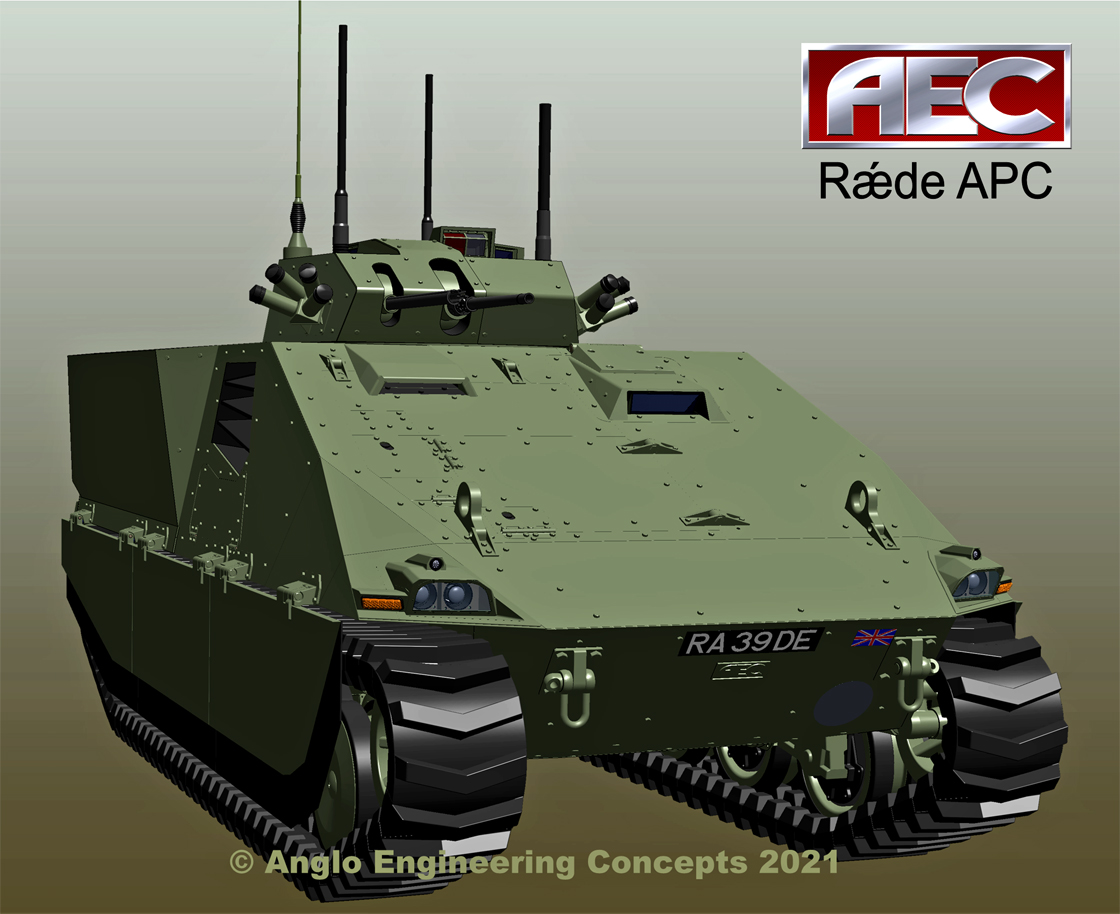
Design: The low-profile Raven hull had its roof plate raised to create a personnel carrier. The resulting vehicle, called Rǽde, has a similar internal volume to the Alvis Stormer APC. But where that vehicle was defined as 2 crew plus 10 dismounts, using the 97th percentile male soldier anthropometric model that is now demanded, reduces the capacity to 5 dismounts.
The current Def Stan requirement is that vehicle seating must be separate and well-defined with restraints and supports, and where possible arranged facing fore/aft. If all the non-mandatory guidance is followed, when there is a seating capacity of five, five is all that can be carried. Older military personnel carriers would be fitted with benches or close-coupled flat-squabbled seating facing side-on.
While there would be a nominal seating capacity, the seating arrangement could take more at a crush in emergencies. Following all Human Factors guidance has implications that must be understood.
In the AEC designs for Armoured Personnel Carriers, the seating for dismounts is blast-attenuating but side-facing, and while the seats are individual and shaped, they are close enough to their neighbours to act as a bench when necessary.
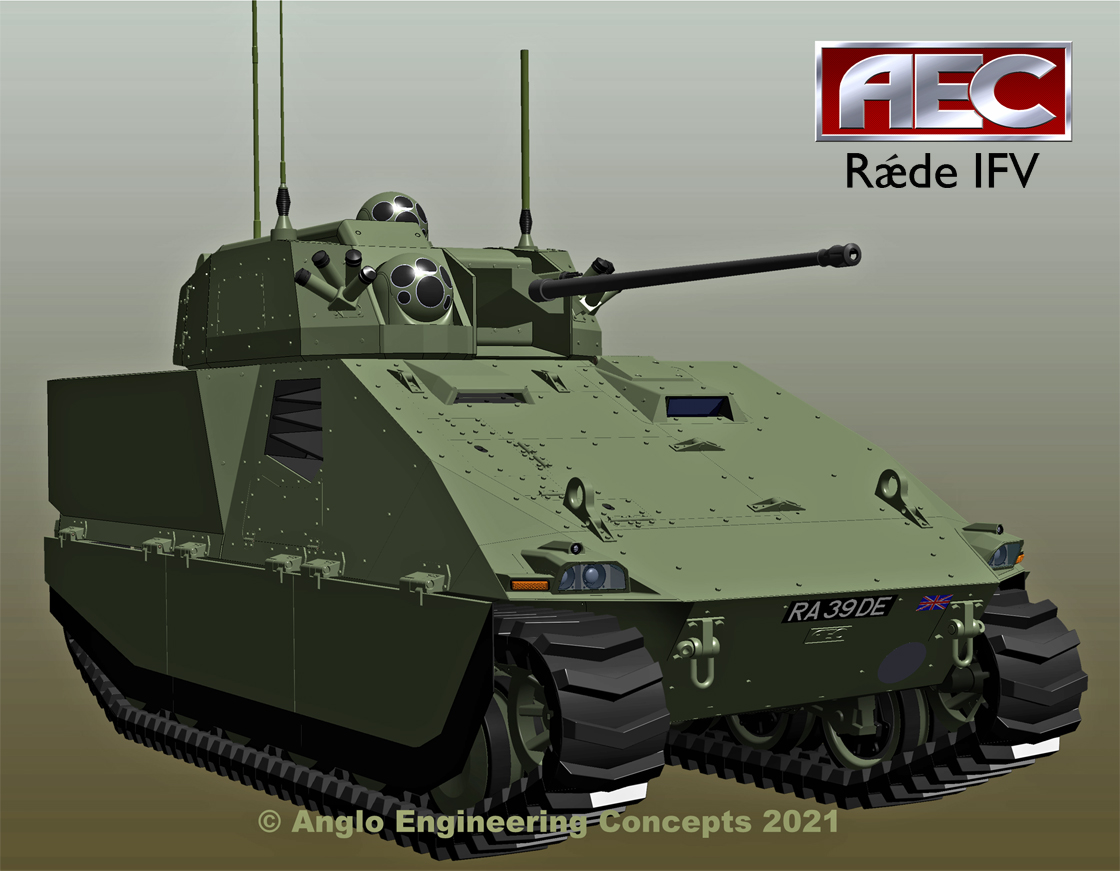
With the cancelling of Warrior CSP, a trial fit of the Rapier remote turret on the Rǽde hull has been given an initial assessment. The turret requires a well in the outer armour of the hull for the ring and RBJ (the slip-ring unit for electrical connection) which constrains dismount compartment headroom, added to which the significant weight of such a turret on a light armoured vehicle would lead to lateral instability.
This IFV version would also exceed the C-130 transport gauge due to excess height. While it might seem an attractive fightable concept, the penalties are not insignificant, and operating APCs in concert with fire support such as Rapier or Raven would probably deliver a more robust combat effect.
Anglo Engineering Ram
Role: Close Combat Support; Assault Gun
Design: With a fixed forward-firing 25 mm Oerlikon KBA or CTA40 and two Selex Enforcer RWS, the Ram is designed for close assault in urban and semi-urban terrain. With one RWS, the opposition may approach if it is focused elsewhere, with two RWS the probability that neither is about to sweep for threats is small.
To aim the hull gun, the vehicle must be aimed much like the S-tank, and like the S-tank the hull attitude can be adjusted in this case by air-suspension units. The flanks are designed to support heavy anti-IED/RPG slab armour, making this vehicle both heavy and wide.
Ram has not yet been transferred into CAD.
Anglo Engineering Rival
Role: Protected Cargo Vehicle
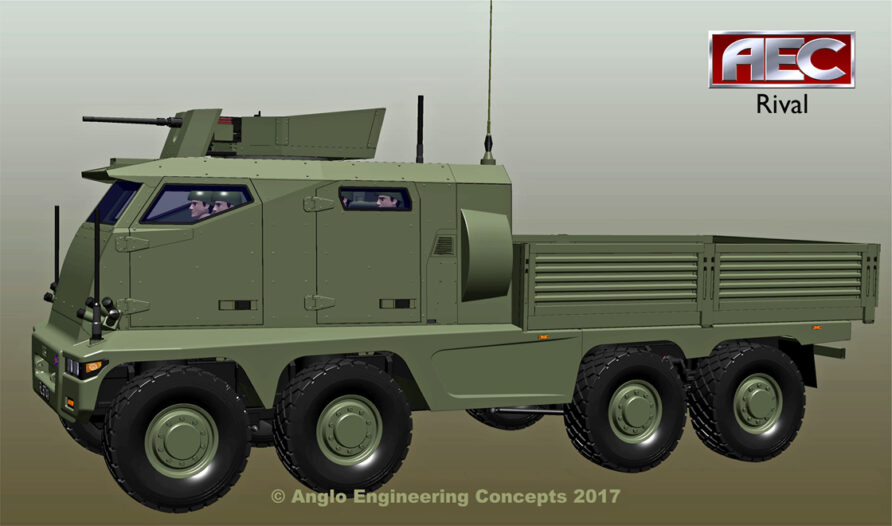
Design: In a complete change of direction, there was a request to investigate if the technology of the tracked vehicles above could be re-engineered into a wheeled chassis, specifically, in this case, a chassis for an existing armoured cab, to be configured as a drop-side cargo truck.
The exercise proved successful and resulted in a cargo carrier of modest size and payload capacities between 8t and 11t and room for six NATO standard pallets on its conventional drop-side load deck.
At a late stage, the Design Authority for the cab decided it was not to be used. An alternative AEC cab was created on the same footprint and with the same mounting interface to suit the chassis. The cargo deck and dropsides were modelled on the excellent Marshall’s products used on current British Army MAN/Rheinmetall cargo vehicles.
This could also be adapted to the protected tanker role.
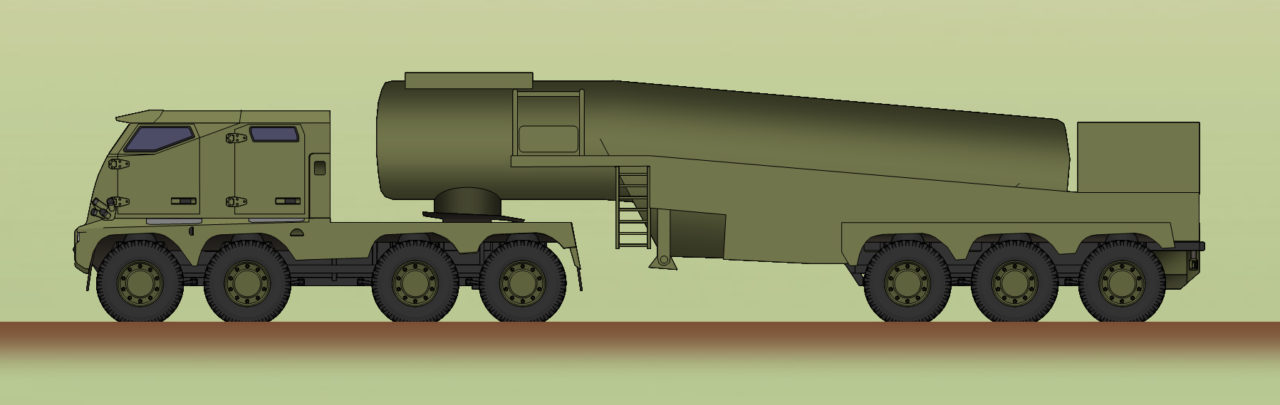
Whilst the suspension and general layout meet the requirement, at between 6.5t and 8t per axle it was too demanding on available technology. The axle rating was reduced to 3.5t per axle for all other wheeled vehicles, making these lighter vehicles feasible within current technology, but the geometry and configuration of the suspension remain the same.
A note about this geometry; a request was made to the designer of Jackal, and he kindly defined the trigonometry of the suspension. The suppleness of wheel movement will be equal of Jackal but at 3.5t the axle loading is less and the tyre width greater, which allied to the high power-weight ratio makes the fully armoured vehicles’ theoretical mobility considerably better than the impressive Jackal
Anglo Engineering Ræcc
Role: Autonomous Engagement Capability; Armoured Car
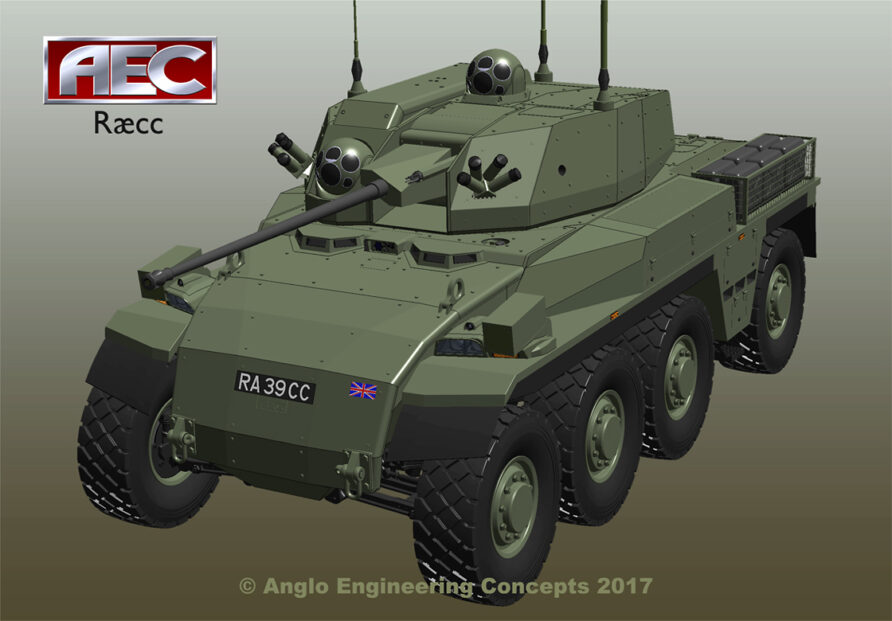
Design: The first of the wheeled vehicles using this 3.5t axle loading was perhaps an odd choice. The lack in the UK Order of Battle of high-speed high mobility firepower capable of long-distance transits and being able to counter a broad spectrum of threats seemed to be a capability gap worth filling.
The four possible UK turrets (one each for FRES and Warrior CSP from BAE Systems and Lockheed Martin UK) did not fit well on a vehicle designed to be small and mobile, not only because of their size and weight but also because the turret basket size did not suit this vehicle’s narrow V-hull. A more comprehensive selection of firepower was also required.
A new remote turret was designed, armed with the CTA40 and with Anti-Aircraft and Anti-Tank Guided Weapons installed conformally. The turret also has an elevating sight – it only rises a few feet, but as one RAC Major commented, he had found standing on the turret top with a pair of binos a very effective way of seeing without being seen; he didn’t see the limited elevation as a handicap.
The hull has room for just two crew, but then the gun has its autoloader and the missiles are in essence ready-rounds, and the 7.62 mm coax was given large ammo can use, so much of the gunnery effort was taken care of by machinery and advance vehicle preparation.
The turret was set on an 8×8 hull of low profile and of a deep V profile in which the crew operated, and sat in a well-protected citadel using the array of electronic vision options for driving targeting and situational awareness.
A point to consider here is that LCoH Bright after the VERDI-2 trial stated the following:
“The trial on Salisbury Plain was a success in as much as it proved a two-man crew can operate effectively for 48 hours in a closed-down environment, and it opened our eyes to what is available to the recce soldier of tomorrow […but…] it must be smaller and faster.”
The Ræcc vehicle concept, like VERDI, is a two-man vehicle, with electronic vision and a remote turret, but packaged small enough to fit C-130 and just possibly light enough for CH-47 lift and has mobility and speed in Jackal’s class. That’s all LCoH Bright’s wishes fulfilled.
It was presented to a group of the Army that has the remit to embrace and assess new developments. But where Raven raised some concerns under review by the User group, Ræcc raised considerable objections. The reliance upon electronic vision, no ability to get the commander’s head out with a clear sight of all sides of the vehicle, difficulties with misfires and ammunition feed stoppages and on and on.
So despite the outcome of the VERDI-2 trial, when offered just what that trial’s team recommended, it was the User who rejected unmanned turrets and solely electronic vision.
Quite disappointing, but the point of the AEC design approach is that the same building blocks may be moved and recombined with a high degree of configuration flexibility, so the rejection of one particular vehicle configuration does not mean a start from scratch.
A redesign then…
Anglo Engineering Raccoon
Role: Autonomous Engagement Capability; Armoured Car
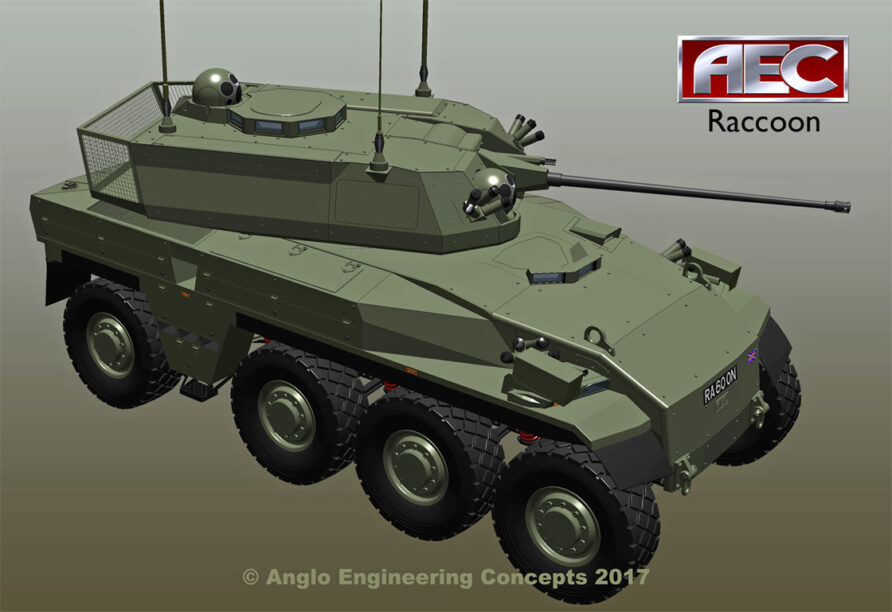
Design: Raccoon is still an 8×8, but now with a one-man turret.
To accommodate one man, the turret is physically larger and has a reduced number of missiles. And of course, it now has a basket that occupies much of the hull. The hull too needed redesign, with effort upon retaining some crew protection mechanisms employed in the earlier Ræcc hull. It grew a little taller, the turret moved further back.
It is not as compact as Ræcc, but one of the opportunities the redesign brought was the provision of protected missile stowage for two of each GW type, armoured both from the outside world and from the crew citadel within.
Anglo Engineering Rapier-C
Role: Reconnaissance Vehicle
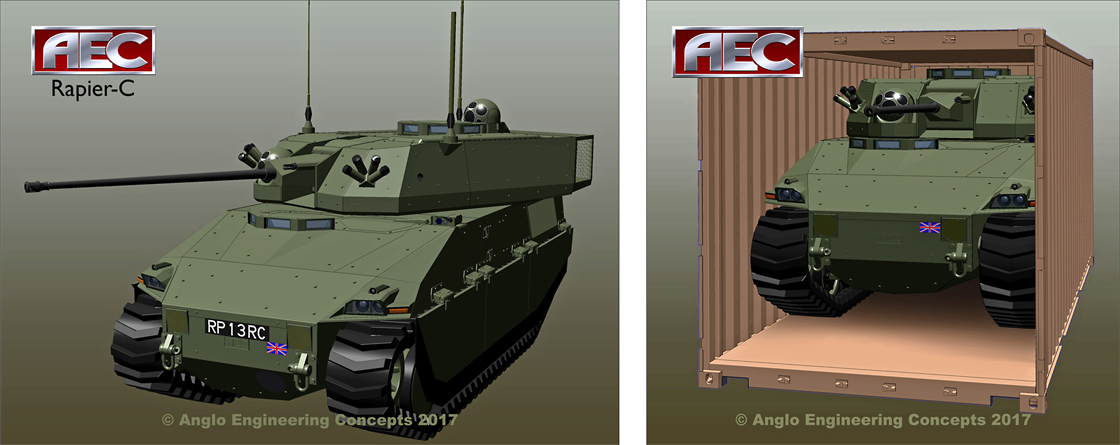
Design: The turret of Raccoon, complete with both natures of guided weapons, is still more compact than the Ajax and Warrior CSP turrets. The next task was to see how much smaller the tracked hull could get if this one-man turret was to be used.
The hull width was reduced as the basket is a smaller diameter; the L/C ratio that defines tracked vehicle steering behaviour allowed a shorter run of track on the ground as the vehicle was narrower, there was (just) enough room to get two crew, driver and gunner, side by side in the hull and room for the engine bay behind the turret basket.
This compact vehicle called Rapier-C ended up very nearly CVR(T) scale.
Rapier-C is a tracked vehicle as narrow as a Scimitar (if track guards are omitted) and a few per cent longer and taller, with a crew of three, and with CTA40, 7.62 coax, ATGW, Anti-Aircraft GW and an elevating sensor.
It has low ground pressure within 10% of that of a Scimitar and a very high power-to-weight ratio that provides astonishing performance. With the removal of track guards, antennas and the upper EO/IR sensor, it fits into an ISO container.
It is perhaps worth pausing here to compare and contrast with Ajax. Many will not have seen Ajax in the metal and will base an idea of scale upon photographs. Face to face, it really is imposingly large as are most new armoured vehicles, but for those who remember the compact dimensions of Scorpion/Scimitar/Sabre, this is a real step-change.
To help appreciate the size difference in absolute terms, the image below provides a comparison, Scimitar the blue-coloured vehicle is Rapier-C, and the pink outline is Ajax. Each to scale
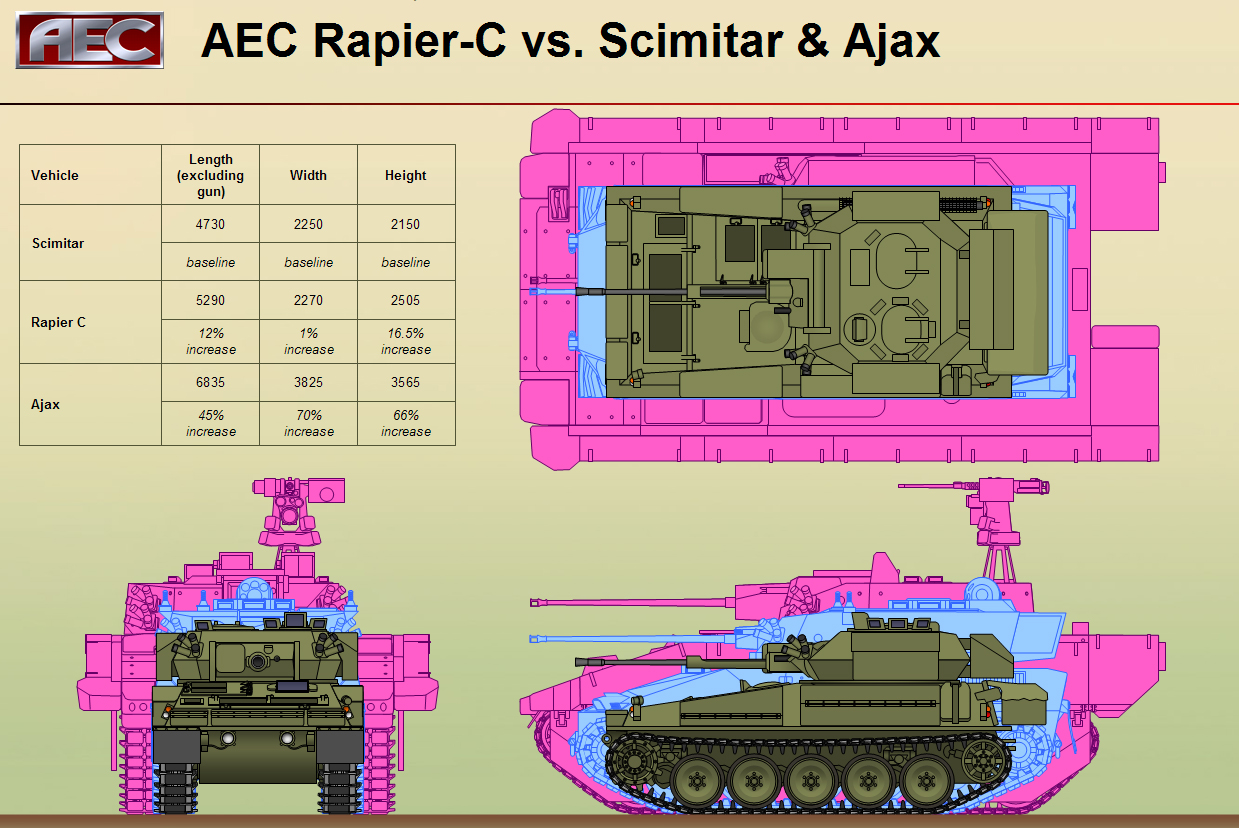
There is no doubt that once in service, Ajax will be a competent vehicle and there will be situations in which it will be the ideal fighting vehicle to use. Would these be situations where similarly armed, similar weight Warrior CSP couldn’t be used with similar success?
Or similarly, armed similar size and weight MIV? Or even Challenger 2 which is similar in width and height and has only 25% greater ground pressure under its tracks?
Possibly, possibly not, but it is a fair bet these other vehicles could be more readily substituted for a missing Ajax far better than an Ajax could be substituted for a missing Scimitar in situations ideally suited to the CVR(T) capability
Anglo Engineering Rapier-A
Role: Reconnaissance Vehicle
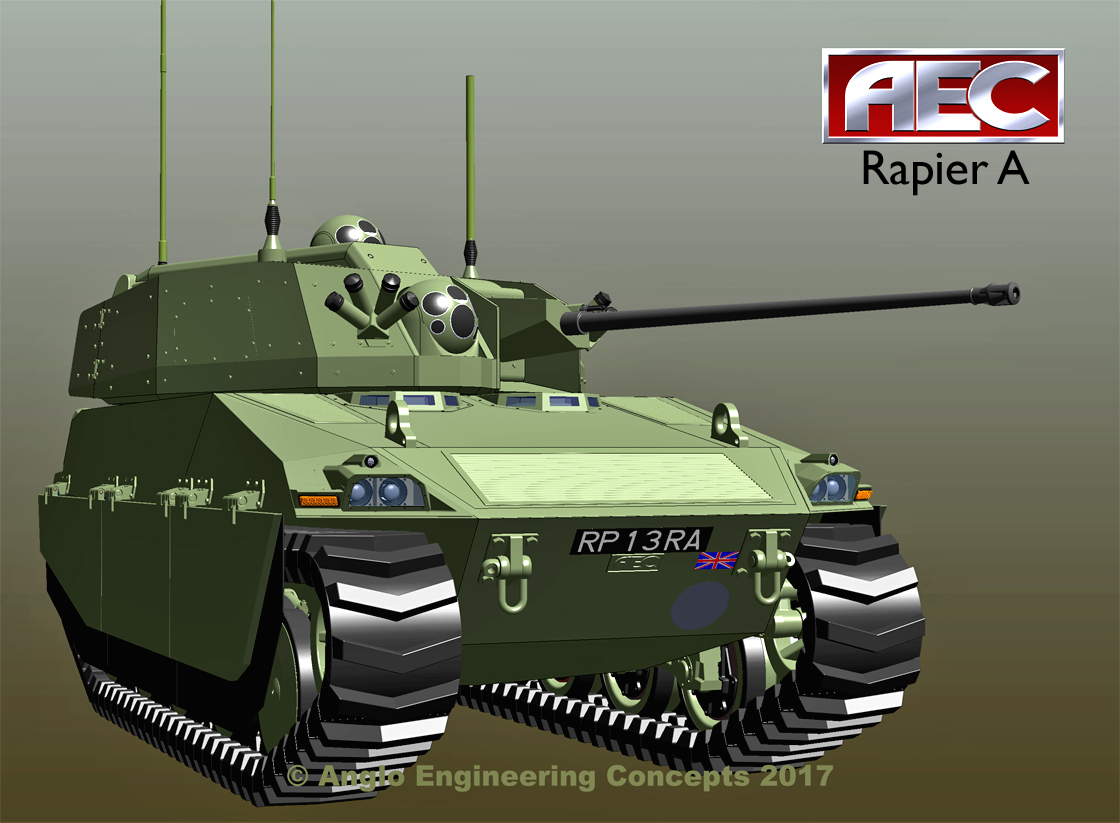
Design: A predecessor to Rapier-C, Rapier-A was a concept using the remote turret of Ræcc complete with CTA40, coax, SHORAD and ATGW and its elevating surveillance sensor, offering better personnel protection than Rapier-C in a smaller package yet, but at the expense of Mk1 eyeball direct vision – a proper VERDI-2 capability in a Scorpion sized vehicle – but currently shelved due to the User rejection of reliance upon remote electronic interaction with the outside world.
Anglo Engineering Raðe
Role: Fast Scout and Liaison
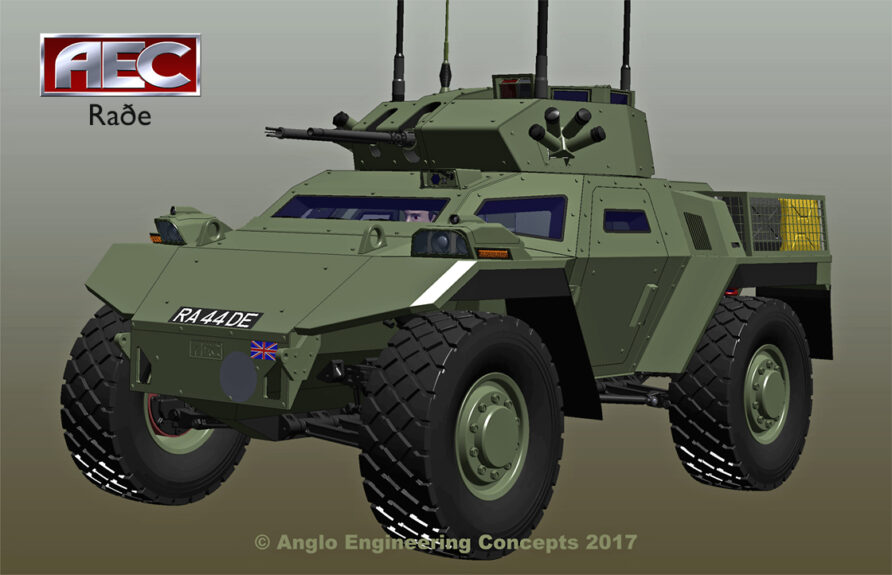
Design: Following the FCLV debacle and the continuing run of rumour and disquiet that Panther may not suit the role for which it was procured, and to see how compact a vehicle the standard wheeled driveline and suspension set-up would support, a vehicle similar to Ferret was constructed.
This was Raðe – a two or three-man vehicle, rear-engined. Originally penned to take the Thales (ex-Helio) FVT800 turret, it seems Thales has withdrawn this. So a similar turret fitted with .50 cal and a 7.62 mm chain gun was created. With the one-man turret, there is only room for the driver to sit ahead of the basket front & centre; with a remote weapon station, two personnel would easily be accommodated behind the driver.
Two axles hence 7t all-up mass, overall dimensions not dissimilar to CVR(T) but obviously with greater ground clearance.
For comparison, this is not of the Ferret scale. The reason is simple – there is no way a vehicle of Ferret size could accommodate two 97th percentile soldiers, let alone the three that this vehicle could accommodate. Raðe is similar in dimensions to the Coventry Armoured Car, and both wider and taller than CVR(W) Fox
Anglo Engineering Rǽs
Role: Civil Order Policing; Military Utility
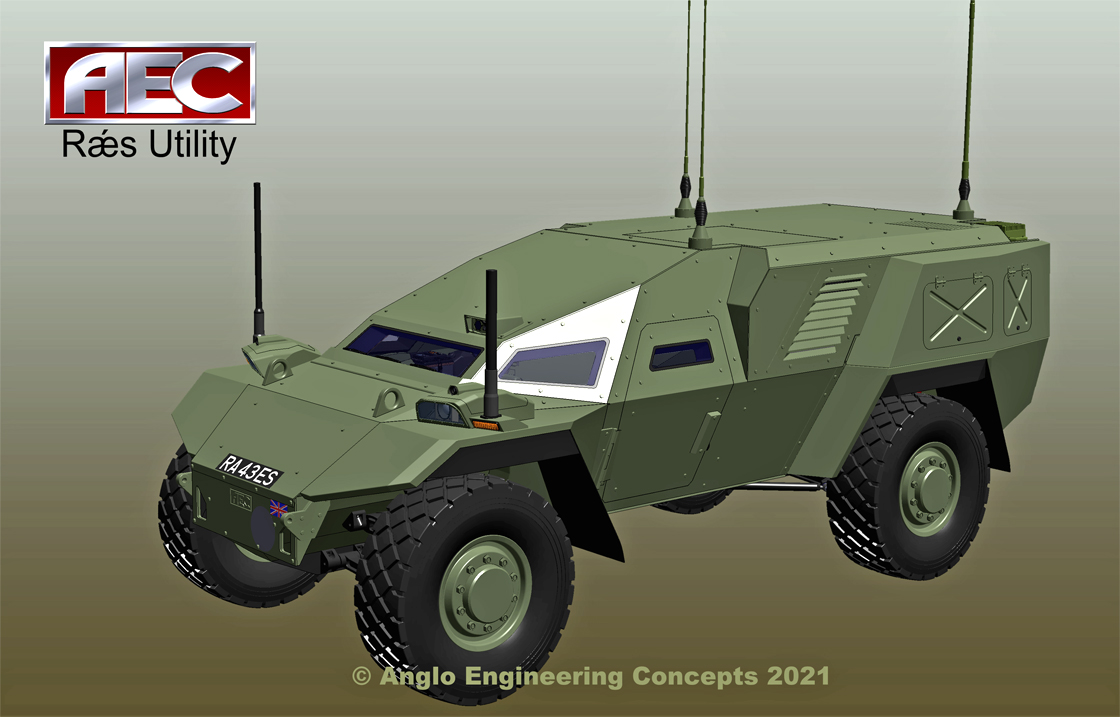
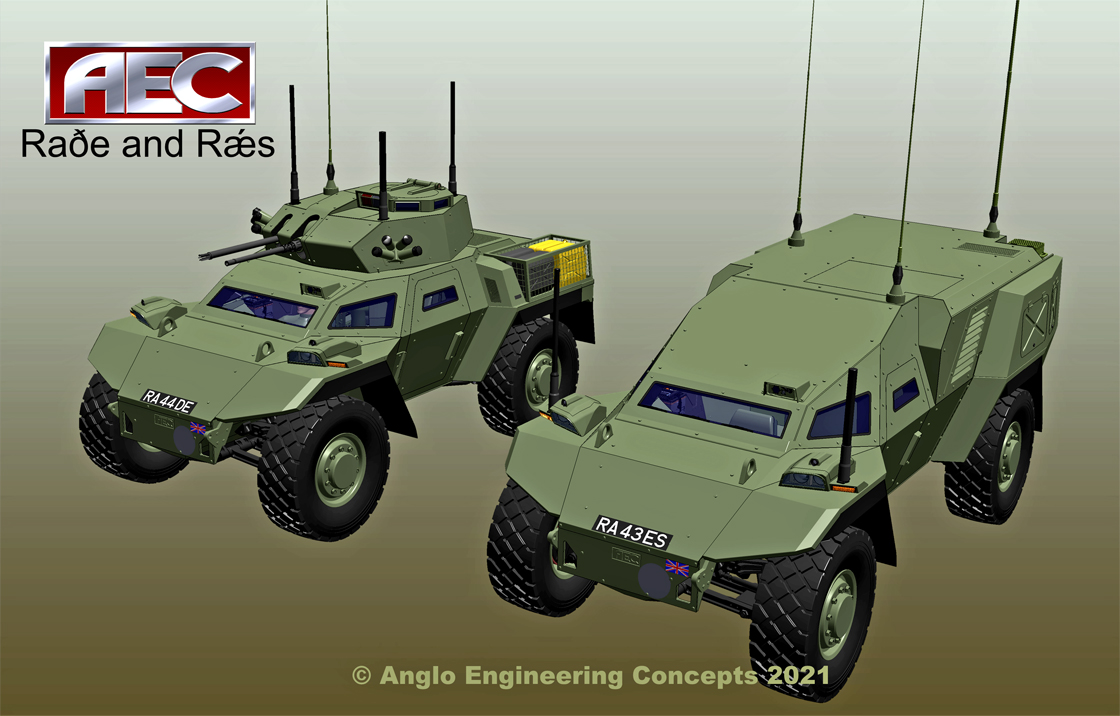
Design: Using Raðe as a starting point, a Utility Variant was drawn up called Rǽs. To create a usable rear access cargo compartment, the engine bay was moved to the side just in front of the rear wheel. The wheelbase had to extend to make the space, meaning this is the only wheeled vehicle that fails to meet defined HMLC criteria, due to break-over angle.
While the cargo space is limited, the vehicle retains the same armour protection as all other vehicles. The siting of the engine bay means there is no room for a turret basket, so RWS or a simple head-out machine gun would be the self-protection measures.
The vehicle was designed to adopt roles that FV1611 (Humber Pig) would have undertaken; riot control and civil order policing.
Anglo Engineering Ræcc-R
Role: Autonomous Engagement Capability; Armoured Car
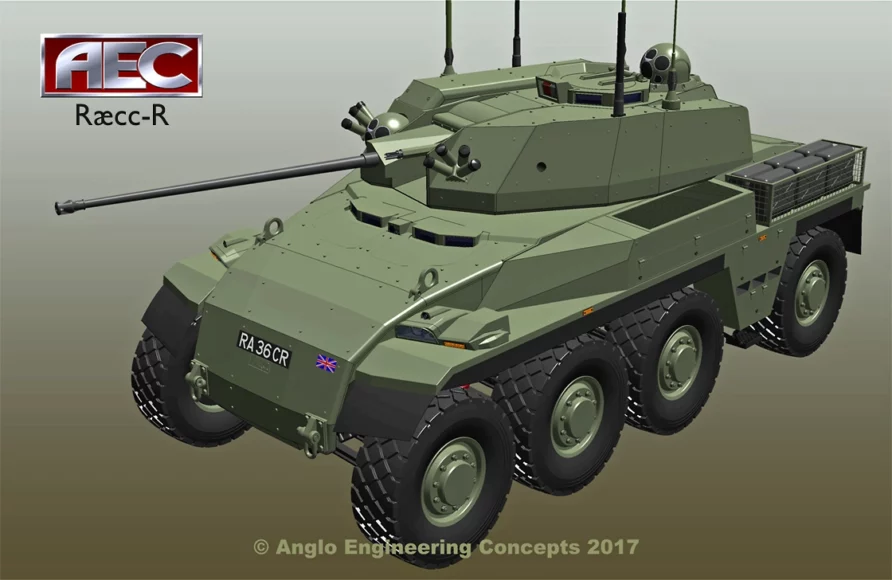
Design: At a briefing to British Army personnel new to the AEC concepts, it was suggested the mix of ATGW and anti-aircraft guided missiles on Raccoon was flawed, not because they were technically incompatible but because the level of training to get one crew competent on both missile types was unlikely to be provided.
Better to fit just ATGW and a gun, they said. Another redesign then.
Removing one of the missile systems allowed the turret profile to reduce back to that of the unmanned turret whilst still having room for the one crew member within. There followed an effort to redesign the first Ræcc hull to suit this smaller one-man turret, which has worked, although some benefits of the earlier design are lost, notably in relation to hull crew protection.
The result was a vehicle looking remarkably similar to Ræcc and using the same subsystems driveline etc, but having an entirely different internal configuration and hull structure.
This is called Ræcc-R, it represents a moderately compact armoured car the likes of which were common Army equipment until the 1970s, armed with the Army’s favourite medium calibre gun, CTA40, and ATGW.
Vehicle performance is on par with the typical Golf TDI.
Anglo Engineering Rapier-AC
Role: Reconnaissance Vehicle
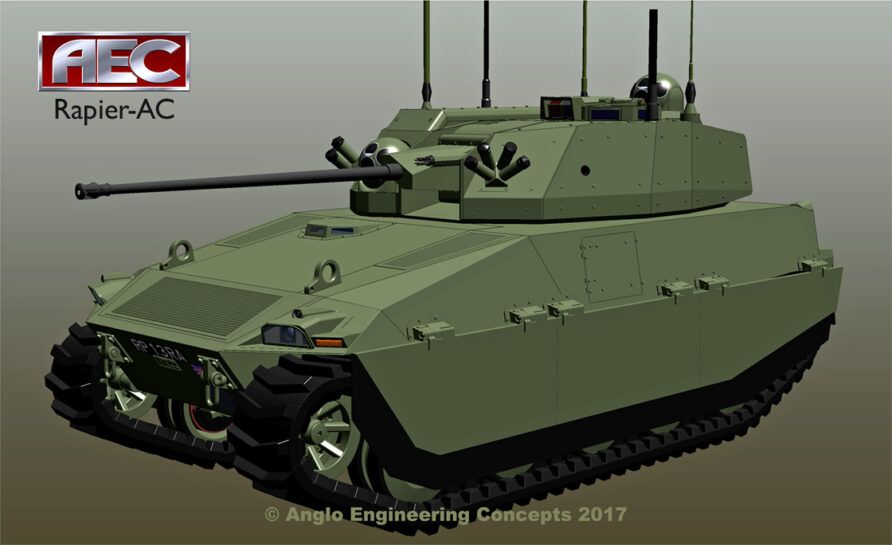
Design: The Ræcc-R turret (or a close derivative of it) offered itself as a way to revive the remote turret Rapier-A recce vehicle. Keeping to a vehicle crew of two, driver in the hull and vehicle commander either in the optionally manned turret or beside the driver, the vehicle remains as compact as the Rapier-A and maintains that vehicle’s crew protection advantages, but now, of course, allows the commander to operate head-out in the turret.
Use of this turret does, of course, mean the absence of anti-aircraft GW, but there remains the 40 mm CTA gun, the coax 7.62 mm chain gun and two ATGW in a conformal silo, as well as an elevating sensor.
A note about sensors here; the preference is to use spherical units as they maintain a constant silhouette as they pan and tilt, which helps reduce their detection.
But fully gyro-stabilised sensor balls are eye-wateringly expensive – each one way more than the cost of the base vehicle – so a more cost-effective adequate surveillance and targeting sensor solution has to be found.
Assuming an affordable optics solution is found, the vehicle design is sound. Still a work in progress, this is Rapier-AC
Anglo Engineering Ox
Role: Multi-Role Rapid Reaction
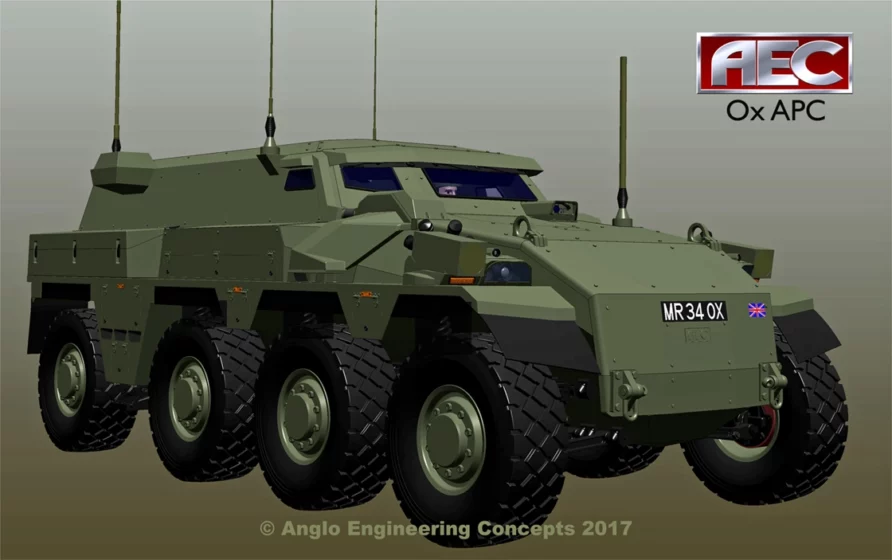
Design: This was the only vehicle in the set that was designed from the outset as a multirole concept based upon an automotive V-hull and a clearly defined and separate ‘mission module’ for the crew and the mission equipment.
However, this is not one vehicle structural design to which role equipment is bolted. Each role requires a separate design of mission module and to support the diverse needs of the role the V-hull may differ in length and number of axles.
The intent is that each vehicle would leave the factory already configured to the role, and that any reconfiguration to a different role would require a return to the factory or at least to third-line workshops.
The design of Ox owes much to FV603 Saracen, a fine design in concept if a little flawed in execution. Not surprisingly, when creating a wheeled V-hulled APC with an engine bay in the nose and crew compartment behind, the result looks like Saracen.
No bad thing; the design was well-considered. The V-hull holds a constant profile for the full length of the vehicle and is the structure upon which all the driveline is mounted.
The mission module sockets into this V-hull behind the engine bay and may take various forms, although each so far considered has a similar driver station.
The following graphic shows some options:
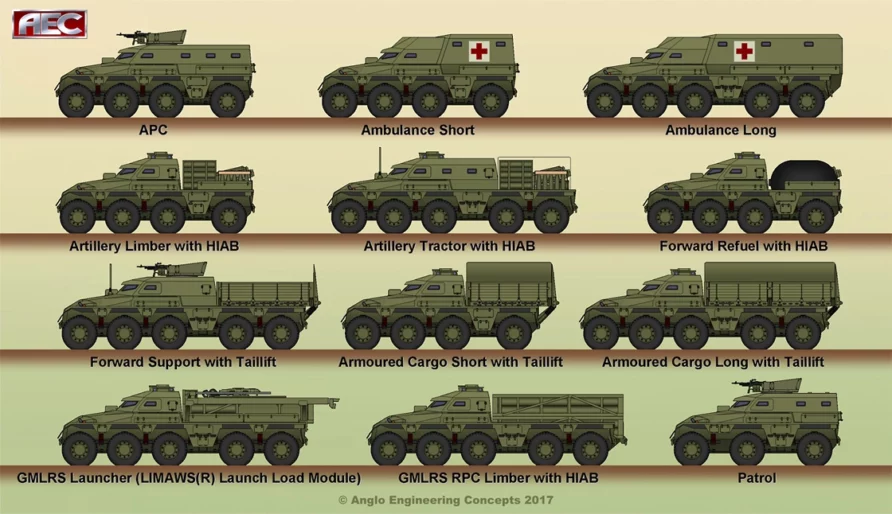
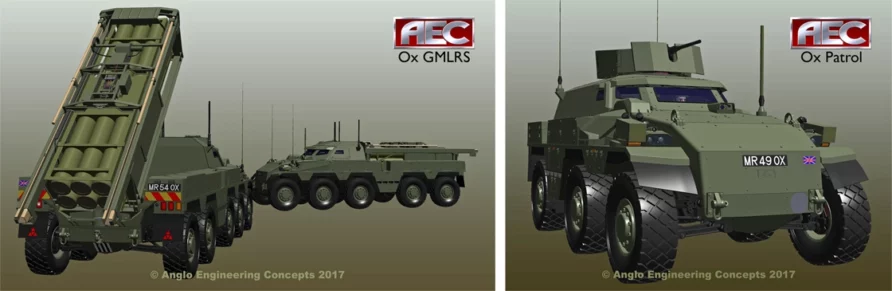
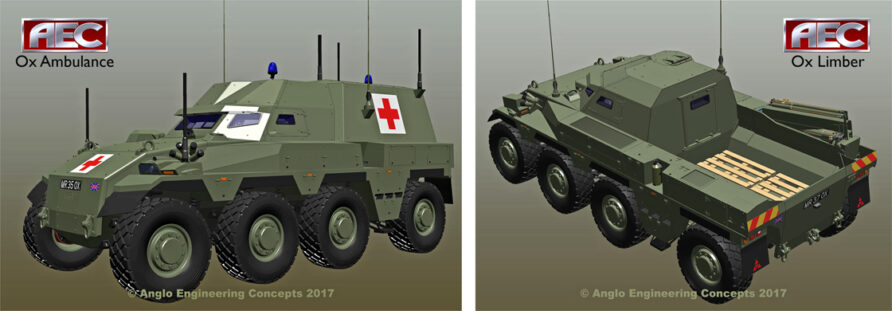
Several variants of the Ox family have been constructed within CAD, showing the variations in V-hull length, number of axles and variations in the mission module.
Anglo Engineering Raven-R
Role: Fast Light Armoured Fire Support
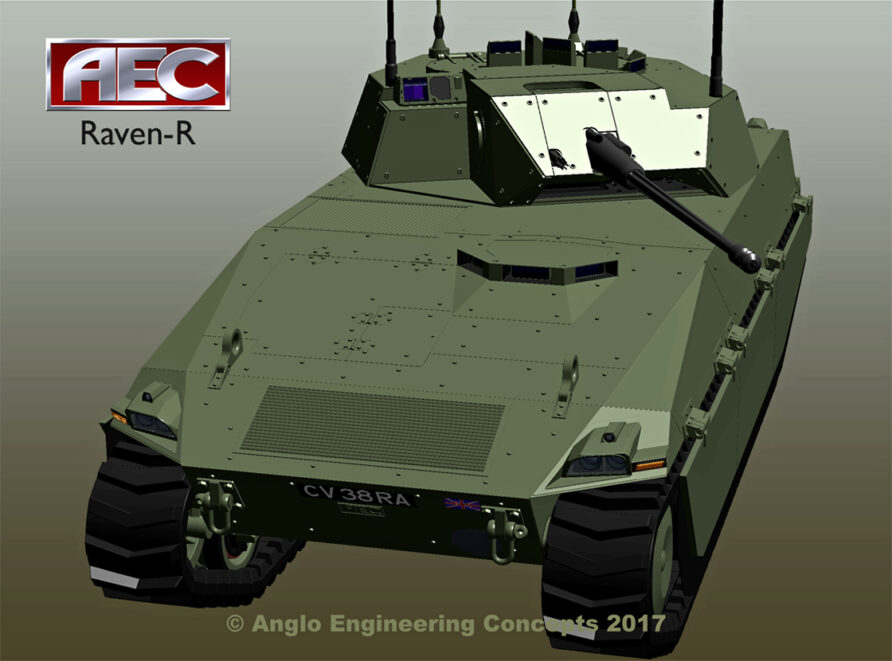
Design: Earlier this year, the Raven hull design was reviewed with the Rheinmetall Lance and Leonardo Hitfist 30P turrets; with these more compact units, the hull could be reconfigured, and some radical elements engineered out. This much more conventional, reworked design has been named Raven-R.
Apart from the obviously different turret, it has a forward engine bay besides the driver and a rear escape/resupply hatch, but otherwise shares the original Raven hull’s components, performance, and vehicle role.
What it loses is the unconventional crew protection advantage of the original Raven hull, but its entirely conventional layout would not raise any of the concerns voiced against the original design.
While the vehicle could be constructed at the same weight as Raven, it would be expected that extra blast protection measures would be demanded to offset the higher risk configuration. This would, of course, impact vehicle weight.
While the use of a turret not fitted with CTA40 may prevent UK MOD from considering the vehicle, the use of this hull with either Lockheed Martin UK turrets, Ajax or Warrior CSP, by current assessments is inappropriate due to the long forward overhang in front of the ring which pushes the turret axis far back down the hull.
There would also seem to be significant width of the turret to the right of the centreline in each of the Lockheed Martin designs, which makes fitment to these narrow vehicles far from ideal. It is possible the information available in the public domain is misleading, or indeed has been misunderstood, but until further information is published it seems wise to look at narrower turrets such as Lance or Hitfist.
Anglo Engineering Concepts — Large Calibre Turret Assessment
An obvious task is to look at the options for fitting turrets with larger calibre guns. Both Leonardo (ex-Oto Melara) and CMI/Cockerill have 105 mm or 120 mm turrets that are offered for OEM fitment.
A high-pressure gun option would be best, such that MBT armour might be challenged. Initial assessments suggest these off-the-shelf turret options have baskets that are too broad for either wheeled or tracked vehicles of this size; the rings are similarly broad but could be accommodated. It is a shame there are apparently no decent guns being made or marketed in the 60 mm to 75 mm range – such a calibre would suit vehicles of this size well.
But for this task, the turret from the BAE M8 Buford (designed by United Defense) has been assessed for its compatibility with AEC vehicle hulls. This is a 105 mm armed turret with an autoloader, but unlike most of the similarly armed turrets available from the likes of Leonardo or CMI/Cockerill, the autoloader is not mounted in a turret bustle.
In the case of M8, it is a very compact unit nestled below the breech. What this means is that the turret armour is compact and ideally suited to small vehicles with limited hull roof plate real estate. This should be no surprise, as the M8 Buford is itself a small vehicle.
In the large calibre turret marketplace, most turrets are designed for hulls larger than the AEC vehicles. Unusually, the M8 turret was designed to suit a vehicle specifically designed for C-130 transportability; a next-generation Sheridan. It was this design constraint that made the M8 turret the ideal candidate for assessment for its compatibility with the AEC hulls.
The Buford hull and that of Raven-R have a similar width between the tracks. The basket would fit neatly. The depth of the internal volume in Raven-R is greater than that of the very compact M8, but for reasons of internal configuration, the Raven-R roof plate cannot be lowered. However, the same limitations do not apply to the original Raven hull; more of that later.
Looking at the autoloader operation, it would seem most likely to be operated hydraulically. The current Raven hulls are not equipped with hydraulic packs, so this would be a further design update.
But for the basic question “does the turret fit?” the answer is a clear yes.
The size of the turret is illustrated by comparison with the Hitfist 30 mm turret that Raven-R was designed to carry. Big, but not outlandish.
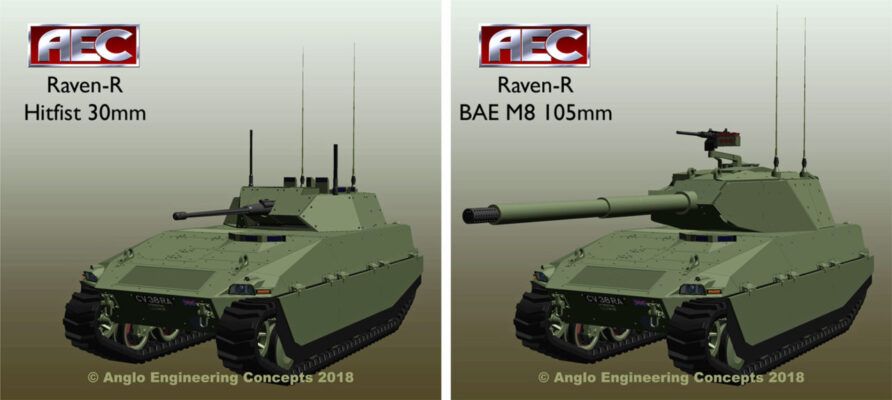
The same turret has been assessed against Raccoon and Ræcc, with the expectation that their steeply sloping hull sides would not allow the M8 turret’s basket to fit. Given the autoloader configuration, it would seem highly unlikely the turret basket, could be reworked to a smaller diameter.
However, the interference in each case is minimal – maybe a 20 mm radius reduction at the basket floor for Raccoon and a 50 mm reduction of floor radius for Ræcc due to its lower hull roof plate – suggesting that it would be possible to engineer a fit.
The hull roof plates of the wheeled vehicles are narrower than on the Raven hulls, which may cause rework if the M8 turret ring is as broad as the armour structure suggests. But again, such changes are possible.
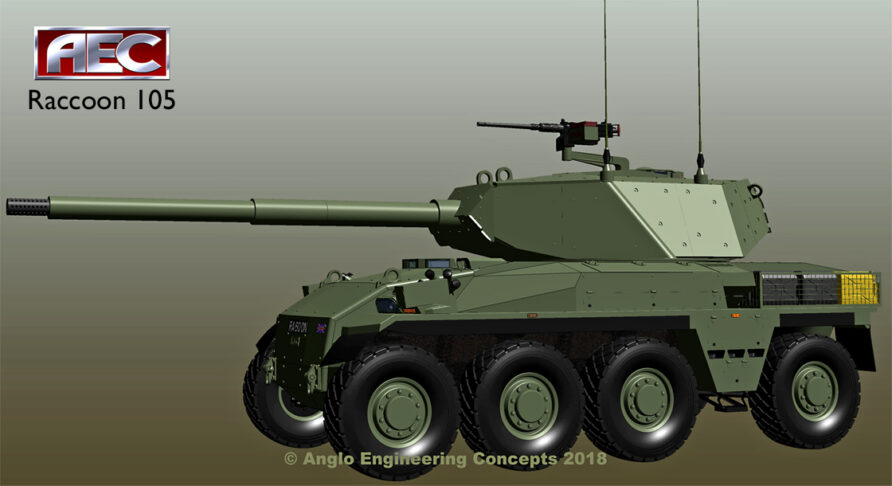
It can be seen that the turret looks larger than the hulls would be expected to carry, despite its compact arrangement. However, even on the taller Raccoon hull, the height of the cupola hatch is within the 9ft (2.74 m) C-130 gauge (just).
Turret weight may be more than desired too, although the complete M8 Buford vehicle was designed for C-130 transport, which suggests the weight of the turret may not be seriously greater than the one-man 40CTA turret that Raccoon was designed to have.
Using the Ræcc hull reduces overall height marginally and moves the turret axis forward nearer to the vehicle midpoint.
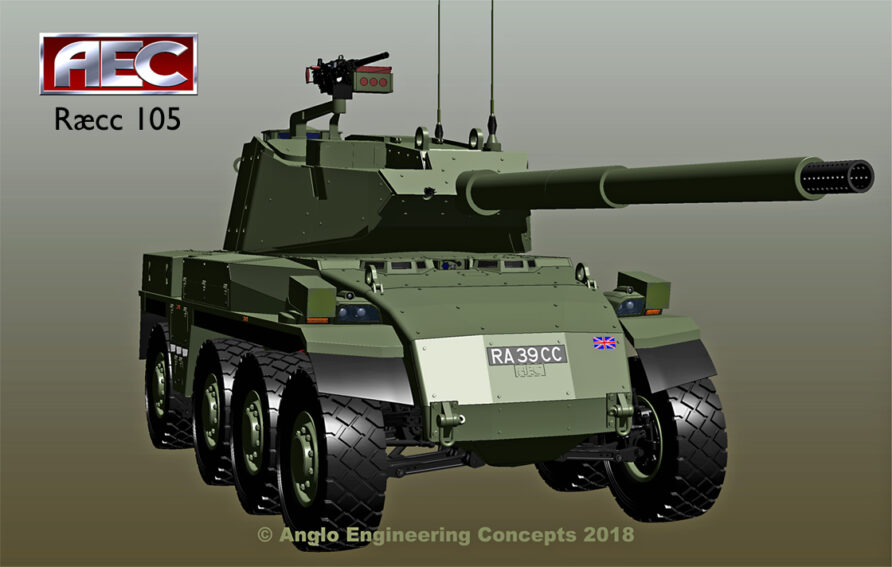
The barrel overhang may be an operational irritation, particularly as there would appear to be fairly limited elevation, so running fast over rugged terrain may prove a risky business. But this would be no different to many large calibre AFVs. Indeed, the issue may be more pronounced on the M8 Buford itself, where the turret is mounted on a lower hull but with just as much forward overhang.
This would also apply to the lower profile Raven hull.
So. Back to the original Raven hull reworked for a lower roof plate, named Raven-F. This is to reduce the hull height under the turret ring, which would make for a more stable platform. On the downside, the turret ring is further forward than in Raven-R, extending the barrel’s overhang. But this option does make a better-balanced solution, in proportions that have since the arrival of Centurion been considered the norm for main battle tanks.
Except in this case the vehicle is smaller and because of that, lighter – rough estimate only, but of the order of 16 or 17t. From muzzle to rump it is 8.7m, from ground to cupola it is 2.45m and to turret ring is just 1.435m.
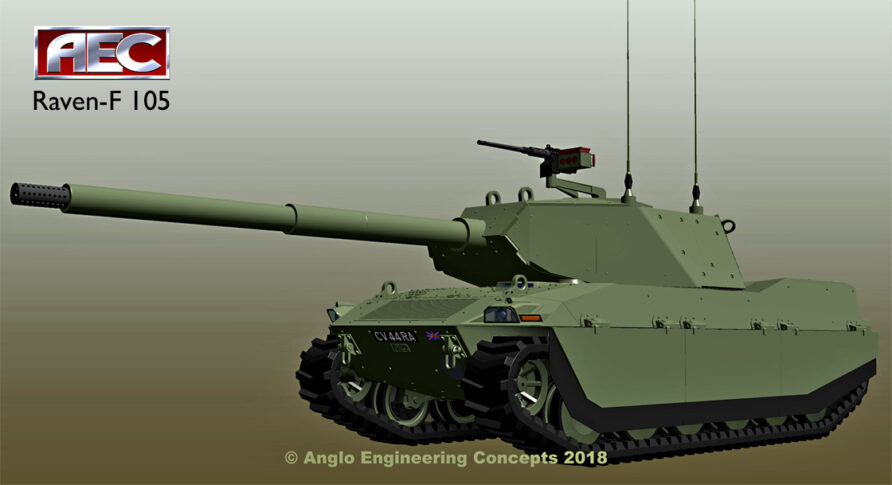
It is little more than the length of Challenger 2’s hull alone; it is just 200 mm longer and 100 mm taller than the unarmed Boxer, and 200 mm narrower. It is also 200 mm shorter and 100 mm lower than the M8 Buford AGS that the turret was designed for, and with a better power-to-weight ratio too.
The obvious question that would be asked is, “Why not just buy the M8 Buford vehicle as it is?” Indeed, if the need was just to buy a tracked 105 mm easily deployable AFV, it would make sense to buy COTS.
But if a 105 mm direct fire capability was desired as just one part of a wider fleet of diverse capabilities, especially if tracked and wheeled were both required, then these AEC hull options make sense.
The commonality is a great advantage.
The OEM option turrets have not been discounted as possibilities and given time and more information than the public domain has to offer, their suitability could be determined. But the apparently comfortable fit of the M8 105 mm turret illustrates such firepower is entirely possible on these compact, high-mobility vehicles.
Anglo Engineering Family Values
Every one of the above vehicles remains within the C-130 gauge for air transport; everyone fits within the UK’s most restrictive W6 rail gauge (for some of the taller vehicles that require the use of Warwell wagons but many could sit on typical flat container wagons).
The 4×4 scout Raðe, the utility Rǽs and each of the Rapier recce vehicles could be moved inside 20ft ISO containers with minimal preparation. These are designed to be easy to deploy in numbers wherever they are needed. Tracked vehicle ground pressure is just 10% higher than CVR(T) at its initial 9t Gross Vehicle Weight, 60% of that of Warrior and 40% of Challenger 2.
Tracked vehicle acceleration would leave most GTIs behind and wheeled vehicle acceleration matches typical family cars, this performance is a result of ensuring enough torque to sustain speed on a 40⁰ climb gradient if ever wheels or track could keep traction. High levels of redundancy within the driveline would offer resilience against damage or component failure.
They are not the world’s most protected armour; they would undoubtedly need to be fitted with RPG protection (Tarian nets would be favourite) and would benefit from being fitted with ABBS VGAM blast protection system; they are not spacious; the turreted vehicles are not armed with 120 mm MBT guns.
Being armoured they are not as light as soft-skinned vehicles and transport under CH-47 would be a challenge for most and impossible for the larger types, but then compromises must be made.
These are simply nimble, small, highly mobile, and reasonably well-protected useful vehicles.
Underlying all the designs is a firm principle to engineering the different vehicle types from common components – common engines and drive systems, common air filtration systems, common instrumentation and controls, for the wheeled vehicles, common suspension, steering, wheels and tyres, for the tracked vehicles common suspension, idlers, road wheels and track-type – with a sharp focus on simple affordability.
Rather than designing a single complex all-encompassing multirole vehicle, individual simpler designs focused on their prime role have been created, but each is based upon the same subsystems and components resulting in very high commonality to ease support burden.
As each vehicle type is freed from the burden of meeting the needs of many roles, they become more compact, lighter, and affordable.
Affordability improves if more types are brought into service as the common support brings benefits in maintenance training, spare inventory, diagnostic aids, and even maintainer currency.
This can perhaps best be illustrated by repeating the earlier graphic of the breadth of UK armour, this time with the above-described AEC vehicles replacing current incumbents:
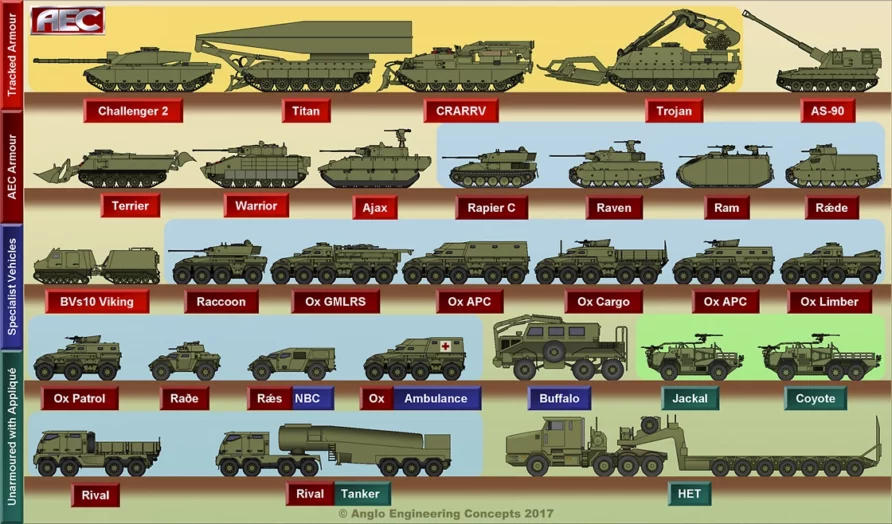
The shading behind the vehicles shows common support. Consider what such broad common support means; much more accurate spare scaling, streamlined maintainer training, and much-improved maintainer currency, leading to greater maintenance efficiency, lower maintenance cost, and greater vehicle availability. Common support makes sense.
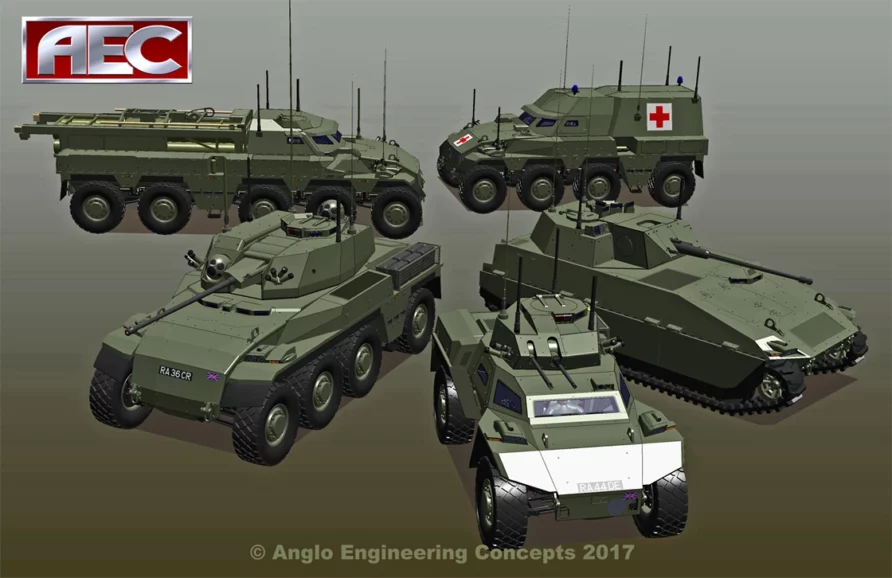
One family of many forms, large and small, tracked and wheeled, this is the sort of joined-up thinking the Army and the MOD needs.
These designs are by no means the limit of possibilities. Given current technology, assume a wheeled vehicle maximum weight of 17t or so, for tracked vehicles that may be increased to somewhere near 28t. This is due to driveline capability, the lower maximum weight for wheeled vehicles down to the larger diameter of wheel/tyre which demands greater torque to achieve acceptable performance.
Note though that the designs undertaken for tracked vehicles have been substantially less than 20t, mostly because this is where the projected UK capability is weak but also because of the self-imposed C-130 transportability constraint. There is no reason why lighter heliportable vehicles could not be designed, as long as lower protection was accepted.
There are challenges not yet met for an amphibious operation, articulation, integration of major hydraulic powered systems (cranes, diggers, winches, lifts) and high recoil force systems (large bore mortar, SP gun), but there are no fundamental reasons why these should be more difficult than in any other armoured vehicle design.
An Echo from the Past
Before Ajax, FRES. MRAV and TRACER, there was the Future Family of Light Armoured Vehicles, FFLAV. Here is what the Alvis team offered for FFLAV:
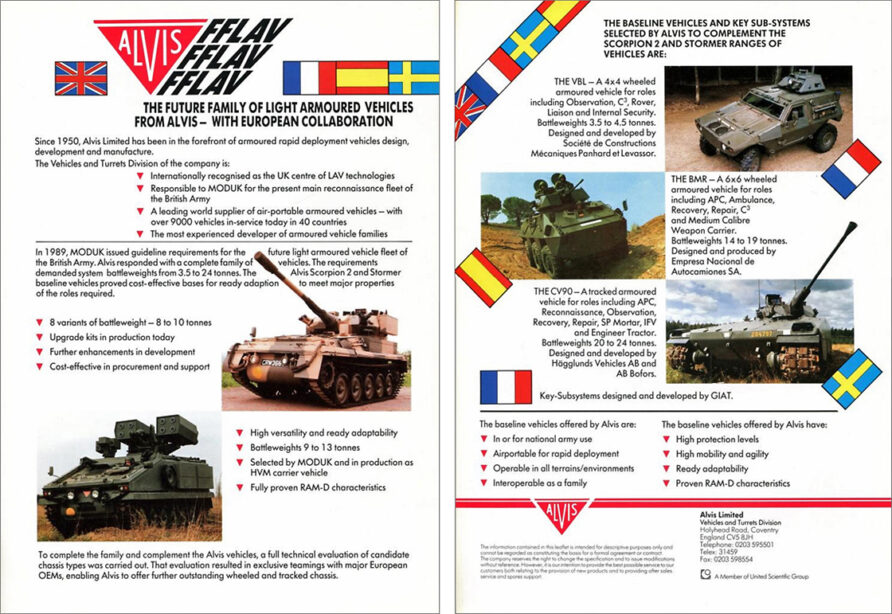
One view of this offering is to see it in the light of where the British Army is now. In place of VBL, the UK has Panther FCLV. In place of CV90, we have Ajax, remembering, of course, CV90 was the other FRES-SV contender. In place of BMR, we will have MIV.
Was FFLAV visionary? Well, probably not, but it was blindingly obvious good honest robust common sense. So blindingly obvious that thirty years down the line, the original FFLAV solution is roughly what the Army has selected.
There are differences, though. Ajax, as delivered, is far heavier than the 1990 FFLAV version of CV90. MIV is likely to be far heavier and bigger than BMR. And of course, where the FFLAV proposal focused on upgraded and developed CVR(T) and Stormer vehicles, these are now due to retire from UK service.
Taking an alternative view, compare the FFLAV offerings to the AEC family described in the text above. VBL roles are covered by Raðe scout and Rǽs utility. BMR is covered in the same weight range by the various versions of Ox.
Stormer and Rǽde APCs are direct equivalents. Scorpion is matched by Rapier. And while CV90 is heavier than the Raven concepts, there is no technical reason why the Raven driveline couldn’t be used on tracked vehicles up to 28t. And in addition to covering the FFLAV bases there are also the Ræcc and Raccoon armoured cars, and Ram assault gun, and providing driveline technology develops there is the Rival armoured logistics truck too.
And there is VERDI-2 envisioned capability in Ræcc Raccoon and Rapier. And the design approach could deliver many more types of light armour for additional roles too.
The AEC family of armoured vehicles aligns exceptionally well with the FFLAV vision. Except for the one attribute that FFLAV couldn’t deliver – common support throughout the entire range.
Options for Advancing the Anglo Engineering Project
The original design, Raven, was first briefed to the appropriate MOD desk officer late in 2010. Several other briefings have been made since as the text above notes, and the designs have been changed where advice from Users was offered.
The most challenging aspect has been the MoD’s procurement process. Although the MoD has several initiatives in certain product sectors for SME engagement, major vehicle projects tend to be placed only with larger and established companies.
It was suggested at one briefing by a DSTL engineer that would be a good idea to generate a prototype of one of the AEC vehicles to test the concepts, with a view to jointly creating a DSL-owned design for the industry to bid to build (very much as Establishments worked) but he failed to convince his colleagues.
The UK still has a broad spectrum of excellent companies, each expert in their domains, despite the low-volume market for military equipment.
And at all levels too, from stock materials through welding, casting, forging, moulding and fabrication, on through component manufacturers and integrators of specific military systems, to platform level assembly and integration plans to vehicle designers and manufacturers, to complete military product suppliers such as the various divisions of BAE.
The UK has all of this onshore, and it would be perfectly feasible to complete the process through to manufacturing within the UK.
What this means is that there is a broad range of opportunities in how to turn the AEC designs into fielded combat equipment. The following options are, of course, predicated on the Authority and the Army deciding they want this sort of capability.
- Government buys the designs outright and either completes the development of the designs in-house and raises a competitive procurement for primes or manufacturers to bid for the production contract, or raises a competitive procurement for a development and production contract. This would be similar to the process used on Establishment-designed products. The Government has purchased the designs, owns the IP and may change production suppliers as needed. The support contract need not rest with the manufacturer and might be competed separately. This gives the Authority the greatest contractual freedom over the course of the equipment service life.
- Government sets up a collaborative design team, containing Authority, Government scientists, and Army and Industry personnel, all performing tasks necessary for the designs to reach maturity. Somewhat similar to recreating the Establishment’s function, except with the use of Industry players in completing the designs, the IP would need to be shared or purchased. If the latter, this would need declaring at the start of the project so that contributing businesses knew from the outset that whatever they embody in the design would cease to be their IP at the end.
- Industry adopts the designs either by collaborative development or simply by the purchase of the designs by a company of the stature the Authority is prepared to contract, thereafter developing the designs under its R&D budget. The resulting vehicles would be COTS for future competitive procurements; should the Authority choose to buy them, the IP would remain firmly within the company’s ownership.
Each of these options has advantages and disadvantages, but it is probably fair to say the preferred MoD method of standard Competitive Procurement adds significant bid and compliance costs, takes the longest and puts the greatest distance between User and Designer, often allowing User input into the design only at formal infrequent reviews and measuring every User suggested improvement against the contracted Requirement.
It also almost guarantees no commonality either to in-service material or to other projects in the procurement cycle.
It is hoped that reforms at DE&S may provide some future flexibility that reduces bid costs and allows a more integrated and collaborative approach.
A shorter concept to ‘out of service’ cycles would also have significant competitive and industrial advantages
Summary
The AEC concept vehicles described above have all been designed using current technology and were deliberately designed to be as affordable as the technology allows. The Army could benefit from an increase in inventory – more tools in the toolbox – so designing the most affordable solution is in the MoD’s interest.
As such, they would be ideal candidates for streamlined low-cost procurement, where the simple adequacy of the vehicles would be matched by a simple and adequate acquisition process based on free open communication and common teamwork.
It could be revolutionary.
Change Status
| Change Date | Change Record |
| 01/10/2017 | Initial issue |
| 22/07/2021 | Format refresh |
| 20/11/2022 | Minor corrections and updates |

Mark – I think its a matter of military utility. I recall visits to the sheds on trials way back in the 90s where the RTR Challenger crews were hugely disparaging about the value of CVR(T), to the point that they clearly thought them pointless and that all tasks could be done better with heavy armour. And yet, 25 years on CVR(T) is still in the ORBAT (just); indeed 100 new Scimitar/Spartan hybrids were bought not so long ago. There must be military utility in this class of armour, or none would still be in service. And equally clearly, there must be military utility determined by the Army for all varieties of armour, light medium and heavy, by the same reasoning. So at the moment it must be that your lack of faith in the value or effectiveness of armour, even in the current low numbers, is not shared by the military. If armour was truly ineffective or an unsustainable drain on budget resources, and the cash could make a much more effective Army elsewhere, I would imagine someone in authority would have worked that out and changed the forward plan.
DN – thanks for the positive note. So. Where does the AEC fleet fit you ask. Looking at the second of the graphics showing the broad range of armour in the ORBAT, you will note Warrior and Ajax (plus derivatives) remain – arguably medium weight although for my money nearer the heavy end of medium. You will also note Jackal & Coyote remain. When this graphic was drawn MRV-P was nowhere near deciding on vehicles, nor really was it clear what MRV-P was to replace. It was more like a Snatch replacement at the time – a more armoured GP Landie. Given the unit cost price cap applied to the programme that seemed rational as only armour in the 5-7t range was affordable. So the bit in the middle of that lot has been the target for the AEC vehicles just as the graphic shows. Some years into the design work, MIV and then Strike turned up. Conceptually I think these vehicles could do very well filling the MIV slot and making Strike a much different beast to the Armoured Bdes – quicker to deploy, in greater numbers, with a much reduced logistic tail, highly mobile and, where armed, with the same gun as Ajax (and with added ATGW and depending on customer decision SHORAD). However, it seems the die is cast and MIV will be a bigger beast which current indications put in the 35t bracket. Personally I see this as a way to slow Strike reactions almost to those of the Armoured Bdes, but I am not the military decision maker and its their budget. But even if you accept MIV is already decided as a Boxer AMV VBCI Terrex SuperAV sort of thing, there is still the question in my mind as to whether there needs to be a CVR(T)-like capability, and whether it should be of a form that could also cover several other diverse and ageing platform families such as Husky Mastiff Ridgeback Wolfhound Panther Fuchs and Bulldog. The logistics advantage would seem to suggest its worth investigating. If, that is, there is value in armour at this weight. We have sat on opposite sides of arguments in the past and I am quite sure you would prefer to spend any spare cash found down the back of MOD’s sofa on heavy armour not light, but in my view there is genuine value in having the broadest spectrum of tools to chose from when deciding what forces to deploy to seize the military objective in the most timely and efficient manner.
A note on weight and size. The Rapier-C is Scimitar sized. It is calculated as being between 13 & 14t. Ajax is 40% larger in each direction (length width height) without its flank applique. If I was to take the Rapier-C design and just scale it up to the same dimensions as Ajax without changing armour thicknesses, lets have a quick look at what happens. Surface area of hull and turret armourplate would double (1.4 squared). The armour weight then would double. This would need heavier duty suspension. The weight of the track would increase 2.8 times (1.4 cubed) as its length thickness and width would all scale up. The heavier vehicle would need a more powerful engine and stronger driveline, to hold the same power to weight ratio the increase would be significant. Weight of these components would be much greater as a result, as would the weight of the volume of fuel required for the same range due to a worse fuel economy. Its all wet-finger guesswork as to attempt to validate the sums would need best part of a years effort to create a proper design, but its rational to consider an Ajax sized version of the 13t Rapier would weigh somewhere near 30t. So when considering the utility and protection offered by compact light armour such as this, its perhaps useful to see it as the capability of an Ajax sized 30t vehicle made really compact and easily deployable? As the text above states, small vehicles can have good protection even if they are relatively light. Add to this that they are smaller targets and can more readily use limited natural cover and can use routes not suited to larger heavier vehicles, and tactical survivability is not much different to heavier vehicles with thicker protection.
mr.fred – as I noted a while back I understand your argument. But I think it comes with penalties. Other manufacturers may well have decided this to be excellent marketing value and designed their products with adaptable replaceable armour rather than an armoured hull. The vehicles shown above have not been designed with interchangeable armour panels and if they had been, their shape and configuration would have no doubt been quite different. And in all likelihood they would have needed to be bigger and of simpler external form, which the rash of cheese-wedge nosed slab-sided 8x8s would tend to evidence. I have tried to give these vehicles a good level of protection that suits their size and the advantages that size offers, knowing full well other heavier bigger vehicles will remain in the ORBAT even if these entered service. I think that makes sound rationale and gives these vehicles their most compact form and best mobility. If a requirement surfaces that demands MBT levels of protection on vehicles not a great deal bigger than Land Rovers, then you’re probably right that this isn’t the best place to start. As I said not that many comments back, and think worth repeating verbatim, if you value the qualities and capabilities of small light highly mobile armour, then accept there must be some discipline in not trying to turn it into something its not, or else all those apparently valued capabilities will be trashed.
Simon – all the arguments about applique apply no matter what reason lays behind the desire. But let me suggest where the good idea of squeezing into transportability limits has difficulties, particularly with helo lift. Assume a 15t vehicle with a 10t core and 5t applique. Also assume the need for helo lift is to move the vehicles way forward to gain significant tactical advantage. At the departure base the vehicle would require strip-down to get to its underslung cargo weight. Lifting off tonnes of armour presumably needing MHE of some form, probably a forklift at minimum, or some form of gantry and block & tackle. The 10t base vehicle is carried close to opposition forces and left there – then what? Even if it arrives with crew and ammunition its in no fit state to fight. So a second helicopter flies in the applique. 5t of it. Is the vehicle crew then responsible for assembling the armour to their own vehicle? Or is a REME detachment shipped in to build a gantry for a hoist and to then assemble the vehicle? When the vehicle is complete, are the REME left there, close to the enemy? And no matter how the scenarios are constructed, the same thought arises – why the necessity for helo lift if the vehicle is not going into action the moment its on the ground? Why not take a slower route and deliver a fully combat ready platform? For helo lift then I see massive stripdown of the vehicle and reassembly on delivery as unacceptable and incompatible with the urgent nature of the delivery method. I do however see the validity in the second case, that of strategic airlift in strip-down form and rebuilding the platform to combat readiness at APOD. At least in that case there would most likely be a wealth of engineering help and MHE in place and the urgency to get into contact would probably be less.
Field-fitted applique makes a lot of sense to me but only for transportability limits. E.g. Chinook 10t vehicle + x tonnes of applique. Or A400M 37t base Ajax + 5t of applique.
Appliqué doesn’t have to be ceramic, flat or limited to certain areas. Most, if not all, modern AFVs derive their protection from appliqué systems. There will be weak spots in any armour schemes. Stanag 4569 allows for this and even defines what is counted as protected and what isn’t.
Chris
The systems thinking is obviously a massive logistical bonus, but I’m not sure where these vehicles are pitched.
My understanding is you are suggesting that we replace everything bar heavy formations with this concept. If so will we not end up facing a medium gap which we already have (especially if we cannot up armour to a small degree)?
Would this concept be better aimed at the MRVP requirement and aim at replacing Jackal etc on the light recce front?
Interesting read from someone who is a novice at vehicles. But as an engineer I like the systems engineering approach behind these concepts and something sadly lacking across much of defence.
“Now put yourself in the shoes of Military Command. Knowing that if they field the vehicle in its base configuration and it was to come under fire that resulted in casualties or fatalities then the tabloids would scream out that the Army was culpable because they hadn’t fitted the applique, do you think Command would ever let the vehicle out of the compound without the weight of applique fitted”
If this is the attitude to risk (and I think it might be) in the army or political chain of command then why would you bother buying light armour at all. You would simply just buy and send heavily armoured vehicles to any and all tasks.
It comes back to my thoughts that light forces outside of special forces are no longer useful or viable on modern battlefields and for the uk we simply can’t afford to equip or deploy and sustain heavy armour at any scale to make a difference on any likely future budget .
mr.fred – while I can see logic in your approach I struggle with practicality. I can see a case (indeed anyone looking at AFVs sees the case everywhere they look) for ‘wallhanging’ applique that adds to the most obvious exposed plates of armour, but in my view the armour effectiveness must be viewed in the round from all directions. I fail to understand how removable panels work when they are to cover the areas where suspension is fitted, or over hull roofplates where there is a turret mounted. Along the flanks, over the nose, up the glacis plate, well OK I can envisage wallhanging. But there will be areas where protection remains at the design baseline. The framework and interchangeable panel construction I suspect only has a role for ballistic and possibly frag protection and would work best on vehicles such as Jackal where the crew sit in an armoured space but the base vehicle protection is understood to never change.
With the exception of Rival which is an armoured cab on an unarmoured chassis, all the AEC vehicles have a coherent protection strategy – there are no areas deliberately weak in protection, neither for either engineering ease nor for supposed probability of risk. If a customer wants to play probability games then all things are possible but its not what I have designed. If a customer wishes to hang ceramic plaques on the upper hull sides then I have no objection. So long as there is understanding that such plaques only improve the bits of hull they cover. Otherwise to get a different level of all-round protection would need in essence a replacement hull (and turret if present).
We may be talking at cross-purposes, but I struggle to see applique making more than local improvements to specific areas of the vehicle. And I stand by the previous point that the AEC vehicles have been designed specifically to slot into the light highly mobile easy to deploy armour capability gap that the withdrawal of CVR(T) and 430 series creates, and if heavy protection is needed the ORBAT has heavy armour available for use.
On turrets I looked briefly in passing at the Kongsberg turret which is taller than I’d like and has a strange armour arrangement (assuming the outer structure is armour and not just there for weather protection). I haven’t looked at the latest iteration of Sampson 30mm yet but then the target customer has declared a requirement for CTA40 so that’s what has been fitted.
Also, on turrets, you might also consider Rafael’s Sampson Mk2 or Kongsberg’s MCT for remote systems.
And for suspension upgrades, I was thinking more along the lines of being able to adjust it and/or fit uprated parts rather than fitting over engineered systems from the get-go.
I was running on the assumption that armour arrays were the staple of any AFV these days and consequently the outer layers would be appliqué as a matter of course, rather than heaping masses of additional armour on a light platform.
You would have a base structural layer and then sections of armour arrays get fitted on top. If your CONOPS allow you could still let a vehicle out “naked” but most of the time you will have your optimised fit on. That would be the design weight of the vehicle. You could attach more weight if mobility less of a concern, or scale it back if the choice is between a more lightly protected vehicle or no vehicle. Or you can alter it based on operational concerns, as most modern armour tends to be optimised against specific threats.
For the specific example, an L2 fit with an L5 upgrade option. You could ship without the L5 and fit in theatre, or swap L5 kits off damaged or otherwise inoperable vehicles onto spares. If the situation means it is unlikely that the opposition doesn’t have anything bigger than a L4 threat, you could drop to L4, taking a substantial load off the vehicle and supporting logistics, improving mobility with no practical difference to the protection. Or you could find yourself somewhere where the kinetic threat from the front is less but the shaped charge or IED threat from all around is higher. Appliqué systems mean you can alter to suit.
Or, ten years down the road when people are regularly using L3 threat weapons and ammunition for small arms, you can use the standard appliqué fittings to bump the base level to L3, while one where the protection is built in needs more costly re-work.* Similarly if the baseline fit is L5 and the threat increases to L6. With a vehicle designed with an appliqué fit it’s a matter of changing the outer layer(s) while a built-in version needs additional modification. Yes it’s a hit to mobility and weight, but it’s at least an option compared to shrugging and saying “if you can’t take a joke you shouldn’t have joined”
Or, going a bit further, you might find that the threat changes to the point where you’d have to increase the weight to the point that your mobility is compromised. At that stage, there’s no point in having armour against a lesser threat than you face and it might be the case that it makes more sense to drop some of the armour and only be proof against the next tier of threat down, regaining mobility and capacity for other useful kit. As an example, you are armoured to L5 and your opponent has up gunned his vehicles to something that could deal with L6 protection, and the next heaviest weapon he has is a L4 one. Rather than add armour to L6+ and rendering your light vehicles tactically and strategically immobile, you say sod it and drop the protection to L4. You won’t stop his best gear, but you wouldn’t have been able to anyway, so you might as well have improved mobility.
* It could be said that optimising a design too far based on the current requirements is a recurring theme on British Armour Engineering**. Challenger 2 is hard to upgrade because it was designed around the 120mm rifle. Several generations*** of WW2 tanks had to be replaced completely because they couldn’t be up gunned.
**non-intentional abbreviation
*** two or three, depending on how you define it
EdS – important stuff first – yes every vehicle has a BV (more accurately a model of the RAK30) fitted, even Raðe. Rest easy.
1. The use of COTS turrets with the likes of Mk44 gun in other vehicles is not straightforward. The vehicles are small and (in the case of the wheeled ones) have steeply angled lower hull sides such that turret baskets of ‘normal’ dimensions do not fit. There is always the opportunity to design new turrets for different weapon fits, but this all takes time and at the moment is probably not sensible. As for 30×173 gun options, the Denel GI 30 looks quite a neat design, having breech-mounted magazines which would eliminate complex ammunition feed systems.
2. I’m none too convinced Raðe could take the likes of M230 in a turret and the added weight may well exceed the design limit of 7t GVW. A heavy turret on such a compact 4×4 would almost certainly result in some undesirable dynamic handling characteristics. See CVR(W) Fox as an example.
3. As it stands I’ve put a hold on inventing new variants as each takes a good deal of time to design and model. The intent has been to show the range of sizes and types of vehicles that can be designed within the family, not every single possible variant. Of course different variants would be investigated to suit requirements as and when a customer turns up with real needs and a programme. Understood that a ‘mini-SPG’ would be a good addition to the fleet though.
4. To repeat because of course it is the most important attribute of each design – yes there is a BV in every vehicle type.
Hi Chris,
Thanks for the very interesting article. Seems like a very sensible proposal and I wish you success in getting the MOD to buy into it. A few comments and questions:
1. You mentioned turrets such as Lance or Hitfist for the Raven… Much as it would be good for allies to support the “courageous” decision of the British&French to introduce CTA40, I suspect many other governments would prefer the lower cost and risk of 30×173 or similar. Would 30×173 be an option on the other cannon equipped vehicles, e.g. Ræcc? Might be useful for the export market.
2. 30×113 option for Raðe?
3. You have GMLRS and artillery tractor variants of the Ox, are any more indirect fire variants planned? e.g. mortar variant of Rǽde or even a light SPG like Abbot? Would these be useful for a rapid deployment force that can’t bring AS90 along? (The SPG being better at the “and scoot” part than a towed howitzer).
4. I appreciate the rationale for keeping the vehicle sizes as small as possible, to keep weight down, improve armour protection for a given weight, etc., but I’m sure you’ll agree that there are certain functionality, ergonomics and habitability considerations that cannot be compromised. Given that, can you reassure us that all the vehicles come equipped with a BV? :-)
mr.fred – yes and no. As noted above in the main text I am sure RPG protection is a good thing and suggested Tarian nets offered the best solution for light armour. I also noted ABBS’s blast acceleration attenuation system was worth fitting. But I set out deliberately to design light armour, focused on high mobility and minimum size for the role. I also noted that the ORBAT would still contain its heavy elements and if the situation (hence threat) was such that heavyweight protection was more important than nimble mobility then take the heavy kit and leave the light armour in the garages.
I understand your desire for flexibility but honestly I see following such a path as a way to get the concept designs upgraded to inadequacy. With maximum added flexible armour the mobility is poor, the size has grown, the economy is worse, the reliability is worse, the utility is worse. So your solution is: Design for all that extra weight?
That means redesigned suspension with more robust (heavier) components and stiffer springing. It means a more powerful engine and more capable driveline, both probably heavier and larger. That means a larger fuel tank. In order to maintain internal volume it means a bigger vehicle. Which makes the same level of protection hull heavier just because plate areas have grown. All of this makes a heavier base GVW which eats into the applique weight budget. Is this really the same vehicle any more? Its certainly not in the same class and as the objective was to address a capability gap, designing something that misses the gap (for no matter what well intentioned reasons) is not a clever strategy. And having designed all the component parts to suit a heavier vehicle the unavoidable question is “but why design it to have less protection than it could so obviously support?” and so the base vehicle design is instantly under pressure to get heavy. Honestly, if you want to get to really heavy protection then don’t bother to buy light armour. Go buy Boxer or Bionix or Terrex2 or more Ajax or the latest AMV or CV90 or VBCI. But accept the penalties that come with bigger heavier vehicles.
But if you value the qualities and capabilities of small light highly mobile armour, then accept there must be some discipline in not trying to turn it into something its not, or else all those apparently valued capabilities will be trashed.
Although the Warrior’s armour fit is a good example of what I am talking about. In Iraq it was fitted with the corrugated ERA setup but when it was deployed to Afghanistan, that got taken off and replaced with less effective, but lighter, bar armour, because it needed the mobility and the threat wasn’t so high.
When seen on excercise the Warrior tends to not have the appliqué fit, which almost certainly reduces wear on the vehicles.
So what is your solution? Build the vehicles up to the light weight limit so there is no room for growth? That’ll still get people in trouble, witness Snatch Land Rover. Or build the vehicle with all the armour permanently fitted, where you can’t rearrange the coverage or type of armour?
I’m of the opinion that any armoured vehicle should have an appliqué fit to increase its flexibility, transportability, upgradability and lots of other words that end in “ility”
mr.fred – let me offer a reason why such excellent adaptability turns out to be redundant. Imagine a vehicle with baseline L2 armour – good against small arms only – with great heavy slabs of applique armour that increases the protection to L5. Now assume the vehicle is designed with growth targets that allows enough suspension capacity to support growth above the base L2 protection level; just enough to take the L5 applique. Now put yourself in the shoes of Military Command. Knowing that if they field the vehicle in its base configuration and it was to come under fire that resulted in casualties or fatalities then the tabloids would scream out that the Army was culpable because they hadn’t fitted the applique, do you think Command would ever let the vehicle out of the compound without the weight of applique fitted? Look at Warrior as an example. Once the slab armour had been fitted for the Balkans as a valid and valuable theatre specific mod, all Warriors have had the applique fitted as standard. I will be very surprised if Ajax ever goes into action without maximum applique fitted. If the applique armour is designed and proven effective it will be the standard fit – the tabloid judge jury and executioner guarantee it.
Its the quickest way to use up all design growth margin. The fact its removable additional armour is of no consequence as it will never be removed. Even if the extra weight makes the vehicle inadequate, no-one will dare put a signature to instructions to remove it. Yesterday I noted a similar effect in a response to Greenie (October 19 07:52) – with the evaporation of the likes of Crown Immunity and the erstwhile robust Military Covenant, individual officers it seems are open to criminal charges if they put their soldiers in harm’s way, so you can understand the change in attitude.
On the subject of removable appliqué armour, I would think that it’s a good idea to design into any given vehicle as it gives you a chance to modify you protection and mobility to suit the environment. Although if you are changing the vehicle weight substantially you also need to be able to change the suspension.
If you plan to do it out in the field, you don’t really want specialist kit that you have to carry on every vehicle (parasitic weight) or a specialist vehicle (thats guaranteed not to be where you need it). Simple cranes if you must, or ideally light enough to be man handled. The brackets should be designed so you can fit the armour in place then fit bolts or what have you to hold it in place. Trying to fit bolts on a suspended load is both a pain in the posterior and dangerous.
SD – I really doubt I did everything to perfection but I’ve tried hard to do what’s right. And anything that needs revision can of course be sorted once issues are identified.
@Chris
According to the latest research the population of the USA has stopped increasing in average hight partly due to dietary issues so perhaps we will plateau out too? As you say the bulk of the kit a modern soldier needs to wear is dramatically bigger than say the 60’s and is only contributing to the growth of vehicle size along with the size of the soldiers themselves. The number of dismounts from an APC has a logical lower limit based on the operational practices of a particular army, a minimum squad size along with weapons that may be embarked based on the specific theater threats ,MANPADS or ATGW etc. You’ve had a tough job conceptualizing this range of vehicle’s , hats off to you Chris!
SD – just so. Don’t forget the volume added by body armour and wearable tech. Someone should get a Uni to study the dramatic increase in average height that has happened over the past 40 years or so. Natural selection? I don’t think so. It would be interesting to compare rates of increase with the use of growth hormones in farm animals?
Ant – as I understand the state of the art and with experience of one modern armoured vehicle with optional applique, there isn’t anything particularly difficult about hanging extra armour on the outside of a vehicle. Its just very very heavy. So at minimum a hoist or crane, or MHE like a fork-lift. Thereafter the difficulty is lining up the applique so it all screws clips or locks together correctly. As with the CH-47 APC, my gut feel is any attempt to invent some form of ‘transformer’ mechanism would be detrimental in that for the rare usage, it would take up space and would weigh quite a bit if it could reliably lift chunks of armour.
I believe that the post WW2 Japanese designed Type 61 MBT took advantage of the then smaller stature of the Japanese soldiers IIRC . It enabled them to produce a 90mm armed MBT 6m long by 3m wide by 2.5m high weighing only 35t.
However today that 97% percentile is pretty much mandatory as people are still getting bigger (my 13 year old is 6’2″ already) .
Someone commented on another blog that a modern APC had to cater for a squad of Fijian soldiers in the back but another commentator added a squad of Fijian soldiers was just plain unfair on the OPFOR !
Ant – don’t take the 20% figure as a cast-iron guaranteed weight saving – as I noted there are many aspects of the design that wouldn’t scale neatly so the figure would end up somewhere between ‘big person’ vehicle weight and a weight 20% less. Without doing the whole design (a few months effort) anything closer than that is blind guesswork. But I am confident a reduction in upper limit of physical size, if translated into a vehicle just the right scale for the new biggest crewman, would result in a vehicle size and weight reduction.
On a different tack;
Puma has extra add-on armour available taking it from (stretching my memory) from ~35 tons (A-400M deliverable) to 44 tons (which is not).
Could you design a “Hobart’s Funny” to mechanise/facilitate rapid post-delivery up-armouring in the field?
You can follow my gist (a bit tangentially) here:
https://www.youtube.com/watch?v=LOJbM0aXZp0
@Chris
Thank you. So if I understand correctly, there is a very considerable 20% weight reduction to be had, although this would not translate into a radical new capability in terms of transportation.
But that 20% is very valuable in giving a smaller target, plus numerous collateral advantages, including further C-130 carriage, or could be traded for better protection, or more range, more ammunition, better sensors at the same weight…
It would take an expert in Equality and Diversity legislation (anyone?) but I am not sure it is unreasonable in the first case to design seats for small people, so not sexist “as such” (although accepting that women being smaller, it is arguable it is in fact discriminatory), but here are so many other posts in the Forces open to patriotic women, a niche employment within the whole as RTR drivers/Gunners may be OK.
Like you I would go for it in a shot with those advantages, and woe betide anyone who makes jokes about women and parallel parking lest they get a tank accidentally parked on their bonnet.
PS: I think @wf and I happened to come out with questions in a similar line together, by chance, and your last paragraph crossed over.
wf – with the components so far developed I would predict a reasonable chance of making heli-portable armour, but underslung and with lower protection levels than currently envisaged. If that was a trade the User was prepared to make, then theres a fighting chance a fully prepared ready-to-fight vehicle could be lifted by CH-47. As it stands there would be a need to reduce the load from the design combat weight to get into the CH-47 lift envelope, meaning there would need to be a few REME run ragged screwing the machine together and a team restacking stowage between helo delivery and being ready to move into action.
Of course all of the above relates to the 8x8s and smaller tracked vehicles. THe 6×6 Ox would be 10.5t GVW, the 4x4s are 7t GVW. They should present few problems for Chinook underslung lift. The 10×10 and larger tracked vehicles would in all likelihood never get down to CH-47 lifting limits.
Could a full-size APC fit inside a Chinook? I’m sceptical. I think there would be too many compromises (very light weight, very narrow, either very low roof or an armoured Dormobile style lifting roof section with all the weaknesses such a floating structure would add) and the end result would be a very bad version of an APC, poorly protected, cramped, very long for its width, iffy roll stability and bad mobility. And to top it all probably minimal dismount capacity.
I have considered self protection for the APCs but up to .50cal HMG. Although FNSS sells a 20mm armed one man turret that might just fit. The APC in CAD (nowhere near a complete concept) has the Raðe turret perched on top as a ‘space claim’ envelope to make sure I don’t put immovable items where its basket would need to be. Ox is shown above with Istec protected ringmounts as an example. But should a customer wish to discuss different options, they could be investigated.
Ant – I did a rough back-of-envelope sum (engineer speak for ‘guess but with numbers’) that suggested a 5% reduction in personnel max linear dimension (height being the obvious one to pick) and a consequent reducing of personnel space to suit would deliver a reduction of vehicle weight of about 20% for the same protection and performance. Obviously its never that simple, as for example a specific type of engine doesn’t come in a range of sizes like clothes do, and the weapons, the ammunition, the jerry-cans, the radio kit etc would also stay as big. But the payback does seem to be disproportionately large for a modest reduction in maximum anthropometric accommodation.
Most will have heard that the Red Army put a size restriction on their tank crews – 5ft 8″ I think – which led to many of the T34s running into battle with female drivers. But if you sit a T34/85 next to the PzKW-5 Panther which has a 75mm gun not an 85mm, the T34 is noticeably smaller. So the smaller personnel meant the crewspace was smaller and lighter for the same protection, so a smaller engine could be fitted that further reduces vehicle size and weight which meant better fuel economy so smaller fuel tanks – a long chain reaction of benefits.
Would the UK military impose such a restriction? Despite having minimum height restrictions for the Guards, I doubt there would be apetite for maximum heights for RTR. No longer Fair Diverse Acceptable or Politically Correct. Personally, if I thought there was military advantage to be gained in making slightly smaller heavy armour and it was my choice to make, I’d impose the limit like a shot.
Back to your question – would it help with C-130 or CH-47 gauge compliance? All the above described vehicles would physically fit C-130 and are within the gross payload weight limit. Slightly smaller might be an advantage where crawlspace over the vehicles is marginal. But would it make any fit inside CH-47? No I don’t think so, for the reasons noted above – the engine and driveline and suspension components and most of the rest of the basic vehicle would all need changing. In essence the link to the rest of the concept family would be gone and it would be a clean-sheet design – a completely different vehicle.
@Chris: I was asking more out of a desire to see how practical you thought it. Whether the theatre entry is via amphibious, parachute or helicopter, the ability to rapidly shuttle around light armoured vehicles by helicopter has proven useful, and obviously internal carriage will allow better flight profiles. Since both the CH47 and CH53 have a fairly low cabin at just under 2m, nothing other than a CROWS type external turret is likely to fit, and as you say, it would be insane to exceed the C130’s 2.74m. It seems to me that without heliborne capability (either slung or internal) and the discipline it imposes, any “light” vehicle will be remorselessly driven up in weight until it hits C130 weight class. And at that point, it probably stops being useful. I’m still interested as to whether the 97th percentile human APC could potentially fit within a CH47 :-)
I understand from the engineering point of view being able to produce “pure” fighty or transport vehicles makes life far easier. But unless we are going to fight in conveniently rolling and open terrain only and ignore towns and close country, the fact is that protection of a lightly armed vehicle via other vehicles becomes very problematic. It’s noticeable that even the Israelis are now fitting the Namer with a remote controlled 30mm turret: despite originally touting it as a pure vehicle, and the US is doing the same with Stryker.
Chris
Great read, thank you.
Regarding only NON-personnel carrier types, where smaller dimensions for drivers/gunners or even commanders could be selected by the user:
What benefits could be derived in terms of reduced weight of armour or better C-130/Chinook carriage?
Let us prescribe, say, the 50th centile for men instead of the 97th. Or, making an exclusive role women in frontline service, say to the 70th centile of female soldiers (with body armour).
Obviously, APC types would still have to cater for 97% male physique.
Does this release any capability?
wf – as it stands none of the vehicles are within CH-47 internal cargo gauge. Jackal only just fits and then only with its air suspension pumped out. Some of the vehicles might make the underslung load limit, although as noted this would be a struggle, and would mean quite a lot of post-lift prep before being combat ready – not ideal. Naturally, being CVR(T) sized or there-abouts, if the protection level was reduced to counter small-arms fire only (much as CVR(T) had) then the weight would reduce and heliportable vehicles would result. Horses for courses. As for squeezing the armour dimensions down to fit within CH-47? Gut feel says the internal volume (given the subsystems developed for the larger scale vehicles) would be compromised beyond tactical sense. A whole new set of assemblies would need developing, and the result wouldn’t look much different from Wiesel so perhaps if internal carriage was a vital consideration a Wiesel variant should be bought?
Would I advocate a full Rapier-A/Ræcc remote turret atop an APC? I don’t think so, for a few reasons. First it would increase the height of the vehicle beyond C-130 gauge which I’d prefer not to do, secondly the raised CofG would potentially compromise dynamic mobility where mobility is one of the key attributes of the vehicles, and thirdly in my view it confuses the role of the vehicle. An APC’s primary role is to stay out of trouble and deliver its dismounts where they need to be as safely as possible. A vehicle with a decent quantity of firepower has a primary role to a) monitor and b) neutralise opposition threats, which means it is not making efforts to stay out of trouble. So if an IFV can be described as a well armed APC, what should it do if it encounters a threat? Does it engage as would a combat vehicle (and put its dismount passengers in the firing line) or does it leave the threat in place to ensure it can deliver its dismounts? On the Tank Museum website I read exactly the same problem affected Ferret Mk5 – the ordinary MG-armed Ferret was designed to operate by stealth. Once fitted with Swingfire, the crew couldn’t easily determine if their role was to watch without being seen, or to give away their presence by taking a shot at a passing threat, potentially giving the opposition valuable intel in the process. Hence I favour fielding APCs and turreted combat vehicles as distinct entities.
As for massed deployment only by air, I suspect you’re right. But an air-bridge deploying a fighty vanguard force makes sense to me – something to hold the fort until the slow-time delivery of heavyweights can be completed.
@Chris: another one of the “lets see what we can screw the forces for” brigade was Graeme Stening, who as memory serves sued the MOD over the 1991 RRF friendly fire incident. Just Google the name to see his just desserts :-)
Personally I think the “medium weight will allow us to rapidly react without 100 C17’s” is massive bollocks: even the Falklands required massive amounts of assault ships, helicopters and BV’s to make a light infantry force marginally viable.
However, “raids and theatre entry” sound a lot more likely, plus the force multiplier effect of even lightly armed CVR(T) is well proven. With that in mind, I see a role for Rapier (C), in the same weight class as original CVR(T) but ideally low enough to fit within a Chinook, so that both assault and recovery are possible via heli, even if they arrive by LCU/LCVP or parachute. Perhaps you should rename Rapier Locust II :-)
Question: if we mounted a remote only turret, could we fit a gun tank tank *and* an APC variant within the Chinook envelope given the human factors that you are working with?
SD – just so. And reiterated in other related concepts such as ‘getting inside the opposition’s OODA loop’ or the value of Tempo once highly lauded in the British Army’s operational handbook. Sadly the idea of acting fast to gain and hold the initiative seems to have fallen out of fashion, which might well prove a painful development.
@Chris
A stitch in time saves nine springs to mind.
Greenie – not so long ago the value of mobility and rapid deployment was understood and valued. But at that time other factors were also understood; there was the Military Covenant for one thing, and an acceptance that one of the risks of a soldier’s military career was of being killed doing his duty.
One aspect of the Military Covenant was that those on active duty under orders were not at risk of being taken through the civil courts when things went wrong – the Government held responsibility for whatever their military forces did. That’s gone now, as several court cases have recently shown, some of which have been little better than witch-hunting by unscrupulous lawyers (reference Phil Shiner, who was struck off for multiple professional misconduct charges). So now, those in command have one eye on the military objective and how to achieve the objective as effectively and rapidly as possible, and the other eye on what lawyers might be able to construe from the results of their orders being followed. Sending troops into danger in the most effective efficient military kit for the task may be seen as reckless, particularly if much bigger heavier better protected but much less militarily efficient kit is available. Cue the queue of lawyers and their manslaughter cases.
As for the understanding that a military career was dangerous, in times past there was a greater acceptance that part of the armed forces implied contract of service was that if ever needed it was simple duty to salute and accept being sent on an unsurvivable mission. I was once present in a briefing where a Sergeant from a Recce troop went through his duties and highlighted the really important aspects. His description finished with a statement akin to “I construct the Report such that the most important information is sent before the less important details, because I need to get the greatest value over to HQ before I’m killed.” This was not emotive; it was just part of the job description. But that was decades ago; now the military is desperate to avoid crucifixion by tabloid headlines, the military command knowing their politician masters will instantly side with the headline writers to protect their own votes. A soldier’s career must be as safe as a teacher’s, and no military imperative is allowed to put any soldier at risk. Or so it would seem.
These two factors would seem to be the core reasons for western armed forces equipping with ever heavier better protected vehicles. And on one plane I can’t disagree that trying as hard as possible to protect your own service personnel has to be a good thing. But. The military has a job to do, and if there is a conflict between ultimate personnel protection and getting the job done, then ultimate protection may not be such a good thing. I come from an age where the accepted wisdom was that acting fast to control situations before they got out of hand was the right military approach, and sending a rapid reaction force forward in a fast fighty formation while seriously risky for the brave personnel involved was the best way to prevent the larger numbers of casualties that would ensue if the opposition had a chance to establish a strong position. Those sent forward still deserve the best kit that can be provided, but necessarily constrained to the needs of rapid reaction and maximum high speed mobility.
I hope the vehicles I have offered as examples meet that criteria. I hope I have done my job well enough to offer the best protection such light armour can provide, and the best mobility I can devise, and the most comprehensive firepower I can fit on the armed fighting vehicles – but not at the expense of true rapid reaction.
If the military situation suits, these would be far more effective than bigger heavier vehicles which would be far slower to deploy in numbers. But equally if the situation has passed and opposition forces are established at strength, then those bigger heavier assets in the inventory must take up the fight.
If there is no option of rapid reaction then the heavyweight slog is all that is left. To a degree then, the choice to go ‘all heavy’ is a self-fulfilling prophecy, as it ensures conflicts develop at a pace that force the use of heavily protected assets.
Clearly then, like yourself, I believe a highly mobile punchy set of light armour has real military benefit. Not in replacing all heavier armour, but as another layer of capability between heliportable WMIKs and 35t+ sloggers, just like CVR(T) once was.
Fascinating read. Bit too much for my little brain to absorb!
I am surprised that lighter armoured vehicles , as described, combined with active defence system with soft and hard kill, are not considered for light ready deployable force.
No, we sure aren’t too keen on those. And yes, motorcycle driver is very sought after profession in the army. Most who are selected to drive them have some sort of motocross background.
Sounds like you don’t like surprises, then? “Battalion has dismounted, motorbike, UAVs and MTLB mounted recce”
– I liked Mike W’s comment below, in the same vein
– and I bet you have conscripts queuing up, to be the ones who get to be on cross-bikes?
Motorized (MTLB) company has a squad of motorbikes that recce the route. They’re also likely to be accompanied by Leo2A4s. Battalion has dismounted, motorbike, UAVs and MTLB mounted recce
It’s true, junior officers leading from front suffered great number of casualties. I think I read an article that said 1/10 of platoon leaders died during the WW2.
Mike W – thanks for the support, its always most welcome. There will be apparently more news tomorrow (15 Oct) about the shape of cuts MOD will have to invoke by Treasury demand. In such times it seems there ought to be MOD teams searching out cost-effective equipment programmes, so the approach I have outlined ought to be of interest, at least it should in a rational world. I live in hope.
As for formal requirements differing from real life capability gaps, there is a suspicion that having spent so long performing studies and eventually selecting ASCOD-based Ajax as the platform which will take over from CVR(T), it would be unconscionable to create a new Requirement for the replacement of CVR(T). Such a move would undoubtedly generate some difficult questions. So even if there is a painful loss of capability, I doubt a formal requirement will surface in the near term. However, the MOD is a multi-faceted organisation and it could chose to set up an investigation related to the retirement of the light armour fleet. If it thought it useful, of course.
Hi Chris
Have not contributed for a long time but came across this article and was moved to comment on it. Found it a riveting read: enthusiastically written and genuinely inspiring. Very best wishes in your efforts to convince the British Army planners that designing the most affordable solution is in the MoD’s interest and would increase their inventory. It would be marvellous to see a regeneration of British armoured vehicle manufacturing.
Just one point on which I think you’re absolutely right. You say in a reply to jedpc, usually a most astute commentator, that there may not be a stated British Army requirement for tracked light recce, but that there might be “a fast approaching capability gap”. I’m sure you’re right and that the British Army will sorely miss a reconnaissance vehicle of the size and weight of CVR(T) when it is retired.
Thx for the additional info. Not to go too far from vehicles, what form of recce supports the MTLBs (which, I hear, go like fire in all terrains, swamps and snow included) so that the guys can be sure they will be the h&ll out of theirs well before closing to 50 meters of the OpFor?
RE: this detail ” Each platoon has FO squad which consists of FO officer…” I hear it is a long tradition and for that reason one in every seven of the Finnish casualties in WW2 were officers? Only “bettered” by the Israeli tank commanders in the Six Day War – vision blocks and aircon added since…
We don’t call them rifle squads because of traditions. We have jäger squads, platoons, companies, battalions and brigades. Recently we bought optics for PKMs, just didn’t mention that. The support gunner has assault rifle with ACOG, others use either iron sights or red dot. The actual snipers at company level use TKIV85 (https://en.wikipedia.org/wiki/7.62_Tkiv_85) and TKIV2000 (TRG-42 .338). We don’t need optics because infantry battalion battle group has 42 indirect fire weapons above 81mm. We just get in contact and the FO does all the killing, the infantry is there just to protect him/her.
I was taught that PKM can penetrate MTLB from 50m.
Snipers and squad leaders don’t call fire, the forward observer does that. Each platoon has FO squad which consists of FO officer, FO NCO, two FO man and radio operator.
“– when the military photos stream was still going the joke was that when the BMP has reservists in the back, the number shrinks by one (may be the joke is so old that it was for BMP-1s?).”
Don’t know about this one.
Holy Moses “is made of three three-man teams. First team: squad leader, support gunner with ACOG and rifleman, second team: assistant squad leader, PKM gunner, ammo bearer/pioneer, third team: team leader, PKM gunner, ammo bearer/medic. Typically everyone without PKM carries LAW. ”
– no wonder you don’t call them rifle squads; a bit strange that the long reaching MGs do not have ACOGs or the like?
– the only rifle seems to be for the “close” protection of the leader and the sniper? The former talking to his NOKIA (calling for an arty/ mortar strike, of course, no gossip) and the latter seeing the world ( a very small part of it) through the straw with magnification
The first bingo! at the beginning of that quote.
The second one ” 6 for BMP-2. For MTLB I think it’s 9.” with the MTLB. But does it really have protection against much more than AP rounds from AKs?
– when the military photos stream was still going the joke was that when the BMP has reservists in the back, the number shrinks by one (may be the joke is so old that it was for BMP-1s?).
Probably so.
TehFinn – consider it less a matter of doing what’s easiest, and more a matter of achieving the best compromise. Vehicles with poor mobility are as much a liability as are vehicles with inconvenient internal space or awkward doors ramps and hatches. The art of the designer is to get the best compromise for the Customer’s requirement priorities.
It’s easier and cheaper to make the dismounting infantry to adapt to the vehicle than the other way around. If you can afford to design and manufacture a vehicle that fits your needs and required amount of dismounting infantry then it’s great but for the rest of us we just have to adapt to others vehicles.
TehFinn – there are sound reasons why wheeled and tracked (unarticulated) vehicles nearly all have the same length to width proportions. Too long and thin and the ability to turn becomes exceptionally hard, so manoeuvrability suffers and so does general mobility. Too short and fat is also an issue; turning is OK but straight line mobility at speed becomes unstable both in direction and in vehicle pitching. Typical length to width ratios tend to fall in the 2:1 to 2.5:1 range (ignoring added width of applique armour and such like). For specific reasons some designs have been of unusual proportions – the GeFaS that SO mentioned for example which in its original form was hugely long for its width, designed such that the crew pod was nowhere near the wheels and so less likely to suffer with mine blast under wheel – but the mobility would still suffer no matter how good the engineering might be. All wheel steering helps a little but a long beam still sweeps a large area when it turns.
As for the right number of seats for personnel carriers, as you note it sort of depends on the force structure the Army has developed. So the right number is the number the Customer requires, whatever it might be.
ArmChairCivvy, finnish jäger squad is made of three three-man teams. First team: squad leader, support gunner with ACOG and rifleman, second team: assistant squad leader, PKM gunner, ammo bearer/pioneer, third team: team leader, PKM gunner, ammo bearer/medic. Typically everyone without PKM carries LAW. In a platoon there’s three jäger squads, FO squad (5 strong), three drivers, couple of runners, signalist, medic, platoon commander and assistant commander. FO and platoon commander are officers, platoon assistand commander, FO NCO, squad leaders and squad assistant leaders are NCOs. Snipers, mortars and heavier AT are company level assets. Each jäger platoon has one NSV which is normally be mounted on one of the vehicles but if the situation requires it can be dismounted and probably fire support squad would be made of 2-4 pkm gunners+ammo bearer pairs and couple of guys carrying the NSV and ammo under the command of platoon assistant commander.
Panzerjäger squads size depends on the vehicle, 8 for CV90 and 6 for BMP-2. For MTLB I think it’s 9.
Stephen, we need to be protected from 6-8kg HE, not the 40kg roadside bomb of Iraq. What I meant by dimensions is that it wouldn’t be vertically high meaning low silhouette, not very wide and reasonably long along x-axis. Like a drag racing car or BMP.
Bradley seems to be in the process of being reworked to provide a good compromise (3 crew and 9 dismounts, can’t remember if the secret sauce is the unmanned turret – or not).
9-man squad, to me is the minimum as one hit (taken) and the “fire pair” is out of the battle. With the 6 dismounts, you get only two “pairs” and some specialists will also need to be incorporated (leader, radio, medic, sniper, anti-tank… you name it – SAW or similar replacing the need for a two-man belt-fed support weapon eating “up” 33% of the squad!).
3+3+3 embedds the specialists that also do the manouevre, and the support the other two, in theor turn.
I think Israel is already treading the path prescribed by TehFinn
“focus on protection against 30×165 APDS and bomblets. APC could be somewhere in 15-20 ton range and IFV 25-30 ton range. Make the IFV lean, short and longish and the APC box on wheels. ” with the wheeled APC and the Carmel family of IFVs and related support vehicles.
– anything bigger than the 30 mm (that proliferates on battle fields) hitting… and it is “gonners” for heavier vehicles, too. Hence APS becoming the primary protection, against anything above the autocannon and aerial/ artillery dispersal bomblets (as area weapons).
I had a slight difficulty with something being, at the same time short and longish… but then it occurred to me that short stood for “not tall”
@TehFinn
” If we are to design vehicles for high end warfare we need to throw mine protection away with birthwater” that’s not going to sell to the British Army or ANY overseas customer IMHO. IED’s and their conventional equivilant anti-tank mines are a part of modern warfare for some time ( a very long one) . When ANYBODY with internet access ( thank you Google) or acess to an experienced ‘ colleague ‘ can build an IED from material available on any farm let alone actual HE mine/IED protection is a must if you expect soldiers to actually use it.
TehFinn – as it stands the personnel carriers have been fitted with side-on seating. With the single traditional and rational rear door, side-on seating makes for much faster mounting and dismounting. No seats to snake between, particularly if the seat squabs of the sideways facing seats flip up like cinema seats once they are unoccupied. Rapid egress and entry seems to be a good idea for a battlefield taxi operating potentially under fire.
That being said, the opportunity remains to attempt a design with fore-aft facing seats. At the moment given the width of personnel compartments possible between the wheels/tracks, I think the packaging would be very low density.
The Rival logistics truck does sit all crew facing forward, this being sensible only because 1) a rear door is impossible, and 2) side doors *are* possible due to the much higher cab floor in this vehicle. This could be configured as a personnel carrier rather than a cargo carrier, but gut feel is that it would be a less ‘tactical’ solution, being taller and heavier and therefore less mobile than the dedicated tracked and wheeled APC options. On the dedicated vehicles side doors along the lines of slam-door commuter railway carriages, one door per seat row each side, are just not viable due to the height of the roof and that of the sponson or mudguards.
Chris, I share the same view. I also think that we should separe infantry carriers and fighting vehicles. APCs should focus on two obvious things: ability to carry as much infantry as possible and mobility whereas fighting vehicles need to focus on firepower and protection. While armoured forces use tracked APCs and tanks for this lighter wheeled formations need to retain their inherent strategic mobility. If we are to design vehicles for high end warfare we need to throw mine protection away with birthwater and focus on protection against 30×165 APDS and bomblets. APC could be somewhere in 15-20 ton range and IFV 25-30 ton range. Make the IFV lean, short and longish and the APC box on wheels.
PS. Is there any vehicles in which infantry sits along the long axis of the vehicle instead of facing each other?