
The Stonefish mine was a British modular naval influence mine developed by Marconi Underwater Systems at Waterlooville. It combined acoustic, magnetic and pressure sensing with electronic signal processing, and was offered for delivery from aircraft, surface ships and submarines.
The family included live warstock, recoverable exercise, assessment and inert training versions. Export customers included Australia, Finland and Pakistan, and BAE Systems Australia later developed Stonefish III for the Australian maritime mine programme.
Table of Contents
Stonefish mine History
Development
Stonefish originated with Marconi Underwater Systems Ltd (MUSL), later GEC-Marconi Naval Systems and Marconi Electronic Systems. It was publicly described in the 1980s, with minelaying envisaged as a major Hercules mission.
Early promotional material illustrated a Stonefish being loaded into an RAF Hercules C.1.
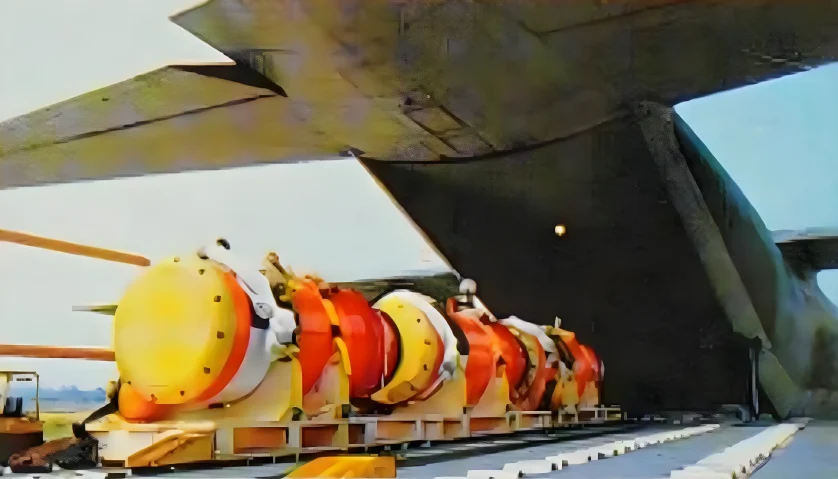
Development continued into the late 1980s and early 1990s. The electronics drew on software experience from the Sting Ray and Spearfish torpedo programmes, with ship and aircraft trials in the early 1990s. The modular design allowed a common electronics section to be combined with different warhead sizes and delivery equipment.
Stonefish was in production by March 1997. The exercise version had been sold to the Royal Australian Navy, and Finland and Pakistan had bought warstock versions. Six further, unnamed customers were reported in 1998.
Stonefish III and Project 2045
In the late 1990s BAE Systems Australia became design authority for Stonefish III. The proposed successor retained the earlier casing and explosive charge while introducing an all-digital electronics architecture, improved sensing and a common system for combat, exercise and drill variants.
Australia selected Stonefish III in 2000 for Phase 1A of Joint Project 2045, its advanced maritime mine programme. The requirement encompassed aircraft and submarine delivery. Later phases envisaged stand-off air delivery, an improved submarine-launched mine and palletised carriage by large aircraft, as well as surface-ship use.
The air-launched proposal included new nose and tail equipment and an aircraft interface. AP-3C Orion, F/A-18 Hornet and F-111 integration was envisaged. Alenia Marconi Systems in the United States undertook preliminary work on an air-delivery kit, with a guided parafoil proposed for stand-off carriage.
The programme encountered financial pressure before selection. In November 1999 a proposed acquisition of up to 300 mines faced cancellation during a review of projects in the A$50 million to A$100 million range. Project 2045 survived to select Stonefish III in 2000 but was subsequently cancelled, with greater emphasis placed on mine countermeasures.
Stonefish III had been expected to enter service in 2002. The Australian combat system did not proceed under Project 2045, although the Royal Australian Navy already held exercise mines from an earlier purchase.
Service and Later Status
On 19 January 1987, defence minister Archie Hamilton told Parliament that Stonefish was not in service with the United Kingdom armed forces. By 1992 the Royal Navy had disposed of its mine stocks. Practice minelaying continued for exercises, as defence minister Adam Ingram confirmed on 4 November 2002.
The Royal Navy still had no stock of sea mines in May 2023. Operational adoption of Stonefish by the Royal Navy or RAF is unconfirmed, as is any use of Stonefish equipment for evaluation or training.
Australia acquired 20 Stonefish exercise mines in the early 1990s and subsequently upgraded them. Several were believed to remain in service in October 2021. Their subsequent service status is unconfirmed.
Australia’s renewed maritime mining acquisition proceeded under Project SEA 2000. In August 2023 the Australian Department of Defence selected RWM Italia to supply new mines, with types and quantities classified. By February 2024 the first batch had been received and used in naval training.
Finland and Pakistan bought Stonefish warstock mines. Their inventories and service status in November 2026 are unconfirmed.
Stonefish mine Capabilities
Design
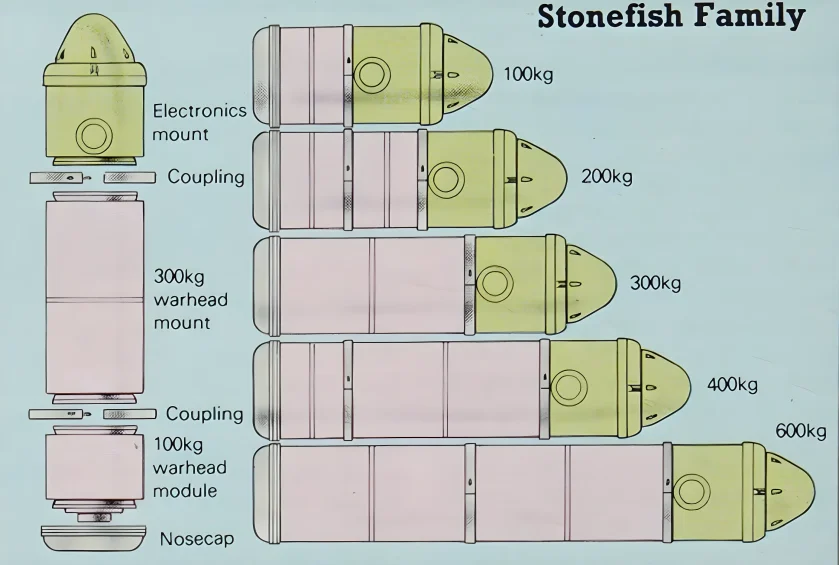
Stonefish was a cylindrical ground mine, intended to rest on the seabed. Its three main assemblies were the warhead, launch kit and electronics pack. The 533 mm body diameter allowed carriage in submarine torpedo tubes, while alternative launch equipment supported surface and air delivery. The air version used additional aerodynamic and parachute equipment.
The warhead system used 100 kg and 300 kg modules joined by coupling rings, allowing explosive loads of up to 600 kg. Overall length and total mass varied with the warhead and delivery equipment fitted.
Acoustic, magnetic and pressure sensors fed the signal-processing electronics. A portable electronic presetter provided programming and automatic test functions. The mine assessed detected influences against stored criteria.
Variants
The warstock version carried a live polymer-bonded explosive (PBX) warhead. Later versions incorporated insensitive-munition technology and an associated safety and arming system.
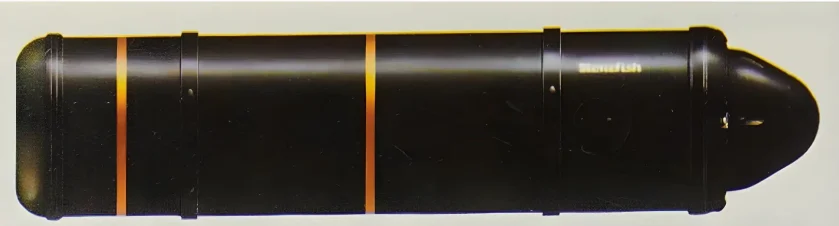
The exercise version used representative sensors and processing without a live warhead. It recorded the influences of passing vessels and indicated when the corresponding warstock mine would have fired. It could support mine-countermeasures assessment and data collection, with an acoustic link for control and recovery.
A flotation collar assisted recovery, including from soft seabed conditions.
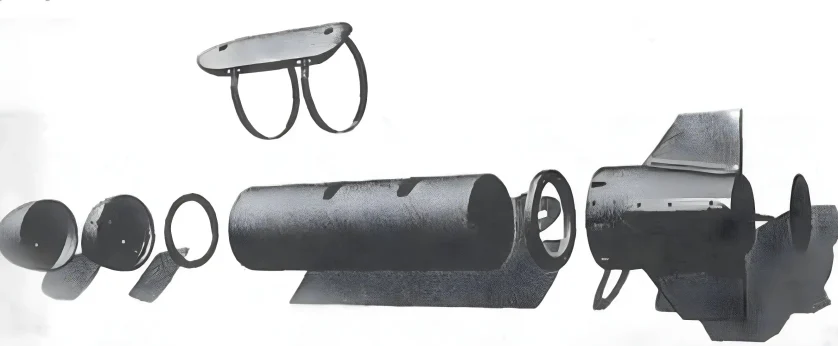
The assessment mine was a non-explosive seabed instrument connected by cable to a shore station for recording and analysing vessel signatures. The training or drill version provided inert equipment for classroom instruction, handling and preparation practice.
Stonefish III was proposed as a common combat mine for air, surface-ship and submarine delivery, sharing detection, safety and arming functions and programming equipment. Exercise and drill versions were also planned.
Specifications
| Item | Mk II | Exercise | Stonefish III |
|---|---|---|---|
| Length | Up to 2.50 m | About 1.90 m | 1.82 m |
| Diameter | 533 mm | 520 mm | 533 mm |
| Mass | Up to 990 kg | Not stated | 755 kg |
| Warhead | Up to 600 kg | Inert | 500 kg |
| Sensing | Acoustic, magnetic, pressure | Representative warstock sensors | Acoustic, magnetic, pressure |
| Status of figures | Maximum modular family | Exercise configuration | Development proposal |
The published surface-role depth range was 5–90 m, with an anti-submarine depth limit of 200 m.
The largest modular Mk II configuration measured up to 2.50 m long, weighed up to 990 kg and carried up to 600 kg of explosive.
The specified warstock storage life was 20 years, with an immersed life exceeding 700 days and an environmental temperature range of −2°C to +35°C.
Document Information
| Date | Change |
|---|---|
| 14 November 2026 | Initial publication |
Sources and Further Reading
Technical sources: the supplied early manufacturer-style Stonefish description, attributed to Marconi Underwater Systems (original publication and date unconfirmed); Jane’s Air-Launched Weapons, issue 26, March 1997; issue 38, entry posted 9 November 2001; and issue 41, March 2003.
BAE Systems, Stonefish Naval Ground Mines (archive capture 6 December 2008)
Hansard, Torpedo Weapon Systems, 19 January 1987, vol 108 c454W
Hansard, Minelaying, 4 November 2002, c65W
Julian Kerr, Defence seeks sea mining capability, 28 October 2021
Ben Felton, Australian Personnel Already Training with New Smart Sea Mines, 23 February 2024
Navy Lookout, Should the Royal Navy rebuild its minelaying capability?, 25 May 2023
Peter La Franchi, $60m naval-mine plan faces cancellation, 12 November 1999
