
“The bayonet is obsolete.” And with those four words, I had kicked a hornet’s nest.
At a recent infantry lethality workshop, I caused a bit of a stir. The event was a gathering of the principal small arms instructors from across the military, small arms engineers/scientists, staff officers and analysts, like me. We had spent most of the day discussing all the things we want for infantry small arms. Some people had strong opinions on bullpup rifles, others on scopes, and even slings were discussed in depth.
At no point was the bayonet mentioned.
Towards the end of the day the facilitators asked the room, “Does anyone have anything else they wish to add?” I then said the four words which had been playing on my mind for quite some time.
The response from the room was instant and clamorous.
Individually incomprehensible yet unmistakably negative, I waited for a break to raise my hand to explain my heresy in more detail. Would I convert the audience, or would I be adding more fuel to the fire being built beneath my stake?
I did not win over everyone in the room, but most.
About six months later, Justin Taylor released a video on his YouTube channel titled, “Bayonets Are Stupid”.
I hit the thumbnail harder than a Brecon DS demonstrating proper technique before a bayonet lane. I agreed with almost everything in that video, but there is more to this subject which should be covered. So, here goes.
The Origin Story
The bayonet emerged in the late 17th Century as a compromise for efficiency in Western armies. Firearms technology was improving, and the desire was to have this become the dominant weapon system for infantry. However, the danger of cavalry against infantry remained and firearms were still too slow in a close fight. Pike and shot, therefore, operated as combined arms for many decades before some bright spark decided to shove a dagger into the muzzle of his musket, turning it into a jury-rigged pike, or officially, the ‘plug bayonet’.
Later the ‘socket bayonet’ allowed the offset of the blade from the barrel, giving the soldier the option to load and fire, even with the bayonet fitted. The epitome of this was the ‘infantry square’ which devastated cavalry with an impenetrable wall of bayonets and a deadly hail of shot, all at once. All very clever stuff, and this set the standard for warfare from the end of the 17th Century, throughout the Napoleonic era, all the way until the early 20th Century.
Warfare Evolves
Just as the pike began to wane, so too did the bayonet. It wasn’t an overnight affair, but a slow decline as technology and warfare evolved. The emergence of repeating rifles with larger magazine capacity saw a reduction in the need for a stopgap between shots. The emergence of the machine gun saw the beginning of the end for cavalry charges against tightly packed infantry. The lethality of the modern battlefield drew forces into complex terrain and the close confines of trenches. Suddenly, having a long rifle-bayonet combo, like the Lee Enfield SMLE at 5 foot, 2 inches long, was no longer as universally useful as before. Light machine guns, hand grenades and grenade launchers, all became significant assets to the infantry formation. In the close confines of trenches, submachine guns, pistols, shotguns and short melee weapons like daggers and clubs were ideal and common.
The trend continued into WW2, where rifles and bayonets got shorter, while also being gradually replaced by semi-automatic rifles/carbines and submachine guns. The submachine gun, in particular, was prioritised for the close quarters fight, despite them almost universally lacking bayonets. Eventually, WW2 saw the emergence of the assault rifle, combining characteristics of the rifle, carbine and submachine gun into one platform. Now troops had up to 30 rounds in a magazine which could be quickly reloaded. They had semi-automatic or fully automatic fire capabilities to dominate close engagements. The bayonet was used less and less.
As warfare continues to evolve we have seen the use of bayonets on the battlefield drop further and further into obscurity. Western militaries conducted nearly two decades of combat during the Global War on Terror (GWOT), with some of the most intense combat experienced since Vietnam (for the US) or Korea (for the UK). Many of these fights took place in the dense vegetation and compounds of the “Green Zone” of Afghanistan or the claustrophobic, dusty streets of Iraq. Despite this, instances of bayonet use were incredibly rare with those few examples being well known because of their rarity.
This didn’t seem to bother anyone, though. By the end of the UK’s deployments to Afghanistan, very few weapons in the infantry section were even capable of mounting a bayonet. The SA80 with grenade launcher attached (two per Section), the Light Machine Gun, the General Purpose Machine Gun and the Sharpshooter rifle, all lacked the bayonet, despite making up the bulk of the section’s weaponry.
Finally, the largest land war in Europe erupted in 2022 with Russia’s full-scale invasion of Ukraine. The brutal conflict has been characterised by the blending of high-tech weaponry and old school warfare. Drones and massed artillery drove combatants into urban terrain, dense woodblocks and trenches. These have seen the brunt of infantry engagements, which have been as close, violent and intense as major 20th Century conflicts. Despite the extensive experiences of close infantry engagements, the bayonet has been all-but absent from the battlefield, with no recorded instances of ‘bayonet kills’ from either side, as far as I am aware.
Modern Challenges to the Bayonet
The bayonet is championed as a last-ditch weapon for if one runs out of ammunition or experiences a malfunction at a… umm… ‘suboptimal’ moment. However, there are a few things to consider with this. The first one being; why have it attached to end of the rifle?
The original purpose was to allow an infantryman on the ground to unseat a cavalryman several feet above him on a horse. We can all agree that this is hardly a likely scenario today. Setting aside the cavalry threat, some argue there is still a ‘reach’ advantage, with the bayonet being a blade-on-a-stick compared to just the blade. However, a bayonet on the end of a very short rifle like the SA80 is unlikely to give any reach advantage whatsoever. The SA80 is just under 80cm long, which is similar to the average length of an adult male’s arm. As the support hand is holding the rifle near the end of the handguard anyway, the “reach” is measured by the portion of barrel extending beyond it, which is only a few inches. Hardly a decisive advantage.
To use it in a close quarters battle (CQB) context as an emergency solution, the user must have it already fitted, something which is extremely rare. There is something inherently dangerous about exposed blades attached to short rifles in a confined space. Simply put, no one wants to be in a CQB stack, adrenaline pumping, while your oppo has a bayonet hovering around the vicinity of your head or legs! It also makes the overall rifle system longer, which is something people try to avoid with rifles for CQB.
CQB is rarely a one-vs-one situation, either. It is conducted by teams. If you run out of ammo or get a malfunction, there are drills to deal with this whereby a teammate takes over and deals with the threat. Pistols are another option, giving an element of stand-off.
If we assume that we have the bayonet fitted, we must acknowledge that adversaries are now increasingly wearing body armour, even those who are non-state actors. A bayonet thrust to the torso, as troops are taught, is unlikely to deliver the desired effect. With the complementary trend of chest-mounted equipment, there is a very real possibility of the bayonet, not just failing to penetrate, but getting stuck during a failed strike on the opponent’s torso. Navigating a bayonet on the end of rifle around the sides of body armour is neither a trivial matter nor practical, and entirely removes any ‘reach advantage’.
A new trend in infantry weapon systems also began to emerge during the GWOT: the suppressor. Suppressor technology has improved considerably in recent decades and their employment has become much more widespread than just in niche, special operations contexts. The US Marine Corps recently issued suppressors to every infantry Marine with their newest rifle, the M27. For the UK, a suppressor is a core feature of the recently adopted L403A1 (Project HUNTER) and issued to the Commando Force and Army Special Operations Brigade.

Suppressors reduce the acoustic signature of the rifle firing, as well as the visual signature from the muzzle flash, making it harder for the enemy to locate the firer. This can be a significant boost to troop survivability. From a close combat perspective, they have two additional important benefits. Firstly, they reduce the concussive effect of firing a rifle in a confined space which has a degrading effect on cognition (i.e. decision-making) and contributes to soldier fatigue. Secondly, they reduce the recoil, enhancing accuracy with rapid follow-up shots, which is crucial when engaging small exposure, fleeting targets common to urban combat.
More and more, militaries are exploring the option to issue suppressors more widely than their special operations communities. However, suppressors mount exactly where a bayonet would go or require an extra-long blade mounted on the handguard to extend beyond the suppressor. This latter option would also cap the suppressor length, limiting options. While quick-detachable suppressors are common, the soldier would have to decide when to swap (not trivial if the suppressor is hot from firing) and which option provides greater utility.
Choices must be made.
The Bayonet is Dead. Long Live Combatives
Let’s take the most commonly cited scenario; CQB in a room or trench.
Pistols are more commonly issued to troops these days, and it is generally accepted that switching to your pistol is always faster than reloading. However, for the sake of this argument, let’s assume that a pistol is not an option here.
The soldier enters the room/trench and is faced with an adversary at very close range. The soldier engages, but their weapon malfunctions and fails to fire. The adversary is wearing body armour and (conveniently) is unable to engage with their primary weapon system, either. The soldier’s oppo has been delayed by…reasons. It’s a good, ol’ fashioned one-on-one stand-off.
In this somewhat contrived scenario, what can the soldier rely on now?
Combatives is the modern term for hand-to-hand fighting. It is something that has been formalised and widely adopted by some militaries, including different systems for both the US Army and USMC. Many of these blend firearms and knives alongside hand-to-hand techniques and, yes, even bayonets.
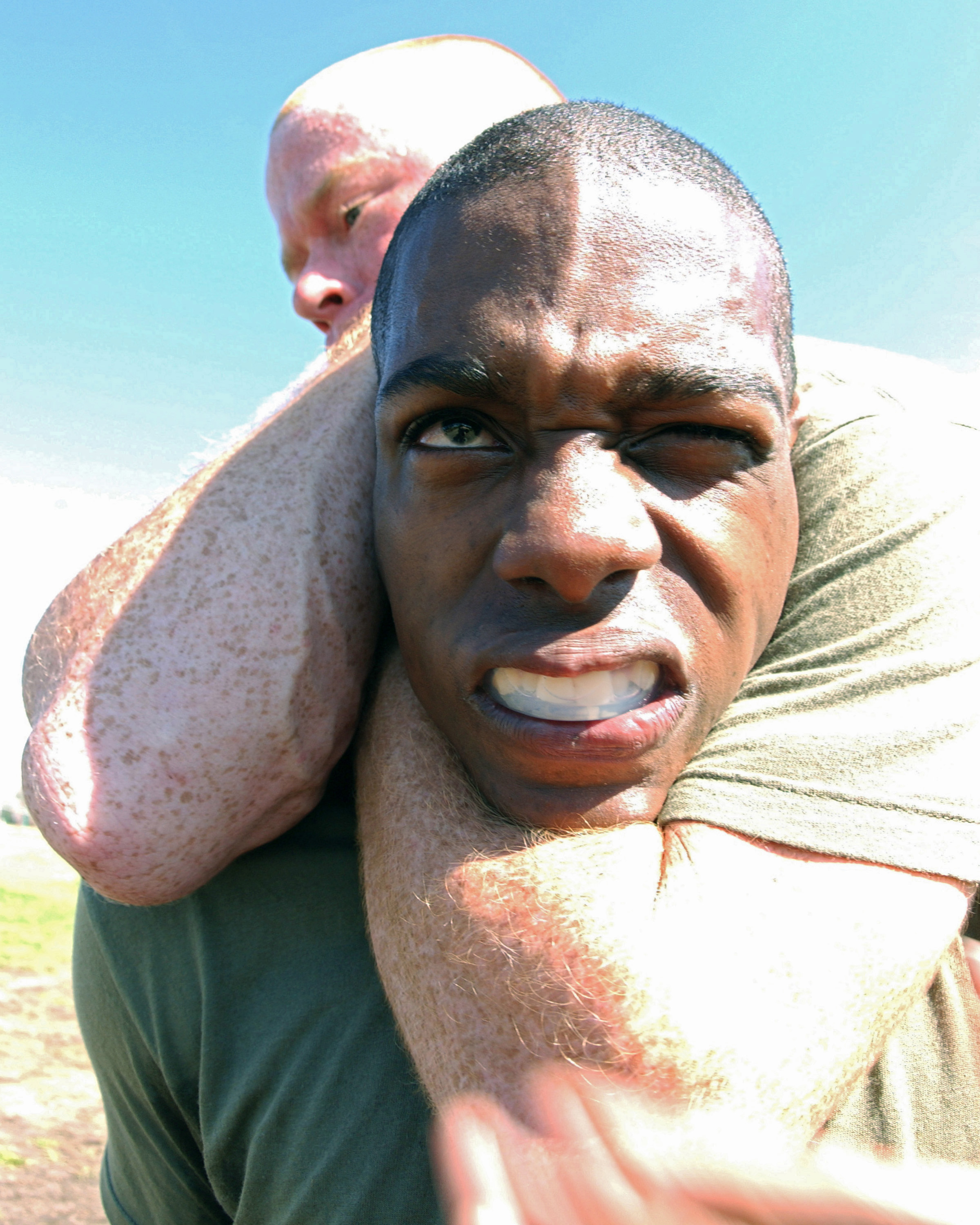
n a CQB context, it is distinctly possible that an adversary can close the distance and engage in hand-to-hand combat. If there is available space, then things like muzzle strikes (aggressively driving the muzzle of the rifle into an adversary’s face, neck or abdomen) can be used to create more space/time, subdue the adversary or allow follow-up attack options.
The British Army recently trialled a combatives course at 16 Air Assault Brigade, but the focus was very much on subduing opponents with non-lethal techniques, “between shouting and shooting”. This is useful across a broad spectrum of military tasks, from peacekeeping to prisoner handling, and should be encouraged. However, in the type of situation described above, it is a fight for survival where lethal options are still essential.
With the advent of body armour/chest rigs, the use of fighting knives is making a resurgence as a suitable option, with the Australian Army taking the step, in 2024, of issuing a dedicated fighting knife and adopting combatives training.
Importantly, the precedent for this was set centuries ago.
In medieval combat, soldiers in full plate armour clashed with a panoply of blades-on-a-stick, known collectively as ‘pole arms’. Pikes, halberds, glaives, poleaxes, swordstaffs, and more, were employed in the initial clashes, but when the fight became a melee, other weapons took centre stage. Short blunt trauma weapons like maces were used to deliver devastating blows through armour. In a grapple between armoured opponents the finishing blow was often delivered by a dagger. In a grapple, daggers are much more manoeuvrable, quick and accurate than anything longer, allowing the user to circumvent armour and deliver a lethal or debilitating strike.
If the opponent can redirect the business end of a rifle away, then both the rifle and the bayonet are now irrelevant. Indeed, the parry is one of the core bayonet fighting techniques taught to British troops, so the expectation is that this is a credible scenario. If the rifle is redirected, the soldier can still draw a fighting knife and engage in extremely close combat.
Even in WW1 when the bayonet still retained some relevance, each of the major combatants still taught their own version of combatives, including the use of knives. One Canadian officer even wrote, “After a bayonet attack, in nine cases out of ten (trench or open) the men grapple.” The bayonet was still somewhat relevant in WW2, but the US military still issued the famous Ka Bar fighting knife in such numbers that the supply produced in WW2 sustained the US military through Korea and Vietnam.

And yet, the bayonet believers retort; “But bayonet training teaches controlled aggression, and this is vital.” Therefore, the argument goes that we should retain the bayonet for training and commit the time to these techniques, despite the limitations of it and even if it’s highly unlikely that it will ever be used in anger. The US Marine Corps does just that and the US Army may even be in the process of joining them.
Well, the inherent assumption there is that controlled aggression cannot be taught any other way, or in a way that is more widely applicable. Yet, combatives teaches exactly this and how to escalate through levels of aggression. It’s worth mentioning that there aren’t many layers of escalation with a bayonet.
In fact, the elite of the British Army, the Airborne Forces, even have a combatives session as part of their selection course. ‘Milling’, as it is known, is a 60 second stand-up fist fight with another course member, specifically to assess controlled aggression. Controlled aggression is also essential in a close combat fight where superior fighting techniques are to be applied or to have the cognitive clarity to know when to escalate to a lethal strike with a knife or pistol.
Combatives, therefore, have much wider utility across the spectrum of conflict, the spectrum of military tasks and is already recognised by the British Army as a good test of controlled aggression.
The one concession I will make is the psychological switch that comes from the command to “Fix bayonets!”. While this is very real (and emotive), brutal combat occurred before the invention of the bayonet, so I don’t see this as a compelling reason in itself to keep an obsolete weapon. For those troops less confident at combatives, there is likely to be a greater comforting factor having a weapon with more heft and reach (even if marginal) than a knife.
Symbolism over Substance
From uniforms to regimental banners, cap badges to mascots, symbols have always been important for militaries. They help to form a sense of unity and identity, can act as a rallying point during the chaos of battle, and they signify elite status or past exploits. Some of the fiercest fighting throughout the British Army’s history has been in defending their own symbols (the regimental “colours”) or trying to capture those of their enemies.
Over time, the bayonet morphed from a simple weapon to being symbolic of the infantry, both literally and figuratively. “Bayonet strength” was the old-fashioned unit of measurement for the number of soldiers in a given unit. The bayonet on a red background is the unit symbol for the Infantry Training Centre and the Infantry Battle School. As one approaches the Infantry Battle School the first thing you see is a bronze statue of a soldier, bayonet fixed, pointing forward as an example for others to follow.

However, symbolism is not the same as relevance. The Royal Lancers no longer go into battle with lances. The Royal Regiment of Fusiliers are no longer issued flintlock muskets, or fusils. While undoubtedly capable of still inflicting a lethal wound, and better than nothing in a pinch, no one would seriously argue that we should retain these in the modern era.
Yet, we are at a point, with Project GRAYBURN, where the British Army is seriously thinking about what it wants in a future infantry rifle and how it envisions generating close combat lethality. Given the incredible rarity that bayonets have been used, despite all the combat experienced by British troops since 9/11, we must conclude that the bayonet contributes almost nothing to the infantry’s lethality. I would argue that there are much better options for enhancing lethality and survivability available today than the bayonet. Suppressors, fighting knives and complimentary combatives training, will likely deliver greater lethality and general close combat capability than the bayonet.
Even when bayonets were more relevant, our institutions and our soldiers still recognised the value in hand-to-hand fighting skills, fighting knives and other melee weapons. We must make a return to this approach and instigate an effective combatives programme across the British Army (and wider UK Armed Forces). We must choose and issue a dedicated fighting knife and capitalise on the absence of the bayonet by issuing suppressors to close combat troops.
Like with the GRAYBURN workshop where no one mentioned the bayonet, but suddenly got very defensive of it, we must not allow a skewed nostalgia for a bygone era to cloud our judgement of what is useful on the modern battlefield.
The bayonet has a bright future in a purely symbolic role.
We just need to admit it and move on.
Author: Stuart Lyle
Stuart is the Urban Operations lead for the UK’s Defence Science and Technology Laboratory (DSTL), part of the UK Ministry of Defence. His role is to provide analysis on Land Operations to support decision-making within the UK Land Force, with a particular focus on close combat and urban operations. He also teaches urban operations at various military schools, including the Infantry Battle School and the Defence Academy. Stuart has served in the MOD as a civilian analyst for over 14 years, with prior military service in light infantry roles (regular and reserve).
He can be found on X.com as @Stu_Lyle

Thought this would be germane………..
https://www.thefirearmblog.com/blog/potd-a-bayonet-for-the-knight-s-armament-ks-1-44830513
I remember once I joked on the old TD site about the Chinese perhaps making a more lethal entrenching tool……..Only for TD to produce a link that showed that the Chinese had indeed made a more lethal entrenching tool.
History? I don't think one infantry square was broached at Waterloo due to the bayonet. In American Civil War show that less than 1% to 2% of battlefield casualties were caused by bayonets. The defeated surrendered or ran……….
As I said above a large blade has utility. There is something to be said about the mass of a knife in a fight too.
My main concern for the infantry is any move from 5.56mm not edged tools.
Bayonets were a poor anti-cavalry defence weapon that transformed a long firearm into a very bad heavy spear.
They were never good for much against infantry.
18th century battles yielded almost no bayonet wounds, for one battalion broke before two opposing battalions met in melee.
First World War recounts pointed out that even shovels were superior (used as axes) to bayonets.
Use some sticks as batons if you need to control civilians. Much better than bayonets.
Overall, bayonets are as much nonsense as sidearm pistols on the battlefield IMO. In case you emptied your mag seek cover, trust your buddy. Don't do anything stupid with pistol or bayonet or knife. Don't reduce yourself from an assault rifle user to a pistoleer. Remember that you are part of a team, not a one-man army from Hollywood. Plus, the infantry is overloaded. Ditch the weight of bayonet, bayonet sheath, pistol, holster, pistol magazines and pistol cartridges!
In 1951 the American army published a fantasy-ORBAT study (FMS P-085 "Infantry organization and equipment based on German experiences in Russia") written by 15 experienced Germany infantry officers from WW2 meant to inform US Cold War choices. They called the bayonet "worthless" in the age of the Stg-44, and said that in a fantasy scenario it was also inferior to a dagger.
More recently, GWOT Americans recorded multiple kills with and at least one casualty to knives. None to bayonets. There are reports of a few knife kills in Ukraine – none to bayonets.
Um. For me this is like sending a surface combatant to sea without a medium gun. Or fighter into the air with no cannon. It's sort of doing away with a last ditch contingency or just an option.
Bayonets spend most of the time opening cans and being used in digging. If soldier is to carry a fixed heavy blade it might as well fit on to the end of the barrel. I will have to give moderators some thought……..
FWIW the best part of L85A1 was probably the bayonet!
Returning to a conventional format with the Grayburn rifles, all of which are longer than A3, means bayoneting at least as an act will be easier.
You are the expert. It is all academic to me.
You might find this of interest.
https://www.youtube.com/watch?v=3k5XzyjmLJ0
Bayonets can be the key psychological basis for an infantry attack. I believe in Iraq a Scottish unit performed a Bayonet Attack. Whether the troops were in battle dress, kilts, or ancient Scottish battle attire was not reported. In the US Marines. 1973, in Boot Camp I generally had 2-3 hours of bayonet, hand to hand all of which was to kill, not restrain, or cause a person to submit. Combative's is the most useless training that is done in the US Army and Marines. I was taught that in one on one fight you had 20 seconds to kill opponent, longer than that can get you killed. When joining the Army and arriving at the 82nd I was shocked to learn that Paratroopers did not get bayonet or H2H combat fighting on a regular basis. One issue I see is that since issuing the M-16 to replace the 'too heavy' M-14, US rifles are to light to use a bayonet without bending the barrel. God Forbid you try a lateral or vertical butt stroke as the damn plastic stock would disintegrate. This combative's crap is merely a method to teach aggressive in stupid ass politically correct method, which leaves under trained troops as a result. I have studied the Ukraine War since late 2021, yes before the attack and called it publicly on my FB page in late January 2022. AK's I believe can survive bayonet usage in combat with little or no damage. I don't either side has been really trained. Also there have been few large engagements where a bayonet would be needed. From what I have seen the war has been brought down to small penny packet trench fights that rely more on grenades than getting close and personal. Furthermore leaders are not taught to consider bayonet attacks. I believe the UK Armed Forces found the bayonet useful in Falklands in 1982 at the Battle of Goose Green (28-29 May 1982), the Battle of Mount Longdon (11-12 June 1982), and at the Battle of Mount Tumbledown.